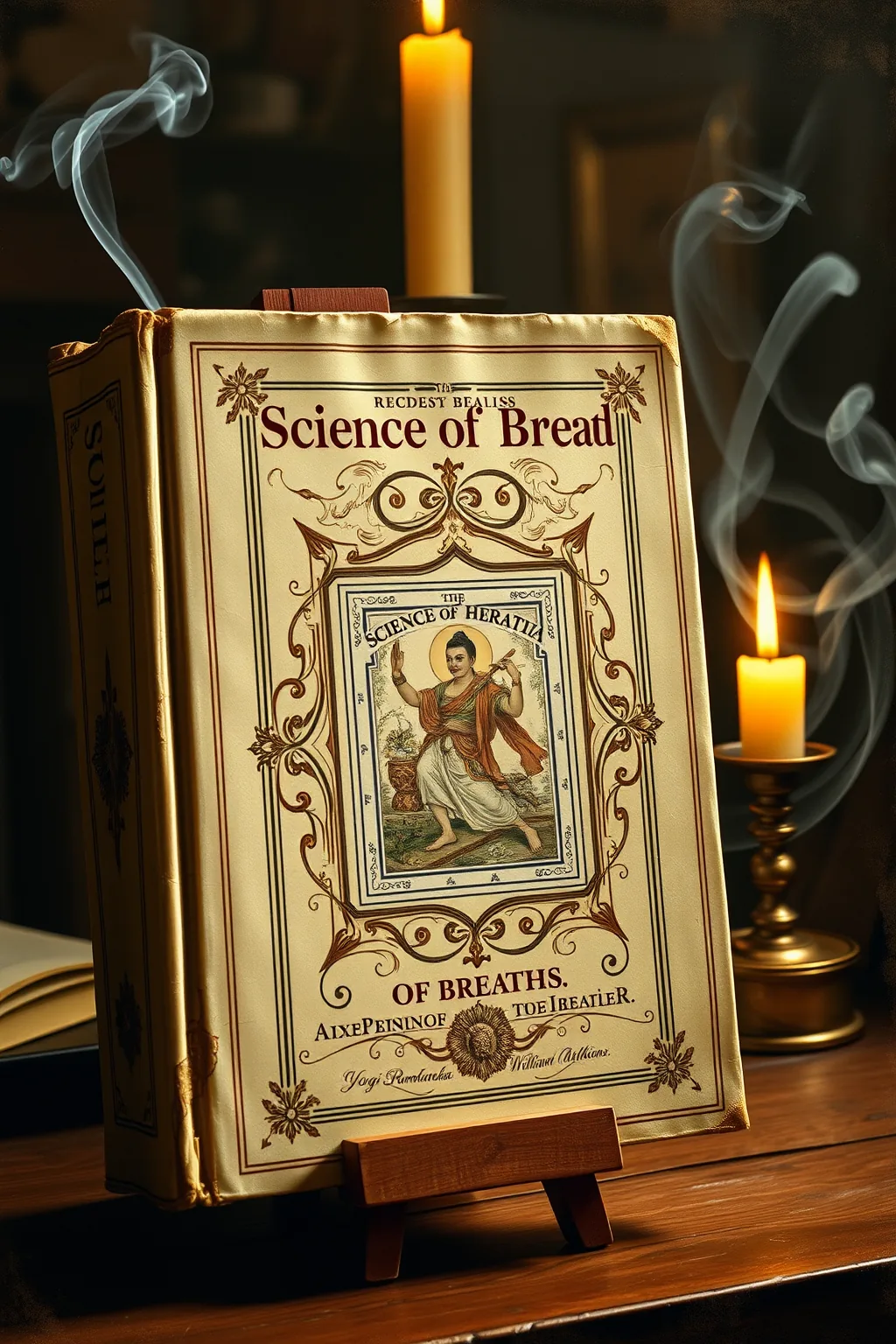
Science of Breath
 76
76

Science of Breath



Marcus Thorne (Esoteric Sciences Reviewer) — A foundational text for any serious student of esoteric philosophy, 'Science of Breath' transcends its era with timeless insights. Yogi Ramacharaka, a brilliant conduit for ancient wisdom, presents breath not just as a biological function, but as the very engine of consciousness and spiritual development. The clarity with which complex concepts are explained makes this accessible to beginners, while the depth of practice offers enduring value for seasoned practitioners. Its strength lies in its holistic approach, seamlessly weaving physical, mental, and spiritual disciplines. This book is an indispensable guide for those seeking to harness the latent powers within.
📝 Description
76
Published in 1904, 'Science of Breath' by Yogi Ramacharaka explains breath control for spiritual and mental development.
Yogi Ramacharaka's 1904 book, 'Science of Breath,' presents breath as a fundamental force in the universe. Written under the pseudonym William Atkinson, the text moves beyond simple respiration to detail how conscious control of breathing can influence physical health, mental acuity, and psychic abilities. It connects breath practices to ancient Oriental philosophies, positing breath as the energetic current that sustains all life. The author guides readers through exercises designed to transmute the everyday act of breathing into a powerful method for inner transformation.
This manual aims to help the earnest seeker achieve self-mastery. It illuminates a path toward realizing one's full potential by aligning the individual with universal principles. The book illustrates the Hermetic concept of 'As Above, So Below,' suggesting a correspondence between the internal and external worlds. Readers are invited to discover how ordinary breathing can become a tool for accessing unseen forces and achieving an extraordinary state of being. The practices described are intended to foster harmony between the practitioner and the wider cosmos.
This work is situated within the broader esoteric tradition that emerged in the late 19th and early 20th centuries, often termed the New Thought movement or Theosophy. These movements sought to synthesize Eastern spiritual philosophies with Western occultism and psychology. 'Science of Breath' specifically draws on yogic traditions, particularly pranayama, and frames these practices within a universalist, energetic worldview. It reflects a common esoteric aim: to reveal hidden laws of nature and consciousness, accessible through specific disciplines, thereby enabling personal transformation and spiritual evolution.
💡 Why Read This Book?
This book offers a direct path to unlocking your inherent potential. It provides practical techniques for enhancing physical health, sharpening mental acuity, and awakening latent psychic abilities. For seekers of spiritual growth and practitioners of yogic and Hermetic arts, it is an essential manual for self-transformation and a deeper understanding of life's energetic currents.
⭐ Reader Reviews
Honest opinions from readers who have explored this book.
❓ Frequently Asked Questions
What is the core philosophy of 'Science of Breath'?
The core philosophy posits that breath is the fundamental life force, a conduit for spiritual energy. Mastering breath control allows for the conscious direction of this energy, leading to holistic development: physical, mental, psychic, and spiritual.
Who was Yogi Ramacharaka?
Yogi Ramacharaka was a pseudonym used by William Walker Atkinson, a prolific writer and early proponent of New Thought and esoteric philosophies in the early 20th century. He synthesized various Eastern and Western mystical traditions.
Is this book suitable for beginners?
Absolutely. While deeply profound, the book is structured to guide newcomers through the foundational principles and practices of breath control with clarity and progressive instruction.
What are the main benefits of practicing Oriental breathing techniques?
Benefits include improved physical health, increased mental focus and clarity, enhanced emotional regulation, development of intuition and psychic awareness, and accelerated spiritual growth.
Is the knowledge presented in this book still relevant today?
The principles of breath control are timeless. The book's insights into energy manipulation, consciousness, and self-mastery are more relevant than ever in our fast-paced world for achieving balance and well-being.
🔮 Key Themes & Symbolism
The Breath as Life Force
This theme explores the ancient understanding of Prana, or life force, as intrinsically linked to the breath. Ramacharaka illuminates how the simple act of inhalation and exhalation is not just a biological process, but a fundamental mechanism for drawing in and circulating vital cosmic energy throughout the body and mind. It studies the energetic pathways, or nadis, and how conscious breathing can purify and energize these subtle channels, leading to a profound sense of vitality and connection to the universal life current. This concept forms the bedrock of the book's transformative teachings.
Alchemy of the Self
The book presents breathwork as a form of internal alchemy, a process of transforming the lower, material aspects of the self into higher, spiritual consciousness. Through specific breathing exercises and mental focus, practitioners are guided to purify their thoughts, emotions, and physical bodies, transmuting limitations into strengths. This aligns with Hermetic principles, where the practitioner becomes the alchemist, using breath as the elemental catalyst to refine the 'base metals' of the personality into the 'gold' of spiritual enlightenment and self-realization.
Mind-Body-Spirit Unification
A central tenet of 'Science of Breath' is the interconnectedness of the physical, mental, and spiritual planes. Ramacharaka demonstrates how breath acts as the bridge between these dimensions. By consciously controlling the breath, one gains dominion over the mind, influencing thoughts, emotions, and perceptions. This mastery, in turn, opens the door to higher spiritual awareness and a unified experience of being. The book emphasizes that true development occurs when these three aspects are harmonized through deliberate practice, leading to holistic well-being and spiritual awakening.
💬 Memorable Quotes
Direct passages from the work, attributed to the author.
“The control of the breath is the control of the mind.”
— Emphasizes the direct link between respiratory control and mental discipline, suggesting that mastering breath leads to mastery over one's thoughts and emotions.
“Inhalation is the taking in of Divine energy; exhalation is the giving out of the material.”
— This poetic interpretation frames breathing as a sacred exchange, receiving spiritual sustenance and releasing worldly attachments or impurities.
“The body is the temple, and breath is its sacred ritual.”
— Elevates the practice of breathing to a spiritual act, viewing the physical body as a sacred space that is purified and animated through conscious breathwork.
“Know thyself through the rhythm of thy breath.”
— Suggests that introspection and self-discovery are facilitated by paying attention to the natural, yet controllable, rhythm of one's own breathing.
💡 Key Ideas
Editorial paraphrase of the work's core concepts — not direct quotes.
Breath is the messenger between the physical and the spiritual.
This quote highlights breath's role as a conduit, linking our material existence with our higher consciousness and spiritual nature.
🌙 Esoteric Significance
Tradition
This work draws heavily from yogic traditions of India, particularly Hatha Yoga and Pranayama, and aligns with Hermetic principles found in ancient Egyptian and Greek mystical philosophies. It bridges Eastern spiritual practices with Western metaphysical thought, presenting breath as the universal 'Prana' or life force, a concept central to many esoteric systems seeking to understand and manipulate subtle energies for personal transformation.
Symbolism
Breath itself is the primary symbol, representing life, spirit, and consciousness. The act of breathing symbolizes the cycle of manifestation and dissolution, the connection between the individual and the cosmos. The various breathing techniques symbolize the alchemical process of purification and refinement, transforming the practitioner's energetic and mental states. The body is viewed as a microcosm reflecting the macrocosm, with breath acting as the vital link between them.
Modern Relevance
In an age of pervasive stress and digital distraction, the principles of conscious breathing remain profoundly relevant. 'Science of Breath' offers practical tools for stress reduction, enhanced focus, emotional regulation, and improved physical health. Its teachings on energy cultivation and mind-body connection resonate with contemporary holistic health and mindfulness practices, providing a timeless framework for achieving balance and well-being in the modern world.
👥 Who Should Read This Book
This important work is important for a diverse range of readers. **Beginners** seeking an accessible introduction to breathwork and its benefits will find clear guidance. **Spiritual Seekers** exploring pathways to higher consciousness and self-mastery will discover a profound method for inner exploration. **Practitioners of Yoga and Meditation** will find a deeper theoretical and practical understanding of Pranayama. **Students of Esoteric Sciences and Hermeticism** will appreciate its synthesis of ancient wisdom and its application to personal development. Ultimately, anyone aspiring to enhance their physical vitality, mental clarity, and spiritual awareness will benefit immensely.
📜 Historical Context
Published in 1904, 'Science of Breath' emerged during a vibrant period of spiritual and intellectual exploration in the West, often referred to as the 'New Thought' movement. This era witnessed a burgeoning interest in Eastern philosophies, mysticism, and alternative healing modalities, as Western scholars and seekers began to explore texts and traditions previously inaccessible. William Walker Atkinson, the mind behind Yogi Ramacharaka, was a key figure in synthesizing these influences, making complex esoteric concepts digestible for a Western audience. The book reflects the era's fascination with hidden knowledge, personal development, and the potential for human consciousness to transcend ordinary limitations, positioning breath as a key to unlocking these potentials in a rapidly industrializing world.
📔 Journal Prompts
How does your current breathing pattern reflect your mental and emotional state?
What is your intention for practicing conscious breathing exercises this week?
In what ways can mastering your breath empower you to navigate challenges?
How can the concept of breath as a life force influence your daily interactions?
Reflect on a moment when you felt deeply connected to something larger than yourself; how was breath involved?
🗂️ Glossary
Prana
The fundamental life force or vital energy that permeates the universe, believed to be circulated throughout the body by the breath. It is the animating principle of all living beings.
Nadis
Subtle energy channels within the body through which Prana flows. Similar to the energetic pathways described in acupuncture or traditional Chinese medicine, their purification is key to health and spiritual development.
Chakras
Energy centers within the subtle body, often depicted as spinning wheels of light. They are believed to be points of intersection for the Nadis, influencing physical, emotional, and spiritual states.
Hermeticism
An esoteric tradition based on the writings attributed to Hermes Trismegistus. It emphasizes principles like 'As Above, So Below,' the interconnectedness of all things, and the pursuit of gnosis (knowledge).
New Thought
A spiritual movement that emerged in the 19th century, emphasizing the power of thought and belief to influence one's reality and well-being. It often incorporates principles from various Eastern and Western esoteric traditions.
This book appears in 2 collections
🔮 Readers Also Liked
Browse all →









From the “Hermeticism” Collection
View all →







More Free Alchemy & Hermeticism Books
View all →





![Mythomystes [1632]](/img/thumb/mythomystes-1632-reynolds-henry.webp)