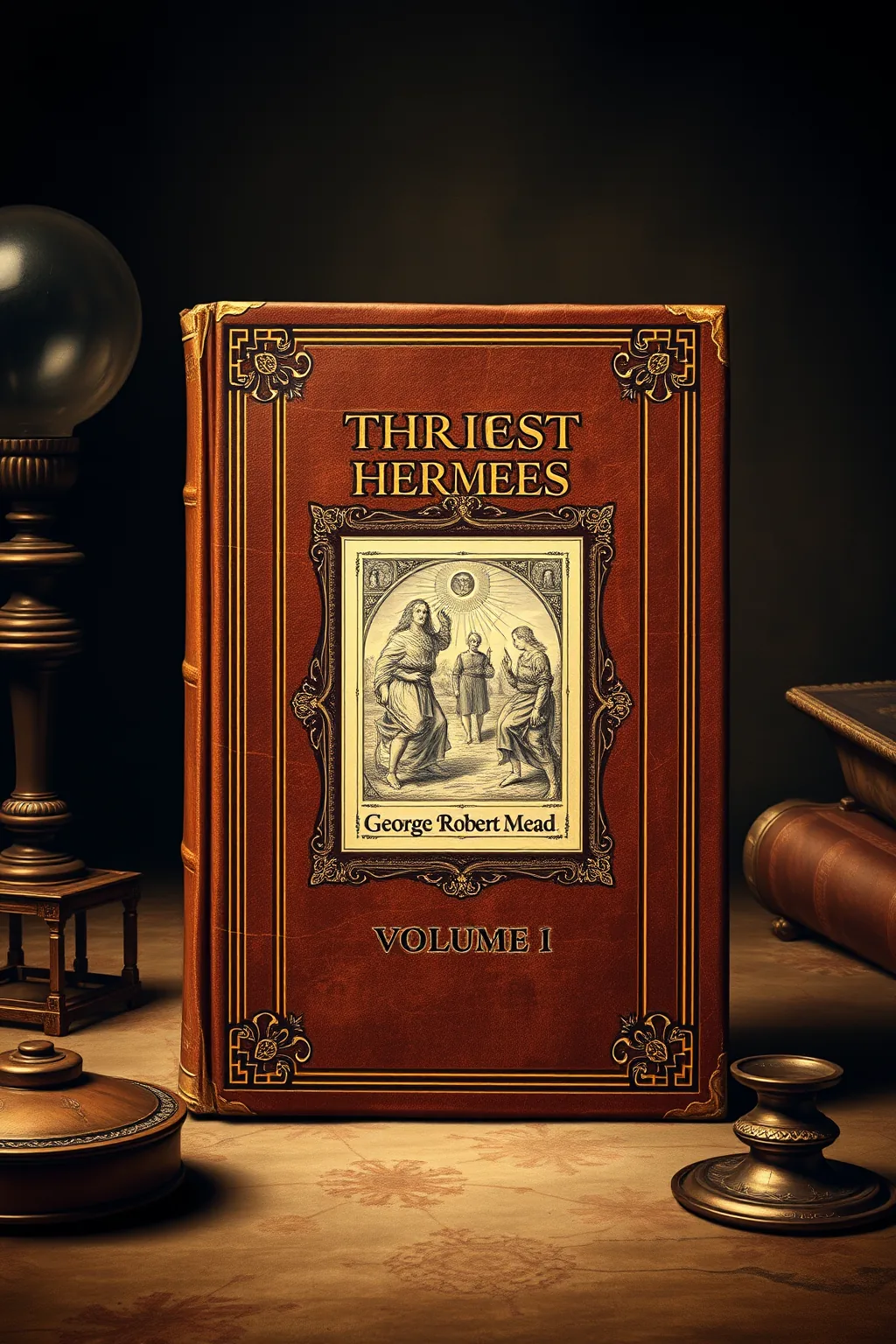
Thrice Greatest Hermes, Volume 1
 78
78

Thrice Greatest Hermes, Volume 1



Sophia Crane (Associate Editor) — George Robert Stowe Mead's 'Thrice Greatest Hermes, Volume 1' is a monumental achievement in Hermetic scholarship. This foundational text meticulously reconstructs and contextualizes the scattered fragments of Hermes Trismegistus' teachings, placing them within the vibrant milieu of Hellenistic philosophy and early Christian mysticism. Mead's erudition shines through in his comprehensive translations and insightful commentary, offering unparalleled access to a rich vein of esoteric knowledge. Ideal for serious students of alchemy, Gnosticism, and Western esotericism, this volume provides the essential groundwork for understanding a tradition that continues to resonate profoundly. Its scholarly rigor is matched by its evocative power, making the ancient wisdom accessible to the dedicated seeker.
📝 Description
78
George Robert Stowe Mead published 'Thrice Greatest Hermes, Volume 1' in 1906, translating key Hermetic texts.
George Robert Stowe Mead's 1906 translation and commentary on the Hermetic tradition, 'Thrice Greatest Hermes, Volume 1,' offers a detailed look at texts attributed to Hermes Trismegistus. Mead's work examines the philosophical basis of this tradition, drawing from Hellenistic theosophy and early Gnostic ideas. The book includes translations of important Hermetic writings, providing context for their historical and intellectual significance.
This volume is notable for its extensive scholarship, featuring around 1,500 footnotes. It aims to clarify the esoteric philosophy contained within the Hermetic corpus, touching on concepts of the cosmos, divinity, and the human pursuit of gnosis. Mead's approach connects these ancient ideas to the broader history of Western esotericism, making it a resource for understanding symbolic language and primordial wisdom.
This book belongs to the study of Hermeticism, a philosophical and religious tradition based on writings attributed to Hermes Trismegistus. Emerging in the Hellenistic period, Hermeticism blends Greek philosophy with Egyptian religious traditions. It influenced Renaissance Neoplatonism and later esoteric movements, focusing on cosmology, theology, astrology, and alchemy as pathways to divine knowledge and human transformation. Mead's work situates these texts within their historical and intellectual milieu, making them accessible to modern readers.
✍️ Author

George Robert Stowe Mead
George Robert Stowe Mead was an English author and scholar of Gnosticism and early Christian mysticism.
Esoteric Writer
💡 Why Read This Book?
This volume is crucial for unlocking the foundational wisdom of the Hermetic tradition. It offers direct access to texts that have profoundly influenced Western esotericism, alchemy, and mystical philosophy. Ideal for scholars, serious practitioners, and anyone seeking a deeper understanding of ancient spiritual thought, it provides the essential context and primary material to explore the perennial quest for divine knowledge and cosmic understanding.
⭐ Reader Reviews
Honest opinions from readers who have explored this book.
❓ Frequently Asked Questions
What is the primary focus of 'Thrice Greatest Hermes, Volume 1'?
This volume focuses on presenting and analyzing the sermons and fragments attributed to Hermes Trismegistus, setting them within the broader context of Hellenistic theosophy and Gnostic thought.
Who is Hermes Trismegistus?
Hermes Trismegistus is a legendary syncretic figure, a fusion of the Greek god Hermes and the Egyptian god Thoth, credited with a body of esoteric and mystical writings that profoundly influenced Western thought.
What is the historical period covered by this book?
The book primarily deals with texts and ideas from the Hellenistic period (roughly 323 BCE to 31 BCE) and early Christian eras, when Hermetic philosophy flourished.
What makes this translation and commentary unique?
Mead's work is distinguished by its scholarly rigor, extensive philological notes, historical contextualization, and comprehensive survey of the Hermetic corpus, making it an authoritative resource.
Is this book suitable for beginners in esoteric studies?
While scholarly, the depth of explanation and contextualization makes it accessible to dedicated beginners willing to engage with complex philosophical and historical material.
🔮 Key Themes & Symbolism
The Divine Revelation of Hermes
This theme studies the concept of divine revelation as transmitted through the figure of Hermes Trismegistus. It explores how these ancient texts are believed to contain direct insights from the divine, offering humanity a path to understanding the cosmos, its creation, and humanity's place within it. Mead meticulously examines the ways in which Hermes acts as a conduit for celestial knowledge, guiding initiates towards gnosis – a profound, intuitive understanding of ultimate reality. The focus is on the transformative power of this revealed wisdom and its potential to elevate the human spirit.
Hermetic Philosophy and Cosmology
This section illuminates the intricate philosophical framework and cosmological models presented in the Hermetic texts. Mead unpacks the Hermetic worldview, which often posits a unified divine source from which all existence emanates. It explores concepts such as the interconnectedness of all things, the macrocosm and microcosm mirroring each other, and the divine architecture of the universe. The emphasis is on understanding the symbolic language used to describe these cosmic principles, providing readers with a foundational understanding of the Hermetic perception of reality and the divine order.
The Path to Gnosis and Spiritual Ascent
This core theme addresses the Hermetic path towards spiritual enlightenment and union with the divine. Mead highlights how the texts serve as a guide for the soul's journey, outlining practices and philosophical understandings that lead to gnosis. The focus is on the transformative process of shedding ignorance, recognizing one's divine potential, and ultimately achieving a state of spiritual awareness and liberation. The book illuminates the ancient methods and philosophies designed to facilitate this profound inner awakening and ascension towards the divine.
💬 Memorable Quotes
Direct passages from the work, attributed to the author.
“The eye of the understanding is the eye of the soul.”
— This highlights the Hermetic emphasis on inner perception and intuitive knowledge over mere sensory experience, pointing towards spiritual insight as the true means of understanding.
“To know God is to love God.”
— This simple yet profound statement suggests that true knowledge of the divine is inseparable from a deep, affective connection, implying that love is the ultimate form of gnosis.
“The universe is a living being, and man is a part of it.”
— This emphasizes the organic and interconnected nature of existence in Hermetic thought, positioning humanity not as separate, but as an integral and vital component of the cosmic whole.
“Wisdom is the knowledge of things divine and human.”
— This defines wisdom in the Hermetic context as a comprehensive understanding encompassing both the celestial realms and the terrestrial experience, suggesting a holistic pursuit of truth.
💡 Key Ideas
Editorial paraphrase of the work's core concepts — not direct quotes.
Man is a second world, or rather, a world within the world.
This quote expresses the Hermetic principle of correspondence, emphasizing the profound connection and mirroring between the individual human being and the greater cosmos.
🌙 Esoteric Significance
Tradition
This volume is a starting point for understanding Hermeticism, a syncretic philosophical and religious tradition that emerged in the Hellenistic period. Hermeticism seeks to understand the divine, the cosmos, and the human soul through a blend of Greek philosophy, Egyptian religion, and Jewish mysticism. It offers a path to gnosis, or direct spiritual knowledge, through contemplation, understanding symbolic language, and aligning oneself with the divine order.
Symbolism
Hermetic texts are rich with symbolism, representing profound spiritual and cosmological concepts. Key symbols include the Emerald Tablet (representing the unity of all things), the Caduceus (symbolizing balance and divine mediation), and the divine androgyne (representing the primordial unity of opposites). Mead's work meticulously deciphers these symbols, revealing their deeper meanings related to creation, transformation, and the ascent of the soul.
Modern Relevance
The Hermetic tradition continues to resonate deeply in contemporary esoteric circles, influencing modern occultism, alchemy, and personal spiritual development. Its emphasis on self-knowledge, the interconnectedness of all things, and the potential for human spiritual transformation offers timeless wisdom. Mead's scholarly yet accessible presentation makes these ancient teachings relevant for seekers today, providing a foundation for exploring concepts of consciousness, universal laws, and the pursuit of inner wisdom.
👥 Who Should Read This Book
This key work is essential for scholars of ancient religions, philosophy, and esoteric traditions. Serious practitioners of alchemy, Western esotericism, and Gnosticism will find it an indispensable resource for understanding foundational texts and concepts. Beginners with a genuine interest in the origins of mystical thought and seekers of profound spiritual wisdom will also benefit greatly, provided they approach it with a dedication to in-depth study and contemplation. Its comprehensive nature makes it a valuable addition to any serious library on spiritual or philosophical inquiry.
📜 Historical Context
Published in 1906, George Robert Stowe Mead's 'Thrice Greatest Hermes, Volume 1' emerged during a period of intense interest in comparative religion, ancient philosophy, and esoteric traditions in the West. The late Victorian and Edwardian eras saw a burgeoning of occult societies, spiritualist movements, and scholarly efforts to unearth and translate lost or obscure texts. Mead, a prominent member of the Theosophical Society, was at the forefront of this movement, seeking to provide scholarly yet accessible renditions of foundational esoteric literature. This work contributed significantly to the academic and popular understanding of Hermeticism, bridging the gap between classical scholarship and the burgeoning interest in mystical thought, and placing Hermes Trismegistus as a central figure in the lineage of Western esoteric wisdom.
📔 Journal Prompts
Reflect on the concept of 'divine revelation' as presented in the Hermetic texts. How does it differ from or align with your personal understanding of spiritual truth?
Consider the Hermetic principle of 'as above, so below.' How can you observe this correspondence in your own life and in the world around you?
Mead discusses the 'path to gnosis.' What does gnosis mean to you, and what personal practices might lead you closer to this state of knowing?
Explore the symbolism of a key Hermetic image (e.g., the Emerald Tablet, the Caduceus). What deeper meanings can you infer from its visual representation?
How does the Hermetic worldview, with its emphasis on interconnectedness, challenge or affirm your current understanding of humanity's place in the cosmos?
🗂️ Glossary
Hermeticism
A philosophical and religious tradition based on writings attributed to Hermes Trismegistus, blending Greek, Egyptian, and Jewish mystical thought, focused on understanding the divine and the cosmos through gnosis.
Gnosis
Greek for 'knowledge,' specifically referring to intuitive, spiritual, or mystical knowledge, often considered a direct apprehension of divine truths, leading to spiritual liberation.
Theosophy
A system of religious philosophy based on mystical, spiritual, and occult insights, seeking to understand the divine nature of reality and humanity's connection to it.
Hellenistic Period
The historical era following Alexander the Great's conquests (roughly 323-31 BCE), characterized by the spread of Greek culture and philosophy throughout the ancient world, fostering syncretic religious and philosophical movements.
Philological Notes
Detailed explanations and analyses concerning the origin, history, and meaning of words and texts, crucial for understanding ancient writings and their linguistic nuances.
This book appears in 1 collection
🔮 Readers Also Liked
Browse all →









More by George Robert Stowe Mead
All books →





From the “Hermeticism” Collection
View all →




More Free Alchemy & Hermeticism Books
View all →