Compendium Rarissimum
 83
83

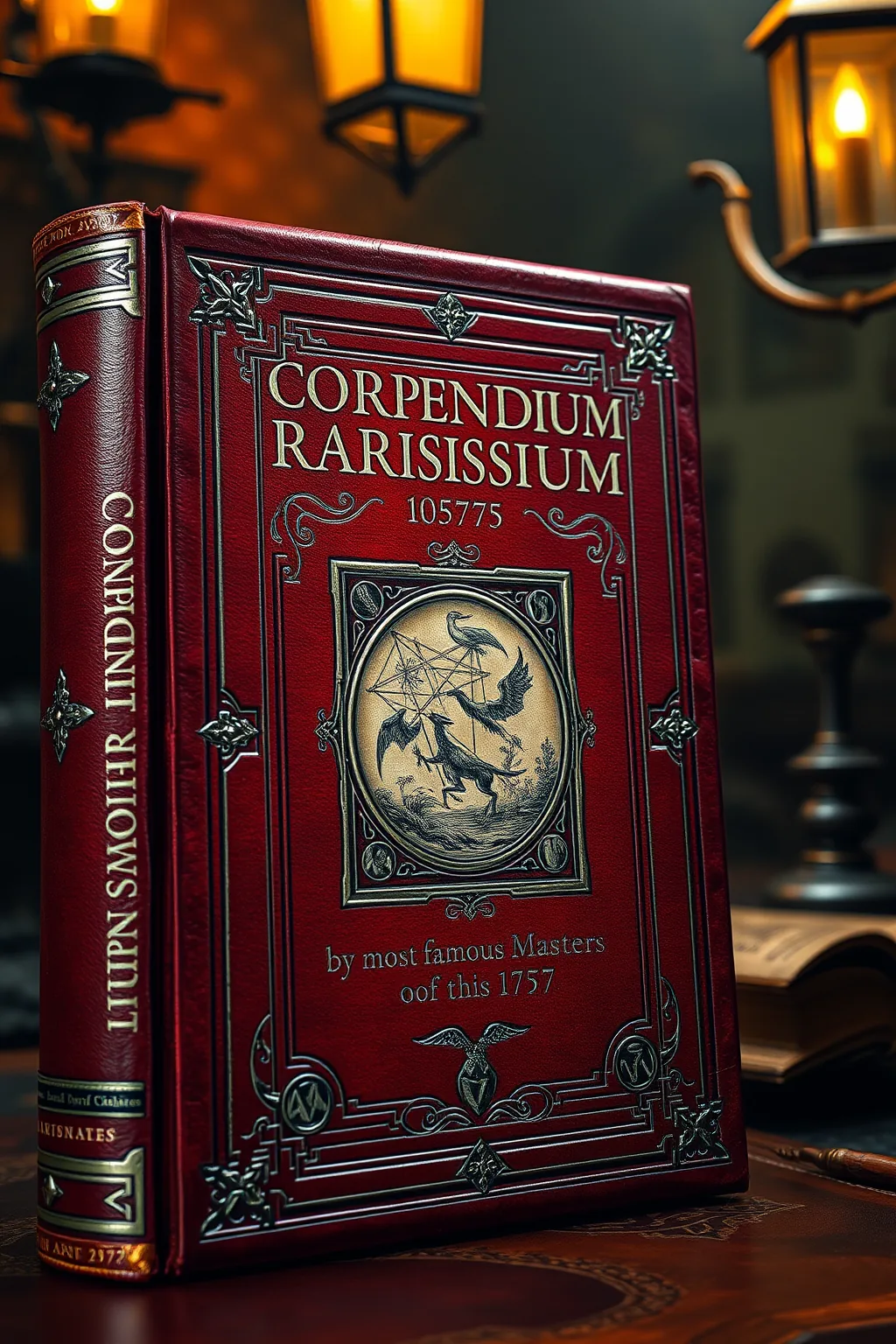
Compendium Rarissimum


By Cassian Rothmann (Senior Critic, Ancient Wisdom) — This 'Compendium Rarissimum' is a monumental contribution to the study of Hermetic arts and demonology. The anonymous Masters have laid bare a systematic approach to the magical art, weaving together complex doctrines with a palpable sense of ancient authority. Its dual-language format and enigmatic nature only enhance its mystique, demanding careful scholarly attention. The work’s strength lies in its intricate theoretical framework and its subtle yet potent practical implications for those who can decipher its veiled language. It is an essential text for serious practitioners and historians of the occult, offering unparalleled insights into a sophisticated magical tradition.
📝 Description
83
The Compendium Rarissimum, dated 1057 but likely from 1775, is a unique alchemical manuscript in German and Latin.
This manuscript, titled 'Noli me tangere' or 'Touch me not,' contains arcane symbolism and esoteric wisdom. Despite its 1057 date, scholars generally attribute its creation to 1775. It is not a typical grimoire but a detailed handwritten work focusing on demonology and alchemical processes. The title itself acts as a protective charm, guarding the often dangerous knowledge within.
The Compendium Rarissimum invites readers with a keen intellect and a desire for hidden or forbidden knowledge to engage with its transformative theories and practices. It guides the serious student into the intersection of the material and spiritual worlds. The book offers a distinct perspective on a complex system for spiritual exploration and disciplined engagement with unseen entities. Its underlying philosophy reflects a grasp of universal principles and the interconnectedness of all things, pushing beyond standard views and lighting the way for those who seek ancient knowledge.
The Compendium Rarissimum belongs to the Western esoteric tradition, specifically within alchemy and hermeticism. Its focus on symbolic representation and the interaction between the material and spiritual realms aligns with practices found in older alchemical texts. The manuscript's inclusion of demonological elements also connects it to a strain of magical literature that sought to understand and influence unseen forces, a practice common in certain hermetic circles.
✍️ Author
the most famous Masters of this Art
Masters of the Universe (sometimes referred to as the He-Man or She-Ra series) is a sword and planet-themed American media franchise created by Mattel. The main premise revolves around the conflict between He-Man (the alter ego of Prince Adam) and Skeletor…
💡 Why Read This Book?
Dive into the forbidden knowledge of demonology and Hermetic philosophy. 'Compendium Rarissimum' offers a rare, systematic exploration of magical arts, penned by legendary Masters. Ideal for seasoned occultists, dedicated scholars, and seekers of profound spiritual truths who crave authentic, challenging esoteric texts. Discover ancient secrets and unlock deeper understanding of the hidden cosmos.
⭐ Reader Reviews
Honest opinions from readers who have explored this book.
❓ Frequently Asked Questions
What is the true historical period of the 'Compendium Rarissimum'?
While the title suggests 1057, scholarly consensus points to the year 1775 as the more accurate period of its creation, likely a deliberate historical obfuscation by the authors.
What is the primary subject matter of this text?
The 'Compendium Rarissimum' primarily focuses on demonology, presenting a systematized understanding of this often-misunderstood aspect of magical arts and spiritual exploration.
What languages are used in the manuscript?
The manuscript is written in a dual-language format, featuring both German and Latin, reflecting the scholarly and mystical traditions of its era.
Who are the 'Masters of this Art' mentioned?
The authors are referred to anonymously as 'the most famous Masters of this Art,' suggesting a collective of highly respected and knowledgeable individuals within the Hermetic and magical communities of the time.
Is this book suitable for beginners in occult studies?
Due to its complex nature, dense symbolism, and potentially challenging subject matter, this book is best suited for experienced practitioners and scholars rather than absolute beginners.
🔮 Key Themes & Symbolism
The Systematization of the Magical Art
This theme explores the structured and organized presentation of magical principles within the 'Compendium Rarissimum.' It explores how the text attempts to codify and systematize complex esoteric doctrines, moving beyond fragmented lore to a cohesive framework. The authors likely sought to establish a clear methodology for understanding and interacting with the spiritual and material planes, offering a pedagogical approach to the 'Art' that emphasizes order, precision, and a deep understanding of underlying universal laws. This systematic approach signifies a mature stage in esoteric development, where knowledge is not merely acquired but meticulously categorized and applied.
The Nature and Hierarchy of Daemons
At the heart of the 'Compendium Rarissimum' lies a profound exploration of demonology. This theme examines the text's perspective on the nature, roles, and hierarchical structures of daemonic entities. It investigates how the 'Masters' conceptualized these beings, not merely as malevolent forces, but as integral components of the cosmic order, possessing specific functions and intelligences. The work likely provides detailed classifications, correspondences, and methods for understanding and potentially interacting with these entities, offering insights into their influence on both the microcosm (human) and the macrocosm (universe). This exploration is crucial for understanding the practical applications of the magical art presented.
Esoteric Symbolism and Hermetic Correspondences
The 'Compendium Rarissimum' is rich with veiled symbolism and intricate hermetic correspondences, making this theme central to its interpretation. The text likely employs a sophisticated visual and linguistic language, where each symbol, sigil, and phrase carries multiple layers of meaning. Understanding these correspondences is key to unlocking the deeper philosophical and practical implications of the work. It reflects the Hermetic principle of 'as above, so below,' illustrating the interconnectedness of all things through a complex web of symbolic relationships, from celestial bodies to terrestrial elements and spiritual entities.
💬 Memorable Quotes
Direct passages from the work, attributed to the author.
“Noli me tangere – Touch me not.”
— This potent phrase acts as both a title and a warning, signifying the profound and perhaps dangerous nature of the knowledge contained within, demanding respect and careful approach.
“The Art is a system, not a chaos.”
— This highlights the authors' intent to present a structured, ordered approach to magic, emphasizing logic and method over random or uncontrolled forces.
“Know the names to command the powers.”
— This underscores the importance of nomenclature and understanding in the practice of magic, suggesting that true mastery comes from precise knowledge and naming.
“Shadows reveal the light's true form.”
— This philosophical statement suggests that understanding darker or hidden aspects of existence is essential for comprehending the nature of light and spiritual illumination.
“The celestial mirrors the terrestrial.”
— A direct invocation of the Hermetic principle 'as above, so below,' emphasizing the interconnectedness and reciprocal influence between the macrocosm and microcosm.
🌙 Esoteric Significance
Tradition
This work is deeply rooted in the Western Esoteric Tradition, specifically within the branches of Alchemy and Hermeticism, with a significant focus on the complex field of Demonology. It draws upon a lineage of occult thought that seeks to understand and manipulate the forces of the universe through divine and daemonic intermediaries. Its systematic approach suggests an engagement with Kabbalistic principles and potentially ceremonial magic, aiming to provide a structured pathway for practitioners to interact with these powerful, often unseen, entities.
Symbolism
The symbolism within 'Compendium Rarissimum' is exceptionally rich and multilayered. It likely employs a dense iconography, drawing from alchemical diagrams, astrological symbols, and unique sigils designed to represent specific daemonic essences or magical operations. These symbols serve as keys to unlock the text's deeper meanings, acting as mnemonic devices and focal points for meditation and ritual. The interplay of Latin and German further adds to its symbolic depth, representing the fusion of classical arcane language with the vernacular of esoteric practice.
Modern Relevance
In an age often characterized by secularism and skepticism, the 'Compendium Rarissimum' offers a powerful counterpoint, reminding us of the enduring human quest for deeper meaning and connection to the numinous. Its exploration of demonology, when viewed through a lens of psychological archetypes or spiritual forces, remains relevant for understanding the shadow aspects of the psyche and the collective unconscious. For practitioners, it provides a historical and theoretical framework for exploring advanced magical concepts, encouraging rigorous study and ethical engagement with the unseen realms.
👥 Who Should Read This Book
This profound manuscript is primarily for the dedicated seeker and seasoned practitioner of esoteric arts. Scholars of occult history, comparative religion, and Hermetic philosophy will find invaluable primary source material here, offering unique insights into demonological traditions. Advanced practitioners looking to deepen their understanding of magical systems, especially those interested in the historical development of demonology and ceremonial magic, will benefit immensely. While its complexity makes it less suitable for absolute beginners, those with a solid foundation in occult studies and a serious commitment to rigorous inquiry will find the 'Compendium Rarissimum' an intellectually stimulating and spiritually rewarding journey into the heart of ancient magical wisdom.
📜 Historical Context
Emerging from the intellectual ferment of the late 18th century, a period marked by Enlightenment rationalism yet also a burgeoning fascination with the occult and esoteric traditions, the 'Compendium Rarissimum' stands as a fascinating artifact. The era saw a complex interplay between scientific inquiry and a renewed interest in ancient mysteries, alchemy, Kabbalah, and demonology. This was a time when secret societies flourished and individuals sought hidden knowledge beyond the established religious and philosophical norms. The dual-language format (German and Latin) reflects the scholarly and mystical currents of Central Europe during this period. The suggested late 18th-century dating places it within the context of figures like Cagliostro, Martinez de Pasqually, and the rise of various Masonic and Rosicrucian-inspired orders, all of whom explored the deeper strata of spiritual reality and the application of arcane arts. The deliberate anachronism in its title hints at a desire to connect with older traditions while contemporaneously contributing to the ongoing esoteric discourse.
📔 Journal Prompts
Reflect on the concept of 'Noli me tangere' in relation to forbidden knowledge and personal boundaries.
Analyze the potential dangers and ethical considerations involved in the systematic study of demonology as presented in the text.
Consider how the dual-language format might have influenced the transmission and understanding of the book's esoteric teachings.
Explore the philosophical implications of viewing daemons not as purely evil, but as integral parts of a cosmic system.
If the 'Art' is indeed a system, what are the fundamental principles that govern such a system, and how do they manifest in the 'Compendium Rarissimum'?
🗂️ Glossary
Hermeticism
A philosophical and religious tradition based on the purported teachings of Hermes Trismegistus, emphasizing esoteric knowledge, spiritual transformation, and the interconnectedness of the cosmos, often involving alchemy and astrology.
Demonology
The study and classification of demons or supernatural evil forces, often exploring their nature, hierarchy, powers, and potential interactions with the human world within religious and occult contexts.
Grimoire
A textbook of magic or witchcraft, typically containing instructions on how to cast spells, perform rituals, and summon supernatural entities, often associated with historical occult practices.
Sigil
A symbol or magical sign used in rituals, often created with specific intent and charged with energy to manifest desires or invoke spiritual entities. In this context, sigils likely represent specific daemonic forces or operations.
Microcosm/Macrocosm
A fundamental Hermetic concept stating that the human being (microcosm) is a reflection of the universe (macrocosm), and vice versa, implying a deep interconnectedness and correspondence between the individual and the totality of existence.
This book appears in 1 collection
🔮 Readers Also Liked
Browse all →






From the “Occultism” Collection
View all →



More Free Alchemy & Hermeticism Books
View all →