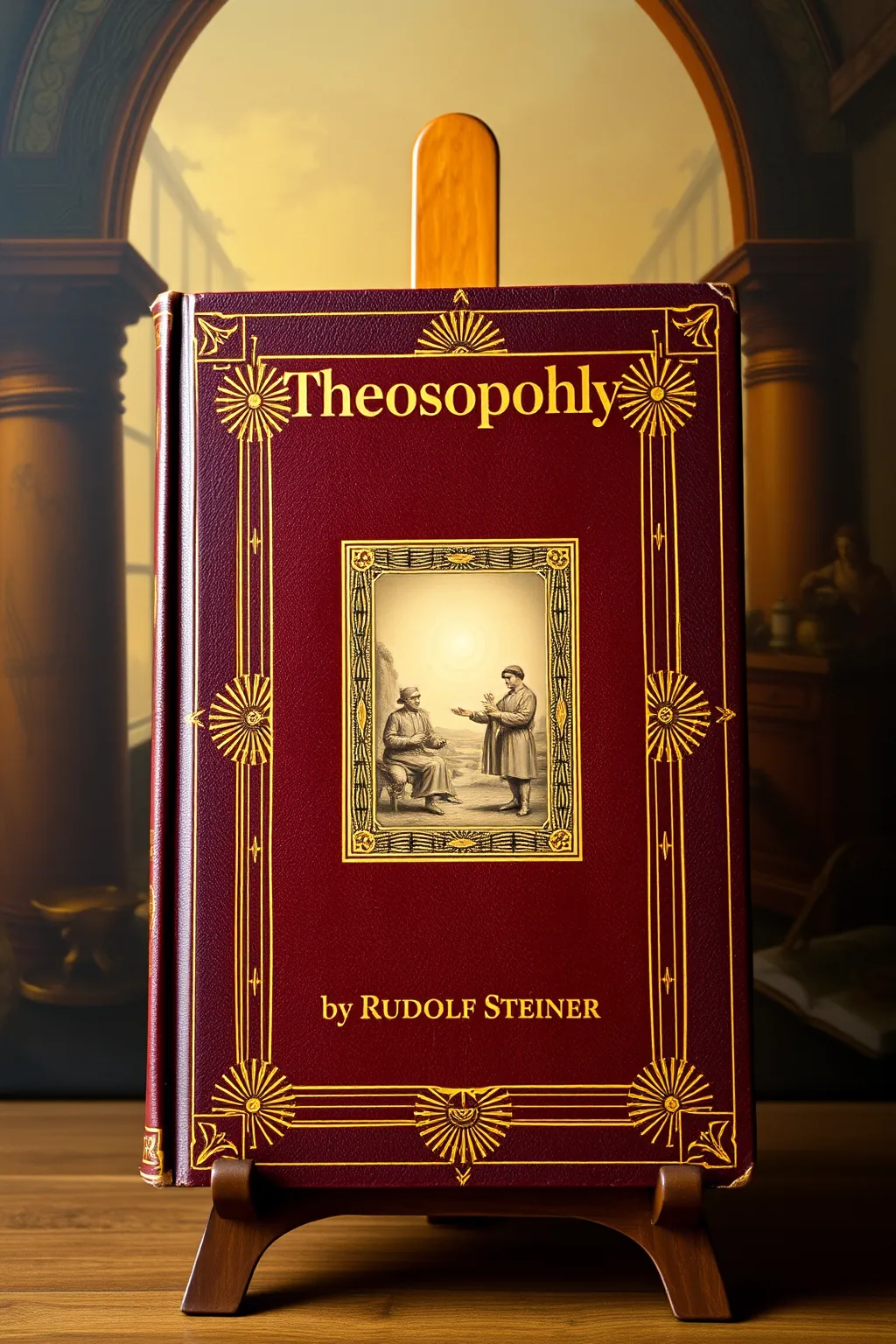
Theosophy
 72
72

Theosophy



Silas Hawthorne (Hermetic Studies Editor) — Rudolf Steiner's 'Theosophy' is a foundational text for any serious student of esoteric knowledge. Steiner offers a lucid, albeit challenging, introduction to his Anthroposophical cosmology, presenting a sophisticated framework for understanding the spiritual evolution of humanity and the cosmos. The book's strength lies in its systematic exposition of supersensible realities, from elemental beings to the cycles of reincarnation. While its terminology may seem arcane, it provides invaluable keys for unlocking deeper spiritual comprehension. Ideal for dedicated seekers and scholars of occult philosophy, this work is an indispensable guide for those aspiring to move beyond superficial understanding and engage with the profound mysteries of existence.
📝 Description
72
Rudolf Steiner published "Theosophy" in 1904, aiming to introduce a spiritual understanding of the world.
Rudolf Steiner's 1904 book, "Theosophy: An Introduction to the Supersensible Knowledge of the World and the Destination of Man," presents a spiritual science intended to go beyond the limits of materialist understanding. Steiner posits a threefold human constitution: physical body, soul, and spirit. He describes a cosmos populated by elemental beings and discusses the soul's progression through reincarnation, experiences he asserts are accessible through spiritual perception.
The text aims to provide a framework for comprehending the universe's spiritual structure and humanity's role within it. Steiner outlines a path for developing inner vision, suggesting that such a development leads to a more complete perception of existence. The book's purpose is to guide individuals toward a spiritual comprehension of life, moving beyond purely empirical observation.
Published in 1904, Steiner's "Theosophy" emerged during a period of intense interest in spiritualism and esoteric philosophies. It aligns with the broader theosophical movement, which sought to synthesize Eastern and Western mystical traditions and reveal hidden spiritual laws. Steiner's work, however, began to diverge from the mainstream Theosophical Society, laying groundwork for his later Anthroposophy. The book attempts to establish a spiritual epistemology, a method for knowing spiritual realities akin to scientific observation.
💡 Why Read This Book?
This book is essential for awakening to the vastness of spiritual reality beyond the physical. It offers a coherent, albeit advanced, framework for understanding human evolution, consciousness, and the hidden forces shaping our world. Ideal for seekers of truth, students of occultism, and practitioners looking to deepen their metaphysical understanding and spiritual practice.
⭐ Reader Reviews
Honest opinions from readers who have explored this book.
❓ Frequently Asked Questions
Is 'Theosophy' a difficult read?
While 'Theosophy' presents complex spiritual concepts, Steiner's writing is remarkably clear for the subject matter. It requires focused attention, but it is designed as an introduction, making it accessible to dedicated seekers willing to engage with its depth.
What is the relationship between Steiner's Theosophy and other Theosophical movements?
Rudolf Steiner was initially associated with the Theosophical Society but later founded his own movement, Anthroposophy. While sharing some roots, his teachings evolved significantly, offering a distinct path of spiritual science.
What does Steiner mean by 'supersensible knowledge'?
Supersensible knowledge refers to insights and perceptions gained through spiritual faculties or clairvoyance, which are beyond the reach of the ordinary five physical senses and conventional scientific methods.
How does this book relate to reincarnation?
The book explores reincarnation as a fundamental aspect of human spiritual evolution, detailing the process of soul development across multiple earthly lives and the preparation for future existences.
Can this book be read without prior knowledge of esotericism?
Yes, it serves as an introduction. However, readers unfamiliar with esoteric concepts may benefit from supplementary reading or discussions to fully grasp the intricate spiritual philosophy presented.
🔮 Key Themes & Symbolism
The Tripartite Nature of Man
Steiner elucidates the human being as a complex interplay of body, soul, and spirit, a foundational concept that challenges materialistic views. He argues that understanding these distinct yet interwoven aspects is crucial for comprehending our existence and potential for spiritual growth. This model serves as a gateway to recognizing the non-physical dimensions of our being, encouraging an exploration of consciousness that transcends biological and psychological limitations, and paving the way for a holistic understanding of self and the universe.
The Hierarchy of Spiritual Beings
This work unveils the intricate cosmic order, describing various orders of spiritual beings – from elemental spirits inhabiting the natural world to higher archangels guiding evolution. Steiner posits that these beings are not mere abstract concepts but active forces in the universe, influencing human development and the very fabric of reality. Understanding their roles provides a profound perspective on the interconnectedness of all existence and the divine intelligence guiding cosmic processes, moving beyond anthropocentric views to embrace a vaster spiritual panorama.
The Cycles of Evolution and Reincarnation
Steiner presents a grand vision of cosmic and human evolution, detailing how consciousness and spirit unfold through successive cycles of existence. Reincarnation is presented not as a mere belief but as a vital mechanism for spiritual learning and maturation, allowing the soul to gather experience and progress towards higher states of being. This theme underscores the purposeful nature of life and death, offering solace and meaning by framing individual lives within an eternal journey of growth and transformation towards ultimate spiritual realization.
💬 Memorable Quotes
Direct passages from the work, attributed to the author.
“We must learn to know the spiritual world.”
— This emphasizes the necessity of cultivating inner perception to access truths beyond the material, a core tenet of esoteric development.
“Man is a being of body, soul, and spirit.”
— This succinctly introduces Steiner's fundamental model of human constitution, inviting deeper inquiry into each aspect.
“The spiritual is not dead, but alive.”
— A powerful assertion that the unseen realms are dynamic and active, challenging the perception of materialism and encouraging spiritual engagement.
“The destination of man is spiritual freedom.”
— This highlights the ultimate purpose of human existence according to Steiner's philosophy: the attainment of self-realization and liberation through spiritual understanding.
“Higher worlds are not far away, but within.”
— This profound statement redirects the search for spiritual realities inward, suggesting that the keys to the supersensible lie within our own consciousness.
🌙 Esoteric Significance
Tradition
Steiner's 'Theosophy' is a core part of modern esoteric thought, particularly within the Western tradition of Spiritual Science and Anthroposophy. It bridges Gnosticism, Hermeticism, and Eastern philosophies, presenting a unique synthesis aimed at developing direct spiritual perception. It offers a systematic approach to understanding the evolution of consciousness and the cosmos through a disciplined inner development, distinct from purely mystical or devotional paths.
Symbolism
The book employs strong symbolism to convey complex spiritual realities. The tripartite model of man (body, soul, spirit) is a fundamental symbolic structure. Concepts like elemental beings, planes of existence, and the karmic wheel are symbolic representations of spiritual processes. Steiner often uses archetypal imagery and mythological narratives to illuminate the underlying spiritual truths, encouraging the reader to interpret these symbols not as literal entities but as pointers to deeper, experiential realities.
Modern Relevance
In an age often characterized by existential doubt and a disconnect from nature, Steiner's 'Theosophy' offers a profound re-enchantment of the world. Its emphasis on the spiritual dimension of human existence, the interconnectedness of all life, and the potential for conscious evolution resonates deeply. The book provides a framework for understanding current global challenges from a spiritual perspective and offers tools for personal growth, ethical development, and a more meaningful engagement with life, making its insights important for contemporary seekers.
👥 Who Should Read This Book
This profound work is ideally suited for the earnest seeker of spiritual truth, the dedicated student of occult philosophy, and the scholar interested in the evolution of esoteric thought. While beginners might find its concepts challenging, it serves as an excellent, albeit advanced, introduction to Rudolf Steiner's comprehensive spiritual science. Practitioners of meditation or other inner disciplines will find valuable insights for their path. Those disillusioned by materialism or seeking a deeper, more purposeful understanding of life and consciousness will find 'Theosophy' a rewarding and transformative read.
📜 Historical Context
Written in the early 20th century, "Theosophy" emerged during a period of intense spiritual and philosophical ferment. The rise of scientific materialism had led many to question traditional religious dogma, creating fertile ground for new esoteric movements. Helena Blavatsky's Theosophical Society had already ignited widespread interest in Eastern religions and occult philosophies. Rudolf Steiner, initially a prominent figure within this movement, eventually diverged to found his own path, Anthroposophy. His work sought to synthesize spiritual insights with scientific inquiry, offering a path to direct spiritual experience and knowledge in an era increasingly dominated by rationalism, aiming to provide a spiritual counterpoint to the prevailing materialistic worldview.
📔 Journal Prompts
Reflect on the concept of 'body, soul, and spirit' as presented by Steiner. How do you perceive these aspects within yourself?
Consider the idea of elemental beings. How might these unseen forces influence the natural world and your daily life?
What personal experiences or intuitions resonate with Steiner's discussion of reincarnation and spiritual evolution?
How can the pursuit of 'supersensible knowledge' complement or challenge your current understanding of reality and science?
Given the 'destination of man' as spiritual freedom, what steps can you take today to move closer to this goal?
🗂️ Glossary
Supersensible
Referring to realms, forces, or perceptions that lie beyond the reach of the ordinary five physical senses and conventional scientific instruments.
Elemental Spirits
Spiritual beings associated with the fundamental forces of nature (e.g., earth, water, air, fire) that operate within the material world.
Reincarnation
The philosophical or religious concept that the non-physical essence of a living being begins a new life in a different physical form or body after biological death.
Karma
The principle of cause and effect, where actions in one life influence experiences in subsequent lives, guiding spiritual development.
Anthroposophy
A spiritual philosophy founded by Rudolf Steiner, based on the idea that there is a spiritual world accessible to human experience, which can be studied through inner development.
This book appears in 2 collections
🔮 Readers Also Liked
Browse all →









From the “Hermeticism” Collection
View all →






More Free Alchemy & Hermeticism Books
View all →