Data integrity patterns of the Torah
 74
74

Data integrity patterns of the Torah



Aurelia Blackwood, Occult Philosophy Critic: Kevin Acre's 'Data Integrity Patterns of the Torah' is a revelation for those who seek the quantifiable sacred. Moving beyond traditional exegesis, Acre applies a rigorous, almost alchemical lens to textual structure, revealing patterns of numerical perfection that suggest an extraordinary preservation of divine intent. The arguments for the Torah's pristine data integrity are compelling, hinting at a cosmic design that transcends simple scribal transmission. This work is essential for scholars of Hermeticism, Kabbalah, and anyone fascinated by the mathematical underpinnings of ancient wisdom. Acre’s unique approach bridges the empirical and the mystical, offering profound insights into the enduring power and structure of sacred texts.
📝 Description
74
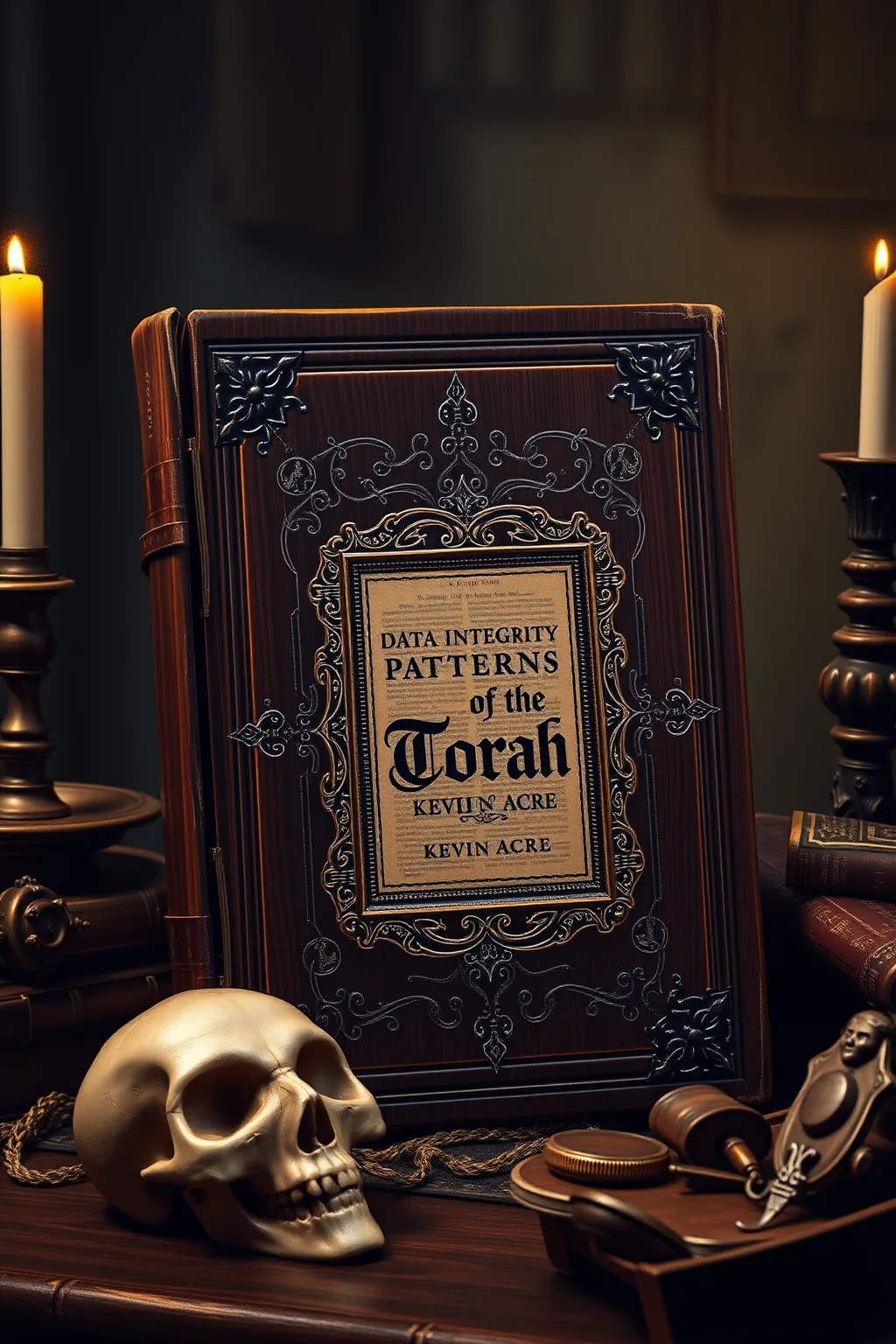
Kevin Acre's 'Data Integrity Patterns of the Torah' examines the Torah's precise letter counts.
Kevin Acre's work investigates the numerical structure of the Torah, focusing on its letter counts. The book proposes that these counts have remained consistent throughout history, suggesting a deliberate design. Acre posits that this numerical integrity points to the Torah being more than a historical record; it is presented as an artifact with built-in preservation mechanisms.
The author connects this idea to concepts of divine inscription and a cosmic blueprint. He suggests that the Torah's structure actively guards sacred knowledge against corruption or loss over time. This perspective frames the text as a divinely engineered information system, aligning with esoteric traditions that see parallels between the celestial and terrestrial.
This book fits within traditions that seek hidden meanings in sacred texts, particularly those influenced by Gematria and other forms of Jewish mysticism. It echoes Hermetic principles by suggesting that structural patterns in the divine text reflect a universal order. The focus on information integrity and preservation aligns with esoteric concerns about maintaining spiritual or arcane knowledge across generations, separate from mainstream textual criticism.
✍️ Author

Kevin Acre presents numerous intriguing t
Jacqueline Lee "Jackie" Kennedy Onassis (née Bouvier; July 28, 1929 – May 19, 1994) was the first lady of the United States from 1961 to 1963, as the wife of John F. Kennedy, the 35th president of the United States.
💡 Why Read This Book?
Embark on a journey into the numerical architecture of divine revelation. Discover compelling evidence for the Torah's perfect preservation, exploring its hidden mathematical symmetries. Ideal for seekers of esoteric knowledge, scholars of ancient texts, and practitioners interested in the intersection of numerology and spirituality. Uncover a deeper understanding of sacred texts as divinely engineered systems.
⭐ Reader Reviews
Honest opinions from readers who have explored this book.
❓ Frequently Asked Questions
What is the primary argument of 'Data Integrity Patterns of the Torah'?
The book argues that the exact letter count in each book of the Torah has remained unchanged throughout history, suggesting a divinely preserved text of unparalleled integrity, possibly due to underlying numerical patterns.
What is meant by 'prime, perfect, and transcendental numbers' in this context?
These mathematical concepts are explored as potential underlying structures or codes within the Torah's letter counts, hinting at a deeper, perhaps divine, organizational principle.
Who is Kevin Acre and what is his background?
Kevin Acre is presented as an author who delves into intriguing types of evidence, suggesting a meticulous researcher with a keen interest in uncovering hidden patterns within sacred texts.
Does this book claim the Torah is a literal code?
While it doesn't explicitly state it's a literal code in the modern sense, it strongly suggests a profound mathematical structure and integrity that implies a purposeful, divinely orchestrated design.
Is this book suitable for beginners in esoteric studies?
Yes, it's accessible to those new to esoteric concepts, as it introduces complex ideas through compelling arguments and clear presentation, sparking curiosity for further exploration.
🔮 Key Themes & Symbolism
The Immutability of Divine Text
This theme explores the profound concept of textual preservation, positing that the Torah's letter count has remained an exact and unbroken record across millennia. It looks at the implications of such immutability, suggesting a divine hand actively safeguarding sacred knowledge from corruption and alteration. The exploration transcends simple historical accuracy, venturing into the area of spiritual certainty and the idea that the text itself is a evidence of its own divine origin and enduring power.
Numerology as Cosmic Blueprint
Central to the book's thesis is the idea that numbers are not merely abstract symbols but fundamental building blocks of reality, acting as a cosmic blueprint. The examination of prime, perfect, and transcendental numbers within the Torah's structure suggests an underlying mathematical order that mirrors the divine architecture of the universe. This theme invites readers to consider the universe and sacred texts as intricately designed systems, where numerical harmony reveals profound spiritual truths.
The Torah as a Living, Data-Rich Artifact
Moving beyond the perception of the Torah as a static historical document, this theme presents it as a dynamic, data-rich artifact. The author argues for an inherent 'data integrity' that speaks to its extraordinary preservation. This perspective invites a re-evaluation of scripture, viewing it not just as a source of narrative and law, but as a meticulously engineered repository of divine information, designed to be transmitted with exceptional accuracy through the ages.
💬 Memorable Quotes
Direct passages from the work, attributed to the author.
“The Torah: a fortress of immutable truth.”
— This evokes the idea of the Torah as an unassailable bastion of knowledge, protected by its inherent structure and numerical integrity, resisting decay and distortion over time.
“Where letters align, divine patterns emerge.”
— This highlights the central thesis, suggesting that the precise arrangement and quantity of letters in the Torah are not accidental but form discernible, meaningful patterns that point to a higher intelligence.
“The scribe's hand, guided by celestial calculus.”
— This implies that the meticulous copying of the Torah was not solely a human endeavor but was overseen or influenced by a cosmic, mathematical order, ensuring its faithful transmission.
“Integrity in ink, transcendence in number.”
— This succinctly captures the book's core idea: the physical integrity of the written text is intrinsically linked to the spiritual and transcendental power revealed through its numerical underpinnings.
💡 Key Ideas
Editorial paraphrase of the work's core concepts — not direct quotes.
Numbers whisper the secrets of eternity.
This quote suggests that mathematical principles are not just abstract concepts but carry profound, hidden meanings that reveal universal truths about existence and the divine.
🌙 Esoteric Significance
Tradition
This work deeply engages with the Hermetic and Kabbalistic traditions, which view the universe and sacred texts as imbued with profound symbolic and numerical meaning. It aligns with the Hermetic principle of 'correspondences,' suggesting that the mathematical order found in the Torah reflects a divine order in the cosmos. The Kabbalistic focus on gematria (the numerical value of Hebrew letters) provides a framework for understanding how Acre interprets the letter counts as carriers of profound, divinely encoded wisdom.
Symbolism
The key symbols here are the numbers themselves—prime, perfect, and transcendental—which are presented not just as mathematical entities but as conduits for divine revelation. The letters of the Torah, when counted precisely, become symbols of enduring truth and divine preservation. The act of meticulous copying is also symbolic, representing the human effort to maintain fidelity to the sacred, guided by an unseen, numerical order that ensures its perfection.
Modern Relevance
In an age saturated with digital information and concerns about data integrity, Acre's work offers a profound, ancient perspective on the preservation of knowledge. It suggests that the principles of robust data management and fidelity are not new, but have been divinely architected from the dawn of spiritual revelation. This provides a unique lens through which to view the enduring power and reliability of ancient wisdom, encouraging a renewed appreciation for the structural depth and inherent integrity of foundational spiritual texts.
👥 Who Should Read This Book
This book is an essential read for those who approach sacred texts with a thirst for deeper, hidden meanings. Scholars of biblical studies, comparative religion, and ancient languages will find Acre's analytical approach clear. Mystics and spiritual seekers interested in the intersection of mathematics, numerology, and divine revelation will discover a wealth of useful insights. Practitioners of Hermeticism and Kabbalah will find connections to their existing frameworks, while beginners in esoteric studies will be drawn in by the compelling evidence and the captivating premise of a perfectly preserved divine message.
📜 Historical Context
While the Torah's origins are rooted in ancient Near Eastern religious traditions, Kevin Acre's work situates the text within a later, yet still ancient, intellectual milieu that valued numerical symbolism and esoteric interpretation. The emphasis on mathematical patterns and textual integrity speaks to Hermetic and Gnostic traditions, which often sought hidden meanings and divine order within sacred scriptures. The Hellenistic period, with its fusion of Greek philosophy and Near Eastern mysticism, saw a rise in allegorical and numerological approaches to religious texts. Furthermore, the development of Kabbalistic thought in medieval Judaism, with its deep dives into gematria and textual exegesis, provides a rich backdrop for understanding how such patterns might be perceived and interpreted as divinely significant, suggesting a continuous thread of seeking numerical and structural meaning in the sacred word.
📔 Journal Prompts
Reflect on a time you encountered seemingly perfect order in nature or a text. What emotions did it evoke?
Consider the concept of 'data integrity' in the context of your own spiritual beliefs or practices. How do you ensure their purity?
If the Torah's letter count is precisely preserved, what does this imply about the nature of divine communication?
Explore a personal experience where numbers played a significant, perhaps coincidental, role. Could there be a deeper pattern?
How does the idea of a divinely engineered text challenge or affirm your understanding of faith and reason?
🗂️ Glossary
Torah
The first five books of the Hebrew Bible (Genesis, Exodus, Leviticus, Numbers, Deuteronomy), considered the foundational text of Judaism and containing divine commandments and narratives.
Data Integrity
In this context, refers to the accuracy, completeness, and consistency of the Torah's textual content, specifically its letter count, suggesting it has been preserved without error across centuries.
Prime Numbers
Natural numbers greater than 1 that have no positive divisors other than 1 and themselves, often seen as fundamental and indivisible building blocks in mathematics.
Perfect Numbers
Positive integers that are equal to the sum of their proper positive divisors (the sum of its positive divisors excluding the number itself). Example: 6 (1+2+3=6).
Transcendental Numbers
Real or complex numbers that are not algebraic; that is, they are not roots of a non-zero polynomial equation with integer coefficients. Examples include Pi and e.
This book appears in 1 collection
🔮 Readers Also Liked
Browse all →







From the “Numerology” Collection
View all →








More Free Alchemy & Hermeticism Books
View all →