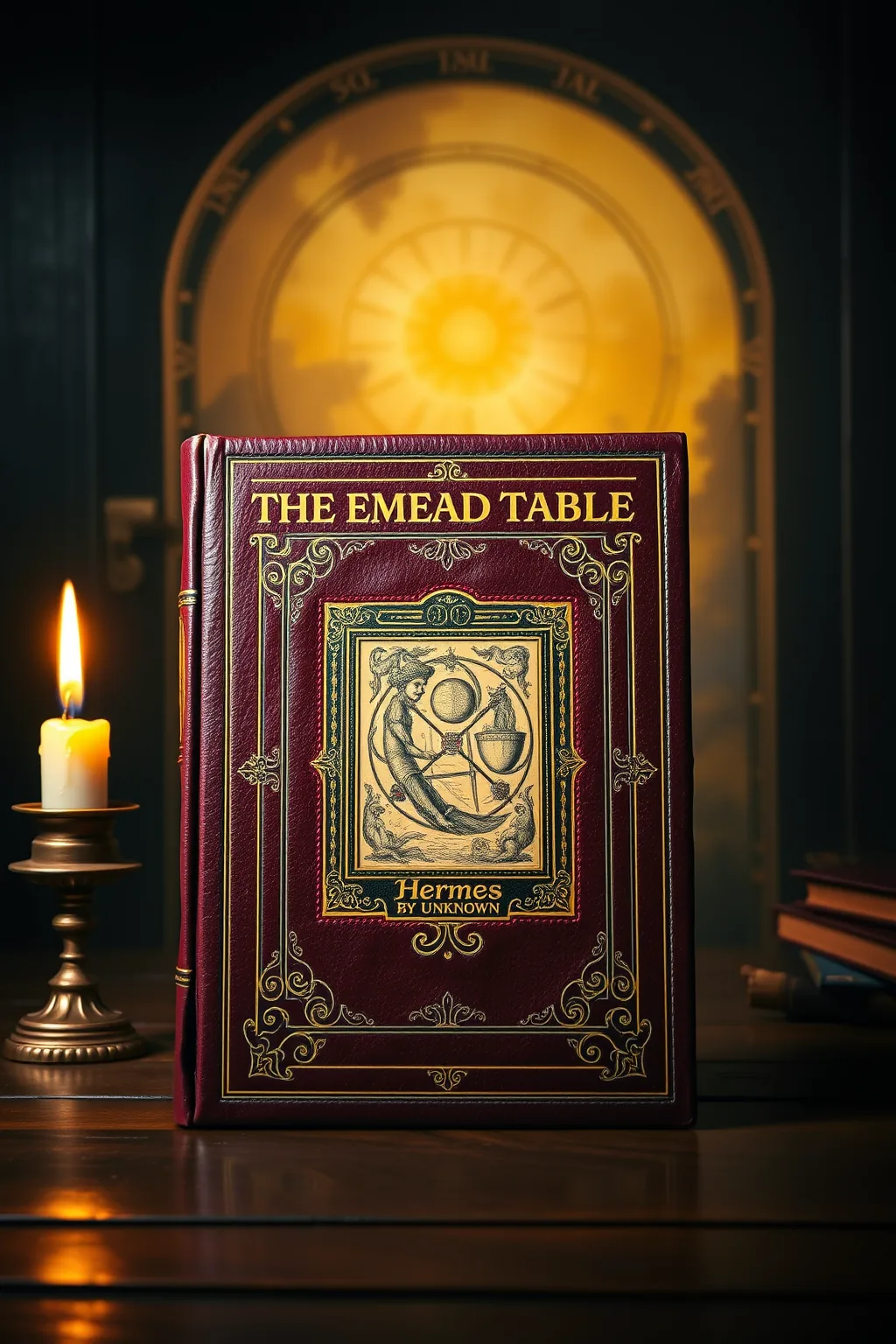
The Emerald Tablet of Hermes
 78
78

The Emerald Tablet of Hermes


Celeste Moreau (Divination & Symbolism Reviewer) — The Emerald Tablet is an indispensable cornerstone for any serious student of Western esotericism. Its profound brevity belies an immense philosophical depth, offering insights into the Hermetic axiom 'As above, so below' that continue to resonate. The text's strength lies in its potent symbolism and its elegant encapsulation of universal principles. While its cryptic nature demands contemplation, it rewards the diligent reader with a potent framework for understanding spiritual alchemy and the interconnectedness of the cosmos. Essential for practitioners, scholars, and anyone seeking the gnosis of ancient wisdom.
📝 Description
78
The Emerald Tablet, possibly dating to the 3rd century CE, contains the core tenets of Hermetic philosophy.
The Emerald Tablet is a short but influential text attributed to Hermes Trismegistus, a syncretic deity combining Greek Hermes and Egyptian Thoth. Its brevity belies its impact on Western esotericism. The tablet's famous opening line, "As above, so below," encapsulates its central theme: the correspondence between the celestial or macrocosmic realm and the terrestrial or microcosmic human experience.
This principle suggests that understanding the greater universe can lead to knowledge of oneself, and vice versa. The text also touches upon the concept of a single, unifying divine principle underlying all of reality, often described as "the One Thing." It hints at the alchemical process of transformation, not just of metals but of the human spirit towards enlightenment. Its cryptic pronouncements have been interpreted and reinterpreted by alchemists, mystics, and philosophers for centuries, making it a touchstone for various esoteric traditions.
The Emerald Tablet is a cornerstone of Hermeticism, a philosophical and religious tradition based on writings attributed to Hermes Trismegistus. This tradition emerged in the Hellenistic period, blending Greek philosophy with Egyptian religious beliefs. Hermetic texts, including the Corpus Hermeticum and the Emerald Tablet, explore cosmology, astrology, alchemy, and the nature of divinity. They often emphasize gnosis, or direct spiritual knowledge, as the path to salvation and understanding the divine order. The tablet's principles deeply influenced medieval and Renaissance alchemy, Kabbalah, and later occult movements.
✍️ Author
💡 Why Read This Book?
This seminal text offers a direct conduit to the foundational principles of Hermeticism and alchemy. It provides a concise yet powerful distillation of cosmic laws and spiritual transformation, ideal for seekers aiming to grasp the 'Great Work.' Scholars will find its historical and philosophical significance unparalleled, while practitioners can draw inspiration for their personal alchemical journeys. It's a gateway to understanding the universe from an ancient, enlightened perspective.
⭐ Reader Reviews
Honest opinions from readers who have explored this book.
❓ Frequently Asked Questions
Who was Hermes Trismegistus?
Hermes Trismegistus is a legendary syncretic figure, merging the Greek god Hermes with the Egyptian god Thoth. He is revered as the author of the Hermetic Corpus, embodying divine wisdom and knowledge.
What is the central message of the Emerald Tablet?
The central message revolves around the principle of 'As above, so below,' emphasizing the correspondence between the celestial and terrestrial realms, and the unity of all things. It hints at the alchemical process of transformation.
Is the Emerald Tablet a literal alchemical guide?
While it inspires alchemical interpretation, the Tablet is primarily viewed as a philosophical and spiritual text. Its 'alchemy' often refers to the transformation of the human soul, not just material transmutation.
How should one approach reading the Emerald Tablet?
Approach with an open mind and a contemplative spirit. Meditate on its cryptic phrases, consider their symbolic meanings, and explore commentaries to grasp its profound, layered wisdom.
What is its historical significance?
The Emerald Tablet has been a pivotal text in Western esotericism for over a millennium, influencing alchemy, astrology, Kabbalah, and various mystical traditions, shaping philosophical and spiritual thought.
🔮 Key Themes & Symbolism
The Unity of All Things
The Tablet posits a fundamental interconnectedness, asserting that all phenomena, from the smallest particle to the grandest star, originate from a single, divine source. This concept underpins the Hermetic worldview, suggesting that by understanding one part of the universe, one can gain insight into the whole. It implies a cosmic range where every thread is intrinsically linked, and separation is an illusion.
As Above, So Below
This iconic Hermetic axiom is central to the Tablet's teachings. It denotes a profound correspondence between the macrocosm (the universe) and the microcosm (humanity and the Earth). Understanding the patterns and laws governing the heavens provides a key to understanding earthly phenomena and the inner workings of the human psyche, suggesting that universal principles are reflected at all levels of existence.
The Great Work (Major work)
The Emerald Tablet alludes to the 'Great Work,' often interpreted as the process of spiritual transformation and purification. This alchemical journey aims to perfect the individual, leading to enlightenment and union with the divine. It involves the transmutation of base elements – both material and spiritual – into higher forms, achieving a state of wholeness and divine consciousness.
💬 Memorable Quotes
Direct passages from the work, attributed to the author.
“That which is below corresponds to that which is above.”
— This fundamental Hermetic principle highlights the mirrored relationship between the macrocosm and microcosm, suggesting universal laws apply across all planes of existence.
“The Father of all perfection, here is its whole strength.”
— Refers to the divine, singular source from which all power and creation emanate, emphasizing its all-encompassing and ultimate nature.
“It ascends from the Earth to the Heaven.”
— Illustrates the process of spiritual ascent and refinement, moving from the material realm towards higher, more rarefied states of consciousness.
“Separating the subtle from the gross.”
— Describes the alchemical process of purification, distinguishing the refined, spiritual essence from the dense, material aspects.
“The Mother of glory.”
— Symbolizes the primordial feminine principle, the creative force of the universe from which all things arise and to which they return.
🌙 Esoteric Significance
Tradition
The Emerald Tablet is the foundational text of Hermeticism, a philosophical and religious tradition rooted in the teachings of Hermes Trismegistus. It serves as the bedrock for understanding the principles of spiritual alchemy, esoteric cosmology, and the pursuit of gnosis (divine knowledge). Its influence extends to various mystical schools, including Rosicrucianism and some branches of ceremonial magic.
Symbolism
Key symbols include the 'Father of all perfection' (the Divine Source), the 'Mother of glory' (primordial creative force), and the 'Sun' and 'Moon' (representing opposing yet complementary principles). The Tablet's cryptic language itself is symbolic, requiring interpretation to reveal its hidden meanings concerning transformation, unity, and cosmic correspondence.
Modern Relevance
In contemporary times, The Emerald Tablet continues to inspire seekers, philosophers, and practitioners. Its emphasis on the interconnectedness of all things and the potential for personal transformation offers a powerful antidote to modern fragmentation. Its principles are applied in fields ranging from psychology and consciousness studies to environmental ethics and integral spirituality.
👥 Who Should Read This Book
This ancient text is essential for seekers of esoteric wisdom, alchemists of all disciplines (spiritual or material), and students of Western esotericism. Beginners will find it a profound, albeit challenging, introduction to Hermetic thought. Scholars of philosophy and religious studies will appreciate its historical impact. Practitioners of magic, meditation, and consciousness work can draw deep inspiration from its symbolic language and universal principles. It is for anyone yearning to understand the hidden mechanics of the universe and the path to inner perfection.
📜 Historical Context
The Emerald Tablet emerged from the fertile intellectual and spiritual field of late antiquity, a period of intense cross-cultural exchange between Hellenistic Greece and ancient Egypt. Attributed to Hermes Trismegistus, a figure embodying the fusion of Greek Hermes and Egyptian Thoth, the text likely coalesced in the early centuries CE. Its cryptic verses, rich with alchemical and mystical symbolism, resonated deeply with the Neoplatonists and Gnostics of the era. During the Islamic Golden Age, the Tablet was translated into Arabic, preserving and disseminating its wisdom. It later entered medieval Europe, profoundly influencing the development of Western alchemy, philosophy, and esoteric traditions, becoming a reference for figures like Roger Bacon and Paracelsus.
📔 Journal Prompts
Reflect on a time when you experienced a profound sense of interconnectedness. How did it feel, and what did it teach you?
Consider a 'gross' aspect of your life or personality that you wish to refine. What 'subtle' qualities could you cultivate to achieve this transformation?
How does the principle of 'As above, so below' manifest in your daily life or in the natural world around you?
If the Emerald Tablet represents the 'Great Work,' what does this work mean to you personally in your spiritual journey?
Meditate on the concept of a singular 'Father of all perfection.' What images or feelings arise within you?
🗂️ Glossary
Hermeticism
A spiritual, philosophical, and esoteric tradition based on the purported teachings of Hermes Trismegistus, emphasizing divine wisdom, the unity of all things, and the principle of 'As above, so below'.
Alchemy
The ancient practice and philosophy that sought to purify, mature, and perfect certain objects, often associated with the transmutation of base metals into gold, but more profoundly, the transformation of the human spirit.
Major work
Latin for 'Great Work,' referring to the ultimate alchemical process, often interpreted as the spiritual perfection and enlightenment of the individual.
Macrocosm
The universe or the greater world, understood as a complex, ordered system, often mirrored by the microcosm.
Microcosm
The human being, or the smaller world, seen as a reflection or miniature representation of the macrocosm.
This book appears in 1 collection
🔮 Readers Also Liked
Browse all →








More by Unknown
All books →



From the “Hermeticism” Collection
View all →









More Free Alchemy & Hermeticism Books
View all →