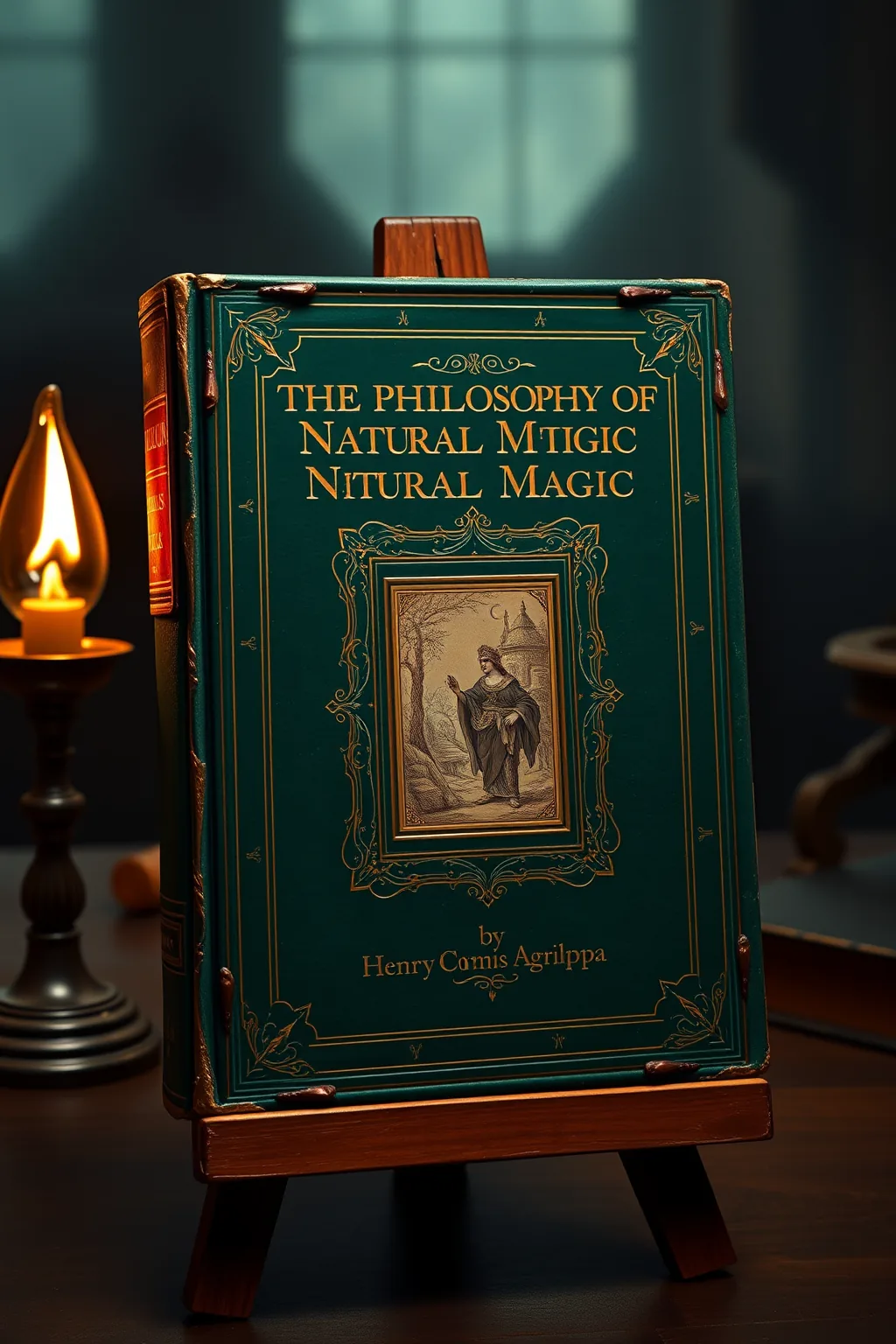
The Philosophy of Natural Magic
 80
80

The Philosophy of Natural Magic



Silas Hawthorne (Hermetic Studies Editor) — Agrippa’s 'The Philosophy of Natural Magic' remains an indispensable treatise for understanding the Hermetic tradition. This edition, bolstered by crucial contextual essays, expertly navigates Agrippa’s bold assertion that natural magic is a Christian art, a divine conduit rather than infernal pact. Its strength lies in its systematic exploration of celestial influences, elemental powers, and the potent language of divine names. Essential for scholars of Renaissance esotericism and practitioners seeking a robust theoretical framework grounded in profound philosophical inquiry. A true testament to the enduring power of sacred knowledge.
📝 Description
80
In 1533, Agrippa argued natural magic was a divine science, not demonic art.
Henry Cornelius Agrippa's 'The Philosophy of Natural Magic,' first published in 1533, presents natural magic as a divine science. Agrippa, a Renaissance scholar, contended that the universe's hidden forces are divine emanations. He believed these forces could be understood through philosophy, ritual, and celestial study. The book details concepts such as the connections between the macrocosm and microcosm, the significance of divine names, and the practical use of elements. It also covers the creation of talismans, tools for harnessing these natural forces. This work connects the spiritual and material worlds, aiming to illuminate the divine order and an individual's role within it. It is written for those who seek a deeper understanding of reality's underlying principles.
Agrippa's work is a key text in Renaissance hermeticism and ceremonial magic. It emerged during a period when scholars rediscovered classical texts and sought to reconcile them with Christian theology. Unlike some contemporaries who viewed magic with suspicion, Agrippa sought to legitimize it as a form of natural philosophy and theology. He placed natural magic within a framework of divine creation, accessible through intellectual and spiritual discipline. This perspective distinguished his approach from darker, more superstitious interpretations of magic prevalent at the time.
💡 Why Read This Book?
Delve into the foundational texts of Western esotericism and grasp Agrippa's revolutionary proposition of magic as a divinely sanctioned art. This work offers a profound understanding of cosmic correspondences, elemental forces, and the philosophical underpinnings of ritual. Ideal for seekers of hidden knowledge, scholars of occult history, and practitioners aiming to integrate deep theory with practical application.
⭐ Reader Reviews
Honest opinions from readers who have explored this book.
❓ Frequently Asked Questions
What is Natural Magic according to Agrippa?
Agrippa defines Natural Magic as the art of harnessing the inherent powers and virtues within nature, influenced by celestial bodies and elemental forces, to achieve wondrous effects. He posits it as a divinely ordained science accessible through study and devotion.
What is the historical significance of this book?
Published in the early 16th century, 'De Occulta Philosophia' (Three Books of Occult Philosophy) profoundly influenced Renaissance thinkers and occultists, including Giordano Bruno, by legitimizing magic as a subject of serious study for Christians.
Who was Henry Cornelius Agrippa?
Agrippa (1486-1535) was a German scholar, physician, lawyer, and occult writer. He was a pivotal figure in the revival of Hermetic philosophy and Neoplatonism during the Renaissance.
Is this book suitable for beginners?
While dense and requiring dedicated study, this edition’s background material can aid beginners. However, its true depth is best appreciated by those with some familiarity with philosophical or esoteric concepts.
What is the relationship between this book and Christianity?
Agrippa's revolutionary thesis is that natural magic is derived from God, not the Devil. He argues that by understanding God's creation, one can ethically employ its hidden forces, viewing it as a form of divine knowledge.
🔮 Key Themes & Symbolism
The Divine Ordination of Natural Magic
Agrippa vehemently argues against the demonization of magic, asserting its origins lie in the divine order established by God. He presents natural magic as a sacred art, accessible through the diligent study of creation's inherent virtues and celestial influences. This perspective was radical for its time, seeking to reintegrate occult practices within a Christian framework, emphasizing that understanding God’s creation is a path to spiritual enlightenment and potent, ethical operation. The text meticulously outlines how the macrocosm's energies can be sympathetically invoked and utilized through a profound understanding of universal laws.
Cosmic Correspondences and Sympathetic Resonance
A central pillar of Agrippa's philosophy is the concept of universal sympathy, the idea that all things in creation are interconnected through invisible threads of influence. He elucidates how celestial bodies, elemental powers, and earthly objects resonate with each other, forming a complex web of correspondences. This understanding forms the basis for practical magic, enabling the practitioner to draw upon specific virtues by aligning with these sympathetic relationships. The book looks at the symbolic language of these connections, from the powers of planetary hours to the properties of herbs and minerals, all echoing a unified divine design.
The Power of Divine Names and Sacred Geometry
Agrippa highlights the profound efficacy of divine names and sacred geometrical forms as conduits for spiritual power. He posits that the true names of God and angelic beings, when understood and invoked correctly, possess inherent power to influence the material and spiritual realms. Similarly, geometric patterns are presented not merely as abstract concepts but as fundamental blueprints of creation, capable of focusing and directing occult energies. This theme underscores the importance of precise knowledge and reverent application in magical practice, stressing that true power lies in understanding and aligning with the divine principles encoded within language and form.
💬 Memorable Quotes
Direct passages from the work, attributed to the author.
“The wise man knows how to draw forth the virtues of things, not by force, but by gentle persuasion.”
— This emphasizes the subtle, philosophical approach to magic, contrasting it with brute force and advocating for understanding and harmony with natural forces.
“Magic is the most perfect and most noble of all sciences, because it is the perfection of the most secret knowledge of all things.”
— Agrippa elevates magic to the highest form of knowledge, positioning it as the ultimate pursuit for understanding the deepest secrets of creation and the divine.
“The world is a living creature, endowed with soul and understanding.”
— This Neoplatonic concept portrays the cosmos as a conscious, animate entity, suggesting that a deep, reciprocal relationship with the universe is possible.
“The power of names is great, for by them we may command the spirits.”
— This points to the efficacy of divine and angelic names within Agrippa's system, asserting their ability to channel spiritual authority and influence otherworldly beings.
💡 Key Ideas
Editorial paraphrase of the work's core concepts — not direct quotes.
There is nothing in the world that is not a part of the world, and all things are connected by an invisible chain.
This quote captures the principle of universal sympathy, highlighting Agrippa's view that all existence is interconnected, forming a unified cosmic body.
🌙 Esoteric Significance
Tradition
Agrippa's work is a core part of Hermeticism and Renaissance Neoplatonism. It synthesizes elements of Kabbalah, Pythagoreanism, and ancient philosophical traditions, reinterpreting them through a Christian lens. It posits a worldview where the divine is immanent in creation, and human intellect, when properly aligned, can access and manipulate these divine forces through natural means, bridging the gap between the material and spiritual realms.
Symbolism
The text is rich with symbolic language, employing celestial bodies, elemental signs, divine names, and geometric forms as keys to understanding universal order. Planets represent specific forces, elements embody fundamental principles, and sacred names are seen as direct conduits to divine power. Geometric shapes, particularly the circle and triangle, are presented as perfect forms that can focus and direct occult energies, reflecting the underlying mathematical and spiritual harmony of the cosmos.
Modern Relevance
In contemporary esoteric circles, Agrippa's work remains a vital source for understanding the philosophical underpinnings of Western magic. It provides a robust theoretical foundation for practitioners interested in elemental work, celestial correspondences, and the power of intention. Its emphasis on ethical practice and divine connection offers a profound perspective for modern seekers reading through the complexities of the spiritual path, encouraging a holistic approach to self-discovery and cosmic interaction.
👥 Who Should Read This Book
This key work is essential for scholars of Renaissance history, philosophy, and the occult sciences, offering primary source material on a key figure. Aspiring practitioners of Western esotericism will find a deep theoretical framework for understanding magical principles and cosmic forces. Seekers of hidden knowledge and spiritual wisdom will be drawn to Agrippa's eloquent articulation of a divinely ordered universe, while those interested in the history of ideas and the interplay between religion and magic will find it a profoundly useful read.
📜 Historical Context
Emerging from the intellectual ferment of the Renaissance, a period marked by a resurgence of classical learning and a burgeoning interest in esoteric traditions, Henry Cornelius Agrippa's 'The Philosophy of Natural Magic' (originally 'De Occulta Philosophia') offered a bold reinterpretation of occultism. Published between 1531 and 1533, it appeared during a time of significant religious and philosophical upheaval. Agrippa’s audacious claim that magic, far from being diabolical, was a divinely sanctioned art, profoundly impacted thinkers who sought to reconcile faith with arcane knowledge. His work provided a sophisticated intellectual framework that legitimized the study of previously marginalized subjects, influencing figures like Giordano Bruno and shaping the trajectory of Western esotericism for centuries to come.
📔 Journal Prompts
Reflect on the concept of universal sympathy. How might you observe or experience these connections in your daily life?
Agrippa posits magic as a divine science. How does this perspective challenge or affirm your own understanding of spiritual or occult practices?
Consider the symbolic power of names. What names or words hold significant power or meaning for you, and why?
Explore the idea of drawing forth virtues from nature. What natural elements or phenomena do you feel a particular affinity with, and what 'virtues' might they represent?
How does Agrippa’s view of magic as accessible to devout Christians influence your perception of its role in spiritual development?
🗂️ Glossary
Hermeticism
A philosophical and religious tradition based on writings attributed to Hermes Trismegistus, emphasizing divine wisdom, the interconnectedness of all things, and the potential for human spiritual ascent.
Neoplatonism
A philosophical school derived from Plato's teachings, emphasizing the concept of 'The One' as the ultimate reality, from which all existence emanates, and the human soul's journey back to this divine source.
Macrocosm
The universe as a whole, often seen as a larger reflection or counterpart to the microcosm (the human being or a smaller system).
Microcosm
The human being, or any small system, seen as a miniature representation of the universe or macrocosm, containing similar patterns and principles.
Sympathy (in magic)
The principle that like attracts like, and that objects or forces that share similarities or are connected in some way can influence each other across distance.
This book appears in 2 collections
🔮 Readers Also Liked
Browse all →









From the “Hermeticism” Collection
View all →





More Free Alchemy & Hermeticism Books
View all →








![Herrman's [sic] black art](/img/thumb/herrman-s-sic-black-art-alexander-herrmann.webp)
