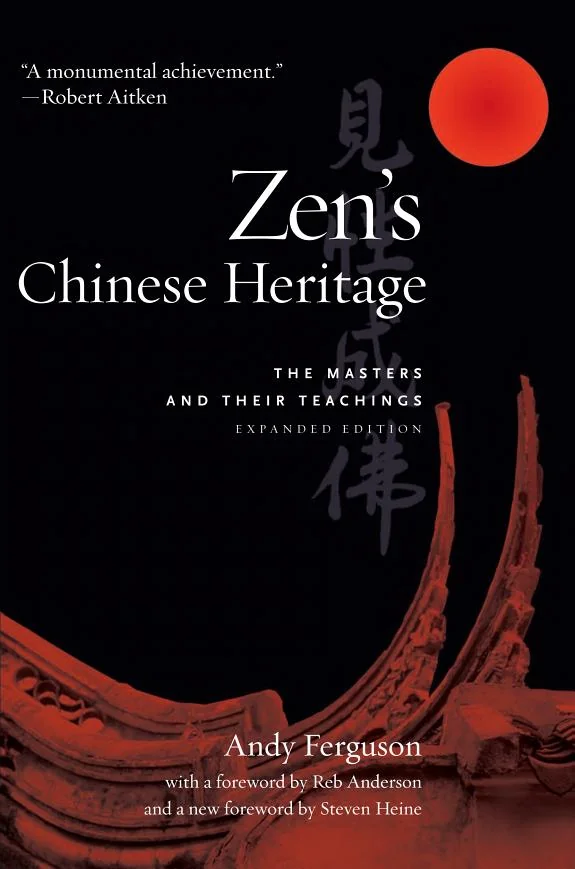
Zen's Chinese Heritage
 74
74

Zen's Chinese Heritage
Andrew Ferguson's "Zen's Chinese Heritage" offers a meticulously researched translation of foundational Chan Buddhist texts, presenting a scholarly approach to a subject often shrouded in mystique. Ferguson's rendition of the early Chinese Buddhist writings is notably clear, making complex philosophical arguments accessible without sacrificing academic rigor. The inclusion of John Daido Loori's endorsement highlights its value as an indispensable reference, a claim well-supported by the depth of scholarship evident throughout the volume. A particular strength lies in its detailed contextualization, situating the Chan school within the broader intellectual currents of Tang Dynasty China. However, the book's academic focus may present a barrier for casual readers or those new to Buddhist philosophy, as it presupposes a certain familiarity with the subject matter. The translation of specific sutras and commentaries, while accurate, demands close attention. Ultimately, "Zen's Chinese Heritage" stands as a vital scholarly contribution for anyone seeking an authoritative understanding of Zen's origins.
📝 Description
74
Andrew Ferguson translated historical Zen Buddhist texts focusing on their Chinese origins in Zen's Chinese Heritage.
This volume offers an English translation of historical Zen Buddhist writings, emphasizing their development within China. It goes beyond basic doctrine to examine the cultural and philosophical environment where Zen took shape in China. The book aims to give scholars and practitioners an accurate rendering of key texts, maintaining their original meaning and historical setting. It is a scholarly work for understanding Zen thought before it spread widely across East Asia.
The translated texts come from a vibrant era in Chinese intellectual history, starting around the Tang Dynasty (618–907 CE). During this time, Buddhism blended with Taoist and Confucian ideas, leading to the formation of distinct Chan schools. The book covers this foundational period of Chan Buddhism, placing it within the larger context of Chinese religious and philosophical thought before its later spread to Japan, Korea, and Vietnam.
Zen's Chinese Heritage situates Chan Buddhism within its formative Chinese context, a period of significant philosophical synthesis. It highlights how Chan developed by integrating Indian Buddhist concepts with native Taoist and Confucian traditions. The book details this process, showing how Chan became a distinct school of thought and practice, moving away from earlier, more purely Indian Buddhist forms. This translation makes accessible the early Chinese texts that shaped Chan's unique meditative and philosophical approach.
💡 Why Read This Book?
• Gain a precise understanding of the foundational texts of Chan Buddhism as they developed in China, offering insights unavailable in generalized overviews of Zen. • Appreciate the specific historical milieu of the Tang Dynasty (618–907 CE), learning how Chinese philosophical traditions influenced early Zen's unique doctrines and practices. • Access an impeccable translation that clarifies complex Buddhist terminology and concepts, providing a scholarly resource for advanced study not easily replicated elsewhere.
⭐ Reader Reviews
Honest opinions from readers who have explored this book.
❓ Frequently Asked Questions
When was "Zen's Chinese Heritage" first published?
The book "Zen's Chinese Heritage" by Andrew Ferguson was first published on February 22, 2011. This edition provides scholars and practitioners with access to historical Chan Buddhist texts.
What is the primary focus of "Zen's Chinese Heritage"?
The primary focus is on the translation and contextualization of early Chan (Zen) Buddhist literature originating from China, detailing its philosophical and historical development.
Is this book suitable for beginners in Buddhism?
While offering valuable insights, the book is geared towards serious students and scholars due to its academic rigor and focus on specific historical texts and philosophical arguments.
What historical period does the book cover?
It primarily covers the formative period of Chan Buddhism in China, largely during the Tang Dynasty (618–907 CE) and subsequent eras, when its distinct characteristics emerged.
Who is John Daido Loori and why is his quote included?
John Daido Loori was a prominent Zen master and Abbot of the Zen Arts Center. His endorsement highlights the book's significance and accuracy as a scholarly reference for understanding Zen's heritage.
What distinguishes this translation from other Zen literature?
Ferguson's translation emphasizes historical accuracy and provides detailed scholarly context, distinguishing it from more generalized or devotional interpretations of Zen teachings.
🔮 Key Themes & Symbolism
Chan Buddhism's Chinese Genesis
This theme examines the crucial period when Buddhism, particularly the Chan school, took root and evolved within the unique cultural and philosophical field of China. It highlights how Chan synthesized with indigenous Taoist and Confucian thought, moving beyond Indian Buddhist origins to develop its distinctive emphasis on direct experience, master-disciple transmission, and a critique of scriptural reliance. The work explores the specific social and intellectual conditions of the Tang Dynasty that fostered this development, presenting Chan not as a purely imported religion but as a distinctly Chinese adaptation.
Textual Foundations of the Chan Lineage
The core of this theme lies in the meticulous translation and analysis of key early Chan texts. It explores the writings that established the lineage, codified practices, and articulated the philosophical underpinnings of the school. This includes examining the nature of the sutras and commentaries that were key in shaping early Chan understanding of enlightenment, emptiness, and the path to awakening. The focus is on presenting these texts with scholarly fidelity, allowing readers to engage directly with the primary sources that formed the bedrock of Zen tradition.
The Master-Disciple Transmission
Central to the development and dissemination of Chan Buddhism was the concept of direct, personal transmission from master to disciple. This theme explores how this relationship was crucial for conveying the essence of the teachings, often bypassing elaborate doctrines or scriptures. The book examines the roles of prominent early Chan masters and the methods they employed to guide their students towards awakening, illustrating the practical and experiential dimension of Chan practice as it was historically cultivated in China.
Critique of Scholasticism and Attachment
A recurring motif in early Chan literature is the critique of excessive intellectualism and attachment to concepts or rituals. This theme investigates how Chan masters challenged conventional Buddhist scholasticism, advocating instead for direct insight and intuitive understanding. The texts reveal a movement that sought to strip away layers of dogma and intellectualization, encouraging practitioners to realize the truth directly through mindful awareness and engagement with the present moment, rather than through abstract study alone.
💬 Memorable Quotes
Direct passages from the work, attributed to the author.
“An indispensable reference. Ferguson has given us an impeccable and very readable translation.”
— This commendation by John Daido Loori emphasizes the book's dual strength: its scholarly accuracy and its accessibility for those engaging with complex historical Buddhist texts.
“The work explores the synthesis of Buddhism with Taoist and Confucian philosophies.”
— This highlights how early Chan Buddhism was not merely an import but an integration, adapting core Buddhist principles to the existing intellectual and spiritual field of China.
“Focus on the direct experience and master-disciple transmission.”
— This points to a central tenet of Chan, emphasizing experiential realization and the guidance of a qualified teacher over purely textual or doctrinal understanding.
“Critique of scholasticism and reliance on scripture.”
— This reflects Chan's historical emphasis on intuitive insight and immediate realization, often contrasting with more traditional, text-based approaches to spiritual understanding.
“The book details the historical development of Zen in China.”
— This indicates the work's primary objective: to trace the origins and formative stages of the Zen (Chan) tradition within its original Chinese cultural context.
🌙 Esoteric Significance
Tradition
This work falls within the broad lineage of Mahayana Buddhism, specifically the Chan (Zen) school, which emphasizes direct insight into the nature of reality. While not typically categorized alongside Western esoteric traditions like Hermeticism or Kabbalah, Chan Buddhism shares a profound interest in consciousness, awakening, and the realization of ultimate truth through non-dualistic perception. It departs from purely philosophical or devotional Buddhist paths by prioritizing experiential realization and a lineage of transmission that often bypasses extensive scriptural study, aligning it with esoteric approaches that value inner gnosis.
Symbolism
Key symbols in Chan Buddhism include the empty circle (ensō), representing enlightenment, emptiness, and the universe; the simple, unadorned robe, symbolizing monastic simplicity and detachment from material possessions; and the notion of the 'mind-ground,' representing the innate Buddha-nature or pure consciousness within all beings. These symbols, while not always overtly discussed in scholarly translations, underpin the practice and philosophy by pointing towards direct perception, the absence of conceptual clutter, and the inherent purity of awareness.
Modern Relevance
Contemporary mindfulness movements, secularized meditation practices, and various schools of Western Buddhism frequently draw upon the principles and historical narratives originating from Chan Buddhism. Thinkers and practitioners exploring non-dual awareness, the critique of egoic structures, and the application of contemplative practices in daily life often find resonance with the historical Chan emphasis on direct experience and mind training. The work's scholarly approach helps ground these modern applications in their authentic historical and philosophical roots.
👥 Who Should Read This Book
• Students of comparative religion and East Asian studies seeking to understand Buddhism's historical evolution in China. • Dedicated practitioners of Zen or mindfulness meditation who wish to explore the deep historical roots and textual foundations of their practice. • Academic researchers requiring precise translations and contextualization of early Chan Buddhist literature for scholarly inquiry.
📜 Historical Context
Published in 2011, "Zen's Chinese Heritage" addresses a period of immense religious and philosophical ferment in China, particularly during the Tang Dynasty (618–907 CE). This era witnessed the flourishing of Buddhism, which underwent significant sinicization, blending with native Taoist and Confucian traditions. The Chan school, the precursor to Zen, emerged during this dynamic environment, developing its distinctive focus on meditation, direct experience, and the master-disciple relationship. Andrew Ferguson's work situates these developments against a backdrop where Buddhism competed with and influenced other schools of thought, notably Taoism, which shared certain metaphysical concerns. The reception of such scholarly works on Chan's origins is generally positive within academic circles, though detailed historical analysis can sometimes be overshadowed by more popular presentations of Zen. Key figures like Bodhidharma and Huineng are central to the narrative of Chan's early transmission and consolidation.
📔 Journal Prompts
The Tang Dynasty context for Chan Buddhism: How did indigenous Chinese philosophies shape early Zen?
Early Chan master-disciple dynamics: Reflect on the importance of direct transmission.
The critique of scholasticism: How does the emphasis on direct experience challenge conventional learning?
Understanding the 'mind-ground': Explore the concept of innate Buddha-nature.
The synthesis of traditions: Analyze how Buddhism integrated with Taoism and Confucianism.
🗂️ Glossary
Chan Buddhism
The Chinese school of Mahayana Buddhism that emphasizes meditation and direct experience of enlightenment, known as Zen in Japan and Korea. It originated in China during the Tang Dynasty.
Tang Dynasty
A major imperial dynasty of China that ruled from 618 to 907 CE. It was a period of significant cultural, economic, and religious development, including the flourishing of Chan Buddhism.
Enlightenment (Satori/Kensho)
The ultimate goal in Buddhist practice; a state of profound spiritual understanding and awakening to the true nature of reality. In Chan, it is often described as a sudden realization.
Mindfulness
A state of active, open attention on the present. In Chan, it relates to mindful awareness cultivated through meditation and integrated into daily activities.
Master-Disciple Transmission
A core principle in Chan Buddhism where teachings and the 'essence' of enlightenment are passed directly from a qualified master to a student, often through personal interaction rather than solely through texts.
Taoism
An indigenous Chinese philosophy and religion that emphasizes living in harmony with the Tao (the Way), the natural order of the universe. It influenced the development of Chan Buddhism.
Scholasticism
An approach to learning and philosophy that emphasizes rigorous logical analysis of concepts and doctrines, often based on established texts. Chan Buddhism historically critiqued excessive reliance on this method.
This book appears in 1 collection
🔮 Readers Also Liked
Browse all →







From the “Zen Buddhism” Collection
View all →








More Free Esoteric History & Biography Books
View all →