Phantasms of the Living
 73
73

Phantasms of the Living
The sheer volume of case studies presented in Phantasms of the Living is its most striking feature. Gurney, Myers, and Podmore catalogued hundreds of reported apparitions and telepathic incidents with a seriousness that belied the often-fantastical nature of the claims. Their attempt to apply rigorous, albeit nascent, scientific methodology to subjective experience is commendable, particularly their statistical analyses of coincidental occurrences. However, the reliance on anecdotal evidence, often gathered years after the event, presents a significant limitation. The psychological and social biases inherent in such reporting are not always adequately addressed. A particularly compelling section details cases of 'telepathic dreams' where a thought or event at one location seemingly manifests in the dream of another person miles away, illustrating the authors' earnest pursuit of a connection between mind and distant events. The work remains a crucial, if flawed, monument to early psychical research.
📝 Description
73
Published in 1886, Phantasms of the Living documented hundreds of alleged telepathic and apparition experiences.
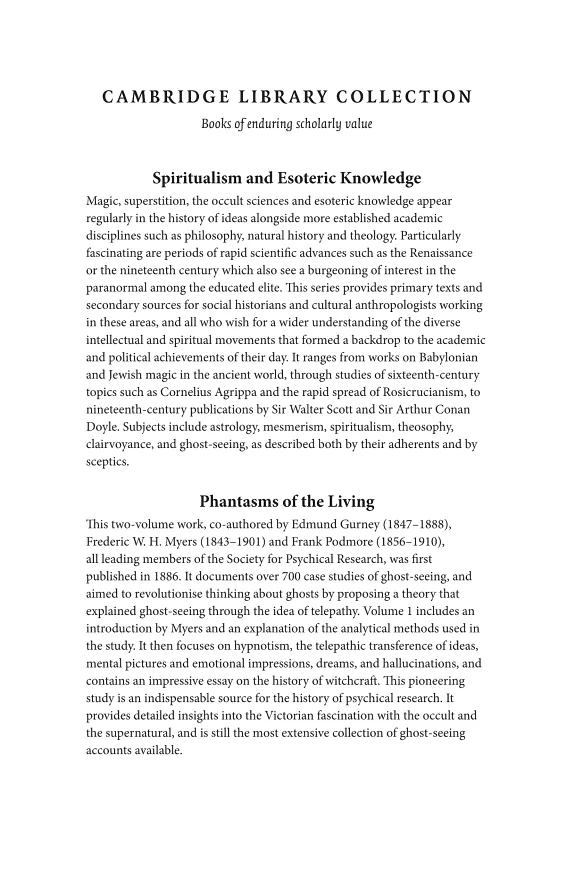
Edmund Gurney, Frederic William Henry Myers, and Frank Podmore compiled this extensive study in 1886, presenting a large collection of anecdotal evidence related to apparitions and telepathic phenomena. The work emerged during a period of significant public and academic interest in subjects that lay beyond conventional scientific understanding. The authors aimed to apply systematic methods to the investigation of these reports, attempting to distinguish between various types of claimed psychic occurrences.
Their research sought to gather empirical data on phenomena like ghost sightings and telepathy. This approach set it apart from more philosophical or purely spiritualist writings of the time. The book categorizes different reported apparitions, distinguishing between spontaneous visions, death-bed visitations, and shared experiences among multiple witnesses. The authors also considered the difficulties in verifying subjective accounts and introduced methods for statistical analysis of the collected data.
Phantasms of the Living was a product of the late 19th century's fascination with spiritualism and psychical research. This era saw a deliberate effort to apply scientific rigor to phenomena previously relegated to folklore or religious belief. Co-founded by Myers, the Society for Psychical Research sought to investigate claims of the supernatural through empirical methods. This book represents a significant attempt within that movement to collect and analyze firsthand accounts of apparitions and telepathy, distinguishing itself from earlier, less systematic explorations of these topics.
💡 Why Read This Book?
• Gain an understanding of the empirical methodologies employed by the Society for Psychical Research in the late 19th century, particularly concerning the statistical analysis of anecdotal evidence as presented in their extensive case collection. • Explore the historical development of the concept of telepathy, as detailed in specific chapters examining coincidental thought-transference and phantom sightings reported by individuals like Mrs. Sidgwick. • Appreciate the intellectual climate of Victorian England and the scholarly debate surrounding consciousness and the supernatural, evidenced by the authors' engagement with established scientific thought of their era.
⭐ Reader Reviews
Honest opinions from readers who have explored this book.
❓ Frequently Asked Questions
When was Phantasms of the Living first published?
Phantasms of the Living was first published in 1886 by Edmund Gurney, Frederic William Henry Myers, and Frank Podmore, marking a significant early contribution to psychical research.
What is the primary focus of Phantasms of the Living?
The book's primary focus is the collection and analysis of anecdotal evidence related to ghost sightings and telepathic experiences, investigating potential connections between them.
Who were the main authors of Phantasms of the Living?
The main authors were Edmund Gurney, Frederic William Henry Myers, and Frank Podmore, all prominent figures in early psychical research and members of the Society for Psychical Research.
What historical movement is Phantasms of the Living associated with?
It is strongly associated with the Victorian psychical research movement and the efforts of the Society for Psychical Research to study anomalous phenomena scientifically.
Does the book offer scientific proof of ghosts or telepathy?
The book presents extensive case studies and attempts statistical analysis to argue for the possibility of telepathy and hauntings, but it does not offer definitive scientific proof in the modern sense.
What kind of evidence does Phantasms of the Living present?
It primarily presents anecdotal evidence in the form of first-hand accounts of apparitions, death-bed visions, and telepathic communications gathered from individuals.
🔮 Key Themes & Symbolism
Apparitions and Hallucinations
The work meticulously categorizes various forms of reported apparitions, distinguishing between those seen by a single individual and those witnessed by multiple people. It explores theories about their origin, including potential telepathic projection from a dying person or agent, or spontaneous psychological phenomena. The authors attempted to correlate the timing and circumstances of these sightings with external events, seeking patterns that suggested a connection beyond mere coincidence or imagination.
Telepathy and Thought Transference
A central theme is the investigation of telepathy, defined as the direct transmission of thought or feeling from one mind to another without the use of known sensory channels. The book presents numerous cases where individuals reported experiencing the thoughts or sensations of others, often at a distance. The authors developed methodologies to test these claims, including controlled experiments and statistical evaluations of spontaneous occurrences, aiming to establish telepathy as a verifiable phenomenon.
Methodology of Psychical Research
The authors grappled with the challenges of studying subjective experiences using empirical methods. They detail their efforts to collect, verify, and analyze vast quantities of anecdotal data, often facing skepticism from the scientific establishment. Their approach involved cross-referencing testimonies, investigating the reliability of witnesses, and applying statistical reasoning to differentiate potential psychic phenomena from chance occurrences, laying groundwork for future parapsychological studies.
The Nature of Consciousness
Implicitly, the research probes the boundaries of consciousness and its potential to interact with the external world and other minds in ways not explained by physical science. The phenomena documented suggest that consciousness might not be solely confined to the brain or limited by physical proximity, raising profound questions about mind-body dualism and the interconnectedness of human experience during the Victorian era.
💬 Memorable Quotes
Direct passages from the work, attributed to the author.
“The evidence for telepathy is largely statistical.”
— This highlights the authors' approach: rather than relying on single dramatic accounts, they sought to build a case for telepathy by analyzing the frequency and patterns of reported coincidences across many cases.
“Apparitions are often seen at the moment of death.”
— This observation points to a recurring theme in their case collection – the correlation between the appearance of phantasms and the death of the person depicted, suggesting a possible link between mortality and psychic manifestation.
“We are presented with a problem which is essentially one of evidence.”
— This statement underscores the authors' self-awareness regarding the evidentiary challenges inherent in psychical research, acknowledging the difficulty of substantiating subjective experiences.
“The coincidence of dreams with external events.”
— This refers to a specific category of cases explored, where dreams reported by individuals appeared to mirror actual events occurring elsewhere, serving as a key piece of evidence for telepathic influence.
“The collective hallucination is a rarer but significant phenomenon.”
— This suggests the authors considered instances where multiple people simultaneously perceived the same apparition, differentiating it from individual psychological experiences and exploring its potential for shared psychic reality.
🌙 Esoteric Significance
Tradition
While not explicitly tied to a single esoteric lineage like Hermeticism or Kabbalah, Phantasms of the Living significantly contributed to the broader Western Esoteric Tradition by providing empirical, albeit controversial, documentation for phenomena often relegated to folklore or occult lore. It helped bridge the gap between subjective, mystical experience and objective, scientific inquiry, influencing later movements like Theosophy and early parapsychology which explored consciousness beyond the materialist paradigm.
Symbolism
The 'phantasm' itself serves as a potent symbol of the liminal space between the physical and the non-physical, the known and the unknown. Apparitions, particularly those linked to death, symbolize the enduring connection of the living to the departed, suggesting a form of consciousness that transcends corporeal existence. Telepathic experiences, often described as fleeting impressions or shared emotions, symbolize the potential for a subtle, interconnected psychic field underlying human interaction.
Modern Relevance
Contemporary researchers in parapsychology and consciousness studies continue to draw upon the extensive case archives and methodological debates initiated by Phantasms of the Living. Thinkers exploring concepts like collective consciousness, the extended mind hypothesis, and the nature of subjective experience in altered states find resonance in the book's detailed case studies. It remains a touchstone for discussions on the limits of materialism and the potential for non-local consciousness.
👥 Who Should Read This Book
• Researchers of Victorian-era science and culture seeking primary source material on the period's engagement with the paranormal and the development of empirical psychical investigation. • Students of psychology and parapsychology interested in the historical roots of theories concerning telepathy, consciousness, and anomalous perception. • Historians of religion and philosophy looking to understand the intellectual currents that challenged traditional views of mind and reality in the late 19th century.
📜 Historical Context
Phantasms of the Living emerged from the intellectual ferment of late Victorian England, a period marked by both scientific triumphalism and a deep-seated fascination with the unseen. The late 19th century saw rapid advancements in physics and biology, prompting some to question traditional religious frameworks and seek explanations for phenomena that lay beyond conventional scientific understanding. The Society for Psychical Research (SPR), founded in 1882, aimed to apply rigorous, empirical methods to the study of such alleged psychic occurrences. Co-founder Frederic William Henry Myers, along with Edmund Gurney and Frank Podmore, meticulously gathered thousands of case reports. This work was published in 1886, a time when spiritualism was widely popular, though often viewed with skepticism by the scientific establishment. The SPR sought to differentiate their scientific approach from mere spiritualist sensationalism. Their work engaged with contemporaries like William James, who was sympathetic to their empirical aims, and contrasted with the more philosophical or theological discussions of the era, positioning itself as a data-driven investigation into the nature of consciousness and perception.
📔 Journal Prompts
The statistical analysis of coincidental apparitions: how might modern computational methods re-evaluate the data presented by Gurney, Myers, and Podmore?
The concept of telepathic dreams: reflect on the subjective experience of a dream that felt uncannily connected to external events.
The challenge of verifying anecdotal evidence: consider the inherent biases in recounting personal experiences of the uncanny.
The authors' categorization of phantasms: analyze the distinctions made between spontaneous visions and those potentially linked to an agent.
The role of the Society for Psychical Research: how did its founding influence the academic study of the supernatural in the 1880s?
🗂️ Glossary
Apparition
A ghost-like image of a person, seen as if present. The book categorizes various types, including death-bed visions and spontaneous hauntings.
Telepathy
The supposed communication of thoughts or ideas by means other than the known senses; mental telepathy. A central focus of the book's investigation.
Percipient
An individual who perceives or experiences something, particularly in the context of psychic phenomena like apparitions or telepathic impressions.
Agent
In telepathic contexts, the person who is the source or originator of the thought or feeling being transmitted to the percipient.
Spontaneous Phenomena
Events alleged to occur naturally and without deliberate experimental arrangement, such as unexpected apparitions or coincidental thought-transference.
Phantasm
A ghost or ghost-like image of someone. Used interchangeably with apparition in the text.
Psychical Research
The study of psychic phenomena, including telepathy, clairvoyance, mediumship, and apparitions, often employing empirical methods.
This book appears in 1 collection
🔮 Readers Also Liked
Browse all →








From the “Telepathy” Collection
View all →



More Free Esoteric History & Biography Books
View all →