Drumming for the Gods
 77
77

Drumming for the Gods
María Teresa Vélez’s "Drumming for the Gods" presents a compelling narrative of Felipe Garcia Villamil, an artist whose life embodies the struggle and survival of Afro-Cuban sacred drumming. The work excels in its detailed examination of how political and personal turbulence impacted Villamil’s practice, offering a micro-history that illuminates broader socio-cultural dynamics. A particular strength lies in the book's focus on the practical transmission of rhythm and ritual, moving beyond abstract theoretical discussions. However, the narrative occasionally feels constrained by its adherence to a historical account, at times lacking the visceral immediacy one might expect from a subject centered on drumming. The exploration of Villamil’s adaptation of Santería practices in the face of economic hardship around the late 20th century is particularly striking. Vélez offers a valuable, if sometimes understated, portrait of cultural endurance.
This is a significant contribution to the study of Afro-Caribbean spiritual arts.
📝 Description
77
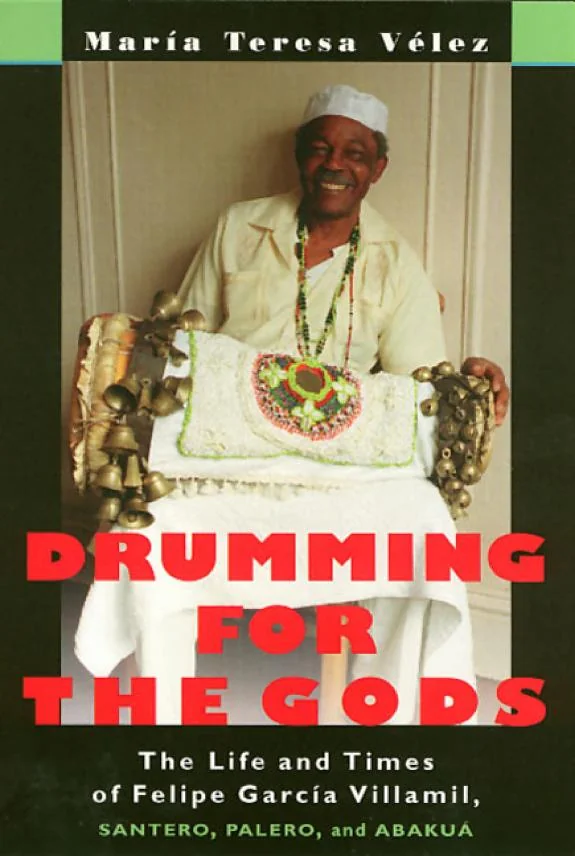
María Teresa Vélez's 2000 book chronicles the life of Afro-Cuban sacred drummer Felipe Garcia Villamil.
Drumming for the Gods details the life and artistic path of Felipe Garcia Villamil, an Afro-Cuban artist and practitioner of sacred drumming. The book records how his music and spiritual life faced significant political and personal difficulties. It is a historical account of a person whose life became central to understanding how societal forces and individual action interact.
This work will interest scholars of ethnomusicology, students of Afro-Caribbean religions, and readers concerned with the endurance of cultural traditions under pressure. It is especially useful for those wanting to grasp how art and spiritual practice can continue through times of social and political trouble. People curious about the historical growth of sacred drumming in Cuba will find it informative.
Published in 2000, this book emerges during a time of increased global attention to indigenous and marginalized spiritual practices. It connects with the late 20th-century academic and public fascination with African diasporic religions. The book provides a different perspective from dominant Western histories by centering individual experience and cultural transmission, specifically within the context of Afro-Cuban Santería.
💡 Why Read This Book?
• Gain a concrete understanding of how Afro-Cuban sacred drumming traditions, specifically those associated with Felipe Garcia Villamil, actively resist and adapt to political suppression and personal hardship, as detailed in the book's account of his life. • Learn about the intricate relationship between social forces and individual spiritual practice by examining the specific historical context of Cuba in the late 20th century and its impact on Villamil's work. • Discover the symbolic and functional role of rhythm in spiritual communication and cultural preservation within Afro-Caribbean religious frameworks, as illustrated through the life and art of Villamil.
⭐ Reader Reviews
Honest opinions from readers who have explored this book.
❓ Frequently Asked Questions
What is the primary focus of "Drumming for the Gods"?
The book centers on the life of Felipe Garcia Villamil, an Afro-Cuban artist and practitioner of sacred drumming, detailing how his music and spiritual practices navigated political and personal adversities.
Who was Felipe Garcia Villamil?
Felipe Garcia Villamil was an Afro-Cuban artist renowned for his practice of sacred drumming, whose life story serves as a case study for cultural resilience.
What historical period does the book primarily cover?
The book examines periods of political and personal upheaval in Cuba, particularly focusing on the experiences of Felipe Garcia Villamil throughout the late 20th century.
What is the significance of sacred drumming in Afro-Cuban culture as presented in the book?
Sacred drumming is presented as a vital medium for spiritual communication, cultural transmission, and community cohesion within Afro-Cuban traditions, capable of enduring significant challenges.
Does the book discuss Santería?
Yes, the book explores Villamil's practice within the context of Afro-Cuban religious expressions, which often includes elements of Santería and its syncretic nature.
What academic fields would find "Drumming for the Gods" most relevant?
Ethnomusicology, religious studies, African diaspora studies, and cultural anthropology would find this work particularly relevant due to its focus on artistic practice and spiritual traditions.
🔮 Key Themes & Symbolism
Cultural Resilience Through Rhythm
The core of "Drumming for the Gods" lies in its examination of how sacred drumming, embodied by Felipe Garcia Villamil, functions as a powerful vehicle for cultural endurance. The work illustrates how rhythmic traditions, deeply intertwined with spiritual practice and identity, can persist and even adapt through periods of severe political and economic strain in Cuba. It highlights drumming not merely as music, but as a living conduit of ancestral knowledge and communal spirit, capable of maintaining integrity against external pressures.
Art as Spiritual and Political Resistance
This book positions the artistic practice of sacred drumming as a form of both spiritual devotion and subtle political resistance. Through Villamil’s experiences, it demonstrates how adherence to tradition and the continuation of sacred arts can serve as acts of defiance against forces seeking to homogenize or suppress cultural expression. The narrative explores the intricate ways individuals maintain their spiritual and cultural autonomy when faced with systemic challenges, using drumming as a primary means of assertion.
Syncretism in Afro-Caribbean Spirituality
"Drumming for the Gods" offers insights into the syncretic nature of Afro-Caribbean religious traditions, exemplified by Villamil's practice. The work touches upon how African spiritual concepts and deities were historically blended with Catholic saints and practices in Cuba, creating a unique hybrid religious landscape. This syncretism is shown not as a dilution, but as a dynamic adaptation that allowed spiritual traditions to survive and flourish under varying historical circumstances, with drumming playing a central role.
The Individual within Societal Forces
The biography of Felipe Garcia Villamil serves as a lens through which María Teresa Vélez examines the complex interaction between individual agency and broader socio-political and economic currents. The book details how external forces shape, but do not necessarily break, the individual's commitment to their spiritual and artistic path. It provides a nuanced look at how personal choices and dedication can maintain cultural threads even when societal structures are in flux.
💬 Memorable Quotes
Direct passages from the work, attributed to the author.
“The rhythm is the voice of the ancestors, speaking to us in the present.”
— This interpretation of a core concept suggests that drumming is not just an artistic performance but a direct channel for ancestral wisdom and spiritual guidance, emphasizing its sacred and communicative function.
“When the drums speak, the spirit listens and the community gathers.”
— This highlights the communal and spiritual power of drumming, suggesting its capacity to unite people and facilitate a shared experience of the sacred.
“Even in silence, the echo of the beat persists.”
— This idea suggests that the influence and memory of sacred drumming transcend its physical performance, indicating its deep integration into the cultural and spiritual fabric of the practitioners.
“The hand that strikes the drum connects the earth to the divine.”
— This interpretation points to the drum as a sacred instrument that bridges the terrestrial and the spiritual realms, underscoring the profound connection facilitated by its playing.
💡 Key Ideas
Editorial paraphrase of the work's core concepts — not direct quotes.
To drum is to remember, to affirm, and to endure.
This paraphrased sentiment highlights the complex role of drumming in maintaining cultural memory, asserting identity, and fostering resilience, particularly within challenging historical contexts.
🌙 Esoteric Significance
Tradition
This work is deeply rooted in the Afro-Caribbean esoteric tradition, specifically the practices and philosophies associated with Santería and related Yoruba-derived spiritual systems. It fits within this lineage by illustrating the practical application of drumming as a sacred art form integral to ritual, divination, and spiritual communion. The book departs from purely academic ethnographies by emphasizing the lived spiritual experience and the survival of these practices against historical odds, aligning with a more devotional or practitioner-focused perspective.
Symbolism
The drum itself is a primary symbol, representing the voice of the Orishas (deities), the heartbeat of the community, and a conduit between the earthly and spiritual realms. The rhythm patterns function symbolically, each carrying specific meanings, invoking particular deities, or guiding spiritual states. The concept of 'tambor secreto' (secret drum) or specific ritual drums can symbolize hidden knowledge or a more profound, internalized spiritual connection that persists even when outward practice is constrained.
Modern Relevance
Contemporary practitioners of Santería, Lucumí, and other Afro-Caribbean spiritual paths find resonance in "Drumming for the Gods" as it validates and historicizes their traditions. Thinkers and artists exploring the intersection of sound, spirituality, and identity in the African diaspora draw on its insights. Furthermore, in an era increasingly focused on decolonizing knowledge and appreciating diverse spiritual systems, the book serves as an important resource for understanding how sacred arts can be preserved and transmitted, influencing contemporary ethnomusicology and comparative religion studies.
👥 Who Should Read This Book
• Students of African Diaspora Religions: Individuals seeking to understand the practical application and historical endurance of traditions like Santería, particularly concerning the role of music. • Ethnomusicologists and Cultural Historians: Researchers interested in the survival of musical and spiritual practices under socio-political pressure, with a focus on the Afro-Cuban context. • Practitioners of Sacred Drumming: Musicians and spiritual seekers who wish to explore the deeper cultural, historical, and spiritual significance of drumming beyond performance.
📜 Historical Context
Published in 2000, "Drumming for the Gods" arrived during a period of significant academic and public interest in African diasporic religions and the resilience of cultural practices. The late 20th century saw a burgeoning critique of Western-centric historical narratives, paving the way for studies that centered marginalized voices and traditions. María Teresa Vélez's work engages with the long history of Afro-Cuban Santería, a tradition that faced periods of suppression and adaptation throughout the 20th century, particularly following the Cuban Revolution in 1959. While not directly engaging in polemics with any specific school of thought, the book implicitly challenges simplistic interpretations of cultural assimilation by demonstrating the enduring strength of indigenous practices. Its focus on individual artists like Felipe Garcia Villamil aligns with a broader trend in ethnomusicology and anthropology to understand cultural phenomena through lived experience, offering a counterpoint to purely structural analyses.
📔 Journal Prompts
Felipe Garcia Villamil's survival of political and personal upheaval through drumming.
The symbolic meaning of specific rhythm patterns in Afro-Caribbean spirituality.
How syncretism in Santería enabled the preservation of sacred drumming.
Reflecting on the 'echo of the beat'—the enduring influence of spiritual practice.
The connection between ancestral voices and contemporary sacred drumming.
🗂️ Glossary
Afro-Cuban
Pertaining to people, cultures, or traditions originating from or influenced by both African and Cuban heritage, particularly evident in music, religion, and art.
Sacred Drumming
The practice of playing drums within a religious or spiritual context, used for ritual, communication with deities, and facilitating spiritual states, as opposed to secular performance.
Santería
An Afro-Caribbean religion with Yoruba roots, characterized by the worship of Orishas (deities) and often syncretized with Catholic saints. Drumming is central to its rituals.
Orishas
Deities or spiritual forces originating from the Yoruba religion, which are central figures in Santería and other related Afro-Caribbean spiritual traditions.
Syncretism
The merging or blending of different religious or cultural beliefs and practices, such as the incorporation of Catholic saints into Yoruba-based spiritual systems in Cuba.
Ethnomusicology
The scholarly study of music in its cultural and social contexts, often examining the relationship between music and its practitioners or communities.
Cultural Transmission
The process by which cultural elements, such as knowledge, beliefs, customs, and skills, are passed down from one generation to the next.
This book appears in 1 collection
🔮 Readers Also Liked
Browse all →







From the “Santeria” Collection
View all →









More Free Esoteric History & Biography Books
View all →