The Rhetoric of Immediacy
 74
74

The Rhetoric of Immediacy
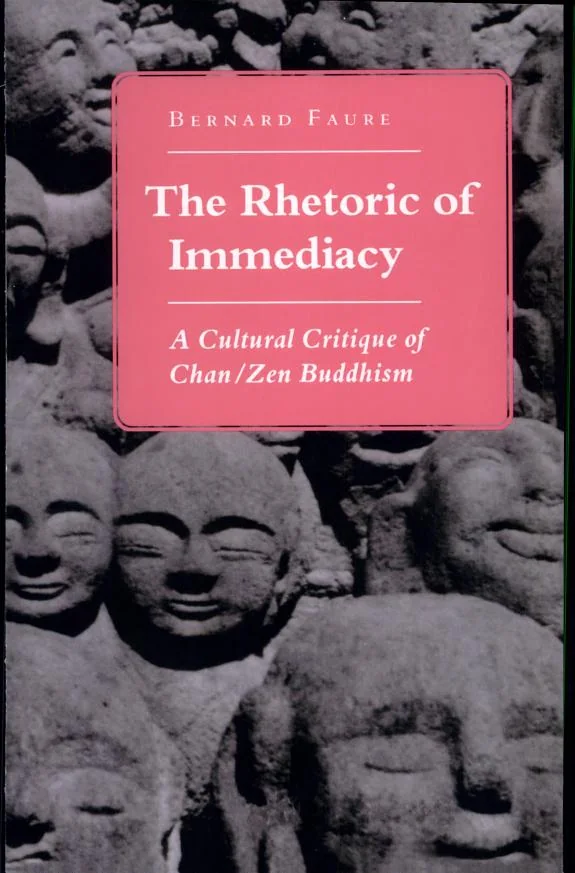
Bernard Faure’s The Rhetoric of Immediacy offers a sharp, incisive critique of the conceptual apparatus surrounding Chan Buddhism. Instead of simply accepting the rhetoric of direct experience at face value, Faure meticulously unpacks the paradoxes inherent in Chan’s purported rejection of all forms of mediation. His examination of how Chan, despite its anti-scriptural stance, nonetheless relies on textual and symbolic frameworks is particularly compelling. A notable strength lies in his analysis of the "immediacy" concept itself, revealing its constructed nature. However, the dense academic prose can sometimes obscure the very immediacy it seeks to analyze, making it a demanding read for those without prior background. Faure’s deconstruction of the anti-meditative stance, while brilliant, might leave practitioners seeking direct guidance feeling underserved. Ultimately, it’s a vital work for understanding the intellectual currents behind Chan discourse, rather than a guide to its practice.
📝 Description
74
Bernard Faure's 1991 book scrutinizes the paradoxical language of Chan Buddhism's emphasis on direct experience.
The Rhetoric of Immediacy examines the paradoxical nature of Chan Buddhism and its focus on direct, unmediated experience. Bernard Faure, in this 1991 study, analyzes the language and concepts used to describe this "immediacy." He reveals how the tradition both rejects and relies upon established frameworks like scripture, ritual, and ethical conduct. This work offers an academic look into the philosophical foundations of a spiritual path.
This text is intended for academics, students of Buddhism, and scholars of comparative religion who appreciate detailed textual analysis. Readers should already have a grasp of Buddhist philosophy and its terminology. It is not a beginner's guide to meditation or Zen practice, but a critical examination of the discourse surrounding these practices.
Published in 1991, The Rhetoric of Immediacy appeared as Western academic interest in Eastern religions, particularly Zen and Chan Buddhism, grew. Faure's study engaged with ongoing scholarly discussions regarding the historical development and philosophical consistency of these traditions. It challenged earlier interpretations that often simplified their teachings, contributing to a more critical understanding of Chan's intellectual history.
This book situates itself within the academic study of Chan Buddhism, a tradition often associated with esoteric practices aimed at direct spiritual insight. Faure addresses the inherent difficulties in articulating an experience that is meant to transcend language and conceptualization. He analyzes how Chan masters used paradox and negation within their teachings, highlighting the very mediations they sought to overcome. The work engages with the intellectual history of Chan, moving beyond simplified accounts to a more complex understanding of its philosophical underpinnings.
💡 Why Read This Book?
• Understand the paradoxical nature of "immediacy" in Chan Buddhism, as explored through Faure's analysis of its rhetorical strategies, a concept central to the book's argument. • Gain insight into the historical context of Chan scholarship in the late 20th century, specifically Faure's engagement with scholarly debates surrounding the tradition's intellectual development. • Appreciate how Chan, despite its emphasis on direct experience, paradoxically employs established religious frameworks, a key theme illuminated by the book's examination of scripture and ritual.
⭐ Reader Reviews
Honest opinions from readers who have explored this book.
❓ Frequently Asked Questions
What is the central paradox explored in Bernard Faure's The Rhetoric of Immediacy?
The central paradox is Chan Buddhism's insistence on "immediacy" and direct experience, while simultaneously relying on conventional means like scripture, ritual, and ethical teachings to convey these ideas.
When was The Rhetoric of Immediacy first published?
The book was first published in 1991, positioning it within a wave of critical academic studies on Eastern religions.
Does this book offer practical meditation techniques?
No, The Rhetoric of Immediacy is an academic analysis of the philosophical and rhetorical underpinnings of Chan Buddhism, not a practical guide to meditation.
What traditions does The Rhetoric of Immediacy primarily focus on?
The book primarily focuses on the Chinese traditions of Chan Buddhism and its Japanese counterpart, Zen.
Who is the author of The Rhetoric of Immediacy?
The author is Bernard Faure, a scholar known for his critical work on Buddhism.
What does Faure mean by "elusive aspects" of Chan and Zen?
Faure refers to the subtle, often paradoxical, philosophical and rhetorical strategies used to describe enlightenment and direct experience, which are difficult to grasp through conventional analytical methods.
🔮 Key Themes & Symbolism
The Paradox of Immediacy
Faure meticulously examines Chan Buddhism's core concept of "immediacy" – the idea of direct, unmediated experience of enlightenment. He reveals the inherent contradiction: this pursuit of the immediate is often articulated through complex philosophical arguments, scriptures, and rhetorical devices that are, by definition, mediations. The work deconstructs how Chan masters navigated this tension, using negation and paradox to point towards an experience that transcends conceptualization.
Rhetoric and Chan Discourse
The book highlights the crucial role of rhetoric and language in shaping the understanding of Chan. Faure analyzes the specific metaphors, koans, and linguistic strategies employed by Chan practitioners and scholars. This focus underscores that even a tradition aiming for experience beyond words relies heavily on carefully constructed discourse to guide adherents and define its teachings.
Mediation in Anti-Meditative Traditions
A key theme is the examination of how traditions that claim to reject traditional forms of meditation (including scriptures and good works) still incorporate forms of mediation. Faure shows that Chan's denial of these elements is itself a rhetorical stance, and that the path to enlightenment, as described in Chan, is never truly without a mediating framework, whether conceptual or practical.
Critique of Western Interpretations
While not explicitly stated as a primary theme, Faure's work implicitly critiques earlier, often romanticized, Western interpretations of Zen and Chan. By focusing on the intricate textual and philosophical dimensions, he moves beyond superficial understandings to offer a more rigorous, academic engagement with the tradition's complexities.
💬 Memorable Quotes
Direct passages from the work, attributed to the author.
“Chan's insistence on 'immediacy'--its denial of all traditional meditations, including scripture, ritual, good works--and yet shows how these mediations have always been present in Chan.”
— This core idea captures the book's central argument: that the very tradition emphasizing directness and the rejection of conventional paths paradoxically relies on those same paths to articulate its message.
“The tension between direct experience and the need for conceptual frameworks.”
— This highlights a fundamental philosophical problem Faure addresses: how to communicate an experience that supposedly lies beyond language and thought, using the very tools of language and thought.
“The paradoxical nature of Chan's relationship with scripture and ritual.”
— This interpretation focuses on Faure's critical examination of how Chan, while often presented as anti-establishment or anti-traditional, nonetheless engages with and reinterprets established religious structures.
“Faure's analysis of the "elusive aspects" of Chinese and Japanese Buddhist traditions.”
— This suggests the book studies the more subtle, perhaps counter-intuitive, philosophical and symbolic dimensions of Chan and Zen that are not immediately apparent to casual observers.
💡 Key Ideas
Editorial paraphrase of the work's core concepts — not direct quotes.
The exploration of key concepts and metaphors used to describe enlightenment.
This paraphrased concept points to Faure's method of dissecting the language and imagery employed by Chan to communicate the ineffable, revealing the rhetorical strategies at play.
🌙 Esoteric Significance
Tradition
While Chan and Zen Buddhism are not typically categorized within Western esoteric traditions like Hermeticism or Kabbalah, Faure's work engages with the *phenomenon* of seeking direct, transformative experience, a common thread in many esoteric lineages. His analysis of paradox, negation, and the inadequacy of language mirrors concerns found in mystical branches of various religions. The work fits within the broader academic study of mysticism and contemplative practices, which often intersect with esoteric thought.
Symbolism
The book dissects the rhetoric surrounding key concepts, rather than focusing on specific, fixed symbols. However, the "emptiness" (śūnyatā) inherent in Mahayana thought, and the paradoxical nature of "Buddha-nature," function as conceptual symbols. Faure examines how the language used to describe these – often through negation or seemingly contradictory statements – serves to point towards an understanding that transcends ordinary conceptualization.
Modern Relevance
Faure's critical approach to religious discourse remains relevant for contemporary scholars of religion, comparative philosophy, and cultural studies. His deconstruction of "immediacy" can inform discussions on authenticity in spiritual practices and the role of media and technology in shaping spiritual experiences. Thinkers interested in post-structuralist approaches to religion and critiques of essentialism in spiritual movements find his work particularly valuable.
👥 Who Should Read This Book
• Scholars of Buddhism and Comparative Religion: Those seeking a rigorous, academic examination of Chan and Zen's philosophical and rhetorical structures will find Faure's analysis important for understanding scholarly debates. • Advanced students of Philosophy: Individuals interested in paradox, epistemology, and the limits of language in conveying experience will benefit from Faure's critical approach. • Critical practitioners of Zen/Chan: Those who have a foundational understanding of Zen practice and are interested in a deeper, intellectual critique of its underlying doctrines and historical development can gain significant insight.
📜 Historical Context
Published in 1991, Bernard Faure's The Rhetoric of Immediacy entered a scholarly landscape increasingly interested in the critical study of Buddhism, moving beyond devotional or purely philosophical approaches. The late 20th century saw scholars like Jacques Derrida influencing continental philosophy and critical theory, which Faure applied to religious studies. Faure’s work contributed to a more nuanced understanding of Chan and Zen, challenging earlier, often romanticized, Western interpretations that favored a simplified "Zen and the Art of Motorcycle Maintenance" aesthetic. It engaged with ongoing debates concerning the historical authenticity and doctrinal coherence of Chan, particularly its relationship with Indian Mahayana Buddhism and its development in China. This period also saw a rise in comparative religion studies, where works like Faure's helped bridge the gap between textual analysis and the lived experience of these traditions, albeit from a critical academic distance.
📔 Journal Prompts
Chan's insistence on 'immediacy': Reflect on the tension between direct experience and the language used to describe it.
The paradoxical nature of Chan's relationship with scripture and ritual, as explored by Faure.
Analyze the rhetorical strategies Bernard Faure identifies for conveying enlightenment.
Consider the concept of 'mediation' within traditions that claim to reject it.
How do the 'elusive aspects' of Chan Buddhism, as presented in the book, challenge conventional understanding?
🗂️ Glossary
Chan Buddhism
A school of Mahayana Buddhism that originated in China, known for its emphasis on meditation, self-reliance, and direct experience of enlightenment, later developing into Zen in Japan.
Immediacy
In the context of Chan, the concept of experiencing enlightenment or reality directly, without the need for intermediaries, rituals, scriptures, or prolonged meditative practices.
Meditation
In Buddhism, a practice of training the mind, often involving focused attention or open awareness, aimed at achieving mental clarity, emotional calm, and insight.
Scripture
Sacred writings or texts considered authoritative within a religious tradition, such as Buddhist sutras.
Ritual
A set of actions performed according to a prescribed order, often with symbolic meaning, used in religious or ceremonial contexts.
Satori
A Japanese Buddhist term for a sudden or intuitive enlightenment or comprehension, often associated with Zen Buddhism.
Koan
A paradoxical anecdote or riddle used in Zen Buddhism to provoke doubt and test a student's progress in Zen practice, intended to aid in achieving enlightenment.
This book appears in 1 collection
🔮 Readers Also Liked
Browse all →









From the “Zen Buddhism” Collection
View all →





More Free Occult Philosophy Books
View all →