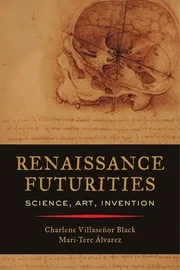
Renaissance Futurities - Science, Art, Invention
 82
82

Renaissance Futurities - Science, Art, Invention



Balthazar Finch (Senior Critic, Occult Philosophy) — 'Renaissance Futurities' offers a compelling reappraisal of an age brimming with latent occult energies. By examining the symbiotic relationship between art, nascent science, and imperialistic ventures, the authors reveal the alchemical underpinnings of innovation. The book masterfully deciphers the symbolic language woven into the works of polymaths like Leonardo da Vinci, suggesting a deeper pursuit of universal principles beyond mere empirical observation. Its strength lies in illuminating the esoteric currents that fueled the Renaissance, making it an essential read for those who understand that true discovery often lies beyond the veil of the mundane. A profound exploration for the discerning occultist and historian alike.
📝 Description
82
Published in the early 21st century, 'Renaissance Futurities' examines the Renaissance intersection of art, science, and esoteric thought.
This book examines the Renaissance, a period where early modern science, artistic achievement, and European expansion were deeply connected. It details how this era's artistic revival, scientific exploration, and global ambitions were linked by hidden knowledge. The work revisits Leonardo da Vinci, viewing him not just as an artist and inventor, but as someone who pursued universal truths. It shows how artistic and empirical breakthroughs were shaped by esoteric philosophies, reflecting a worldview that saw the material and spiritual as one.
The book invites readers to understand the symbolic language and intellectual currents of this significant period. It suggests that the future was present in the past, offering a way to grasp the origins of modern thought. This perspective emphasizes interconnectedness and veiled wisdom. It aims to reveal the secrets of human ingenuity and cosmic design to those interested.
The book situates Renaissance thought within traditions of Hermeticism and Neoplatonism, which flourished during the period. It highlights how figures like Leonardo da Vinci engaged with concepts of correspondence between the macrocosm and microcosm, a central tenet in esoteric philosophy. The work suggests these thinkers sought a unified understanding of the universe, blending observation with mystical insights. This approach contrasts with later scientific rationalism, emphasizing a holistic worldview where hidden forces and spiritual principles influenced material reality.
💡 Why Read This Book?
Uncover the hidden alchemical currents that powered Renaissance innovation. Explore the esoteric philosophies behind Leonardo da Vinci's genius and the era's artistic and scientific leaps. Ideal for seekers of hidden knowledge, scholars of Hermeticism, and practitioners interested in the historical roots of magical and scientific inquiry. Discover how the past holds keys to future understanding.
⭐ Reader Reviews
Honest opinions from readers who have explored this book.
❓ Frequently Asked Questions
What is the central argument of 'Renaissance Futurities'?
The book argues that artistic rebirth, scientific inquiry, and European imperialism in the early modern period were deeply intertwined, often influenced by esoteric philosophies and a search for hidden knowledge.
Who is Leonardo da Vinci examined in this book?
He is presented not just as an artist and inventor, but as a polymath whose work reflects a deep engagement with universal principles and a visionary outlook on the future.
What kind of esoteric themes are explored?
The book delves into the symbolic language, alchemical thinking, and Hermetic philosophies that informed the era's intellectual and creative output.
Is this book suitable for beginners in esoteric studies?
Yes, while sophisticated, the book aims to illuminate complex ideas in an accessible way, making it valuable for both seasoned scholars and curious newcomers.
What is the significance of 'open access' for this title?
It signifies a commitment to democratizing knowledge, allowing wider access to profound insights into history, art, and esoteric thought, thanks to generous patronage.
🔮 Key Themes & Symbolism
The Alchemical Imagination
This theme explores how alchemical principles, with their emphasis on transformation, hidden essences, and the interconnectedness of all things, permeated Renaissance thought. It suggests that the era's scientific and artistic endeavors were not solely empirical but were often guided by an alchemical worldview, seeking to transmute base elements into gold, both literally and metaphorically, in art, science, and even societal structures. The search for the 'prima materia' and the 'philosopher's stone' finds echoes in the relentless experimentation and conceptual breakthroughs of the period, revealing a deeper, symbolic layer to their pursuit of knowledge and mastery over nature.
Leonardo's Esoteric Vision
Leonardo da Vinci is re-examined not just as a genius of observation and invention, but as a figure whose work was imbued with esoteric symbolism and a profound understanding of universal laws. This section examines how his anatomical studies, mechanical designs, and artistic compositions might reflect Hermetic principles, his fascination with flight perhaps mirroring the aspiration for spiritual elevation, and his meticulous note-taking serving as a coded repository of hidden wisdom. The focus is on uncovering the veiled meanings and philosophical underpinnings that elevate his creations beyond mere technical prowess, hinting at a cosmos understood through divine proportion and hidden correspondences.
Imperialism and the Quest for Knowledge
This theme scrutinizes the complex relationship between European expansionism and the concurrent explosion of scientific and artistic knowledge. It posits that the drive to explore and conquer new lands was often intertwined with a desire to understand and control the world, a quest that mirrored the esoteric pursuit of hidden truths and mastery. The acquisition of new materials, perspectives, and even peoples during the age of exploration can be seen as a form of 'alchemical' transformation for European society, fueling innovation but also raising profound ethical questions about the application of power derived from newfound knowledge.
💬 Memorable Quotes
Direct passages from the work, attributed to the author.
“In Leonardo's lines, whispers of universal harmony echo.”
— This highlights the esoteric interpretation of Leonardo's work, implying that his art and inventions contained deeper, symbolic meanings related to cosmic order and interconnectedness.
“The compass points not only to new lands, but to new consciousness.”
— This connects the Age of Exploration with inner transformation, suggesting that voyages of discovery also led to shifts in perception and understanding of the self and the world.
“Art and science were twin keys, unlocking the secrets of creation.”
— This emphasizes the synergy between artistic expression and scientific inquiry during the Renaissance, portraying them as complementary methods for unveiling the mysteries of existence.
“Hidden knowledge fuels both the palette and the projectile.”
— This provocative statement links the pursuit of esoteric wisdom to both creative endeavors and the tools of power and conquest that characterized the era.
💡 Key Ideas
Editorial paraphrase of the work's core concepts — not direct quotes.
The Renaissance mind sought not just to understand, but to transmute.
This quote expresses the alchemical spirit of the era, suggesting that discovery was viewed as a process of transformation, akin to the alchemist's quest to turn base metals into gold, applicable to knowledge and society.
🌙 Esoteric Significance
Tradition
The book primarily engages with Hermeticism and Alchemy, two prominent esoteric traditions of the Renaissance. Hermeticism, rooted in the writings attributed to Hermes Trismegistus, emphasized divine wisdom, the correspondence between the macrocosm and microcosm, and the potential for human spiritual ascent. Alchemy, beyond its pursuit of material gold, was a philosophical and spiritual discipline focused on transformation, purification, and the search for the elixir of life and the philosopher's stone, often employing rich symbolic language that resonated deeply within Renaissance art and science.
Symbolism
Key symbols explored include the ouroboros (eternity, cyclicality), the divine proportion (harmony, cosmic order), alchemical apparatus (furnaces, retorts representing transformation), and anatomical diagrams (the body as a microcosm). These symbols were not merely decorative but served as vehicles for complex philosophical and spiritual ideas, reflecting a worldview where the material and immaterial realms were intrinsically linked and understood through a shared symbolic language.
Modern Relevance
The book's exploration of the interconnectedness between art, science, and philosophy appeals to contemporary discussions about interdisciplinary approaches and the holistic nature of knowledge. It suggests that by understanding the esoteric underpinnings of past innovations, we can gain new perspectives on our own technological advancements, creative processes, and our relationship with the natural world, encouraging a more integrated and perhaps more spiritually aware approach to future endeavors.
👥 Who Should Read This Book
This volume is a treasure for the discerning reader. Scholars of Renaissance history, art history, and the history of science will find a novel framework for understanding their fields. Seekers of esoteric knowledge and practitioners of mystical traditions will discover the historical roots of their disciplines and the profound influence of Hermeticism and alchemy. Beginners curious about the hidden currents of history will find an engaging entry point into complex philosophical ideas. Ultimately, anyone fascinated by the creative explosion of the Renaissance and the enduring power of hidden wisdom will find 'Renaissance Futurities' an informative and thought-provoking journey.
📜 Historical Context
The Renaissance, spanning roughly the 14th to the 17th century, was a period of profound cultural, artistic, political, and economic rebirth following the Middle Ages. It witnessed a renewed interest in classical antiquity, leading to advancements in art, architecture, literature, and philosophy. Simultaneously, the seeds of modern science were sown with figures challenging established doctrines and developing new methods of inquiry. This era also saw the rise of European imperial ambitions, marked by voyages of discovery, colonization, and the establishment of global trade networks. 'Renaissance Futurities' situates these developments within a broader intellectual landscape, suggesting that the era's innovative spirit was deeply influenced by esoteric traditions like Hermeticism and alchemy, which offered alternative frameworks for understanding the cosmos and humanity's place within it, thereby shaping both the outward expansion and the inward intellectual explorations of the time.
📔 Journal Prompts
Reflect on a modern scientific discovery or artistic creation. How might it be viewed through an alchemical lens of transformation?
Consider Leonardo da Vinci's many-sided genius. What aspects of his work suggest a pursuit of knowledge beyond the purely empirical?
In what ways does the concept of 'correspondence' (as in 'as above, so below') manifest in contemporary art, science, or personal philosophy?
Imagine you are a Renaissance patron. What esoteric knowledge would you commission an artist or scholar to explore and immortalize?
How can understanding the historical interplay between exploration and knowledge acquisition inform our approach to global challenges today?
🗂️ Glossary
Hermeticism
A philosophical and religious tradition based on writings attributed to Hermes Trismegistus, emphasizing divine wisdom, spiritual enlightenment, and the interconnectedness of the universe (macrocosm and microcosm).
Alchemy
An ancient proto-scientific and philosophical tradition focused on the transformation of matter, often through symbolic processes of purification and transmutation, with spiritual and philosophical goals beyond mere material wealth.
Polymath
An individual whose knowledge spans a significant number of subjects, demonstrating expertise in multiple diverse fields, such as Leonardo da Vinci.
Macrocosm
The universe considered as a complex and ordered whole, often seen as mirroring the microcosm.
Microcosm
The human being or a smaller system considered as a miniature representation of the universe (macrocosm), embodying the same principles and structures.
This book appears in 3 collections
🔮 Readers Also Liked
Browse all →







From the “Hermeticism” Collection
View all →






More Free Alchemy & Hermeticism Books
View all →