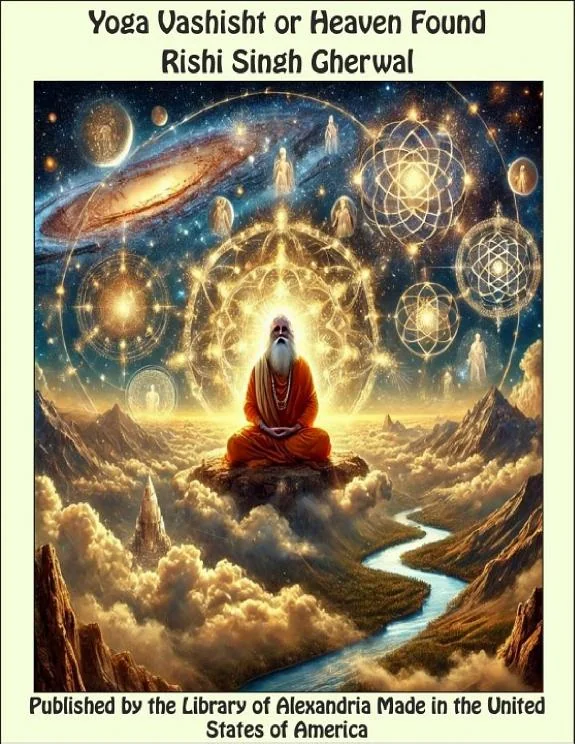
Yoga Vashisht or Heaven Found
 78
78

Yoga Vashisht or Heaven Found
Rishi Singh Gherwal’s rendering of Yoga Vashisht, subtitled Heaven Found, offers a potent distillation of this ancient Indian philosophical text. Unlike many spiritual commentaries that rehash familiar platitudes, Gherwal presents the "small" Yoga Vashisht with a directness that can be initially jarring but ultimately rewarding. The book’s strength lies in its systematic exposition of the seven states of ignorance and wisdom, offering tangible markers for spiritual progress. The limitation, however, is its inherent exclusivity; the blurb’s assertion that it is "not for the ignorant" underscores its demand for a prepared mind, potentially alienating those new to Advaita or Vedanta concepts.
A particularly striking passage describes the illusion of multiplicity, where the world appears as separate entities, yet Vashisht guides Rama to see this as a mere play of consciousness. Gherwal’s work provides spiritual food for those who hunger, as the original blurb suggests, but one must be prepared to digest its challenging fare. It is a text for the dedicated seeker, not the casual reader, demanding contemplation over passive consumption.
📝 Description
78
Rishi Singh Gherwal's 1929 edition distills the essential Yoga Vashisht dialogue.
Yoga Vashisht, or Heaven Found, presents a dialogue between Sage Vashisht and Prince Rama. This edition, often called the "small" Yoga Vashisht, focuses on the core teachings for those seriously pursuing spiritual liberation and self-knowledge. It outlines seven states of ignorance and seven states of wisdom, acting as a guide for spiritual progress.
The book is for the dedicated seeker of ultimate reality, providing nourishment for those desiring wisdom beyond the superficial. It rewards readers prepared to grapple with complex philosophical ideas and contemplate consciousness. The text challenges individuals to confront their own ignorance and aim for higher states of being.
The Yoga Vashisht is attributed to the Vedic sage Vashisht, a figure prominent in the Ramayana epic. This "small" edition is a focused compilation of its teachings, likely composed over centuries. It emerged within a rich Indian philosophical setting, alongside Vedanta and Samkhya schools, all addressing existence, karma, and liberation (moksha).
The Yoga Vashisht emerges from the Advaita Vedanta tradition, emphasizing that reality and individual consciousness are aspects of a single, supreme consciousness, Brahman. It details a path to liberation (moksha) through discriminative knowledge (viveka) and detachment (vairagya). The text guides the aspirant through stages of spiritual development, aiming to dissolve false perceptions of self and achieve union with the divine.
💡 Why Read This Book?
• Gain a structured understanding of spiritual ignorance and wisdom through Vashisht's seven states, offering a clear framework for self-assessment absent in generalized spiritual guides. • Contemplate the Advaita Vedanta concept of Maya, the illusory nature of the perceived world, and learn techniques to discern reality from illusion as presented in the text. • Explore the dialogue between Sage Vashisht and Prince Rama, a specific narrative device used to illustrate the path to liberation (moksha) through direct philosophical inquiry.
⭐ Reader Reviews
Honest opinions from readers who have explored this book.
❓ Frequently Asked Questions
What is the 'small' Yoga Vashisht mentioned in relation to the 'great' one?
The 'small' Yoga Vashisht, as presented by Rishi Singh Gherwal, is a condensed version of the larger work. Both are attributed to Sage Vashisht and focus on profound spiritual wisdom, but the smaller text is often considered more accessible for focused study.
Who is Sage Vashisht and why is he important?
Sage Vashisht is a revered Vedic sage, appearing as a prominent character in the epic Ramayana. He served as the guru to Lord Rama and is credited with imparting profound spiritual teachings on self-realization and the nature of existence.
What are the 'seven states of wisdom' mentioned in Yoga Vashisht?
The seven states of wisdom, as detailed in Yoga Vashisht, describe progressive stages of spiritual realization and enlightenment, moving from initial inquiry and intellectual understanding to direct experience of non-dual reality.
Is Yoga Vashisht suitable for beginners in spirituality?
The text itself suggests it is for those 'seeking truth' and not 'the ignorant.' While it offers profound insights, its philosophical depth and direct approach may be more suited for individuals with some prior contemplation on spiritual matters.
What is the primary goal of the teachings in Yoga Vashisht?
The primary goal is liberation (moksha) from the cycle of birth and death, achieved through self-knowledge, the dissolution of ego, and the realization of the non-dual nature of consciousness, as expounded by Sage Vashisht.
Does this book offer practical exercises for spiritual growth?
While primarily philosophical, the text implies practical application through contemplation, discrimination (viveka), and detachment (vairagya) to overcome ignorance and realize the ultimate truth of Brahman.
🔮 Key Themes & Symbolism
The Nature of Reality
The text posits that the perceived world of multiplicity is ultimately an illusion (Maya), a projection of the singular, divine consciousness (Brahman). It challenges the reader to question the solidity of their individual self and the external world, urging a deeper inquiry into the nature of existence. This perspective aligns with Advaita Vedanta's core tenets, emphasizing that all phenomena arise from and are identical with the ultimate reality.
States of Ignorance and Wisdom
A central framework of the Yoga Vashisht involves detailing seven distinct states of ignorance (avidya) and seven corresponding states of wisdom (jnana). These stages map the human spiritual journey from bondage caused by delusion and ego to ultimate liberation. Understanding these states provides a diagnostic tool for self-awareness and a progressive path toward enlightenment.
Path to Liberation (Moksha)
The book outlines the means to achieve moksha, which is freedom from suffering and the cycle of rebirth. This liberation is attained not through external rituals alone, but primarily through discriminative knowledge (viveka), detachment (vairagya), and the direct realization of one's true nature as consciousness. The dialogue between Vashisht and Rama illustrates these principles.
The Role of the Mind
The mind is depicted as both the source of bondage and the instrument of liberation. Through its inherent tendencies, desires, and conceptualizations, the mind creates the illusion of a separate self and a material world. However, by purifying and redirecting the mind through spiritual discipline and wisdom, it can become the vehicle for realizing the ultimate truth.
💬 Memorable Quotes
Direct passages from the work, attributed to the author.
“No one can miss the God consciousness within.”
— This statement suggests that the divine essence or ultimate reality is inherent to every being, not an external entity to be found. It implies that realization is a matter of uncovering what is already present, rather than acquiring something new.
“This is the small book; both hooks are the work of the Rishi Vashisht.”
— This highlights the existence of multiple versions of the Yoga Vashisht text, with this particular edition being a condensed or 'small' version attributed to the ancient sage Vashisht, known for his profound spiritual wisdom.
“It is the book for those who are seeking truth but not for the ignorant.”
— This emphasizes the advanced nature and specific audience for the Yoga Vashisht. It is intended for individuals actively pursuing profound spiritual understanding, rather than those unwilling or unprepared to engage with its challenging philosophical concepts.
“It gives spiritual food for those who hunger.”
— This metaphor suggests that the book provides essential nourishment for the soul and intellect of those who feel a deep spiritual longing or dissatisfaction with superficial knowledge.
“It also gives us the seven states of ignorance.”
— Beyond outlining the path to wisdom, the text systematically details the various levels and manifestations of ignorance that keep individuals bound to suffering and illusion, serving as a crucial aspect of self-diagnosis on the spiritual path.
🌙 Esoteric Significance
Tradition
The Yoga Vashisht deeply aligns with the Advaita Vedanta tradition, a prominent school of Hindu philosophy. It emphasizes the non-dual nature of reality, positing that the individual soul (Atman) is identical with the ultimate reality (Brahman). While rooted in Vedic scriptures, its focus on yogic practices and the dissolution of the ego connects it to broader Indic esoteric streams, including Tantra and certain yogic lineages that seek liberation through direct experiential knowledge.
Symbolism
Key symbols include the 'dream state,' representing the illusory nature of waking consciousness and the external world, suggesting that our perceived reality is as transient and constructed as a dream. The 'world-tree' or 'tree of existence' symbolizes the interconnectedness of all life and the unfolding of creation from a single source. The recurring motif of 'consciousness' itself functions as a primary symbol, representing the fundamental substratum of all being, from which all forms arise and to which they return.
Modern Relevance
Contemporary thinkers and spiritual practitioners within both Eastern and Western esoteric traditions draw upon the Yoga Vashisht. Its profound exploration of consciousness, illusion, and self-realization influences modern Vedanta studies, Advaita teachings, and various forms of mindfulness and contemplative practices. Gurus and authors synthesizing Eastern philosophy with Western psychology often reference its concepts to explain the nature of mind and the path to inner peace and enlightenment.
👥 Who Should Read This Book
• Students of Advaita Vedanta: Those seeking a foundational text that articulates the core principles of non-dualism and the path to realizing Brahman, offering a direct philosophical exploration. • Seekers of Self-Knowledge: Individuals engaged in deep introspection and questioning the nature of their own consciousness and identity, looking for a text that systematically addresses illusion and the ego. • Comparative Religion Scholars: Researchers interested in the diverse philosophical field of Indian spirituality, examining texts that bridge philosophical inquiry with yogic practice.
📜 Historical Context
The Yoga Vashisht, with its philosophical underpinnings, emerged from the rich intellectual milieu of ancient India, likely evolving over centuries. While attributed to Sage Vashisht, a figure from the Ramayana epic, its compilation and dissemination reflect the flourishing of various schools of Hindu philosophy, particularly Vedanta and Samkhya. These traditions, active from roughly 800 BCE onwards, grappled with concepts of consciousness, liberation (moksha), and the nature of reality. The Yoga Vashisht's emphasis on non-dualism (Advaita) places it within a lineage that also includes thinkers like Adi Shankara (c. 8th century CE). Its teachings offered an alternative or complementary perspective to more ritualistic or devotional paths, focusing on knowledge and self-inquiry as the primary means to spiritual freedom. The text's reception was generally favorable within ascetic and philosophical circles, though specific reception events like formal critiques or widespread bans are not widely documented for this particular period.
📔 Journal Prompts
The illusion of multiplicity as described by Vashisht: How does it manifest in your daily perceptions?
Reflect on the seven states of ignorance: Which state do you currently identify with most strongly?
The nature of consciousness: What evidence from your experience suggests it is the sole reality?
Vashisht's concept of liberation: What does freedom from the cycle of birth and death mean to you?
The mind as a tool for bondage and freedom: How can you consciously redirect your mental processes?
🗂️ Glossary
Brahman
The ultimate, unchanging reality or supreme cosmic spirit in Hinduism. It is considered the source and substratum of all existence, pervading everything and being identical with the individual soul (Atman).
Atman
The true Self or soul in Hindu philosophy. In Advaita Vedanta, Atman is identical with Brahman, representing the eternal, unchanging consciousness that lies at the core of every individual.
Maya
An important concept in Hinduism, referring to the illusory power or cosmic illusion that conceals the true nature of reality (Brahman) and makes the phenomenal world appear real and diverse.
Moksha
Liberation or release from the cycle of birth, death, and rebirth (samsara). It is the ultimate goal in many Indian spiritual traditions, achieved through self-knowledge and spiritual realization.
Viveka
Discrimination or discernment, particularly the ability to distinguish between the real and the unreal, the eternal and the transient. It is a key faculty for spiritual progress in Vedanta.
Vairagya
Detachment or dispassion, the state of being free from worldly desires and attachments. It is cultivated to overcome the influence of Maya and focus on spiritual pursuits.
Avidya
Ignorance, particularly spiritual ignorance. It is considered the root cause of suffering and bondage, leading individuals to mistake the unreal for the real and identify with the ego.
This book appears in 1 collection
🔮 Readers Also Liked
Browse all →








From the “Vedanta” Collection
View all →







More Free Sacred Texts & Gnosticism Books
View all →