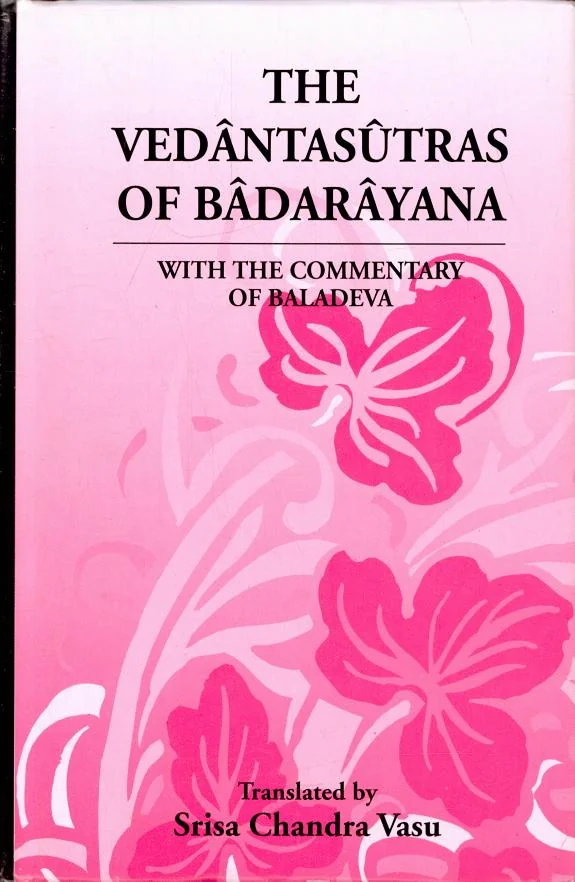
The Vedantasutras Of Badrayana (vols.2 Set)
 71
71

The Vedantasutras Of Badrayana (vols.2 Set)
The dual-volume presentation of Badarayana's Vedanta Sutras, with translations and notes by B.D. Basu and S.C. Vasu, offers a substantial resource for navigating the intricate philosophical arguments that underpin Hindu thought. The sheer density of the sutras themselves, reduced to terse aphorisms, necessitates extensive commentary, and this edition provides a thorough, if sometimes dense, exploration. Its strength lies in its comprehensive approach, allowing readers to trace the development of key Vedantic concepts through the lens of various interpretations. A notable limitation, however, is the potential for the sheer volume of text to become overwhelming; the distinction between Badarayana's original intent and subsequent commentary can blur without careful attention. The section discussing the nature of Brahman as the sole reality, particularly in relation to the empirical world, is rendered with a depth that rewards patient study. Ultimately, this set serves as an indispensable, albeit challenging, reference for serious scholars of Vedanta.
📝 Description
71
The Vedanta Sutras of Badarayana, translated by B.D. Basu and S.C. Vasu, appeared in a two-volume set.
This two-volume translation of the Vedanta Sutras presents Badarayana's foundational work in Hindu philosophy. The text organizes and expands on the Upanishadic teachings found in the Vedas. Attributed to the sage Badarayana, it acts as a synthesis intended to resolve apparent discrepancies in Vedic scriptures regarding Brahman, the self (Atman), and their connection.
The sutras themselves are aphoristic, meaning they require extensive commentary for comprehension. This edition is noted for its detailed explanations. It aims to provide access to the original source material, moving beyond secondary interpretations. The translators' notes are included to assist readers unfamiliar with Hindu concepts, though some prior knowledge is beneficial. This work is particularly for those committed to rigorous study of Advaita, Vishishtadvaita, and Dvaita Vedanta.
The Vedanta Sutras, composed between 400 BCE and 200 CE, emerged during a significant period of Indian intellectual development. This era saw the codification of many Vedic texts and the rise of distinct philosophical schools. Badarayana's work sought to establish Vedanta as a unique philosophical system, engaging with and sometimes critiquing traditions like Samkhya, Yoga, Nyaya, Vaisheshika, and Mimamsa. Its foundational role allowed later thinkers such as Shankara, Ramanuja, and Madhvacharya to build their major commentaries upon it, shaping the major interpretive schools of Vedanta.
💡 Why Read This Book?
• Gain a foundational understanding of Brahman and Atman directly from the source text, moving beyond simplified explanations of non-duality as presented in the Sutras' aphorisms. • Trace the historical development of major Vedanta schools (Advaita, Vishishtadvaita, Dvaita) by examining how later commentators like Shankara engaged with Badarayana's arguments from approximately 200 CE. • Grasp the intricate relationship between Vedic injunctions and philosophical inquiry, understanding how the Sutras aimed to synthesize diverse scriptural statements on ultimate reality.
⭐ Reader Reviews
Honest opinions from readers who have explored this book.
❓ Frequently Asked Questions
What is the primary purpose of Badarayana's Vedanta Sutras?
The Vedanta Sutras systematically organize and interpret the Upanishadic teachings, aiming to establish a coherent philosophical framework for understanding Brahman, the self, and the nature of reality, reconciling various scriptural statements.
Who are the main commentators on the Vedanta Sutras that this edition might reference?
While this edition focuses on Basu and Vasu's translation and annotation, the Vedanta Sutras are historically commented upon by major figures like Adi Shankara (Advaita Vedanta), Ramanuja (Vishishtadvaita), and Madhvacharya (Dvaita Vedanta).
What does 'Sutra' mean in the context of this book?
In Sanskrit, 'Sutra' means 'thread' or 'aphorism.' The Vedanta Sutras are concise, often cryptic, statements designed to encapsulate complex philosophical ideas, requiring extensive commentary for full comprehension.
When were the Vedanta Sutras likely composed?
Scholarly estimates place the composition of the Vedanta Sutras between 400 BCE and 200 CE, a period of significant philosophical development in ancient India.
What is Brahman as discussed in the Vedanta Sutras?
Brahman represents the ultimate, unchanging, absolute reality in the Vedanta philosophy. The Sutras explore its nature as the source, sustainer, and ultimate destination of all existence.
How does this text relate to the Vedas?
The Vedanta Sutras specifically focus on the Vedanta or 'end' portion of the Vedas, namely the Upanishads, to expound philosophical doctrines about ultimate reality.
🔮 Key Themes & Symbolism
Brahman: The Absolute Reality
The central focus of the Vedanta Sutras is the nature of Brahman, the supreme, all-pervading consciousness that is the source of all being. The text meticulously argues for Brahman's unconditioned, unchanging essence, distinct from the transient phenomena of the material world. It synthesizes Upanishadic statements to present Brahman not merely as a creator god, but as the very substance of existence, the ground of all reality from which everything arises and into which everything dissolves.
Atman: The Inner Self
Closely linked to Brahman is the concept of Atman, the individual soul or self. The Vedanta Sutras engage in profound analysis to establish the identity of Atman with Brahman, particularly within the Advaita Vedanta interpretation. It explores the Atman's true nature as pure consciousness, unmanifested and eternal, often obscured by ignorance (avidya) and identification with the physical body and mind. Understanding Atman is presented as crucial for realizing one's true spiritual identity.
Moksha: Liberation from Samsara
The ultimate goal propounded by the Vedanta Sutras is moksha, liberation from the cycle of birth and death (samsara). This liberation is achieved through discriminative knowledge (viveka) and direct realization of the unity of Atman and Brahman. The text outlines various paths and practices, often emphasizing the importance of right understanding and detachment from worldly desires and illusions as essential components of the spiritual journey towards freedom.
Scriptural Authority and Interpretation
A significant aspect of the Vedanta Sutras is their role in establishing the authority of the Vedas, particularly the Upanishads, as the pramāṇa (means of valid knowledge) for understanding ultimate truth. Badarayana systematically interprets these scriptures, aiming to resolve apparent contradictions and present a unified doctrine. This process highlights the importance of careful exegesis and commentary in understanding profound philosophical and spiritual texts.
💬 Memorable Quotes
Direct passages from the work, attributed to the author.
“Brahman is that from which these beings are born, by which they are sustained, and into which they enter again.”
— This aphorism captures the cosmological function of Brahman as the origin, sustenance, and ultimate dissolution point of the universe, establishing its supreme and all-encompassing nature.
“The self is to be perceived, heard of, reflected on, and meditated upon.”
— This highlights the Upanishadic emphasis on the Atman as the subject of profound spiritual inquiry, requiring a multi-stage process of understanding and realization beyond mere intellectual assent.
“The scriptures declare, 'He who knows That, what then becomes of him?' (This refers to the state after liberation).”
— This points to the ineffable nature of the liberated state, which transcends ordinary categories of existence and non-existence, a common theme in discussions of spiritual realization.
“Because of the possibility of scriptural difference, one should not rely on inference alone.”
— This emphasizes the primacy of Vedic revelation over mere logical deduction when it comes to metaphysical truths, underscoring the foundational role of scripture in Vedantic philosophy.
“Because of the absence of a name, the Lord is not to be apprehended by name.”
— This suggests that the ultimate reality, Brahman, cannot be confined or fully grasped by any specific designation or name, pointing to its transcendent and absolute quality.
🌙 Esoteric Significance
Tradition
The Vedanta Sutras are the a core part of the Vedanta tradition within Hindu philosophy, which can be seen as a profound esoteric lineage focused on realizing the ultimate nature of reality. While not typically categorized alongside Western esoteric systems like Hermeticism or Kabbalah, its exploration of consciousness, the illusory nature of the manifest world (maya), and the identity of the individual soul with the Absolute (Brahman) shares thematic parallels with mystical and Gnostic traditions globally.
Symbolism
Key symbolic motifs include the 'cave' or 'heart' where the Atman resides, representing the inner sanctuary of consciousness. The concept of 'sleep' and 'waking' are used metaphorically to describe states of ignorance and awareness, respectively. The 'ether' (akasha) symbolizes Brahman as the all-pervading substratum from which all phenomena arise, much like space contains objects.
Modern Relevance
Contemporary practitioners of yoga and meditation often draw upon Vedantic principles, particularly the Advaita Vedanta interpretation, for philosophical grounding. Thinkers and spiritual teachers influenced by Vedanta continue to explore themes of consciousness, non-duality, and the nature of the self, impacting modern spiritual movements and mindfulness practices worldwide. Its rigorous philosophical inquiry remains a reference point for comparative philosophy and theology.
👥 Who Should Read This Book
• Advanced students of comparative philosophy and religion seeking to understand the foundational texts of Hindu metaphysics and their influence. • Dedicated practitioners of yoga and meditation who wish to deepen their theoretical understanding of consciousness, the self, and the ultimate reality beyond postural practice. • Scholars of ancient Indian texts and intellectual history requiring a detailed, systematic exposition of the Upanishadic doctrines as interpreted by Badarayana.
📜 Historical Context
The Vedanta Sutras of Badarayana emerged during a vibrant period of Indian philosophical discourse, likely between 400 BCE and 200 CE. This era witnessed intense intellectual activity, with numerous schools of thought vying for prominence, including the early formulations of Samkhya, Yoga, Nyaya, and Mimamsa. Badarayana's work served as a critical synthesis and systematization of the Upanishadic teachings, aiming to establish Vedanta as a distinct philosophical system. It provided a foundational text for the subsequent development of major Vedantic traditions. Adi Shankara, in the 8th century CE, wrote his influential commentary on the Sutras, solidifying the Advaita Vedanta school and engaging directly with competing philosophical ideas prevalent at the time, such as the atomism of Vaisheshika and the logical systems of Nyaya.
📔 Journal Prompts
The concept of Brahman as the sole reality: How does this differ from monotheistic or polytheistic understandings of divinity?
Badarayana's synthesis of Vedic texts: What challenges arise when reconciling seemingly contradictory scriptural statements?
The nature of Atman: Reflect on the distinction between the empirical self and the true Self as described in the Sutras.
The path to Moksha: What practical implications does the pursuit of knowledge (jnana) have for daily life?
The role of Maya: How does the concept of cosmic illusion influence one's perception of the world?
🗂️ Glossary
Brahman
The ultimate, unchanging, absolute reality that is the source and ground of all existence in Vedanta philosophy.
Atman
The individual soul or self, often considered identical with Brahman in Advaita Vedanta.
Sutra
An aphorism or concise statement, forming the basic unit of the Vedanta Sutras, requiring extensive commentary.
Upanishads
The concluding philosophical sections of the Vedas, forming the basis of Vedanta philosophy.
Moksha
Liberation from the cycle of birth, death, and rebirth (samsara); spiritual freedom.
Avidya
Ignorance; the fundamental ignorance that obscures the true nature of reality and the self.
Pramāṇa
A means of valid knowledge; the Vedanta Sutras establish the Vedas as a primary pramāṇa for metaphysical truths.
This book appears in 1 collection
🔮 Readers Also Liked
Browse all →








From the “Vedanta” Collection
View all →






More Free Occult Philosophy Books
View all →