The Mediator
 74
74

The Mediator
Emil Brunner’s "The Mediator" presents a formidable case for the centrality of Christ's mediatorial role, a concept often assumed rather than deeply explicated. Its strength lies in its systematic, almost architectural, construction of theological argument, meticulously building a case for Christ as the indispensable bridge between the divine and human. Brunner’s engagement with scripture, particularly in his analysis of Christ's person and work, offers a robust alternative to more subjective theological approaches prevalent in some circles. A particularly compelling section is his exploration of revelation, where Christ is not merely a teacher but the very substance of God's self-disclosure. However, the book’s dense prose and reliance on specific theological terminology, while precise, can present a significant barrier to entry for those unacquainted with early 20th-century Protestant scholasticism. The sheer intellectual weight of the arguments, while admirable, sometimes overshadows the personal, existential implications of faith. Despite this, the work remains a significant contribution to Christological studies, offering a clear, albeit demanding, articulation of a foundational Christian doctrine.
📝 Description
74
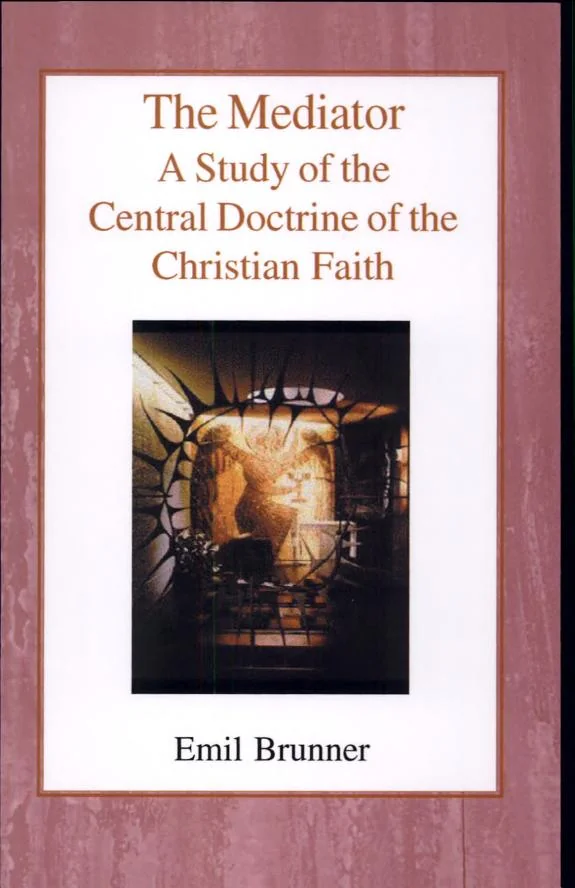
Emil Brunner's 1934 work, The Mediator, argues for Christ's unique role in divine-human reconciliation.
Published in 1934, Emil Brunner's The Mediator offers a systematic theological analysis of Jesus Christ's function as the intermediary between God and humanity. Brunner grounds his arguments in scriptural interpretation, examining the nature of Christ's personhood and his salvific work. The book addresses core questions of faith, revelation, and the possibility of reconciliation, positioning Christ's mediation as central to this divine-human relationship. Brunner structures his work to build a coherent theological case, considering the implications of Christ's mediation for understanding God's attributes and humanity's ultimate fate.
This text is suited for theological students, scholars, and serious lay readers interested in Christian doctrine. It appeals to those who value systematic inquiry and want to trace the historical development of Christological thought. Readers exploring comparative religion or seeking deeper insights into faith's metaphysical foundations will find its detailed exegesis useful. It is particularly relevant for those interested in Protestant scholasticism and early 20th-century theology, engaging directly with key Christian tenets.
The Mediator emerged in 1934, a time of significant theological reevaluation in Europe following World War I. This period saw a reaction against liberal theology and the rise of dialectical theology, championed by figures like Karl Barth. Brunner, while associated with Barth, carved out his own theological path. The book's focus on the objective reality of revelation and Christ's centrality aligns with a broader movement within Protestant thought to reaffirm traditional doctrines against more subjective or philosophical approaches to religion.
💡 Why Read This Book?
• Understand Christ's unique role as the sole bridge between God and humanity, a concept explored in detail through Brunner's rigorous theological framework, offering a theological perspective distinct from mere ethical teachings. • Grasp the 1934 theological landscape by examining Brunner's dialectical theology, positioning his work within a crucial period of Protestant thought shaped by figures like Karl Barth. • Gain a precise theological vocabulary for concepts like revelation and atonement, learning how Brunner defines Christ's personhood as the essential ground for divine-human reconciliation.
⭐ Reader Reviews
Honest opinions from readers who have explored this book.
❓ Frequently Asked Questions
What is the primary theological concept Emil Brunner addresses in 'The Mediator'?
The book's primary focus is the doctrine of Christ's mediation, examining Jesus Christ as the essential intermediary and bridge between God and humanity, as articulated in biblical theology.
When was 'The Mediator' by Emil Brunner originally published?
Emil Brunner's 'The Mediator' was first published in 1934, placing it within a significant period of 20th-century theological discourse.
What is the significance of Christ's 'Person' in Brunner's argument?
Brunner meticulously analyzes the 'Person of Christ,' arguing that his unique dual nature (divine and human) is the very foundation that enables him to act as mediator.
Does 'The Mediator' discuss the concept of atonement?
Yes, the work delves into the doctrine of atonement, explaining Christ's sacrificial work as the crucial means by which reconciliation between God and humanity is accomplished.
Who are the intended readers for Emil Brunner's 'The Mediator'?
The book is aimed at theological students, scholars, and serious readers interested in systematic theology, Christology, and the intellectual currents of early 20th-century Protestant thought.
How does 'The Mediator' relate to dialectical theology?
Published in 1934, it engages with dialectical theology, a movement influential at the time, with Brunner offering his distinct perspectives within this broader theological conversation.
🔮 Key Themes & Symbolism
Christ as Mediator
The core of Brunner's work posits Jesus Christ as the indispensable link connecting the divine and human spheres. This mediation is not merely symbolic but ontological, rooted in Christ's unique personhood. The book systematically breaks down how this mediatorial function operates, covering aspects from divine revelation to human salvation. It argues that without this specific intermediary, the relationship between God and humanity would remain fundamentally broken, highlighting the absolute necessity of Christ's role in theological salvation.
Nature of Revelation
Brunner contends that true divine revelation is not found in abstract pronouncements or natural signs alone, but is uniquely embodied in the Person of Christ. He explores how Christ himself is the self-disclosure of God, making divine truth accessible and comprehensible to humanity. This perspective shifts the focus from a human quest for God to God's initiative in revealing Himself through His Son, a central tenet of dialectical theology.
The Person of Christ
A significant portion of "The Mediator" is dedicated to a thorough examination of Christ's dual nature – divine and human. Brunner argues that it is precisely this hypostatic union that qualifies Christ to act as the mediator. The book meticulously dissects the theological implications of Christ being both fully God and fully man, asserting that this unique identity is the bedrock upon which the entire edifice of Christian salvation rests.
Reconciliation and Atonement
Central to the concept of mediation is the work of atonement. Brunner explains how Christ's sacrificial death serves as the mechanism for reconciling sinful humanity with a holy God. This section examines the theological meaning of the cross, presenting it not as an arbitrary event but as a divinely ordained act essential for restoring the broken relationship, thereby enabling true communion between Creator and creation.
💬 Memorable Quotes
Direct passages from the work, attributed to the author.
“Christ is the Mediator because He is the God-Man.”
— This concise statement expresses Brunner's central thesis. It asserts that Christ's unique identity, possessing both divine and human natures, is the essential prerequisite for his function as the bridge between God and humanity.
“Revelation is not a message, but a Person.”
— This highlights Brunner's view that divine truth is not merely conveyed through words, but is fundamentally embodied in Jesus Christ himself. He is the living expression of God's self-disclosure.
“The work of Christ is the ground of reconciliation.”
— This interpretation points to Brunner's understanding of atonement. The salvific actions and sacrificial death of Christ are presented as the foundational basis upon which God and humanity can be brought back into harmony.
“Faith is the human response to divine initiative.”
— Brunner emphasizes that faith is not a humanly generated effort but a divinely enabled response. It is humanity's reception of God's overture of reconciliation made possible through Christ.
💡 Key Ideas
Editorial paraphrase of the work's core concepts — not direct quotes.
The separation between God and man requires a divine bridge.
This paraphrase emphasizes the radical nature of the chasm separating humanity from God due to sin, and posits Christ as the necessary, divinely provided solution to overcome this separation.
🌙 Esoteric Significance
Tradition
While rooted in orthodox Christian theology, "The Mediator" touches upon themes that resonate with esoteric traditions by focusing on the concept of a divine intermediary. The emphasis on Christ as the singular bridge between the material and spiritual realms aligns with Gnostic ideas of a savior figure who bridges the divine Pleroma and the lower material world. Brunner's rigorous Christology, however, remains distinct from Gnostic dualism, maintaining a unified view of God's creation and redemption.
Symbolism
The primary symbol is Christ himself, understood not merely as a historical figure but as the living embodiment of divine truth and the conduit for salvation. The concept of the 'bridge' is a potent metaphor for mediation, symbolizing the connection across an otherwise impassable gulf between God and humanity. The 'Person of Christ' becomes a locus of divine-human interaction, representing the union of the transcendent and immanent.
Modern Relevance
Contemporary discussions in comparative theology and mystical Christianity often revisit Brunner's work. Thinkers exploring the intersection of faith and reason, or seeking to articulate Christology in non-traditional philosophical terms, may find his arguments valuable. His emphasis on mediation also finds echoes in New Age spirituality's focus on avatars and divine messengers, though Brunner's framework is strictly within a Trinitarian Christian context.
👥 Who Should Read This Book
• Theological students and seminarians seeking a foundational understanding of Christology and the doctrine of mediation, presented with rigorous argumentation. • Scholars of religious history interested in the intellectual field of early 20th-century Protestant theology and its engagement with traditional doctrines. • Serious lay readers of Christian theology who wish to deepen their comprehension of Christ's role in salvation beyond devotional familiarity.
📜 Historical Context
Published in 1934, Emil Brunner's "The Mediator" emerged from the fertile, yet contentious, ground of German Protestant theology in the interwar period. This era witnessed a significant reaction against liberal theology's perceived overemphasis on human reason and subjective experience. Dialectical theology, spearheaded by Karl Barth, urged a return to the objective reality of God's Word and the centrality of Christ. Brunner, while a key figure in this movement, often diverged from Barth, offering a more nuanced approach to revelation and the person of Christ. "The Mediator" reflects this milieu, systematically defending traditional Christological doctrines against modernist critiques and asserting the necessity of Christ's unique mediatorial role. The work engaged with contemporary philosophical and theological currents, seeking to establish a robust Christocentric framework for understanding God, humanity, and salvation, standing in contrast to existentialist theological explorations gaining traction.
📔 Journal Prompts
The concept of Christ as the 'divine bridge' between God and humanity: explore its implications for understanding divine accessibility.
Brunner's analysis of Christ's 'Person' as the foundation of mediation: reflect on how this dual nature informs his salvific work.
The idea of revelation being embodied in a 'Person' rather than a message: consider how this shifts understanding of divine communication.
The theological necessity of atonement for reconciliation: contemplate the implications of this concept for human-divine relationship.
Reflect on the historical context of 1934 and how it shaped Brunner's defense of traditional Christology against contemporary theological trends.
🗂️ Glossary
Mediator
In theology, a person or entity who stands between two parties, facilitating communication, reconciliation, or union. In "The Mediator," this role is exclusively assigned to Jesus Christ.
Christology
The branch of Christian theology concerned with the nature, person, and work of Jesus Christ, particularly his divinity and humanity.
Hypostatic Union
Theological doctrine stating that in Jesus Christ, one divine person subsists in two natures, fully divine and fully human, without confusion or separation.
Atonement
The doctrine concerning how humanity's sin is forgiven and reconciliation with God is achieved, typically through the sacrificial death and resurrection of Jesus Christ.
Revelation
The act by which God discloses Himself and His will to humanity. Brunner emphasizes Christ as the ultimate and personal form of divine revelation.
Dialectical Theology
A theological movement emphasizing the qualitative difference between God and humanity, and the paradoxical nature of God's self-disclosure through Word and event.
Scholasticism
A method of critical thought which dominated teaching by the use of dialectical method to resolve learning, characterized by rigorous systematic analysis and argumentation.
This book appears in 1 collection
🔮 Readers Also Liked
Browse all →







From the “Revelation” Collection
View all →









More Free Sacred Texts & Gnosticism Books
View all →