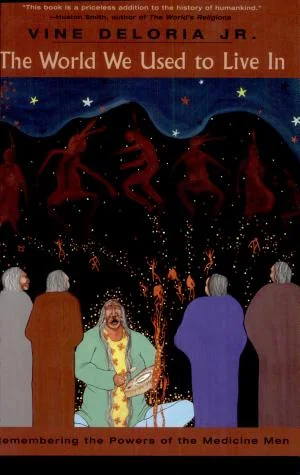
The World We Used to Live in
 81
81

The World We Used to Live in
Vine Deloria Jr.'s "The World We Used to Live In" is not a gentle introduction to Native American spirituality; it's a direct challenge to Western assumptions about reality. Deloria, a formidable intellect, dissects the perceived powers of medicine men with a scholar's rigor and a spiritual advocate's conviction. He posits that these figures operated within a coherent, functioning cosmology, one deeply interwoven with the Earth and the cosmos, a concept often reduced to myth by outsiders. A particular strength lies in his insistence on the tangible, functional aspects of these traditions, moving them from the realm of folklore to that of active engagement with universal forces. However, the book can be dense, at times demanding a reader already familiar with its specific intellectual terrain. The section discussing the "mechanics" of spiritual power, while fascinating, might leave some readers wanting more concrete, universally interpretable examples beyond anecdotal accounts or specific tribal frameworks. Despite this, Deloria’s work remains a vital, unapologetic assertion of indigenous epistemologies.
📝 Description
81
Vine Deloria Jr.'s 2006 book questions Western views of reality through Native American spiritual practices.
Vine Deloria Jr.'s "The World We Used to Live In" (2006) examines the connections between indigenous spiritual practices, the cosmos, and the nature of reality. The book moves past simple descriptions of Native American beliefs to discuss the complex cosmological frameworks and the practical workings attributed to medicine men and shamans. Deloria investigates how these traditions understood and engaged with universal forces, providing a counterpoint to Western scientific and religious viewpoints.
This work is relevant for scholars of comparative religion, anthropology, and indigenous studies. It also appeals to those interested in alternative cosmologies, shamanism, and the philosophical foundations of spiritual traditions. Readers looking to understand the Earth's connection to celestial bodies from non-Western perspectives will find substantial content. Those who question the limits of materialist worldviews may find a thorough examination of spiritual effectiveness.
Published in 2006, the book appeared during a time of growing academic and public interest in indigenous knowledge systems and their criticisms of Western modernity. Deloria, a recognized advocate for Native American rights and culture, contributed to ongoing discussions about spirituality, science, and the environment. His writing offered a critical view of how Western thought had historically sidelined or misinterpreted indigenous cosmologies, especially regarding the perceived abilities of traditional healers and their understanding of natural laws.
This book engages with esoteric traditions by examining indigenous cosmologies that posit a coherent, observable universe governed by spiritual forces. It challenges the Western separation of the material and spiritual, suggesting a functional relationship between human action, natural laws, and celestial influences as understood by traditional healers. Deloria's work places these practices within a context of deep ecological and cosmic awareness, distinct from but interacting with mainstream Western esoteric thought.
💡 Why Read This Book?
• Understand the cosmological frameworks of medicine men, exploring how they perceived the Earth's connection to the cosmos, a perspective distinct from Western scientific models. • Gain insight into the concept of spiritual efficacy as presented by Deloria, moving beyond superstition to see these traditions as functional systems of knowledge and power. • Engage with a critical examination of Western epistemologies and their limitations in understanding non-Western spiritual and scientific traditions, specifically referencing Deloria's 2006 publication.
⭐ Reader Reviews
Honest opinions from readers who have explored this book.
❓ Frequently Asked Questions
What is the primary focus of Vine Deloria Jr.'s "The World We Used to Live In"?
The book primarily focuses on the sophisticated cosmological understanding and perceived powers of medicine men within indigenous traditions, examining their relationship with the Earth and the cosmos.
When was "The World We Used to Live In" originally published?
Vine Deloria Jr.'s "The World We Used to Live In" was first published in 2006.
Does the book discuss specific Native American tribes?
While the book discusses general principles and concepts related to medicine men, its focus is on broader cosmological frameworks rather than an exhaustive tribal-by-tribal analysis.
What kind of "powers" does Deloria attribute to medicine men?
Deloria explores the idea that medicine men possessed a functional understanding of spiritual and cosmic forces, enabling them to interact with and influence natural phenomena and human well-being.
Is this book suitable for beginners in esoteric studies?
It is suitable for those with some background or serious interest in esoteric philosophy and indigenous studies, as it presents complex concepts and critiques Western paradigms.
How does this book relate to modern science?
The book offers a critical perspective on modern Western science, suggesting that indigenous cosmologies present alternative, and in some ways more complete, understandings of reality and the universe.
🔮 Key Themes & Symbolism
Indigenous Cosmological Efficacy
This theme examines how medicine men and shamans operated within a coherent and functional worldview, one that understood the Earth and cosmos as interconnected systems. Deloria argues against dismissing these traditions as mere superstition, highlighting their sophisticated grasp of universal forces and their practical application in healing and understanding existence. The work posits that these systems offered a complete framework for understanding reality, deeply tied to the natural world and celestial movements.
Critique of Western Paradigms
A significant aspect of the book is its challenge to the dominance and perceived limitations of Western scientific and religious thought. Deloria critiques the reductionist, materialist tendencies of Western paradigms, suggesting they fail to account for the full spectrum of human experience and the efficacy of spiritual practices. He contrasts this with the holistic, integrated approach found in indigenous traditions, advocating for a broader understanding of knowledge and reality.
The Earth-Cosmos Relationship
The work deeply explores the ancient understanding of a profound, reciprocal relationship between the Earth and the cosmos. It moves beyond simple observation to suggest an active, energetic connection, where celestial events and earthly phenomena influence each other in ways understood by traditional practitioners. This theme underscores the idea that humans are integral parts of this cosmic dance, not separate observers.
Spiritual Power and Mechanics
Deloria looks at the concept of spiritual power as understood and wielded by medicine men. He suggests these figures possessed specific knowledge, or "mechanics," allowing them to interact with the spiritual and natural realms. This isn't presented as magic but as a sophisticated understanding of energetic principles and consciousness that govern existence, offering an alternative to purely physical explanations for events.
💬 Memorable Quotes
Direct passages from the work, attributed to the author.
“Medicine men were not just telling stories; they were explaining the mechanics of the universe.”
— This statement expresses Deloria's argument that indigenous spiritual leaders possessed a functional, scientific-like understanding of how the cosmos operated, challenging the Western tendency to categorize such knowledge as purely symbolic or mythical.
“The Earth and the cosmos were not separate entities but part of a single, living system.”
— This highlights the holistic worldview presented in the book, where celestial bodies and terrestrial life are seen as intrinsically linked and mutually influential, forming a unified, dynamic whole.
“Western science often fails to account for the powers that indigenous traditions understood.”
— This points to Deloria's critique of Western scientific limitations, suggesting that its focus on materialism overlooks significant aspects of reality and efficacy recognized and utilized by other knowledge systems.
“The powers attributed to medicine men were based on a deep understanding of natural laws.”
— This interpretation emphasizes that Deloria views the abilities of medicine men not as supernatural feats, but as the result of profound knowledge and skillful application of principles governing the universe.
💡 Key Ideas
Editorial paraphrase of the work's core concepts — not direct quotes.
Understanding the world required recognizing the spiritual dimension as much as the physical.
This quote reflects the book's core assertion that a complete understanding of reality necessitates acknowledging and integrating the spiritual or energetic dimensions, which are often marginalized or ignored in purely materialistic worldviews.
🌙 Esoteric Significance
Tradition
While not strictly belonging to a single Western esoteric lineage like Hermeticism or Kabbalah, Deloria Jr.'s work aligns with traditions that emphasize a living cosmos and the efficacy of consciousness. It shares common ground with Hermetic principles of "as above, so below" and Gnostic ideas of hidden knowledge, but grounds these concepts within specific indigenous cosmologies rather than classical or Abrahamic frameworks. It represents a significant departure from theosophical or Anthroposophical interpretations by focusing on the sophisticated, functional cosmology of Native American medicine men.
Symbolism
The book implicitly engages with potent symbols of the Earth and cosmos as unified entities. The medicine man himself becomes a symbol of integrated knowledge, bridging the mundane and the spiritual, the human and the cosmic. Celestial bodies are not mere distant lights but active participants in earthly life, symbolizing interconnectedness and cyclical time. The Earth is presented as a conscious entity, a source of power and wisdom, symbolizing grounding and the manifestation of universal principles.
Modern Relevance
Deloria's work continues to influence contemporary thinkers in fields ranging from environmental philosophy and indigenous studies to consciousness research and comparative religion. Modern practitioners of shamanism, animism, and ecological spirituality draw on his arguments to validate and deepen their understanding of non-dualistic worldviews. His critique of Western scientific materialism finds echoes in quantum physics interpretations that explore consciousness and interconnectedness, providing a historical indigenous perspective on these emerging ideas.
👥 Who Should Read This Book
• Indigenous studies scholars and students seeking to understand Deloria Jr.'s influential perspective on cosmology and spiritual efficacy. • Practitioners and students of comparative religion and esoteric philosophy interested in non-Western epistemologies and their critique of materialist worldviews. • Individuals drawn to shamanism, animism, or earth-based spiritualities looking for a deeper intellectual framework for understanding the relationship between humanity, the Earth, and the cosmos.
📜 Historical Context
Published in 2006, "The World We Used to Live In" arrived at a time when academic discourse was increasingly grappling with indigenous knowledge systems and their critiques of Western modernity. Vine Deloria Jr., a seminal figure in Native American intellectual history since the 1960s, built upon his extensive body of work challenging ethnocentrism. The intellectual currents of the era included post-colonial studies, critiques of scientific reductionism, and growing interest in comparative spirituality. Deloria's work engaged with, and often directly countered, the anthropological frameworks that had historically framed indigenous practices as folklore or primitive superstition. While not a direct response to a single event, his publication contributed to a broader intellectual movement that sought to revalidate and understand non-Western epistemologies on their own terms, pushing back against the lingering influence of 19th and early 20th-century evolutionary models of culture and religion. His approach stood in contrast to purely historical or sociological analyses, emphasizing the philosophical and cosmological dimensions.
📔 Journal Prompts
The mechanics of the universe as explained by medicine men.
The Earth-Cosmos relationship and its implications for human existence.
Critiques of Western scientific paradigms in understanding spiritual phenomena.
The concept of spiritual efficacy beyond superstition.
The role of consciousness in interacting with universal forces.
🗂️ Glossary
Medicine Man
An indigenous spiritual leader or healer believed to possess knowledge of natural laws, spiritual forces, and the ability to influence health and well-being through rituals and understanding of the cosmos.
Cosmology
A framework of understanding the origin, structure, and workings of the universe, often including the relationship between the Earth, humanity, and celestial bodies within indigenous traditions.
Spiritual Efficacy
The belief that spiritual practices, rituals, or consciousness can produce tangible effects or influence outcomes in the physical world, a concept explored by Deloria as functional knowledge.
Western Paradigms
Refers to the dominant intellectual and scientific frameworks originating in Western cultures, often characterized by materialism, reductionism, and a separation between the spiritual and physical realms.
Natural Laws
In the context of the book, this refers to the underlying principles governing both the physical and spiritual aspects of the universe as understood by indigenous traditions, distinct from Western scientific laws.
Cosmic Forces
Energetic or influential powers originating from the universe, celestial bodies, or the spiritual dimensions, which indigenous traditions are understood to interact with.
Indigenous Knowledge Systems
The complex bodies of knowledge, practices, and beliefs developed by indigenous peoples over generations, often deeply connected to their environment and cosmology.
This book appears in 1 collection
🔮 Readers Also Liked
Browse all →








From the “Shamanism” Collection
View all →







More Free Occult Philosophy Books
View all →