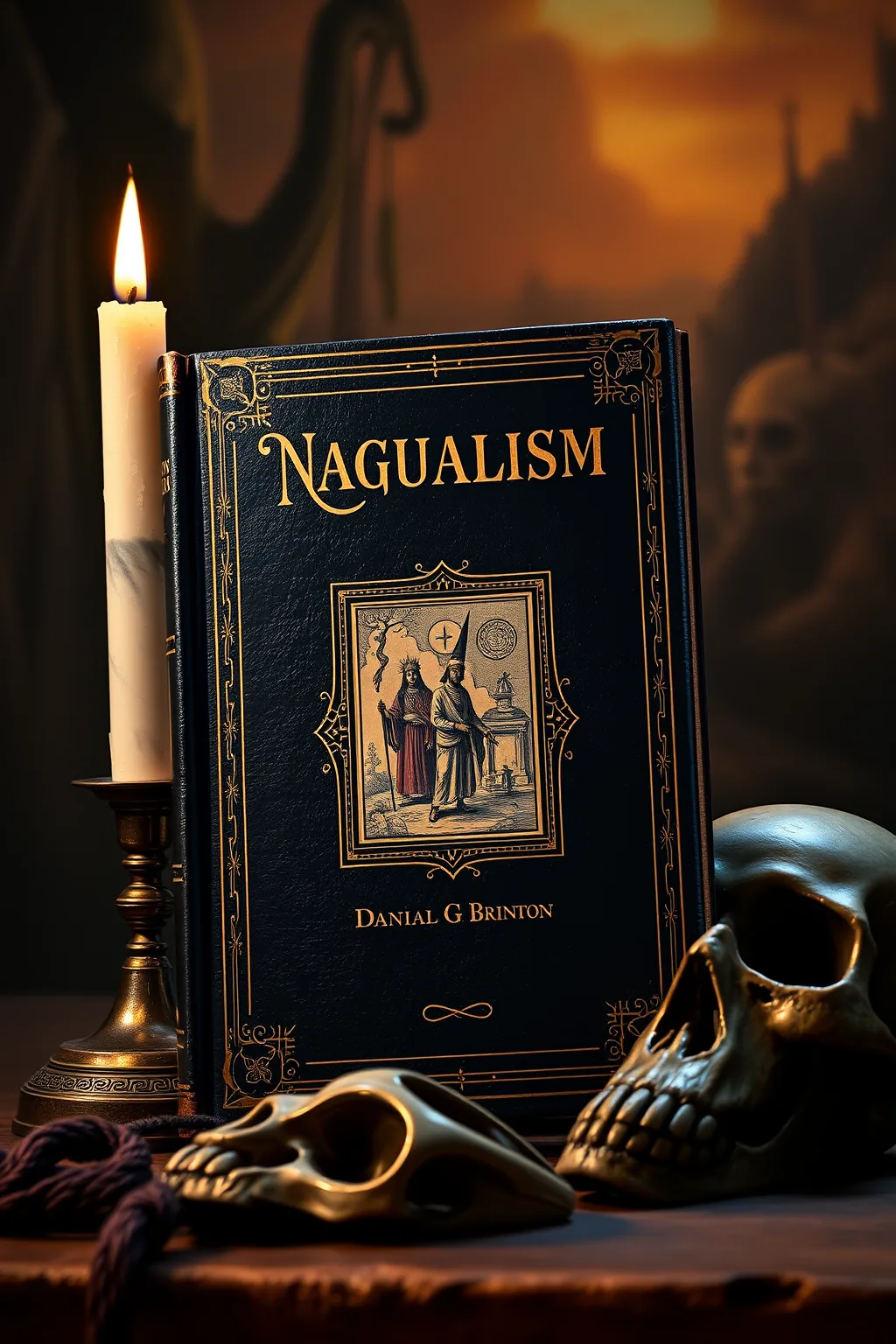
Nagualism
 71
71

Nagualism


Ophelia Vance (Mystical Literature Reviewer) — Nagualism by Danial G. Brinton is an indispensable cornerstone for anyone exploring the depths of Native American shamanism and esoteric traditions. Brinton meticulously reconstructs the belief systems surrounding the Nagual, a shape-shifting entity central to many Mesoamerican cosmologies. His work illuminates the profound connection between spiritual practice, altered states of consciousness, and the symbolic language of the natural world. The book's strength lies in its scholarly rigor coupled with an evident respect for the indigenous worldview, offering insights that resonate with practitioners and academics alike. It serves as a crucial, often overlooked, precursor to modern explorations of shamanic journeys and altered perception, making it essential reading for seekers of ancient wisdom.
📝 Description
71
Danial G. Brinton presented his study of Nagualism before the American Philosophical Society.
In 1894, Danial G. Brinton's "Nagualism" examined the spiritual practices and beliefs of indigenous peoples in North America. The work details concepts such as shapeshifting, soul flight, and the role of animal familiars within these traditions. Brinton analyzed the cosmological frameworks and visionary states associated with Nagualism, drawing on available ethnographic and historical sources. He approached the subject with a scholarly rigor, attempting to understand the internal logic of these belief systems.
The book covers the reported abilities and transformations attributed to individuals within Nagualist traditions. It discusses the symbolic significance of animals and the connection between the physical and spiritual realms as understood by these cultures. "Nagualism" sought to document and interpret these phenomena for a Western academic audience, presenting them as integral aspects of the indigenous worldview.
Nagualism belongs to the study of shamanic traditions and indigenous spiritual systems. It engages with themes common in comparative mythology and folklore, particularly concerning altered states of consciousness and the perceived ability to interact with the spirit world. The book situates these practices within the broader context of Native American religious life, examining how they informed social structures and individual experience. It reflects an early academic attempt to categorize and understand these phenomena from a Western perspective, placing them within a developing field of religious studies.
✍️ Author
Danial G. Brinton and read before the Ame
Classic literature author · Public Domain
💡 Why Read This Book?
Uncover the ancient roots of visionary experiences and shamanic practices. Explore a foundational text that predates modern interpretations of Native American spirituality. Ideal for seekers of esoteric knowledge, scholars of folklore and anthropology, and practitioners interested in the profound symbolism of indigenous traditions. Discover a rich tapestry of beliefs that connect the human spirit to the cosmos.
⭐ Reader Reviews
Honest opinions from readers who have explored this book.
❓ Frequently Asked Questions
What is Nagualism?
Nagualism refers to a complex system of beliefs and practices found in some Native American cultures, particularly in Mesoamerica, involving spiritual transformation, shape-shifting, and a deep connection to the animal kingdom and visionary states.
Who was Danial G. Brinton?
Danial G. Brinton was an American surgeon, ethnologist, and scholar who extensively studied Native American languages, cultures, and mythologies, contributing significantly to the academic understanding of these subjects.
Is this book related to Carlos Castaneda?
Yes, Brinton's 'Nagualism' is considered foundational material that likely influenced Carlos Castaneda's later popular works on Yaqui sorcery, providing an academic framework for many of the concepts he explored.
What kind of 'folklore' does it cover?
It covers the folklore surrounding shapeshifting ('naguals'), shamanic practices, dream journeys, hallucinogenic plant use for spiritual insight, and the animistic beliefs of various indigenous tribes.
Is this book suitable for beginners?
While scholarly, the book offers accessible insights into complex spiritual concepts. Beginners interested in the esoteric roots of indigenous traditions will find it a valuable, albeit dense, starting point.
🔮 Key Themes & Symbolism
The Nagual and Metamorphosis
This theme looks at the central concept of the 'Nagual,' often understood as a spiritual double or a being capable of transforming into animal forms. Brinton meticulously examines the folklore surrounding these entities, exploring how they represent a profound connection between the human psyche, the animal kingdom, and the forces of nature. The concept of metamorphosis in Nagualism is not merely physical but symbolic, representing spiritual evolution, the unlocking of hidden potentials, and the ability to transcend ordinary limitations through esoteric knowledge and practice.
Visionary States and Shamanic Practices
The book illuminates the significant role of altered states of consciousness in indigenous spiritual traditions. It details how certain compounds and rituals were employed to induce visionary experiences, allowing individuals to commune with the spirit world, gain prophecy, and acquire knowledge beyond the mundane. Brinton's research highlights the shaman's role as a mediator between the visible and invisible realms, a keeper of ancient wisdom, and a healer who navigates the energetic currents of existence.
Symbolism of the Natural World
Nagualism is deeply interwoven with the symbolism of the natural world. Animals, plants, celestial bodies, and the elements are not merely environmental factors but potent symbols imbued with spiritual meaning and power. Brinton illustrates how indigenous cultures interpreted these symbols as reflections of cosmic order and the underlying spiritual forces governing reality. Understanding this rich symbolic language is key to deciphering the Nagualist worldview and its clear insights into the interconnectedness of all life.
💬 Memorable Quotes
Direct passages from the work, attributed to the author.
“Dreams were considered pathways to other worlds.”
— This highlights the importance of the dream state in Nagualist traditions, viewing it not as mere subconscious activity but as a sacred portal for spiritual exploration and communication with unseen realms.
“The study of ancient beliefs reveals the persistence of primal spiritual forces.”
— This suggests that exploring archaic mythologies and practices uncovers fundamental, enduring spiritual energies that continue to influence human consciousness and the natural world.
“Nature itself is a vast library of hidden knowledge.”
— This emphasizes the animistic perspective within Nagualism, where the natural world is seen as a living repository of wisdom, offering clear insights to those who can interpret its signs and symbols.
💡 Key Ideas
Editorial paraphrase of the work's core concepts — not direct quotes.
The Nagual is a spirit that can transform into animal forms.
This quote expresses the core concept of the Nagual, representing a spiritual entity's ability to manifest in the physical world as an animal, symbolizing a profound connection to primal energies and transformative power.
The journey of the spirit is as real as the journey of the body.
This quote underscores the belief in the primacy of spiritual experience and the validity of internal, unseen journeys, equating their significance and reality to physical travel and existence.
🌙 Esoteric Significance
Tradition
Nagualism is deeply rooted in ancient Mesoamerican spiritual traditions, particularly those of Nahuatl and Mayan peoples, though Brinton also draws parallels with other indigenous belief systems. It represents a complex form of shamanism, animism, and ecstatic religion, focusing on the interplay between the human soul, the natural world, and the spirit realm. It is a tradition that emphasizes direct spiritual experience, transformation, and the hidden powers inherent in both the individual and the cosmos.
Symbolism
The symbolism within Nagualism is rich and complex. The 'Nagual' itself, often associated with animal familiars or spirit doubles, symbolizes the primal, untamed aspects of the psyche and the capacity for transformation. Animals represent specific spiritual energies and archetypes, while celestial bodies and natural phenomena are seen as manifestations of divine will or cosmic cycles. Dreams, visions, and specific plants serve as symbolic conduits to deeper truths, with their interpretation forming a crucial part of the esoteric knowledge passed down through generations.
Modern Relevance
In contemporary times, Nagualism offers clear insights into the nature of consciousness, the human-spirit connection, and the wisdom of indigenous cultures. Its emphasis on the interconnectedness of all life, the power of inner transformation, and the validity of visionary experiences speaks to modern spiritual seekers, psychologists, and those disillusioned with purely materialistic worldviews. The study of Nagualism provides a vital counterpoint to Western reductionism, reminding us of the ancient, potent ways of knowing and being in the world that are still relevant today.
👥 Who Should Read This Book
This key work is essential for scholars of anthropology, folklore, and religious studies seeking a foundational understanding of Native American spiritual practices. It is useful for esoteric practitioners and spiritual seekers interested in shamanism, altered states of consciousness, and indigenous cosmologies. Those fascinated by the roots of concepts explored in modern shamanic literature, such as Carlos Castaneda's works, will find Brinton's meticulous research a crucial precursor. Beginners drawn to the mysteries of ancient belief systems will discover a rich, albeit dense, introduction to a profound and enduring worldview.
📜 Historical Context
Penned in an era when the academic study of non-Western cultures was burgeoning, Danial G. Brinton's 'Nagualism' emerged from a late 19th-century intellectual climate fascinated by ethnography, comparative mythology, and the perceived 'primitive' origins of human thought. The American Philosophical Society, a venerable institution founded by Benjamin Franklin, provided a platform for disseminating scholarly findings. At this time, there was a growing interest in understanding the spiritual and cultural landscapes of Native American peoples, often viewed through lenses of romanticism, scientific curiosity, or a paternalistic desire for 'civilization.' Brinton's work, while contributing to this academic discourse, stands out for its respectful engagement with indigenous belief systems, offering a more nuanced perspective than many of his contemporaries. The book's publication predates the widespread popularization of shamanism by figures like Carlos Castaneda, positioning it as a crucial, foundational text for those seeking earlier, scholarly examinations of these profound traditions.
📔 Journal Prompts
Reflect on a time you felt a deep connection with an animal. What qualities did you perceive in it, and how might they relate to your own inner nature?
Consider the concept of 'spirit doubles.' How might the idea of having a spiritual counterpart influence one's perception of self and the world?
Explore the role of dreams in your life. Do you believe they hold messages or offer insights beyond ordinary waking consciousness? How can you pay more attention to them?
What aspects of the natural world (plants, animals, landscapes) resonate most deeply with you? How do you interpret their symbolic meaning in your life?
Imagine you could transform into an animal. Which animal would you choose and why? What spiritual lessons might this transformation offer you?
🗂️ Glossary
Nagual
In Mesoamerican folklore, a spiritual entity or individual capable of transforming into an animal form, often seen as a spiritual double or a being connected to primal forces.
Shamanism
A spiritual practice involving a practitioner who is believed to be able to communicate with the spirit world, often through altered states of consciousness, to heal, divine, or guide.
Animism
The belief that natural objects, phenomena, and the universe itself possess a distinct spiritual or soul-like essence, imbuing them with consciousness and agency.
Visionary Experience
An altered state of consciousness characterized by profound sensory perceptions, vivid imagery, and often spiritual or mystical insights, typically induced by ritual or psychoactive substances.
Cosmology
A model of the universe, including its origin, structure, and underlying principles, particularly as understood through a specific cultural or spiritual framework.
This book appears in 2 collections
🔮 Readers Also Liked
Browse all →



From the “Witchcraft” Collection
View all →







More Free Witchcraft & Paganism Books
View all →







![BAILEY, Michael D. Historical Dictionary Of Witchcraft. [inglês]](/img/thumb/bailey-michael-d-historical-dictionary-of-witchcraft-ingl-s.webp)
