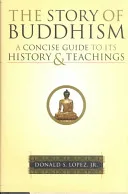
The Story of Buddhism
 72
72

The Story of Buddhism
Donald S. Lopez Jr.'s *The Story of Buddhism* is a commendable effort to distill a complex global religion into an accessible narrative. Lopez, a respected scholar, successfully demystifies Buddhist practices and teachings, presenting them with clarity and an appreciation for their lived reality. His skill in blending analytical depth with engaging prose is evident, particularly when illustrating the common threads and divergences among major Buddhist traditions. A significant strength lies in its focus on practice, making the abstract accessible. However, the sheer breadth of the subject means that some nuances of specific schools, especially those less represented in Western scholarship prior to 2001, might feel somewhat condensed. For instance, the discussion on tantric Buddhism, while present, could perhaps benefit from further elaboration given its esoteric significance. The book ultimately offers a balanced and informative introduction, proving its value for both newcomers and those with existing knowledge.
📝 Description
72
Donald S. Lopez Jr.'s 2001 book, *The Story of Buddhism*, examines Buddhist thought and practice beyond simplistic views.
Published in 2001, Donald S. Lopez Jr.'s *The Story of Buddhism* offers a clear introduction to Buddhist thought and practice. The book moves past common oversimplifications to detail the core ideas, various schools, and everyday application of Buddhist principles. Lopez emphasizes how Buddhist concepts are lived out in daily life across different traditions, presenting a grounded view of their lasting appeal and practical use.
This work is for anyone seeking a straightforward, open-minded understanding of Buddhism. It is especially useful for students of religion, philosophy, and world cultures. Buddhists who wish to learn more about the historical development and connections between different schools will find it valuable. Newcomers to Buddhist ideas will appreciate its clear presentation, which does not compromise scholarly depth.
The book appeared as Western interest in Buddhism grew significantly. Lopez's work contributed to Buddhist studies by focusing on actual lived experiences and the varied forms Buddhism takes, rather than solely on doctrine. It provided a broad overview that recognized the diversity of Buddhist traditions, unlike earlier, more uniform introductions.
Lopez's work contributes to the study of Buddhism as a living tradition, moving beyond purely philosophical or doctrinal analyses that characterized some earlier Western scholarship. It connects with a lineage of scholars who sought to understand Buddhism not just as a historical or textual phenomenon, but as a practice and a way of life. By detailing the evolution of Buddhist thought and its manifestation across different cultures and times, the book situates itself within the broader contemplative traditions that seek to understand the human condition through meditative and ethical frameworks.
💡 Why Read This Book?
• Gain a structured understanding of Buddhist history and its major schools, learning how traditions like Theravada and Mahayana diverged after the Buddha's passing in 483 BCE. • Appreciate the emphasis on lived practice, understanding how concepts like the Four Noble Truths are integrated into daily life, not just abstract philosophy. • Grasp the distinctions and commonalities between Buddhist traditions, learning about the development of different monastic and lay communities across Asia.
⭐ Reader Reviews
Honest opinions from readers who have explored this book.
❓ Frequently Asked Questions
When was Donald S. Lopez Jr.'s 'The Story of Buddhism' first published?
Donald S. Lopez Jr.'s 'The Story of Buddhism' was first published on June 5, 2001, making it a relatively contemporary scholarly introduction to the subject.
What is the main focus of 'The Story of Buddhism' by Donald S. Lopez Jr.?
The book focuses on demystifying Buddhism by explaining its practices, teachings, and schools, with a particular emphasis on actual lived practice and the appeal of Buddhism through history.
Is 'The Story of Buddhism' suitable for beginners?
Yes, it is designed as an engaging and lucid introduction, making complex Buddhist concepts accessible without sacrificing scholarly depth, ideal for those new to the subject.
Does the book cover different schools of Buddhism?
Absolutely. Lopez explores the commonalities and differences among major Buddhist traditions, providing an overview of their distinct teachings and practices.
What is Donald S. Lopez Jr.'s background?
Donald S. Lopez Jr. is a leading Buddhist scholar and Professor of Buddhist and Tibetan Studies at the University of Michigan, renowned for his extensive research and writings on Buddhism.
How does the book explain the appeal of Buddhism?
It explains Buddhism's appeal by highlighting how its teachings and practices have offered practical help and meaning to individuals across diverse cultures and historical periods.
🔮 Key Themes & Symbolism
Lived Practice Over Doctrine
Lopez shifts focus from abstract philosophical debates to how Buddhist principles are actually lived. This approach reveals the practical application of teachings like the Four Noble Truths in everyday existence, demonstrating Buddhism's enduring relevance. It highlights how rituals, meditation, and ethical conduct are not mere theoretical constructs but integral components of spiritual development for millions across diverse cultures and historical epochs, making the esoteric accessible through tangible actions.
Diversity of Buddhist Schools
The work emphasizes the vast spectrum of Buddhist traditions, from the early schools to later developments like Mahayana and Vajrayana. It meticulously details the commonalities and divergences, illustrating how a shared lineage can manifest in distinct philosophical interpretations and ritualistic practices across different regions. This exploration clarifies the perception of Buddhism as a monolithic entity, revealing its rich, complex nature and historical evolution since the Buddha's passing around 483 BCE.
The Buddha's Teachings
Central to the narrative is an exploration of the core teachings attributed to Siddhartha Gautama, the historical Buddha. Lopez examines foundational concepts such as karma, rebirth, and the path to enlightenment, presenting them in a manner that is both scholarly and comprehensible. The book clarifies the historical context of these teachings and traces their transmission and transformation through centuries of monastic and lay engagement, offering insight into their profound influence.
Appeal and Utility
Lopez investigates why Buddhism has resonated with so many people across millennia and continents. The book argues that its appeal lies in its practical guidance for alleviating suffering and cultivating wisdom and compassion. By focusing on the tangible benefits and psychological insights offered by Buddhist practices, the work explains its enduring utility as a path toward personal transformation and ethical living in a complex world.
💬 Memorable Quotes
Direct passages from the work, attributed to the author.
“Buddhism has been appealing and helpful through...”
— This points to the book's core thesis: Buddhism's enduring relevance stems from its practical applications and ability to provide solace and guidance, rather than solely its complex philosophical doctrines.
“The Story of Buddhism focuses on actual lived practice...”
— This highlights Lopez's methodological approach, emphasizing the experiential and ethical dimensions of Buddhism over purely theoretical or historical accounts, making it accessible.
“clarifies Buddhism and explains its practices, teachings, and schools.”
— This captures the book's primary objective: to clarify the often-misunderstood aspects of Buddhism, presenting a coherent and understandable overview for a broad audience.
“Blending penetrating analysis with engaging storytelling...”
— This describes the narrative style, suggesting a balance between rigorous academic scholarship and a narrative that captures the reader's interest, making complex subjects more palatable.
“reveals the commonalities and differences among the major traditions.”
— This indicates the book's comparative approach, underscoring its value in understanding the diverse expressions of Buddhism worldwide and their interconnectedness.
🌙 Esoteric Significance
Tradition
While *The Story of Buddhism* is primarily an academic introduction rather than a text from a specific esoteric lineage, it serves as a crucial foundational text for those exploring esoteric traditions influenced by Buddhism. Its scholarly yet accessible approach allows practitioners of Western esoteric paths (like Theosophy or certain branches of modern occultism) to gain a solid understanding of Buddhist cosmology, ethics, and contemplative practices, which often intertwine with or are referenced within these Western systems. It provides the necessary context for understanding Buddhist concepts that have been integrated into broader esoteric frameworks.
Symbolism
The book explains core Buddhist symbols and motifs, such as the lotus flower, often associated with purity and enlightenment, or the Dharma wheel, representing the Buddha's teachings and the path to liberation. While not examining esoteric interpretations per se, Lopez contextualizes these symbols within their historical and doctrinal significance. For esoteric students, understanding the original Buddhist meanings of these symbols is vital, as they are frequently recontextualized and utilized within Western esoteric traditions, often carrying layered meanings related to spiritual ascent and cosmic order.
Modern Relevance
Contemporary thinkers and practitioners in fields ranging from comparative religion to mindfulness-based therapies draw heavily on scholarly works like Lopez's to understand the roots of Buddhist practices. Modern esoteric movements that incorporate Buddhist philosophy, such as certain forms of Western Buddhism or new age spirituality, rely on such texts for accurate grounding. Furthermore, scholars examining the globalization of religions and the adaptation of Eastern traditions in the West find this book indispensable for tracing the transmission and evolution of Buddhist ideas and practices beyond their Asian origins.
👥 Who Should Read This Book
• Students of comparative religion and world philosophies seeking a clear, scholarly overview of Buddhism's historical development and core tenets. • Individuals interested in understanding the practical and ethical dimensions of Buddhist practice, moving beyond abstract doctrines to lived experience. • Scholars and practitioners of esoteric traditions who require a foundational understanding of Buddhist concepts, symbols, and practices that often inform Western esoteric thought.
📜 Historical Context
When Donald S. Lopez Jr.'s *The Story of Buddhism* was released in 2001, the study of Buddhism in the West was in a period of significant growth and diversification. Academic discourse was moving beyond purely textual or philosophical analyses to incorporate anthropological and historical perspectives on lived religious experience. Lopez's work contributed to this trend by offering a lucid, comprehensive overview that acknowledged the pluralism of Buddhist traditions, a departure from earlier, often simplified, introductions. It engaged with the ongoing scholarly conversation about the historical development of Buddhist thought and practice, implicitly responding to the need for accessible yet rigorous scholarship. While not directly engaging in a polemic, the book's emphasis on the diversity and lived reality of Buddhism offered a counterpoint to more essentialist or romanticized Western interpretations prevalent in some circles, aligning with scholars who championed nuanced, historically grounded studies.
📔 Journal Prompts
The Four Noble Truths as a framework for understanding suffering.
The historical development of Buddhist monastic communities.
The concept of karma and its practical implications.
The role of meditation in Buddhist practice across traditions.
Siddhartha Gautama's journey from prince to Buddha.
🗂️ Glossary
Siddhartha Gautama
The historical figure who attained enlightenment and became known as the Buddha, the founder of Buddhism. His life and teachings form the basis of Buddhist philosophy and practice.
Dharma
A complex term in Buddhism referring to the teachings of the Buddha, cosmic law, truth, or phenomena. It is central to the Buddhist path and is one of the Three Jewels.
Sangha
The community of Buddhist monks, nuns, and sometimes lay followers. Traditionally, it refers to the monastic order, considered one of the Three Jewels that provide refuge.
Karma
The principle of cause and effect where volitional actions create future consequences. In Buddhism, karma influences rebirth and the cycle of suffering (samsara).
Nirvana
The ultimate goal in Buddhism, representing the cessation of suffering, desire, and the cycle of rebirth. It is a state of liberation and profound peace.
Mahayana
A major branch of Buddhism that emphasizes the ideal of the Bodhisattva, one who delays their own enlightenment to help all sentient beings achieve liberation.
Theravada
The 'School of the Elders,' considered the oldest surviving branch of Buddhism, prevalent in South and Southeast Asia. It emphasizes the original teachings of the Buddha.