Hindu World
 82
82

Hindu World
Benjamin Walker's "Hindu World" is an ambitious, if somewhat dated, survey of a vast religious tradition. Its strength lies in its sheer comprehensiveness; the 700+ articles, cross-referenced extensively, provide a structured entry point into Hinduism's multifaceted nature. Walker’s commendable effort to integrate modern scholarship with traditional perspectives is evident, particularly in his detailed explanations of concepts like *dharma* and the various *darshanas*. However, the work's age is also its primary limitation. The scholarship, while advanced for 1968, naturally does not reflect decades of subsequent archaeological discoveries, textual analyses, or evolving theological interpretations within Hinduism itself. For instance, while discussing the Vedic period, it may not fully incorporate later scholarship on the Indus Valley Civilization's potential links to later Hindu practices. Despite this, "Hindu World" remains a valuable, dense reference for anyone seeking a foundational, encyclopedic understanding of Hindu life and thought from a mid-20th-century academic viewpoint.
📝 Description
82
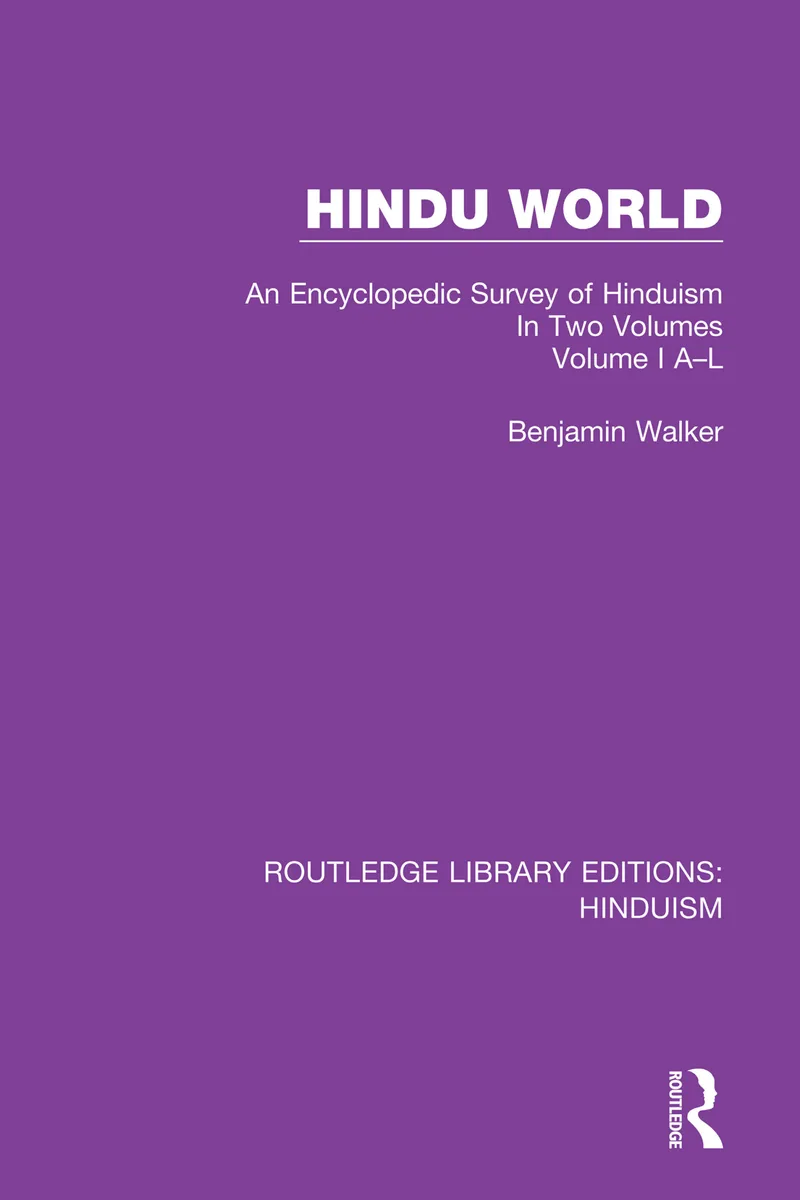
Benjamin Walker's Hindu World, published in 1968, is a two-volume encyclopedia detailing over 700 Hindu subjects.
Benjamin Walker's Hindu World is a two-volume encyclopedia first published in 1968. It presents a comprehensive overview of Hinduism, covering its beliefs, practices, deities, and philosophical systems. The work organizes information through over 700 distinct articles, linked by cross-references to create a coherent understanding of Hindu thought. This reference is intended for serious students of religion, comparative theology, and cultural history. Scholars seeking a foundational text for understanding Hinduism's diverse expressions, from ancient Vedic origins to modern forms, will find it valuable. It also offers significant information for those interested in Dharmic traditions.
Walker's work appeared when Western academic interest in Eastern religions was increasing, but comprehensive scholarly resources were limited. Hindu World distinguished itself by combining modern critical scholarship with an appreciation for traditional viewpoints. This systematic resource significantly influenced subsequent academic discussions of Hinduism in the West. It breaks down complex concepts like cosmology, karma, dharma, and moksha into accessible articles. Readers can also find detailed explanations of the Hindu pantheon, various philosophical systems (darshanas), yogic practices, and the socio-religious structures that have shaped Hindu civilization.
Published in 1968, Benjamin Walker's Hindu World emerged during a period of growing academic engagement with Eastern religious traditions in the West. While not exclusively an esoteric text, its encyclopedic scope covered concepts central to many esoteric interpretations of Hinduism, such as yogic practices, the philosophical schools (darshanas), and the complex cosmology. Walker's approach, which balanced critical scholarship with an appreciation for traditional viewpoints, made these often complex and symbolically rich traditions more accessible to a wider audience. The work functions as a detailed reference for the underlying structures and beliefs that inform both mainstream and more specialized spiritual paths within Hinduism.
💡 Why Read This Book?
• Gain a foundational understanding of over 700 distinct Hindu subjects, from the concept of *moksha* to the intricacies of Vedic rituals, presented in a structured, encyclopedic format. • Access a mid-20th-century scholarly perspective that bridges modern academic analysis with traditional Hindu viewpoints, offering context for how Hinduism was understood in 1968. • Explore the interconnectedness of Hindu concepts through an extensive cross-referencing system, allowing for deep dives into related topics like *karma* and *dharma*.
⭐ Reader Reviews
Honest opinions from readers who have explored this book.
❓ Frequently Asked Questions
When was Benjamin Walker's "Hindu World" originally published?
Benjamin Walker's "Hindu World" was first published in 1968. The work is presented here as part of a curated collection, reflecting its enduring significance in the study of esoteric sciences.
How many articles are included in "Hindu World"?
The encyclopedia contains over 700 articles. Each article provides a comprehensive account of its subject and is interconnected with related topics through a system of cross-references.
What is the primary scope of "Hindu World"?
The book covers the entirety of Hinduism, detailing its major aspects of life and thought. It aims to present the results of modern scholarship while also acknowledging traditional viewpoints.
What kind of approach does "Hindu World" take towards its subject matter?
Walker's approach combines modern scholarly findings with an appreciation for traditional perspectives. This dual focus ensures a balanced and comprehensive overview of Hindu beliefs and practices.
Is "Hindu World" suitable for beginners in the study of Hinduism?
Yes, while dense and scholarly, its encyclopedic nature and cross-referencing system make it a valuable starting point for beginners seeking a structured overview of Hinduism's complex subject matter.
What makes "Hindu World" a significant work in the study of religion?
It was one of the first comprehensive encyclopedias of Hinduism to integrate modern scholarship with traditional viewpoints, providing a systematic reference for scholars and students alike since its 1968 publication.
🔮 Key Themes & Symbolism
The Hindu Pantheon
Walker's encyclopedia systematically details the vast array of Hindu deities, providing essential information on figures like Brahma, Vishnu, Shiva, and the various goddesses such as Durga and Lakshmi. It explores their mythological roles, iconography, and the specific forms of worship associated with them, offering a structured way to comprehend the divine hierarchy and the devotional practices (bhakti) central to many Hindu traditions.
Philosophical Systems (Darshanas)
The work meticulously outlines the six orthodox schools of Hindu philosophy, known as the *shad-darshanas*. These include Nyaya, Vaisheshika, Samkhya, Yoga, Mimamsa, and Vedanta. Walker elucidates their core tenets, epistemological approaches, and metaphysical frameworks, such as the Samkhya concept of *purusha* and *prakriti*, providing clarity on the intellectual underpinnings of Hindu thought.
Concepts of Dharma and Karma
Central to Hindu worldview, the concepts of *dharma* (righteous duty, cosmic order) and *karma* (action and its consequences) are thoroughly examined. The encyclopedia explains how these principles govern individual lives and the cyclical nature of existence (samsara), influencing one's rebirth and ultimate liberation (moksha).
Vedic and Ritualistic Traditions
Walker looks at the foundational Vedic scriptures and the elaborate sacrificial rituals that characterized ancient Hinduism. It explores the hymns of the Rigveda, the priestly traditions, and the evolving significance of these practices through the Brahmanical and Upanishadic periods, connecting ancient rites to later developments.
💬 Memorable Quotes
Direct passages from the work, attributed to the author.
“The encyclopedia provides a comprehensive account of the subject, interlinking all related topics.”
— This highlights the work's encyclopedic structure and its innovative use of cross-references, designed to create a holistic understanding of Hinduism's interconnected elements.
“It embodies the results of modern scholarship yet not ignoring the traditional point of view.”
— This statement underscores Walker's balanced approach, aiming to reconcile contemporary academic analysis with the enduring perspectives found within Hindu traditions themselves.
“Hinduism is presented in its entirety in two volumes.”
— This emphasizes the ambitious scope of the work, aiming to offer a complete, albeit condensed, overview of a complex and diverse religious civilization.
“Over 700 articles give a comprehensive account of the subject.”
— This quantifies the depth of coverage, indicating the extensive range of topics addressed within the encyclopedia's detailed articles.
“The work covers every major aspect of Hindu life and thought.”
— This asserts the encyclopedic breadth of "Hindu World," claiming to touch upon all significant facets of Hindu civilization, from its spiritual doctrines to its social structures.
🌙 Esoteric Significance
Tradition
While not strictly aligned with a single esoteric lineage like Hermeticism or Kabbalah, "Hindu World" serves as a foundational reference for those exploring the esoteric dimensions embedded within Hinduism. It provides the essential background for understanding concepts like yoga, mantra, and the subtle body, which are often integrated into Western esoteric practices influenced by Eastern thought, particularly through theosophy and later New Age movements.
Symbolism
The encyclopedia illuminates key symbols central to Hindu esoteric traditions. For instance, the symbol of *Om* (Aum) is explored for its representation of the ultimate reality and the sound of creation, crucial in meditation and yogic practices. The *Lotus* (Padma) is discussed as a symbol of purity, spiritual awakening, and divine beauty, often associated with deities and enlightened beings.
Modern Relevance
Contemporary practitioners of yoga, meditation, and various forms of Eastern-inspired spirituality frequently consult works like "Hindu World" for accurate background information. Thinkers and teachers in fields ranging from comparative mythology to integral psychology often draw upon its comprehensive data to contextualize their own explorations of consciousness and the sacred.
👥 Who Should Read This Book
• Students of comparative religion and mythology seeking a comprehensive, alphabetically organized reference for Hindu deities, concepts, and practices. • Scholars of South Asian studies requiring a foundational text that details the historical and philosophical breadth of Hinduism from a mid-20th-century academic perspective. • Individuals interested in the esoteric and spiritual traditions of India who need a structured overview of concepts like *dharma*, *karma*, and various yogic paths.
📜 Historical Context
Published in 1968, Benjamin Walker's "Hindu World" emerged during a period of burgeoning Western interest in Eastern religions, often fueled by the counterculture movement and a search for alternative spiritualities. This era saw figures like Mircea Eliade publishing influential works on comparative religion, though often with a more phenomenological or mythic emphasis. Walker's contribution was distinct in its encyclopedic approach, aiming for a systematic cataloging of Hindu elements grounded in what was then considered modern scholarship. Its reception was largely positive within academic circles for its breadth and accessibility, providing a structured counterpoint to more esoteric or impressionistic accounts of India. Unlike contemporaries who might focus on a single philosophical school or deity, Walker sought to map the entire terrain. The work offered a valuable, if somewhat Western-centric, academic framework for understanding a tradition frequently misunderstood or exoticized in popular discourse.
📔 Journal Prompts
The concept of *dharma* as presented in Walker's encyclopedia and its potential application to modern ethical dilemmas.
Analysis of the interconnectedness between the Vedic rituals described and later Hindu devotional practices.
Comparison of the philosophical underpinnings of the *Samkhya* school with other metaphysical systems.
Reflection on the symbolic representations of major Hindu deities and their archetypal significance.
Mapping the evolution of the concept of *moksha* across different Hindu philosophical schools detailed in the text.
🗂️ Glossary
Dharma
In Hinduism, dharma refers to one's duty, righteousness, cosmic law, and the underlying order of the universe. It encompasses ethical conduct, social obligations, and the principles that sustain reality.
Karma
The principle of cause and effect, where actions (karma) performed by an individual influence their present life and future rebirths. It is a fundamental concept governing the cycle of existence (samsara).
Moksha
Liberation or release from the cycle of birth, death, and rebirth (samsara). It is the ultimate spiritual goal in many Hindu traditions, often achieved through knowledge, devotion, or ascetic practices.
Darshana
Literally 'view' or 'seeing,' darshana refers to one of the orthodox philosophical systems of Hinduism. There are typically considered to be six such systems (shad-darshanas).
Samsara
The continuous cycle of birth, death, and rebirth, driven by karma and ignorance. It is often viewed as a state of suffering from which liberation (moksha) is sought.
Vedas
The most ancient and foundational scriptures of Hinduism, comprising hymns, rituals, and philosophical insights. They are considered divinely revealed (shruti) texts.
Bhakti
Devotion or love towards a personal deity. Bhakti yoga is a path to spiritual liberation focused on cultivating intense love and surrender to God.