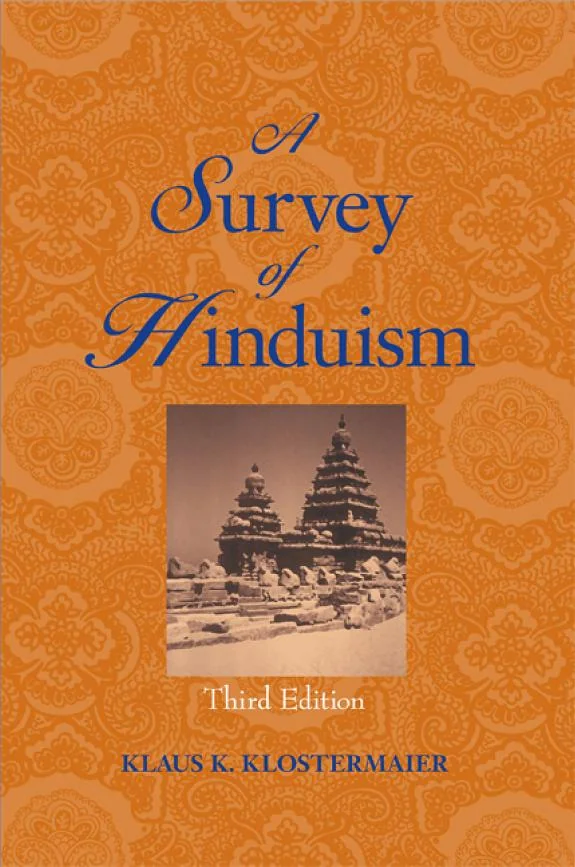
A Survey of Hinduism
 83
83

A Survey of Hinduism
Klaus K. Klostermaier’s "A Survey of Hinduism" achieves a commendable balance between academic rigor and accessible exposition. The third edition, updated in 2007, thoughtfully expands on the religion's origins and its dialogue with competing traditions, a strength that distinguishes it from more insular treatments. The inclusion of Hindu science, though brief, offers an intriguing angle. However, the sheer breadth of the subject matter inevitably means certain areas receive less depth than a specialist might desire; the nuanced evolution of Tantric practices, for instance, feels somewhat condensed. A particularly illuminating section details the philosophical underpinnings of Advaita Vedanta, contrasting it with other schools. For serious students of Indic religions, this remains a solid, informative resource.
📝 Description
83
Klaus K. Klostermaier's 2007 "A Survey of Hinduism" offers a structured view of a vast tradition.
This third edition of Klostermaier's survey details the beliefs, practices, and philosophies of Hinduism. It traces the religion's historical development from its Vedic origins through the Puranic age and into modern South Asia. The book examines Hinduism's interactions with other spiritual traditions and philosophical systems, noting periods of reform and renewal. It covers the religion's encounters with rival traditions and its engagement with scientific thought.
The text is intended for students of comparative religion, philosophy, and cultural history. Researchers, theological students, and intellectually curious readers will find its analysis useful for grasping a complex tradition. The book covers Hinduism from its earliest beginnings to its present forms, giving readers a structured understanding.
While not strictly an esoteric text itself, Klostermaier's survey provides the necessary academic framework for understanding traditions often considered esoteric. It grounds concepts such as Brahman, Atman, and the various yogic paths within their historical and philosophical contexts. By detailing the philosophical schools and devotional movements, the book allows readers to approach deeper spiritual inquiries with a solid academic understanding of Hinduism's diverse expressions.
💡 Why Read This Book?
• Gain a structured understanding of the origins of Hinduism, including its Vedic roots and the development of the Upanishads, providing a foundational historical perspective. • Explore the intricate relationships between Hinduism and rival traditions, understanding its historical dialogues and potential conflicts with other philosophical and religious systems. • Analyze the concept of Hindu science as presented in the text, offering a unique lens on the intersection of spirituality and empirical inquiry within the tradition.
⭐ Reader Reviews
Honest opinions from readers who have explored this book.
❓ Frequently Asked Questions
When was the third edition of A Survey of Hinduism published?
The third edition of Klaus K. Klostermaier's "A Survey of Hinduism" was published on July 5, 2007, incorporating new material and updated scholarship on the religion's origins and scientific engagement.
What does the book cover regarding Hinduism's origins?
The book delves into the foundational elements of Hinduism, tracing its historical development from ancient Vedic roots, offering insights into its earliest expressions and philosophical underpinnings.
Does A Survey of Hinduism discuss Hindu science?
Yes, the third edition of the book includes new material specifically on Hindu science, exploring its relationship with the religion and its historical context.
Who is the author of A Survey of Hinduism?
The author is Klaus K. Klostermaier, a respected scholar in the field of religious studies whose work provides a comprehensive overview of Hindu traditions.
What kind of rival traditions are discussed in relation to Hinduism?
The book examines Hinduism's interactions with various rival traditions, including its historical dialogues, philosophical engagements, and potential conflicts with other religious and spiritual systems.
Is A Survey of Hinduism suitable for beginners?
While comprehensive, the book is best suited for students and researchers seeking a structured, in-depth understanding. Beginners might benefit from starting with more introductory texts before tackling this detailed survey.
🔮 Key Themes & Symbolism
Vedic Roots and Upanishadic Thought
The text meticulously traces the lineage of Hindu thought back to the Vedic period, examining the foundational hymns and rituals. It then charts the philosophical evolution into the Upanishads, highlighting the development of core concepts like Brahman and Atman. This section is crucial for understanding the ontological and cosmological frameworks that underpin later Hindu traditions, offering a deep dive into the early intellectual currents that shaped the religion.
Interactions with Rival Traditions
Klostermaier analyzes the dynamic historical relationship between Hinduism and other religious and philosophical systems that emerged in India and beyond. This includes examining periods of syncretism, debate, and sometimes tension with traditions like Buddhism, Jainism, and later Islamic influences. Understanding these interactions provides critical context for the development of Hindu theology, practice, and social structures.
Hindu Science and Philosophy
This work offers a unique perspective by exploring the concept of Hindu science, examining how empirical observation and theoretical frameworks were integrated within religious and philosophical inquiry. It discusses the cyclical nature of time, cosmological models, and the philosophical underpinnings of practices that sought to understand the material world through a spiritual lens.
Paths of Liberation (Yoga)
The book provides a detailed exposition of the various paths to spiritual liberation (moksha) within Hinduism, most notably the different forms of Yoga. It elaborates on Karma Yoga (the path of action), Jnana Yoga (the path of knowledge), Bhakti Yoga (the path of devotion), and Raja Yoga (the path of meditation), explaining their methodologies and ultimate aims.
💬 Memorable Quotes
Direct passages from the work, attributed to the author.
“The religion's origins”
— This phrase points to the book's focus on the foundational historical and textual sources of Hinduism, emphasizing its deep roots in ancient Indian civilization.
“Its relations with rival traditions”
— This highlights the text's examination of Hinduism's historical and philosophical engagement with other belief systems, offering context for its development and unique characteristics.
“Hindu science”
— This refers to the book's exploration of how scientific inquiry and cosmological understanding were integrated within the broader framework of Hindu philosophy and religious practice.
“Diverse paths of Yoga”
— This captures the book's detailed exposition of different methodologies for spiritual realization, including action, knowledge, devotion, and meditation.
“Vedic and Upanishadic thought”
— This emphasizes the book's engagement with the foundational scriptures and philosophical texts that form the bedrock of Hindu tradition.
🌙 Esoteric Significance
Tradition
While not strictly an esoteric text in the Western sense (like Hermeticism or Kabbalah), "A Survey of Hinduism" engages with concepts that have significant esoteric dimensions within Hinduism itself. It explores yogic practices and philosophical schools (like Advaita Vedanta) that are often pursued for profound inner transformation and direct experience of reality, aligning with esoteric aims of spiritual realization and transcendence.
Symbolism
The book touches upon potent symbols like the Om (Aum) mantra, representing the primordial sound and the ultimate reality, and the concept of the chakras, energy centers within the subtle body explored in Tantric traditions. It also discusses the divine figures of the Trimurti (Brahma, Vishnu, Shiva) not just as deities but as representations of cosmic functions, revealing deeper philosophical layers.
Modern Relevance
Contemporary Western practitioners of yoga and meditation often engage with Hindu philosophy through secondary sources. Klostermaier’s text provides a scholarly bridge, offering accurate historical and philosophical context for practices like Hatha Yoga and mindfulness, which have become widespread. Thinkers and schools focused on consciousness studies and comparative spirituality can find grounded information on Indic concepts relevant to their research.
👥 Who Should Read This Book
• Students of comparative religion and philosophy: To gain a comprehensive and scholarly overview of the historical development, core tenets, and diverse schools of Hindu thought. • Researchers of Indic traditions: To access updated scholarship on Hinduism's origins, its relationship with rival belief systems, and its engagement with scientific concepts. • Individuals interested in Yoga and Meditation: To understand the philosophical and historical underpinnings of these practices within their original South Asian context.
📜 Historical Context
First published in 2007, Klaus K. Klostermaier's "A Survey of Hinduism" emerged in an academic landscape increasingly interested in comparative religion and the nuances of Indic traditions. The third edition specifically addressed the religion's origins, its interactions with rival traditions like Buddhism and Jainism, and its unique engagement with scientific thought. This period saw continued scholarly debate, building on the foundational work of figures like Surendranath Dasgupta and S. Radhakrishnan, who had earlier explored the philosophical depths of Hinduism. Klostermaier’s work positions itself as an updated synthesis, incorporating decades of subsequent research and offering a structured overview for students and scholars alike, seeking to present a coherent picture amidst diverse sectarian and philosophical developments.
📔 Journal Prompts
The Vedic roots of Brahman and Atman
Hinduism's dialogue with Buddhism and Jainism
The philosophical implications of Hindu science
The distinct paths of Karma Yoga and Jnana Yoga
The historical development of the Upanishads
🗂️ Glossary
Brahman
The ultimate, unchanging reality or absolute consciousness that is the source and substratum of all existence in Hindu philosophy, particularly in Vedanta.
Atman
The individual soul or self, which in many Hindu traditions is considered identical to Brahman, the universal consciousness.
Karma
The principle of cause and effect, where actions (karma) in this life influence future circumstances and rebirths in the cycle of Samsara.
Samsara
The continuous cycle of birth, death, and rebirth, driven by karma, from which liberation (moksha) is sought.
Moksha
Liberation or release from the cycle of Samsara, the ultimate goal in many Hindu traditions, often achieved through spiritual knowledge, devotion, or action.
Upanishads
A collection of philosophical texts forming the theoretical basis for much of Hindu philosophy, dealing with concepts such as Brahman, Atman, and the nature of reality.
Vedas
The oldest scriptures of Hinduism, comprising hymns, rituals, and philosophical insights, considered divinely revealed (shruti).