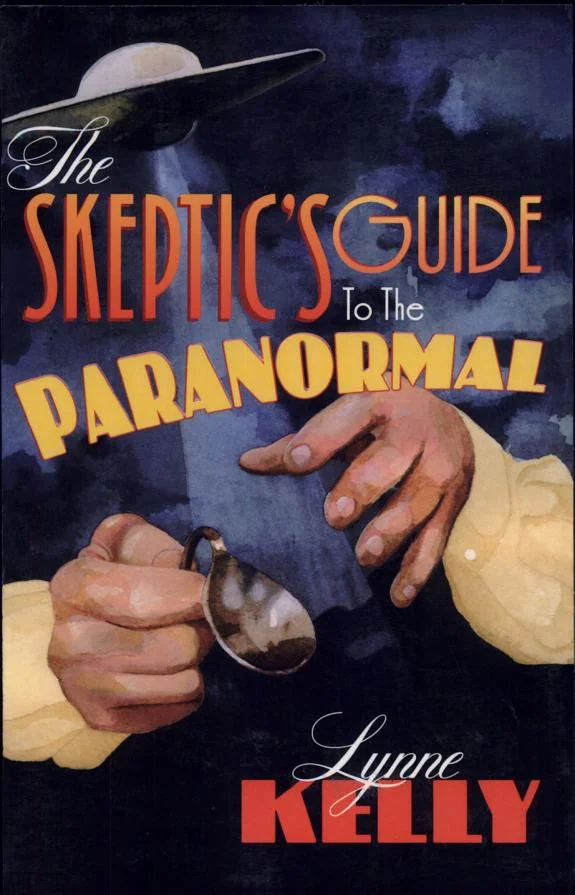
The Skeptic's Guide to the Paranormal
 75
75

The Skeptic's Guide to the Paranormal
Lynne Kelly’s "The Skeptic's Guide to the Paranormal" provides a much-needed dose of rationality to a field often clouded by sensationalism. Its strength lies in its systematic approach, dissecting 27 diverse phenomena, from the seemingly impossible feat of firewalking to the chilling concept of spontaneous human combustion, with clear, scientific explanations. Kelly’s explanation for firewalking, for example, hinges on the physics of heat transfer and the psychological state of participants, offering a concrete, verifiable alternative to supernatural interpretations. However, the book’s singular focus on debunking can sometimes feel reductive, potentially overlooking the deeper symbolic or psychological resonance some individuals find in these experiences. Despite this, the work serves as an excellent primer for anyone seeking to understand the scientific underpinnings of alleged paranormal events. Kelly's methodical deconstruction makes the extraordinary seem, if not ordinary, then at least understandable.
📝 Description
75
Lynne Kelly's 2004 book examines 27 paranormal phenomena with scientific explanations.
Published in 2004, "The Skeptic's Guide to the Paranormal" by Lynne Kelly systematically investigates 27 phenomena often considered outside mainstream science. Kelly applies principles from physics, psychology, and physiology to find naturalistic explanations for events like firewalking and alleged spontaneous human combustion. The book is written for those who approach extraordinary claims with critical thought and a desire to understand the scientific basis behind seemingly inexplicable occurrences. It is a useful resource for students of critical thinking, science communication, and parapsychology.
Kelly's work emerged during a period of significant public interest in the paranormal, a time also marked by a rise in skeptical literature. Researchers like James Randi were active, challenging paranormal claims and offering rewards for verifiable demonstrations. Kelly's contribution was a methodical approach that sought to demystify these phenomena through explanation, contributing to the ongoing discussions between believers and skeptics.
While this book engages with phenomena often discussed in esoteric circles, its framework is explicitly skeptical and scientific. It addresses claims that might be found in occult traditions or New Age beliefs but seeks to explain them through established scientific laws rather than supernatural or mystical forces. Kelly's work stands in contrast to many esoteric texts that embrace the unexplained, instead grounding its analysis in physics, psychology, and physiology to demystify alleged paranormal occurrences.
💡 Why Read This Book?
• Gain concrete explanations for 27 seemingly paranormal phenomena, understanding the scientific principles like adiabatic heating that underpin events such as firewalking, as detailed in Kelly's analysis. • Develop critical thinking skills by learning how to apply scientific reasoning to extraordinary claims, moving beyond anecdotal evidence as encouraged by the book's methodology. • Appreciate the psychological and physiological factors that contribute to reported paranormal experiences, such as the states induced during alleged psychic events, offering a different perspective on belief.
⭐ Reader Reviews
Honest opinions from readers who have explored this book.
❓ Frequently Asked Questions
What specific paranormal phenomena does Lynne Kelly explain in her book?
Lynne Kelly's "The Skeptic's Guide to the Paranormal" offers rational explanations for 27 phenomena, including walking over hot coals, spontaneous human combustion, psychic abilities, and near-death experiences, all examined through a scientific lens.
When was 'The Skeptic's Guide to the Paranormal' first published?
The book was first published in 2004, positioning it within a period of significant public interest in paranormal claims and a corresponding rise in skeptical analyses.
What scientific fields does the book draw upon for its explanations?
The work primarily utilizes principles from physics, psychology, and physiology to provide naturalistic explanations for alleged paranormal events, focusing on verifiable phenomena and cognitive biases.
Is the book aimed at people who believe in the paranormal?
While it can inform believers, the book is primarily intended for those with a skeptical inclination or a desire to understand the scientific reasoning behind seemingly inexplicable events.
Does the book discuss historical accounts of paranormal phenomena?
Yes, the book often references historical accounts and famous cases to illustrate the phenomena it examines, providing a historical context for its scientific deconstruction.
What is the core message of 'The Skeptic's Guide to the Paranormal'?
The core message is that many phenomena attributed to the paranormal can be explained through known scientific laws and psychological principles, encouraging critical evaluation of extraordinary claims.
🔮 Key Themes & Symbolism
Science vs. Supernatural
This theme directly contrasts empirical, testable scientific principles with claims of supernatural causation. Kelly meticulously dissects phenomena like firewalking, not by dismissing the experience, but by explaining the physics of heat transfer and the psychological state of the participants. The work argues that understanding these naturalistic explanations removes the need to invoke paranormal forces, thereby explaining events that appear to defy scientific laws. It champions a rationalist worldview where extraordinary claims require extraordinary evidence, which is often found to be lacking when subjected to scientific scrutiny.
Cognitive and Psychological Factors
Kelly looks at how the human mind can contribute to the perception or reporting of paranormal events. Concepts such as confirmation bias, suggestibility, and the power of belief are explored as crucial elements in understanding why people report extraordinary experiences. For instance, the way memory can be influenced or how group dynamics can reinforce shared beliefs are examined. This theme highlights that the subjective experience of the paranormal is often rooted in well-understood psychological mechanisms rather than external supernatural agents.
The Power of Explanation
This theme centers on the explanatory power of science to explain phenomena that might otherwise seem inexplicable or frightening. By providing clear, evidence-based accounts for events like spontaneous human combustion (often explained by the chain reaction theory), the book empowers readers with knowledge. The act of understanding the natural causes behind seemingly supernatural occurrences reduces mystery and fosters a more critical and informed perspective. It suggests that the satisfaction of a rational explanation can be as profound as belief in the unexplained.
Explaining Common Myths
The book systematically tackles widely held beliefs about the paranormal, from levitation to psychic predictions. Kelly aims to debunk these myths by providing accessible scientific counter-arguments. For example, alleged hauntings are often analyzed through environmental factors or psychological projection. The work serves as a guide for dissecting sensational stories and folklore, offering a grounded perspective that encourages readers to question sensational claims and seek verifiable evidence before accepting supernatural explanations.
💬 Memorable Quotes
Direct passages from the work, attributed to the author.
“Many paranormal claims can be explained by natural phenomena.”
— This core assertion underpins the entire work, suggesting that a scientific, rather than supernatural, lens is sufficient to understand seemingly inexplicable events like firewalking or psychic phenomena.
“Understanding the physics of heat transfer is key to firewalking.”
— This highlights the book's methodology: breaking down complex or seemingly impossible feats into understandable scientific principles, offering a rational alternative to paranormal explanations.
“Psychological states influence our perception of reality.”
— This points to the significant role of the human mind, including belief systems and suggestibility, in interpreting and reporting paranormal experiences, as explored throughout the book.
“Anecdotal evidence is insufficient for paranormal proof.”
— Kelly emphasizes the need for rigorous, verifiable evidence, contrasting it with personal stories or testimonials which, while compelling, lack scientific validity.
“Spontaneous combustion has naturalistic explanations.”
— This indicates the book's approach to even the most extreme paranormal claims, seeking scientific causes such as the chain reaction theory rather than accepting supernatural origins.
🌙 Esoteric Significance
Tradition
While not directly aligned with a specific esoteric tradition like Hermeticism or Gnosticism, Kelly's work functions as a critical external examination of phenomena often discussed within esoteric circles. It engages with claims that sometimes border on or are incorporated into mystical belief systems, such as psychic abilities or near-death experiences. The book's significance lies in its role as a 'gatekeeper' for rational thought, providing a counterpoint to purely faith-based or anecdotal acceptance of the extraordinary, which is often a prerequisite for deeper esoteric study.
Symbolism
The book does not focus on esoteric symbolism in the traditional sense. Instead, its 'symbols' are the phenomena themselves—firewalking, spontaneous combustion, psychic readings. These act as symbolic representations of humanity's enduring fascination with the unknown and the limits of our understanding. Kelly's interpretation strips away the mystique, revealing the underlying natural processes. The 'symbol' of the unexplained is thus reframed as the 'symbol' of discoverable scientific principles, shifting the focus from wonder to understanding.
Modern Relevance
In an era still saturated with misinformation and sensationalized paranormal content online, Kelly's work remains highly relevant. Contemporary thinkers and educators focused on critical thinking, media literacy, and scientific skepticism draw upon this book's methodical approach. It serves as a foundational text for understanding how to critically evaluate claims encountered on social media, in documentaries, or through popular culture, reinforcing the value of evidence-based reasoning in a world increasingly prone to belief without verification.
👥 Who Should Read This Book
• Inquisitive individuals seeking rational explanations for alleged paranormal events, providing a scientific counterpoint to supernatural claims. • Students and educators of critical thinking and science communication, offering concrete examples and methodologies for analyzing extraordinary claims. • Anyone interested in the psychology of belief and perception, understanding how cognitive biases and physiological states can influence reported paranormal experiences.
📜 Historical Context
Published in 2004, "The Skeptic's Guide to the Paranormal" emerged during a period of heightened public engagement with paranormal topics, fueled by television shows and popular media. It arrived amidst a strong skeptical movement, with figures like Carl Sagan having paved the way for scientific debunking in the preceding decades. Kelly's work built upon the foundations laid by earlier critics, offering a more contemporary and comprehensive catalog of phenomena explained through physics, psychology, and physiology. The intellectual currents of the time favored empirical evidence and rationalism, making Kelly's methodical approach timely. While the work itself didn't face significant censorship, it contributed to the ongoing dialogue between paranormal enthusiasts and scientific skeptics, a debate notably championed by organizations like the Skeptics Society.
📔 Journal Prompts
The scientific explanation for firewalking, contrasted with its symbolic meaning.
Cognitive biases that might influence perceptions of psychic phenomena.
The role of spontaneous human combustion as a historical paranormal claim.
Applying critical evaluation to a personal experience that seemed paranormal.
The concept of adiabatic heating and its real-world applications.
🗂️ Glossary
Adiabatic Heating
The process where the temperature of a gas increases when it is compressed, or decreases when it expands, without heat being added or removed from the system. Relevant to explaining firewalking.
Spontaneous Human Combustion (SHC)
A poorly understood and rare phenomenon in which a person's body is alleged to combust without an apparent external source of ignition. Often explained by the 'chain reaction theory'.
Confirmation Bias
The tendency to search for, interpret, favor, and recall information in a way that confirms or supports one's preexisting beliefs or hypotheses.
Chain Reaction Theory
A proposed explanation for some cases of spontaneous human combustion, where external heat ignites clothing, which then acts as a wick, burning body fat and sustaining the combustion process.
Physiology
The branch of biology that deals with the functions and activities of living organisms and their parts. Crucial for understanding bodily responses in paranormal contexts.
Psychology
The scientific study of the mind and behavior. Essential for understanding perception, belief, suggestion, and cognitive biases related to paranormal claims.
Naturalistic Explanation
An explanation for an event or phenomenon that relies on natural laws and processes, rather than supernatural or mystical forces.
This book appears in 1 collection
🔮 Readers Also Liked
Browse all →








From the “Extrasensory Perception” Collection
View all →








More Free Occult Philosophy Books
View all →