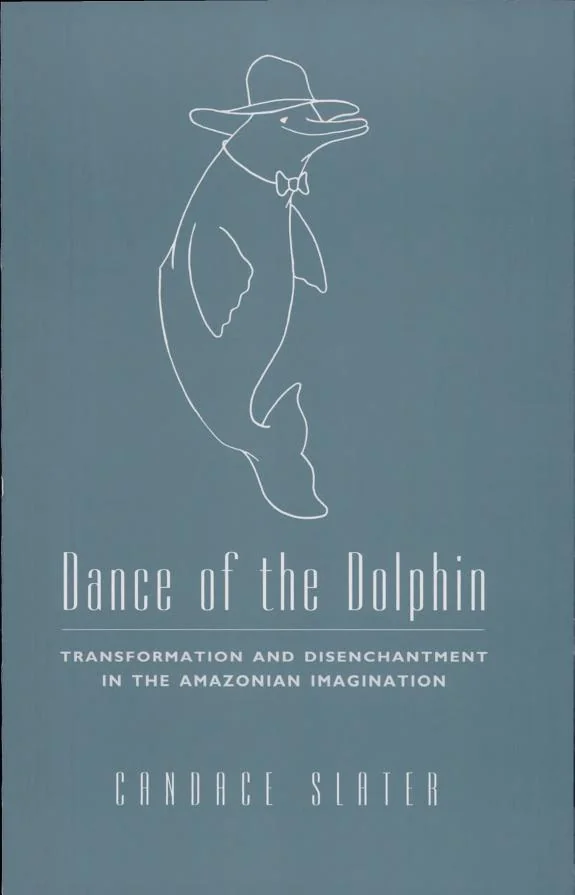
Dance of the Dolphin
 81
81

Dance of the Dolphin
Candace Slater's "Dance of the Dolphin" offers a granular exploration of Amazonian river dolphin folklore, moving beyond simple myth collection to analyze the complex spiritual and psychological dimensions of the "encantados." Slater's strength lies in her meticulous documentation and nuanced interpretation of how these beings function within local belief systems, not just as supernatural agents but as figures that mediate human interactions with the powerful, often dangerous, Amazonian environment. A particularly striking aspect is the detailed portrayal of the male dolphins' human guise—dressed in straw hats and white suits—underscoring the often surreal and specific details embedded in these oral traditions. While the book excels in ethnographic detail, its sheer density of information might prove challenging for readers unacquainted with the region's specific cultural landscape. The work consistently grounds its analysis in the lived realities and spiritual practices of the people who tell these stories, making it a valuable contribution to the study of folklore and shamanism. Slater's study is a vital resource for understanding the intricate spiritual ecology of the Amazon.
📝 Description
81
Candace Slater's 1994 book examines the rich folklore of Brazil's Amazon, focusing on the mythical 'encantados'.
Candace Slater's "Dance of the Dolphin" investigates the pervasive folklore of the Brazilian Amazon, centering on the mythical "encantados" or Enchanted Beings. These supernatural entities, primarily associated with river dolphins, are depicted as shape-shifters capable of assuming human form. The work meticulously documents their purported activities: attending vibrant festivals, engaging in seductive encounters with humans, and luring individuals to submerged cities beneath the water.
These beings hold a dual nature, capable of inflicting madness or death, yet are also invoked for aid in shamanic healing practices. The "encantados" of Amazonian folklore have been a subject of anthropological interest since at least the late 19th century. Slater's work, first published in 1994, offers a focused examination of this specific mythological complex, situating itself within a broader academic discourse on myth, ritual, and belief systems in the region.
This book engages with the esoteric traditions of indigenous Amazonian peoples, particularly concerning their cosmology and spiritual practices. The "encantados" represent a potent manifestation of animistic beliefs, where spirits inhabit the natural world and influence human lives. Slater's work details how these beings are understood as intermediaries, capable of both harm and healing, and are central to shamanic rituals and the maintenance of cultural understanding. The focus on their dual nature and their role in altered states of consciousness connects to broader themes in shamanism and the exploration of spirit realms.
💡 Why Read This Book?
• Gain a nuanced understanding of the "encantados" as complex spiritual beings, not mere mythical creatures, drawing from specific folklore documented from the Brazilian Amazon. • Explore the symbolic significance of the "dance" and the "city beneath the river" as recurring motifs in shamanic and spiritual narratives, as detailed in the book's analysis. • Appreciate the dual nature of these "Enchanted Beings" – their capacity for both danger and assistance – as a lens through which to view human-environment spiritual relationships, as presented in the 1994 publication.
⭐ Reader Reviews
Honest opinions from readers who have explored this book.
❓ Frequently Asked Questions
What are the "encantados" mentioned in "Dance of the Dolphin"?
The "encantados" are supernatural beings from Brazilian Amazonian folklore, primarily associated with river dolphins. They are depicted as shape-shifters who can take human form, interact with people, and lure them away to underwater cities. Their nature is dual, capable of causing death or madness, but also offering aid to shamans.
What is the primary focus of Candace Slater's "Dance of the Dolphin"?
The book focuses on the folklore of the "encantados" in the Brazilian Amazon, particularly their association with river dolphins. It delves into their mythical attributes, their seductive powers, their role in shamanic practices, and their connection to the Amazonian environment, as first explored in the 1994 edition.
How do the "encantados" influence human lives according to the book?
According to the folklore documented in "Dance of the Dolphin," the "encantados" can seduce humans, leading them away to a world beneath the river. They are also believed to cause madness or death. However, they are also invoked by shamanic healers for their spiritual power and assistance in healing.
What is the significance of the dolphin in Amazonian folklore as presented by Slater?
In the folklore examined, dolphins, particularly male dolphins, are central figures as "encantados." They are often depicted in human guise, wearing distinctive attire like straw hats and white suits, and are known for their dancing prowess and their ability to father children with humans, embodying a potent, often dangerous, spiritual force.
When was Candace Slater's "Dance of the Dolphin" first published?
Candace Slater's "Dance of the Dolphin" was first published on September 15, 1994. This edition serves as a foundational text for understanding the specific myths and beliefs surrounding the "encantados" in the Brazilian Amazon.
Does the book discuss specific shamanic practices related to the "encantados"?
Yes, the book explores how "encantados" are called upon by shamanic healers. These beings are understood to possess spiritual power that can be channeled for healing, making them integral to the spiritual and medicinal practices within the Amazonian communities studied.
🔮 Key Themes & Symbolism
The Encantados' Dual Nature
Central to "Dance of the Dolphin" is the concept of the "encantados," beings who embody a profound duality. They are simultaneously seductive figures capable of luring humans to a hidden realm and destructive forces that can bring madness or death. This ambiguity is not presented as a contradiction but as a reflection of the powerful, untamed forces of nature in the Amazon. The book details how these "Enchanted Beings" are invoked by shamanic healers, highlighting their spiritual utility despite their inherent dangers, demonstrating a complex relationship between humanity and the supernatural.
Shape-Shifting and Liminality
The "encantados," particularly the river dolphins, are masters of transformation, shifting between animal and human forms. This ability places them in a perpetual state of liminality, existing between worlds—the river and the land, the human and the spirit realm. Slater's work illustrates how this fluidity allows them to mediate between these realms, acting as conduits for spiritual power and influencing human destiny. The iconic image of the male dolphin in human attire, complete with straw hats and shiny shoes, exemplifies this uncanny ability to bridge disparate realities.
The River as a Spiritual Axis
The Amazon River and its watery depths serve as the primary stage for the "encantados" and their interactions with humanity. The concept of a "city beneath the river" represents a profound mythological space, an underworld where souls might be taken or transformed. Slater's research highlights the river not just as a physical entity but as a potent spiritual axis, a boundary between the known and the unknown, life and the afterlife. The folklore illustrates the river's power to both sustain and consume, mirroring the "encantados" themselves.
Ritual, Seduction, and Ecstasy
The "dance" motif in the book's title is crucial, representing not only physical movement but also ritualistic engagement and potent seduction. The "encantados" are depicted as accomplished dancers who lead humans into ecstatic states, often culminating in their abduction to the submerged city. This theme explores how spiritual encounters can be both alluring and dangerous, blurring the lines between pleasure and peril. The raucous festivals attended by these beings underscore the wild, untamed energies they embody and their capacity to disrupt ordinary human experience.
💬 Memorable Quotes
Direct passages from the work, attributed to the author.
“They are encantados, or Enchanted Beings, capable of provoking death or madness, but also called upon to help shamanic healers.”
— This statement emphasizes the dualistic nature of the "encantados." It positions them not merely as supernatural agents but as potent forces that demand respect, acknowledging their capacity for both destruction and beneficial intervention within the spiritual framework of Amazonian cosmology.
“Male dolphins—accomplished dancers who appear dressed in dapper straw hats, white suits, and with shiny black shoes—reportedly father numerous children.”
— This vivid description offers a specific, almost surreal, image of the "encantado's" human guise. The meticulous attire and dancing skill underscore their sophisticated, alluring persona, while the mention of fathering children points to their generative, yet potentially disruptive, influence on human lineage and society.
“The females are said to lure...”
— Although the original blurb cuts off, this phrase suggests that female "encantados" possess their own distinct methods of interaction and influence, likely involving seduction or enchantment, complementing the documented activities of their male counterparts. It hints at a broader spectrum of "encantado" behaviors.
“The work explores the "city beneath the river" as a recurring underworld archetype.”
— This interpretation frames the "city beneath the river" not just as a location within folklore, but as a symbolic representation of an underworld or spiritual realm. It connects the specific Amazonian myth to broader archetypal patterns found in global mythology and spiritual traditions.
💡 Key Ideas
Editorial paraphrase of the work's core concepts — not direct quotes.
Dolphins take human form, attend raucous dances and festivals, seduce men and women, and carry them away to a city beneath the river.
This passage expresses the core myth of the "encantados." It highlights their shape-shifting abilities, their engagement with human social rituals, their seductive nature, and their ultimate power to transport individuals to a spiritual or otherworldly realm located beneath the water.
🌙 Esoteric Significance
Tradition
While not strictly adhering to a single Western esoteric lineage like Hermeticism or Kabbalah, "Dance of the Dolphin" engages with themes resonant in animistic and shamanic traditions worldwide. It explores concepts of spirit possession, soul journeys, and the sacredness of nature, which find parallels in indigenous spiritual practices across continents. The work can be seen as a bridge, offering academic insights into belief systems that share foundational principles with esoteric philosophies concerning the interconnectedness of all life and the existence of unseen realms.
Symbolism
The river dolphin itself is a potent symbol of transformation and the liminal. Its ability to navigate both water and air (through breaching) and its shape-shifting into human form symbolize the fluid boundary between the physical and spiritual worlds. The "city beneath the river" symbolizes the subconscious, the collective unconscious, or an underworld realm where transformation and initiation occur. The "dance" represents ecstatic spiritual experience, seduction by the numinous, and the ritualistic engagement with powerful natural forces.
Modern Relevance
Contemporary eco-spirituality and neo-shamanic practices often draw inspiration from the deep connection to nature found in indigenous traditions. The "encantados" serve as archetypes for understanding human-animal spiritual relationships and the sacredness of the natural world, particularly aquatic environments. Thinkers and practitioners interested in animism, interspecies communication, and the spiritual ecology of vital ecosystems find resonance in Slater's documented folklore, informing contemporary discussions on environmental ethics and animistic resurgence.
👥 Who Should Read This Book
• Students of comparative mythology and religious studies seeking in-depth case studies of South American folklore, particularly concerning animal spirits and shamanism. • Anthropologists and ethnographers interested in the belief systems and cultural practices of Amazonian indigenous communities, focusing on oral traditions and spiritual cosmology. • General readers fascinated by folklore, mythology, and the intersection of human and animal spiritualities, looking for rich, detailed accounts of lesser-known mythic traditions.
📜 Historical Context
When "Dance of the Dolphin" was first published in 1994, Amazonian folklore was well within the purview of anthropological study, building upon decades of research. Scholars like Claude Lévi-Strauss had already established structuralist frameworks for understanding indigenous myths in the region. However, Slater's work offered a more focused examination of the "encantados," particularly the river dolphin myths, moving beyond general mythic structures to explore the nuanced spiritual and psychological dimensions. The late 20th century saw a growing academic interest in indigenous cosmologies, shamanism, and the complex relationship between human societies and their environments. While not facing overt censorship, works examining indigenous spiritual beliefs often navigated a delicate balance between academic rigor and respectful representation, particularly concerning practices that challenged Western rationalism. Slater's contribution provided detailed ethnographic grounding for a specific set of beliefs that had previously been treated more generally.
📔 Journal Prompts
The "encantados'" dual capacity for destruction and aid—how does this duality inform your understanding of powerful natural forces?
Reflect on the symbolic meaning of the "city beneath the river" in relation to personal journeys of transformation or hidden realms.
Consider the "dance" motif as a representation of spiritual ecstasy or dangerous seduction in folklore.
Analyze the portrayal of male dolphins in human attire—what does this specific imagery suggest about cultural perceptions of the human-animal boundary?
Explore the relationship between shamanic healers and the "encantados" as depicted in the text.
🗂️ Glossary
Encantados
Portuguese term for "Enchanted Beings" in Brazilian Amazonian folklore. These are supernatural entities, often associated with river dolphins, capable of shape-shifting and interacting with humans in profound, often dangerous, ways.
Shamanic healers
Individuals within indigenous communities who practice shamanism, acting as intermediaries between the human and spirit worlds. They are believed to possess the ability to heal, divine, and influence events through spiritual means.
City beneath the river
A recurring mythological concept in Amazonian folklore, representing an underwater realm or an underworld where "encantados" reside and to which they may lure humans, often signifying a place of spiritual transformation or eternal captivity.
Shape-shifter
A mythical being or entity that possesses the ability to alter its physical form, changing from one shape to another, most notably in this context from dolphin to human.
Folklore
The traditional beliefs, customs, and stories of a community, passed through generations by word of mouth. In this context, it refers specifically to the oral traditions of the Brazilian Amazon.
Liminality
A state of being in-between or on the threshold, often referring to transitional periods, places, or states of consciousness. The "encantados" embody liminality by existing between animal and human, water and land, physical and spiritual realms.
Numinous
A term coined by Rudolf Otto, describing that which is awe-inspiring, mysterious, and terrifyingly fascinating. It refers to the experience of encountering the divine or sacred in a powerful, overwhelming way.
This book appears in 1 collection
🔮 Readers Also Liked
Browse all →









From the “Shapeshifting” Collection
View all →






More Free Occult Philosophy Books
View all →