Heroides
 76
76

Heroides
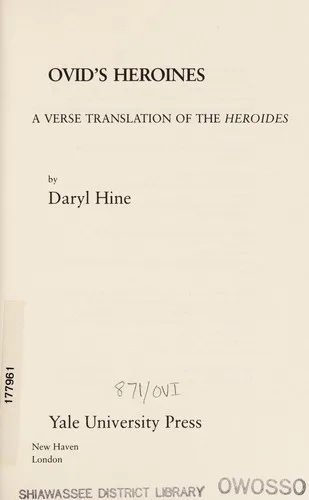
The strength of Kennedy's 1921 edition of Ovid's *Heroides* lies in its preservation of Ovid's potent voice, particularly his ability to imbue mythological figures with raw, relatable emotion. The epistolary format, allowing each woman to speak directly from her heart, remains a compelling technique. However, the editorial apparatus, while scholarly for its time, can feel dated, occasionally imposing interpretations that modern readers might question. The sheer emotional force of Penelope's letter to Odysseus, for instance, stands out, a masterclass in sustained longing and subtle accusation. While the work offers profound character studies, its occasional tendency towards rhetorical flourish can sometimes overshadow the visceral impact of the women's plights. It's a vital, if sometimes challenging, window into classical emotional landscapes.
📝 Description
76
Arthur Palmer Kennedy published his edition of Ovid's Heroides in 1921.
This 1921 edition of Ovid's *Heroides*, prepared by Arthur Palmer Kennedy, presents a collection of fictional letters from legendary women of Greek and Roman mythology. These are not simple stories, but deeply felt monologues from figures such as Penelope, Dido, and Ariadne. Each letter gives voice to the unspoken pain, yearning, and defiance of women often relegated to minor roles in ancient epics. The work shifts focus from grand narratives of war or politics to the inner lives and personal sorrows of its characters.
Scholars of classical literature and Roman poetry will find this edition valuable for its specific textual presentation and historical context. It speaks to readers interested in early feminist literary criticism, offering a pre-modern look at female perspectives within patriarchal stories. Students of mythology seeking deeper character studies and understanding of classical intertextuality will appreciate the focused examinations of these iconic figures' internal experiences.
While Ovid's *Heroides* is primarily a work of classical literature, its focus on intense personal emotion and the subjective experience of mythic figures has resonated with later traditions seeking to understand inner states. The work's dramatic monologues, revealing the psychological depths of women often silenced in traditional epic, provided a model for exploring individual consciousness. This attention to interiority, even within a classical framework, connects to broader esoteric interests in personal revelation and the hidden aspects of human experience, finding parallels in later mystical or psychological interpretations of myth.
💡 Why Read This Book?
• Understand the power of the epistolary form in classical antiquity, as demonstrated through Ovid's fictional letters from figures like Penelope, learning how this structure amplifies emotional expression. • Explore the archetypes of the abandoned woman in mythology, gaining insight into their psychological states and narrative agency as presented in the *Heroides*. • Engage with Ovid's reinterpretation of classical myths, appreciating how his focus on individual sentiment in the late 1st century BCE offered a distinct perspective from earlier epic traditions.
⭐ Reader Reviews
Honest opinions from readers who have explored this book.
❓ Frequently Asked Questions
What is the primary literary form of Ovid's Heroides?
The *Heroides* is primarily composed of fictional letters written from the perspective of legendary women of Greek and Roman mythology. This epistolary format allows for direct expression of their inner thoughts and emotions.
Who is Arthur Palmer Kennedy and what is his role in this edition?
Arthur Palmer Kennedy is credited with the English translation and scholarly introduction for this 1921 edition of Ovid's *Heroides*. His work aimed to make Ovid's classical poems accessible to an English-speaking audience.
When was Ovid's Heroides originally written?
Ovid originally composed the *Heroides* around the turn of the 1st century BCE, likely between 25 BCE and 8 CE, during the Augustan Age of Roman literature.
What kinds of mythological figures are featured in the Heroides?
The *Heroides* features prominent female figures from Greek and Roman mythology, such as Penelope (wife of Odysseus), Dido (Queen of Carthage), Ariadne (who aided Theseus), and Medea. Each writes to her absent or faithless lover.
Does this edition include Ovid's original Latin text?
This specific 1921 edition primarily features Arthur Palmer Kennedy's English translation and commentary. For the original Latin, one would need to consult scholarly editions that include the classical text alongside translations.
How does the Heroides differ from traditional epic poems?
Unlike grand epics focusing on battles and heroes, the *Heroides* shifts focus to the private emotional lives and grievances of women, using personal letters to explore themes of love, abandonment, and betrayal.
🔮 Key Themes & Symbolism
Female Voice in Antiquity
The *Heroides* is groundbreaking for its sustained effort to give voice to women within a predominantly male literary tradition. Figures like Penelope, writing to Odysseus, articulate complex emotions—longing, anger, and resilience—that challenge the passive roles often assigned to them. Ovid's imagined correspondence reveals a profound psychological landscape, offering a counter-narrative to the heroic exploits and political machinations that typically dominate classical literature. This focus on individual sentiment and personal grievance provides a unique lens through which to understand the emotional realities of these legendary figures.
The Abandoned Woman Archetype
A central theme is the plight of the abandoned or betrayed woman. Through letters from characters like Dido to Aeneas, Ovid explores the devastating consequences of broken promises and unilateral departures. These are not simple laments; they are often impassioned pleas, sharp accusations, and declarations of self-worth in the face of rejection. The *Heroides* examines the psychological toll of such abandonment, portraying the women's internal struggles and their attempts to grapple with their altered circumstances and wounded pride.
Myth as Emotional Exploration
Ovid utilizes the framework of well-known myths not merely to retell stories, but to excavate the emotional truths embedded within them. By shifting the narrative focus to personal correspondence, he transforms epic figures into relatable individuals grappling with universal human experiences like love, loss, and desire. This approach allows for a deeper exploration of character psychology, revealing the complex motivations and feelings that lie beneath the surface of legendary events. The *Heroides* demonstrates how myth can serve as a powerful vehicle for understanding the enduring aspects of the human condition.
Epistolary Innovation
The collection is a significant early example of the epistolary form in Western literature. Each letter functions as a dramatic monologue, offering intimate access to the sender's state of mind. This structure enables Ovid to explore subjective experience in depth, allowing characters to articulate their perspectives directly to their intended recipients, and by extension, to the reader. The format fosters a sense of immediacy and personal connection, making the emotional impact of the narratives particularly potent and paving the way for later developments in the novel.
💬 Memorable Quotes
Direct passages from the work, attributed to the author.
“Dido, to Aeneas: 'Nor did you say that you were bound for Italy.'”
— A poignant accusation from Dido, revealing the foundation of her betrayal. Aeneas’s departure was not just an abandonment but a deception, leaving her blindsided and heartbroken after their shared life.
“Ariadne, to Theseus: 'You left me on the shore, a maiden lost.'”
— This captures Ariadne's sense of utter desolation and vulnerability. Having aided Theseus, she found herself abandoned on Naxos, a stark symbol of misplaced trust and the consequences of love.
“Helen, to Paris: 'You swore that you would come and carry me away.'”
— Helen’s letter frames the Trojan War not as an act of aggression, but as the fulfillment of a promise. It presents her perspective on her own agency and the events that led to the legendary conflict.
“Hypermnestra, to Lynceus: 'I alone spared my husband.'”
— This highlights Hypermnestra's unique act of defiance against her father and sisters. Her letter justifies her choice to spare Lynceus, emphasizing love and mercy over familial duty and vengeance.
💡 Key Ideas
Editorial paraphrase of the work's core concepts — not direct quotes.
Penelope, writing to Odysseus: 'And yet, you bid me wait: / I wait. My parents urge me to remarry: / I answer: 'He will return.' My own son grows / And asks his father's place.'
This passage captures Penelope's predicament—her unwavering loyalty tested by time, societal pressure, and her son Telemachus's growing need. It highlights her enduring hope mixed with the practical anxieties of her prolonged widowhood.
🌙 Esoteric Significance
Tradition
While Ovid’s work is classical Roman literature, the *Heroides* has been interpreted through esoteric lenses due to its deep psychological exploration and archetypal figures. It doesn't belong to a single esoteric lineage like Hermeticism or Kabbalah but offers fertile ground for psychological archetypes, particularly relevant to Jungian psychology and later esoteric interpretations of mythology. The focus on inner emotional states and the articulation of suppressed feminine narratives speaks to modern esoteric traditions seeking to integrate the 'anima' or explore the divine feminine.
Symbolism
The primary symbolism lies in the letters themselves, representing the act of communication and the yearning for connection or resolution. The figures—Penelope’s loom symbolizing fidelity and the passage of time, Dido’s Carthage representing a lost kingdom and tragic love, Ariadne’s thread symbolizing guidance and subsequent abandonment—are potent archetypal motifs. These women’s narratives often symbolize aspects of the soul’s journey through trials of love, betrayal, and resilience, offering allegorical readings for personal transformation.
Modern Relevance
Contemporary thinkers and practitioners in fields like depth psychology, feminist literary criticism, and modern paganism often revisit the *Heroides*. Its exploration of female archetypes and emotional authenticity informs discussions on the divine feminine and the integration of psychological shadow aspects. Artists and writers continue to draw inspiration from its characters and themes, adapting their stories for new audiences, demonstrating the enduring power of Ovid's deeply human portrayals of mythic figures.
👥 Who Should Read This Book
• Students of classical literature and Roman poetry seeking nuanced character studies beyond epic narratives. • Readers interested in early explorations of female psychology and voice in literature, particularly those engaging with feminist literary theory. • Aspiring writers and poets looking for models of epistolary composition and the dramatic monologue to deepen emotional expression in their work.
📜 Historical Context
Ovid's *Heroides*, composed around the turn of the Common Era, emerged during the sophisticated literary milieu of the Augustan Age in Rome. This period, while characterized by imperial consolidation under Augustus, also fostered a rich artistic and intellectual climate. Ovid, a prominent poet alongside figures like Virgil and Horace, pushed the boundaries of Roman poetry with his innovative themes and styles. The *Heroides* itself departed from the grand narratives of epic and history, focusing instead on the intimate emotional lives of women through fictional letters. This focus on individual psychological states and subjective experience was a significant development. While not facing overt censorship for this particular work in the way Ovid later would be exiled by Augustus, the *Heroides* represented a subtle shift in literary focus, moving towards more personal and emotional explorations of myth and human relationships, potentially diverging from the more stoic or duty-bound ideals sometimes promoted by the regime. Its reception over centuries has cemented its place as a foundational text for understanding female voices in classical literature.
📔 Journal Prompts
Penelope's enduring wait and Telemachus's growing presence: How does external pressure shape internal resolve?
Dido's accusation of Aeneas's broken promise: Reflect on a time when trust was irrevocably broken by unspoken intentions.
Ariadne's abandonment on Naxos: Consider the feeling of being left behind after providing crucial support.
The varied emotional tones of the *Heroides* letters: Analyze the spectrum of anger, sorrow, and defiance expressed.
Ovid's technique of giving voice to mythological women: How can marginalized perspectives be amplified in contemporary discourse?
🗂️ Glossary
Epistolary
Relating to or denoting the writing of letters. In literature, it refers to a genre where the narrative is conveyed through correspondence between characters.
Monologue
A long speech by one person, especially in a play or movie. In the *Heroides*, each letter functions as a dramatic monologue from a specific female character.
Augustan Age
The period of Roman history during the reign of Augustus (27 BCE – 14 CE), known for its literary flourishing, with poets like Virgil, Horace, and Ovid producing major works.
Mythological Figures
Characters originating from myths and legends, such as those found in Greek and Roman stories. The *Heroides* reinterprets these figures through personal correspondence.
Archetype
A typical example of a certain person or thing; an original model or pattern. In literature, archetypes are recurring symbolic characters or motifs.
Subjectivity
The quality of existing in someone's mind rather than the external world; personal perspective, feelings, and experiences.
Anima
In Jungian psychology, the unconscious feminine aspect of a man's psyche. In broader esoteric contexts, it can represent the feminine principle or soul.
🔮 Readers Also Liked
Browse all →








More by Ovid, Arthur Palmer, Kennedy
All books →
More Free Occult Philosophy Books
View all →