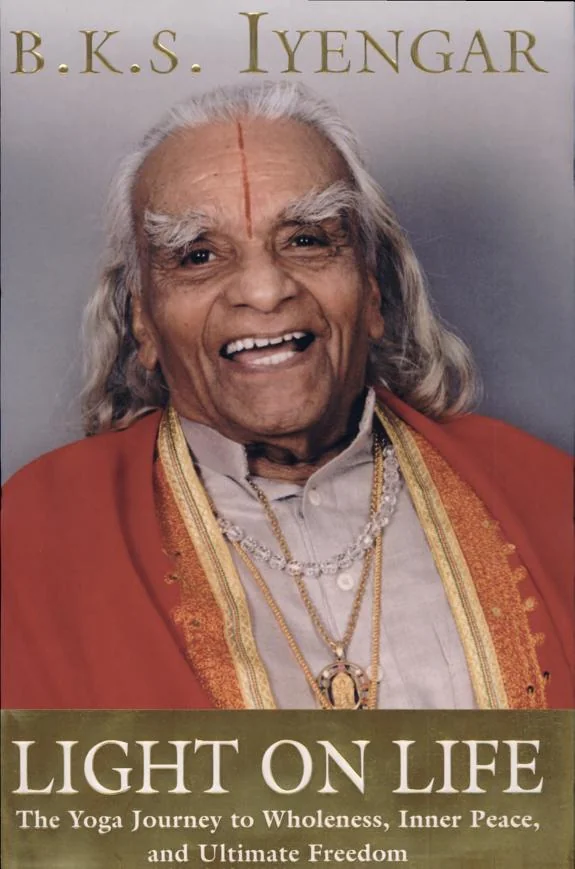
Light on Life : the Yoga Way to Wholeness, Inner Peace and Ultimate Freedom
 75
75

Light on Life : the Yoga Way to Wholeness, Inner Peace and Ultimate Freedom
Iyengar's "Light on Life" is less a gentle unfolding and more a direct, unvarnished transmission of yogic philosophy from a master nearing the end of his long teaching career. His assertion, "It is my profound hope that my end can be your beginning," sets a tone of urgency and profound generosity. The book excels in its detailed explanations of how yogic principles, particularly the subtle body and the eight limbs of yoga, can be applied to overcome everyday anxieties and achieve a state of integrated consciousness. A particularly striking section details the nature of 'avidya' (ignorance) as the root of suffering, a concept he dissects with characteristic precision. While the prose can sometimes feel dense, demanding focused attention, the clarity of Iyengar's vision is undeniable. The limitation, if one can call it that, is the expectation of an engaged reader ready to grapple with complex ideas rather than seek simple remedies. It is a serious work for serious practitioners, offering not just knowledge, but a path to embodied wisdom.
📝 Description
75
B. K. S. Iyengar published "Light on Life" in 2005, moving beyond asana to discuss the deeper philosophy of yoga.
B. K. S. Iyengar's "Light on Life," released in 2005, moves beyond his well-known focus on physical postures to address the philosophical and spiritual dimensions of yoga. Drawing on decades of teaching, Iyengar aims to show how yogic principles can lead to wholeness and inner peace in daily life. The book is intended for practitioners who have moved past initial stages and seek a more profound understanding of yoga's application to mental clarity, emotional balance, and spiritual growth. Iyengar's mature perspective distills yogic wisdom for those ready to grasp its full transformative potential.
This work systematically examines core yogic concepts, translating ancient teachings into practical guidance for contemporary living. Iyengar highlights the essential connection between the body, mind, and spirit, asserting that genuine well-being stems from their balanced integration. The book presents yoga not just as a physical discipline but as a comprehensive path to self-awareness and freedom. It encourages diligent application of yogic practices to achieve this integration.
This book sits within the tradition of Vedanta, specifically the practical application of its philosophical tenets through the discipline of Yoga. Iyengar interprets classical Yoga as a means to understand the self and achieve liberation from suffering, aligning with the ultimate goals of Indian spiritual traditions. The emphasis on inner work and the interconnectedness of all aspects of being reflects a broader esoteric worldview found in schools that seek direct experience of reality beyond the material. It connects the practice of asana and pranayama to the pursuit of higher consciousness and self-realization.
💡 Why Read This Book?
• Gain a practical framework for applying the eight limbs of yoga beyond asana, as detailed in the book's exploration of 'Patanjali's Yoga Sutras,' to cultivate inner peace. • Understand the concept of 'avidya' (ignorance) as a root cause of suffering, learning how Iyengar suggests using yogic discipline to overcome it and achieve wholeness. • Discover how to integrate yogic principles into daily life for ultimate freedom, a core teaching Iyengar presents as his life's work, particularly relevant for those seeking profound self-transformation.
⭐ Reader Reviews
Honest opinions from readers who have explored this book.
❓ Frequently Asked Questions
What is B. K. S. Iyengar's main contribution to yoga discussed in 'Light on Life'?
Iyengar's primary contribution highlighted is the detailed application of yogic principles, including the eight limbs, to daily life for achieving wholeness and inner peace, moving beyond just physical postures.
When was B. K. S. Iyengar's 'Light on Life' first published?
'Light on Life' was first published in 2005, representing a culmination of Iyengar's over fifty years of teaching and practice.
Does 'Light on Life' focus primarily on yoga asanas (poses)?
While Iyengar is renowned for his work with asanas, 'Light on Life' expands to explore the philosophical and spiritual dimensions of yoga, focusing on inner transformation and peace.
Who is considered the world's leading teacher of yoga in relation to this book?
B. K. S. Iyengar is widely recognized as a leading, if not the foremost, living master of yoga, and 'Light on Life' is his sharing of the complete yoga journey.
What does Iyengar mean by 'wholeness, inner peace, and ultimate freedom' in the book's subtitle?
Iyengar presents these as the ultimate aims of the yoga journey, achievable through the diligent application of yogic principles to all aspects of life, leading to a balanced and liberated existence.
What is the 'yoga journey' Iyengar wishes to share?
The 'yoga journey' he shares encompasses the full spectrum of yogic practice and philosophy, from ethical conduct and physical discipline to meditation and self-realization, presented as a path to profound self-understanding.
🔮 Key Themes & Symbolism
The Eight Limbs of Yoga
Iyengar meticulously unpacks the eight limbs outlined by Patanjali, presenting them not as sequential steps but as interconnected facets of a holistic practice. He emphasizes that Yama (ethical restraints) and Niyama (observances) are foundational, providing the ethical framework necessary for deeper practices like Asana (posture) and Pranayama (breath control). The internal limbs—Pratyahara (sense withdrawal), Dharana (concentration), Dhyana (meditation), and Samadhi (absorption)—are shown to arise naturally from a well-established external practice. This detailed exposition offers a path toward integrating yoga into every aspect of existence, fostering not just physical health but profound mental and spiritual alignment.
Avidya and the Path to Liberation
A central theme is the concept of 'avidya' or ignorance, which Iyengar identifies as the root cause of human suffering and delusion. He posits that our perception is often clouded, leading us to misidentify the transient with the permanent and the non-self with the self. 'Light on Life' guides the reader toward understanding and dismantling this fundamental ignorance through the systematic application of yogic principles. By cultivating self-awareness, discipline, and wisdom, practitioners can gradually peel back the layers of illusion, moving towards a state of 'wholeness' and 'ultimate freedom' from the cycles of suffering.
Yoga as a Way of Life
This work transcends the notion of yoga as mere physical exercise, presenting it as a comprehensive philosophy and a practical guide for living. Iyengar illustrates how the principles of yoga—such as self-discipline, mindfulness, and equanimity—can be applied to overcome the challenges of modern life. He argues that by bringing yogic awareness to our actions, thoughts, and emotions, we can transform ourselves and our relationships, fostering a sense of inner peace and contentment. The book serves as an invitation to start a lifelong journey of self-discovery and personal evolution, guided by the wisdom of yoga.
💬 Memorable Quotes
Direct passages from the work, attributed to the author.
“Fifty years after my first trip west... I now wish to share with you the whole of the yoga journey.”
— This statement, made by an 86-year-old Iyengar, signifies a profound desire to impart his complete understanding of yoga, accumulated over decades of teaching and practice, as a final legacy.
“It is my profound hope that my end can be your beginning.”
— This poignant hope expresses Iyengar's wish for his life's work to serve as a foundational starting point for others, enabling them to start their own transformative yoga journey.
“Hailed as 'the Michelangelo of yoga' by the BBC”
— This description underscores Iyengar's immense influence and artistic mastery in the field of yoga, likening his precision and impact to that of the Renaissance master.
“Bringing yogic principles into all aspects of daily living.”
— This core concept emphasizes that yoga is not confined to the mat but is a practical philosophy meant to be integrated into one's entire existence for holistic transformation.
“The world's leading teacher of yoga”
— This designation reflects B. K. S. Iyengar's global recognition and authority in the field of yoga, acknowledging his significant contributions and widespread impact on practitioners worldwide.
🌙 Esoteric Significance
Tradition
While not strictly adhering to a single esoteric lineage, Iyengar's work is deeply rooted in the classical Yoga tradition as codified by Patanjali in the Yoga Sutras. His approach can be seen as a modern, highly disciplined interpretation that bridges the gap between ancient yogic philosophy and contemporary Western understanding. It shares common ground with Hermetic principles of 'as above, so below' by linking physical practice to inner states and aligns with Gnostic pursuits of self-knowledge for liberation, albeit through a distinctly yogic methodology rather than mystical gnosis.
Symbolism
Central to Iyengar's teaching is the concept of the 'koshas' (sheaths) that veil the true Self, a symbolic representation of the layers of illusion and identification. The 'prana' (life force) and 'chakras' (energy centers) are also discussed as symbolic maps of the subtle body, crucial for understanding energy flow and its impact on consciousness. The practice of asana itself becomes symbolic, representing the disciplined effort required to refine the physical form as a vessel for spiritual awakening, transforming the body into a vehicle for higher awareness.
Modern Relevance
Iyengar's systematic approach to yoga continues to influence contemporary somatic practices, mindfulness-based therapies, and even some branches of sports psychology. Thinkers and practitioners in fields ranging from contemplative neuroscience to embodied cognition draw inspiration from his emphasis on precise physical alignment as a pathway to mental clarity. His work is a foundational text for anyone exploring embodied spirituality or the practical application of ancient wisdom traditions in modern wellness and personal development spheres.
👥 Who Should Read This Book
• Dedicated yoga practitioners aged 30-60 seeking to deepen their understanding beyond asana, particularly those interested in the philosophical underpinnings of yoga as presented in classical texts. • Students of comparative religion and philosophy interested in the practical, systematic application of Eastern spiritual traditions to achieve psychological integration and inner peace. • Individuals exploring paths to self-mastery and spiritual growth who are drawn to disciplined, methodical approaches grounded in ancient wisdom, seeking a comprehensive guide for holistic transformation.
📜 Historical Context
Published in 2005, 'Light on Life' emerged at a time when yoga had become a global phenomenon, yet often misunderstood as primarily a physical discipline. B. K. S. Iyengar, already a towering figure whose influence began to spread significantly in the West from the 1960s onwards, was a key architect of this global diffusion. His earlier work, 'Light on Yoga' (1966), had already set a standard for comprehensive asana instruction. By 2005, Iyengar, then 86, was offering a mature synthesis of his lifelong teachings, emphasizing the philosophical and psychological dimensions of yoga. This book arrived amidst a burgeoning interest in Eastern philosophies in the West, a trend paralleled by the rise of various New Age and self-help movements. Unlike purely spiritual or strictly academic approaches, Iyengar's method, rooted in rigorous practice and precise instruction, offered a distinct, embodied path to self-understanding, differentiating itself from more esoteric or less structured spiritual explorations.
📔 Journal Prompts
The nature of 'avidya' as the root of suffering, as presented by Iyengar.
How Asana and Pranayama can support the internal limbs of yoga.
The practical application of Yama and Niyama in modern daily life.
Integrating the concept of 'wholeness' into personal goals.
The journey from ignorance towards self-realization.
🗂️ Glossary
Asana
Literally 'seat,' referring to a stable and comfortable physical posture practiced in yoga. Iyengar emphasizes precision and alignment in asana for physical health and mental discipline.
Pranayama
The practice of controlling breath, involving various breathing techniques. It is considered essential for regulating life force (prana) and calming the mind.
Yama
Ethical restraints or moral disciplines that form the first limb of Patanjali's Yoga Sutras, guiding one's conduct towards others and the world (e.g., non-violence, truthfulness).
Niyama
Observances or self-disciplines that form the second limb of yoga, focusing on internal cultivation and purification (e.g., purity, contentment, self-study).
Avidya
Ignorance or nescience; the fundamental delusion that is considered the root cause of suffering and the cycle of rebirth in yogic philosophy.
Koshas
The five 'sheaths' or layers that cover the true Self (Atman), ranging from the physical body to the blissful body. Understanding them is key to self-realization.
Samadhi
A state of profound meditative absorption or union, the ultimate goal of yoga, where the mind becomes still and one experiences pure consciousness.
This book appears in 1 collection
🔮 Readers Also Liked
Browse all →








From the “Yoga” Collection
View all →





More Free Occult Philosophy Books
View all →