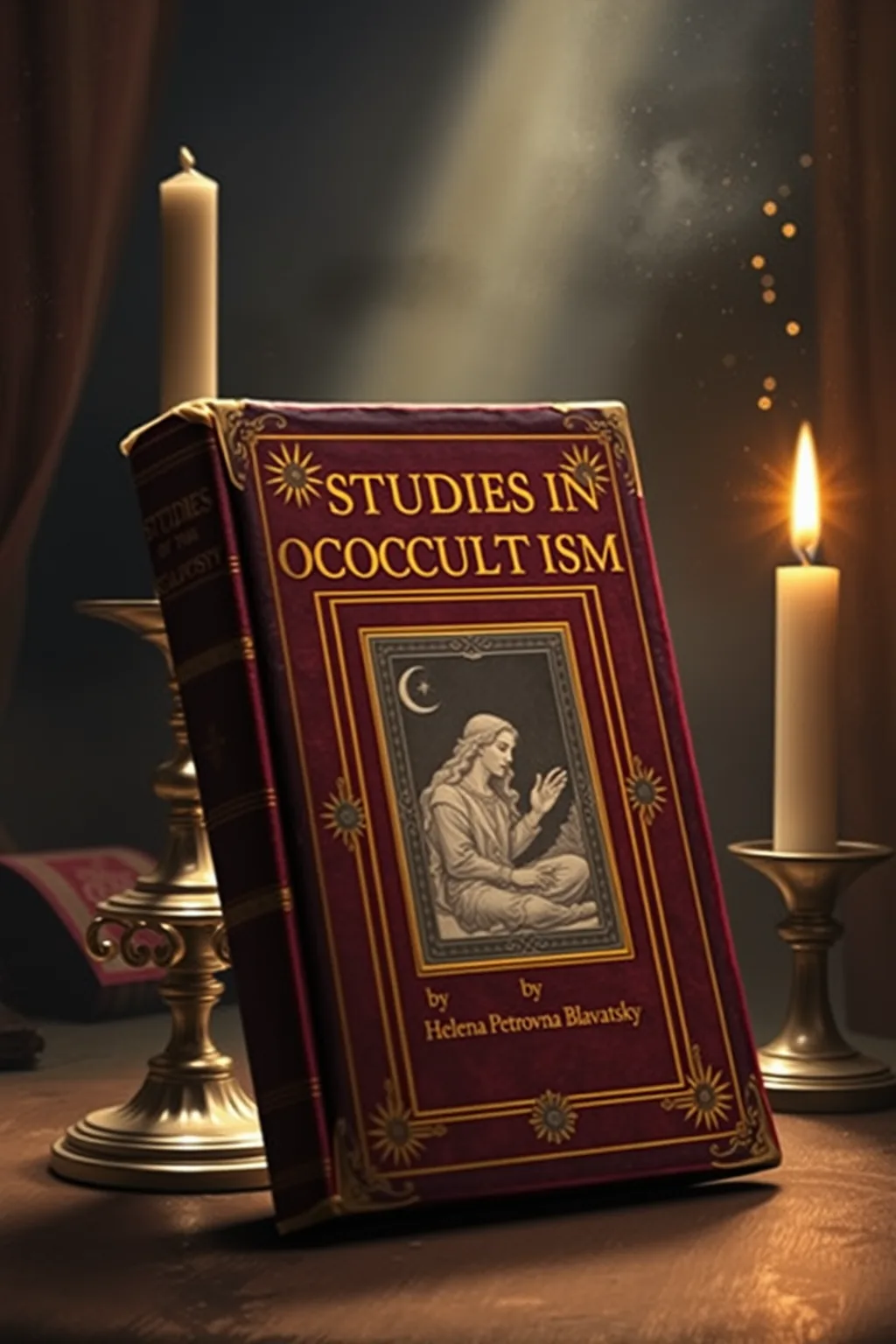
Studies in Occultism
 73
73

Studies in Occultism
Helena Petrovna Blavatsky's Studies in Occultism, first printed in 1895, offers a dense exploration of esoteric principles that remain influential in occult circles. Its strength lies in Blavatsky's ambitious attempt to systematize complex metaphysical ideas, drawing from diverse ancient traditions. The section on karma, for instance, presents a rigorous, almost scientific, application of cause and effect that transcends simplistic notions of reward and punishment. However, the work can be challenging; Blavatsky's prose is often dense, and her critique of contemporary religious and scientific views, while pointed, can feel polemical rather than purely explanatory. A notable passage discusses the nature of 'chelas' or disciples, outlining a demanding path of spiritual discipline that may seem inaccessible. Ultimately, Studies in Occultism is a foundational text for Theosophists and serious occult students, though its density requires significant reader commitment.
📝 Description
73
Helena Petrovna Blavatsky's Studies in Occultism, published in December 1895, compiles essays on esoteric philosophy.
Studies in Occultism is a collection of essays by Helena Petrovna Blavatsky, first published in December 1895. Rather than a narrative, it compiles her writings that examine core principles of occult science and esoteric philosophy. Blavatsky aimed to clarify concepts obscured by religious dogma and scientific materialism, proposing an alternative framework for understanding existence. The essays address interconnected subjects, intending to illuminate hidden laws governing the cosmos and individual spiritual development. This compilation serves as an introduction to her wider philosophical system.
This volume is suited for serious students of esoteric thought, particularly those interested in the foundations of modern Theosophy. Readers benefit from a prior understanding of comparative religion and philosophy, as Blavatsky frequently references and critiques established doctrines. It will appeal to individuals seeking to explore the metaphysical underpinnings of phenomena often dismissed by mainstream science or religion. Those interested in detailed expositions on karma, reincarnation, and psychic abilities will find substantial material. The book requires focused attention rather than casual reading.
Published in 1895, Studies in Occultism appeared during a period of significant intellectual activity in Europe and America, marked by a rising interest in spiritualism, Theosophy, and alternative philosophies. Blavatsky was a central figure in this milieu, working to synthesize Eastern esoteric traditions with Western occultism. This era saw figures like Annie Besant and William Quan Judge continue Theosophical work after Blavatsky's death. The book was part of a larger effort to present a worldview that challenged prevailing Victorian scientific and religious paradigms.
💡 Why Read This Book?
• Gain a foundational understanding of karma and reincarnation as explained within the Theosophical framework, moving beyond popular interpretations to grasp their role in cosmic evolution as detailed in Blavatsky's essays. • Explore Blavatsky's critique of 19th-century scientific and religious thought, understanding her arguments for a hidden spiritual science that challenges materialist assumptions prevalent since 1895. • Examine Blavatsky's views on psychic phenomena and spiritual hierarchies, learning to differentiate between genuine spiritual development and superficial mediumship as presented in her systematic approach.
⭐ Reader Reviews
Honest opinions from readers who have explored this book.
❓ Frequently Asked Questions
When was Studies in Occultism first published?
Studies in Occultism by Helena Petrovna Blavatsky was first published on December 4, 1895, making it a key text from the late Victorian era of esoteric revival.
What is the primary focus of Blavatsky's Studies in Occultism?
The book primarily focuses on explaining core esoteric principles such as karma, reincarnation, psychic abilities, and spiritual evolution, intended to clarify occult science.
What intellectual traditions influenced Blavatsky in this work?
Blavatsky draws heavily from ancient wisdom traditions, Eastern philosophies (particularly Hinduism and Buddhism), and Western mystical thought to construct her esoteric system.
Is Studies in Occultism a narrative or a collection of essays?
It is a collection of essays, presenting distinct but interconnected explorations of various occult concepts rather than a continuous story.
Who is the intended audience for this book?
The book is best suited for serious students of Theosophy and esoteric philosophy who have some background in comparative religion and are prepared for dense, philosophical exposition.
Does the book discuss practical occult techniques?
While it discusses spiritual discipline and the nature of psychic phenomena, its primary aim is philosophical and theoretical explanation rather than a manual of practical magic.
🔮 Key Themes & Symbolism
The Law of Karma
Blavatsky presents karma not as fate, but as an immutable, impersonal law of moral causation. The work details how actions create consequences that reverberate across lifetimes, shaping individual destiny and collective experience. It emphasizes that understanding karma is crucial for spiritual evolution, offering a framework for ethical living and self-mastery. This concept is explored through the lens of universal justice, suggesting that every event, from the mundane to the catastrophic, is an outcome of past causes.
Reincarnation as Evolution
The essays articulate reincarnation as a fundamental process for the soul's development. It is portrayed as a necessary cycle through which fragmented aspects of the divine consciousness regain wholeness and spiritual understanding. Blavatsky posits that the physical form is merely a temporary vehicle for the enduring ego, and each life offers lessons essential for progress. This perspective challenges linear notions of time and existence, framing life as a continuous journey of learning and spiritual refinement across multiple embodiments.
Psychic Phenomena and Spiritualism
Blavatsky critically examines the nature of psychic abilities and the phenomena associated with spiritualism, prevalent in her time. She distinguishes between genuine spiritual perception and lower, often deceptive, psychic manifestations influenced by the astral plane or lower elementals. The work aims to clarify these powers, suggesting they are latent within humanity and can be developed through rigorous spiritual discipline, rather than being solely the domain of mediums or séances.
Universal Brotherhood and Hierarchy
Underlying the discussions on karma and reincarnation is the concept of an underlying spiritual unity connecting all beings. Blavatsky hints at a cosmic hierarchy of enlightened beings who guide humanity's evolution. The ideal of Universal Brotherhood, a core tenet of Theosophy, emerges as a practical application of this interconnectedness, advocating for compassion and mutual respect among all peoples, regardless of their spiritual or material development.
💬 Memorable Quotes
Direct passages from the work, attributed to the author.
“Karma is the ultimate law of the universe.”
— This statement underscores Blavatsky's view of karma not as a minor principle, but as the foundational mechanism governing all existence, from cosmic events to individual lives, ensuring balance and consequence.
“The human spirit seeks reunion with the divine.”
— This concept highlights the teleological aspect of reincarnation in Blavatsky's philosophy, suggesting that life's purpose is the soul's journey back to its source, a process facilitated by successive earthly existences.
“True psychic powers stem from spiritual purity.”
— This emphasizes Blavatsky's distinction between genuine spiritual attainment and mere psychic sensitivity, linking authentic esoteric abilities to moral and ethical development.
“Evolution is a spiral, not a straight line.”
— This metaphorical description conveys the cyclical and progressive nature of spiritual development as envisioned by Blavatsky, where humanity advances through stages, revisiting themes and lessons on higher levels.
“Occult science offers a rational explanation for the unseen.”
— This asserts the intellectual rigor of occultism as presented by Blavatsky, positioning it as a valid system of knowledge capable of explaining metaphysical realities that elude conventional scientific inquiry.
🌙 Esoteric Significance
Tradition
This work is firmly rooted in the Theosophical tradition, which Blavatsky herself was instrumental in establishing. It draws heavily upon Neo-Platonism, Hermeticism, Kabbalah, and, significantly, the philosophies of Hinduism and Buddhism. Studies in Occultism seeks to present a cohesive esoteric worldview, often referred to as the 'Secret Doctrine,' that transcends specific religious or cultural boundaries, positing a universal spiritual science applicable to all.
Symbolism
Key symbols include the serpent, often representing wisdom, cyclical nature, or Kundalini energy, and the triangle, signifying the divine trinity or the interplay of spirit, mind, and matter. The concept of 'planes' of existence also functions symbolically, representing different levels of consciousness and reality that practitioners aspire to perceive or traverse, moving from the dense physical to the subtle spiritual.
Modern Relevance
Blavatsky's synthesis of Eastern and Western esoteric thought continues to influence contemporary spiritual seekers, occultists, and scholars of religion. Modern practitioners of various forms of Western esotericism, New Age philosophies, and even some elements within contemporary paganism and witchcraft movements often trace their conceptual lineage back to Blavatsky's foundational ideas on karma, reincarnation, and spiritual evolution.
👥 Who Should Read This Book
• Students of Theosophy seeking to understand the core philosophical tenets articulated by H.P. Blavatsky, particularly regarding karma and reincarnation. • Researchers of 19th-century esoteric movements interested in primary source material from a key figure shaping modern occultism. • Individuals exploring comparative philosophy and religion who wish to engage with a synthesis of Eastern and Western metaphysical concepts.
📜 Historical Context
Studies in Occultism was published in 1895, a period of intense spiritual exploration and philosophical debate. The late 19th century witnessed a surge of interest in Theosophy, spiritualism, and Eastern religions, partly as a reaction against the perceived soullessness of industrialization and materialism. Helena Petrovna Blavatsky, a co-founder of the Theosophical Society in 1875, was an important figure in this movement. Her writings, including this collection, aimed to synthesize esoteric traditions from both East and West. This work emerged shortly after her death in 1891, with figures like Annie Besant continuing to popularize Theosophical ideas. The intellectual landscape also included competing spiritual movements like Christian Science and The New Thought, as well as critiques from scientific circles who viewed such inquiries with skepticism, sometimes leading to accusations of fraud or delusion against figures like Blavatsky herself.
📔 Journal Prompts
The impersonal nature of karma as a universal law.
Personal reflections on the cyclical view of reincarnation.
Distinguishing between genuine spiritual insight and psychic impressions.
The concept of spiritual hierarchies guiding human evolution.
Interconnectedness of all beings through a universal consciousness.
🗂️ Glossary
Chelas
Disciples in Indian spiritual traditions, particularly those who undergo rigorous training under a guru. Blavatsky discusses the path of the chela as one of intense self-discipline and dedication to spiritual growth.
Karma
The principle of cause and effect, where actions (physical, mental, or verbal) produce consequences that influence an individual's present and future lives. It is seen as a fundamental law of cosmic justice and balance.
Reincarnation
The process by which a soul or consciousness is reborn into a new physical body after death. In Blavatsky's view, it is a mechanism for spiritual evolution across multiple lifetimes.
Psychic Phenomena
Abilities or occurrences that seem to transcend the known laws of physics and psychology, such as telepathy, clairvoyance, or precognition. Blavatsky distinguishes between lower, materialistically-inclined psychic manifestations and higher, spiritual perceptions.
Esoteric Philosophy
A body of knowledge and belief systems concerning the hidden nature of reality, often transmitted through initiation or specialized study, which seeks to understand the underlying spiritual principles of the universe.
Occult Science
A term used by Blavatsky to describe a system of knowledge pertaining to hidden or secret aspects of nature and the cosmos, believed to operate according to precise laws that can be studied and understood.
Universal Brotherhood
A core principle of Theosophy advocating for the fundamental unity and equality of all humankind, irrespective of race, creed, sex, or caste, fostering mutual understanding and cooperation.