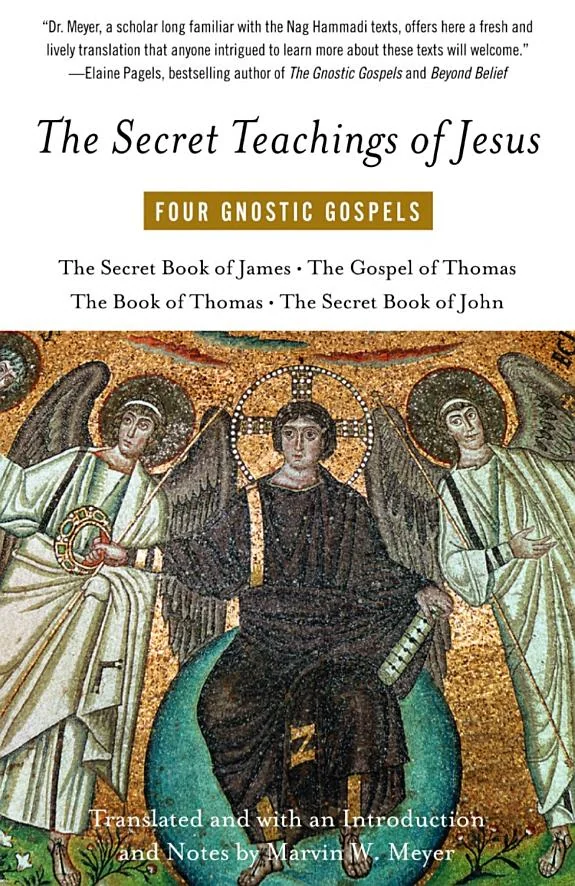
The Secret Teachings of Jesus
 73
73

The Secret Teachings of Jesus
The 2011 publication of *The Secret Teachings of Jesus*, attributed to an unknown author, offers a glimpse into Gnostic Christianity through the lens of the Nag Hammadi library. The work explores the profound implications of these 1945 discoveries in Egypt, particularly how they recontextualize early Christian discourse. While the translation and commentary provide accessible entry points, the sheer volume of esoteric material can sometimes feel overwhelming for the uninitiated. A notable strength lies in its detailed examination of the Gospel of Thomas, presenting its aphoristic structure not as mere sayings but as keys to inner spiritual unlocking. However, the lack of extensive comparative analysis with later orthodox Christian interpretations leaves some theological threads hanging. This text is essential for anyone seeking to understand the heterodox streams that flowed alongside nascent Christianity.
📝 Description
73
### What It Is ### Who It's For ### Historical Context ### Key Concepts
💡 Why Read This Book?
• Understand the Gnostic concept of 'gnosis' as direct spiritual knowledge, distinct from faith-based doctrine, as presented in the Nag Hammadi texts. • Explore the Gospel of Thomas, learning how its cryptic sayings offer alternative pathways to spiritual understanding beyond conventional biblical narratives. • Gain insight into the historical context of early Christianity, recognizing the diversity of belief systems present around the 1st century CE, challenging monolithic interpretations.
⭐ Reader Reviews
Honest opinions from readers who have explored this book.
❓ Frequently Asked Questions
What are the Nag Hammadi texts and why are they important for understanding early Christianity?
Discovered in 1945 near Nag Hammadi, Egypt, these texts include Gnostic gospels and other early Christian writings. They are crucial because they reveal a rich diversity of beliefs and practices that existed alongside, and sometimes in opposition to, the developing orthodox Christian church.
What does 'Gnosticism' mean in the context of these teachings?
Gnosticism derives from the Greek word 'gnosis,' meaning knowledge. In this context, it refers to a spiritual path emphasizing direct, experiential knowledge of the divine, often contrasting with faith-based or ritualistic religious practices.
How does *The Secret Teachings of Jesus* differ from the canonical Gospels?
This work focuses on texts like the Gospel of Thomas, which present Jesus's teachings as esoteric wisdom or mystical insights rather than historical accounts of miracles or salvation through his death. The emphasis is on individual enlightenment.
Who was the intended audience for these original Gnostic texts?
The original audience likely comprised individuals seeking a deeper, more personal spiritual understanding. They were probably adherents of mystical movements within or alongside early Christianity who valued inner revelation.
When were the Nag Hammadi texts discovered?
The significant discovery of the Nag Hammadi library, containing many Gnostic texts, occurred in December 1945 by local farmers in Egypt.
Does this book present a historical view of Jesus or a spiritual one?
The book interprets the teachings found in texts like the Gospel of Thomas through a spiritual and esoteric lens, focusing on Jesus as a revealer of hidden knowledge for personal awakening, rather than solely as a historical or salvific figure.
🔮 Key Themes & Symbolism
The Nature of Gnosis
This work elucidates 'gnosis' not as mere intellectual understanding but as a direct, intuitive apprehension of divine reality. It contrasts this with external dogma and ritual, positioning the seeker's inner experience as the primary path to spiritual liberation. The texts suggest that true understanding comes from within, unlocked by recognizing one's inherent divine spark.
Jesus as Revealer of Hidden Knowledge
Central to the teachings is the portrayal of Jesus as a hierophant, imparting secret wisdom intended for a select few. The book examines sayings, particularly from the Gospel of Thomas, that emphasize self-discovery and the realization of the Kingdom of Heaven within oneself, shifting focus from external salvation to internal transformation.
Dualism and the Material World
The Gnostic perspective often presents a view of the material world as a flawed or illusory creation, distinct from a higher, spiritual realm. This work explores how the teachings found in the Nag Hammadi codices articulate a desire to transcend the limitations of the physical existence through the acquisition of gnosis, achieving reunion with the divine source.
The Inner Kingdom
Many of the unearthed texts describe the spiritual journey as an inward quest. The concept of the 'Kingdom of God' is frequently interpreted not as a future event or physical place, but as a present, internal state attainable through the understanding and application of Jesus' secret teachings, emphasizing self-awareness and spiritual awakening.
💬 Memorable Quotes
Direct passages from the work, attributed to the author.
“The jar proved to hold treasure of an unexpected sort: a collection of some fifty-two ancient manuscripts.”
— This highlights the serendipitous nature of the 1945 discovery, framing the Nag Hammadi texts not as conventionally religious artifacts but as unexpected spiritual riches that profoundly altered scholarly understanding of early Christianity.
“Most of which reflect the teachings of a mystical religious movement we call Gnosticism.”
— This statement defines the core content of the discovered library, identifying Gnosticism as a key mystical tradition whose Christian expressions are now accessible, offering an alternative to mainstream historical narratives of the faith's origins.
“The texts are also, with few exceptions, Christian documents.”
— This fact underscores the complex relationship between Gnosticism and early Christianity, demonstrating that many Gnostic writings were deeply rooted in Christian traditions and figures, challenging the notion of a single, unified early Christian belief system.
“Thus they provide us with valuable new information about the character of that movement.”
— This emphasizes the scholarly and historical significance of the Nag Hammadi findings, asserting their power to illuminate previously obscure or misunderstood aspects of early religious history and the diverse spiritual field of the 1st century CE.
“The Greek word gnosis, 'knowledge'.”
— This provides the etymological root and core meaning of Gnosticism, defining it as a path centered on experiential knowledge and direct spiritual insight, distinguishing it from belief systems reliant on dogma or external authority.
🌙 Esoteric Significance
Tradition
This work is fundamentally situated within the Gnostic tradition, a mystical branch of early Christianity that emphasized direct experiential knowledge ('gnosis') of the divine. It departs from later orthodox Christianity by prioritizing inner revelation over scriptural exegesis or hierarchical authority, viewing the material world as a lesser creation and seeking liberation through spiritual insight.
Symbolism
Key symbols include the 'Kingdom of Heaven' interpreted as an internal state of consciousness, and the 'Light within' signifying the divine spark inherent in the individual soul. The 'Father' often represents the ultimate, ineffable divine source, from which emanations (Aeons) descend, with Jesus acting as a messenger to reawaken humanity to its divine origin.
Modern Relevance
Contemporary esoteric thinkers and practitioners, particularly those exploring consciousness studies, Jungian psychology, and comparative mysticism, find resonance in the Gnostic emphasis on subjective experience and the inherent divinity within. Schools focusing on Western Esotericism and independent Gnostic churches continue to draw inspiration from these teachings for their spiritual practices and philosophical frameworks.
👥 Who Should Read This Book
• Students of Comparative Religion: Those seeking to understand the diverse theological field of early Christianity beyond the canonical texts will find valuable insights into Gnostic beliefs. • Seekers of Esoteric Knowledge: Individuals interested in mystical paths and alternative spiritual traditions will benefit from exploring the concept of 'gnosis' and its application. • Researchers of Early Church History: Scholars wishing to challenge traditional narratives and examine heterodox Christian movements will find the Nag Hammadi discoveries crucial.
📜 Historical Context
The discovery of the Nag Hammadi library in 1945 occurred during a period of intense academic and public interest in the origins of Christianity and alternative spiritualities. The mid-20th century saw scholars like Walter Bauer questioning the monolithic view of early church history, and figures like Carl Jung exploring psychological interpretations of religious symbolism, creating fertile ground for re-evaluating Gnostic texts. These documents, largely suppressed by early Church Fathers like Irenaeus in the 2nd century, offered direct evidence of the vibrant, diverse Gnostic movements that existed concurrently with, and often in dialogue with, nascent orthodox Christianity. The texts challenged the prevailing narrative by presenting alternative cosmologies, Christologies, and paths to salvation, forcing a re-examination of what constituted 'Christianity' in its formative centuries.
📔 Journal Prompts
The concept of 'gnosis' as presented in the Gospel of Thomas.
Jesus's teachings on the 'Kingdom of Heaven' as an inner state.
Reflecting on the dualistic worldview found in Gnostic texts.
The significance of the Nag Hammadi discovery for understanding early Christian diversity.
Identifying the divine spark within oneself, as suggested by Gnostic teachings.
🗂️ Glossary
Gnosis
Greek for 'knowledge.' In Gnosticism, it refers to direct, intuitive, and experiential knowledge of the divine, often contrasted with faith-based belief or intellectual understanding.
Nag Hammadi Library
A collection of early Christian and Gnostic texts discovered in 1945 near Nag Hammadi, Egypt. It includes numerous gospels and treatises offering insights into heterodox spiritual movements.
Gospel of Thomas
A non-canonical collection of sayings attributed to Jesus, found among the Nag Hammadi texts. It emphasizes individual spiritual insight and the attainment of the Kingdom of Heaven within.
Fellahin
Peasants or agricultural laborers, particularly in Egypt and the Middle East. The discoverers of the Nag Hammadi codices were local farmers.
Orthodox Christianity
The generally accepted or 'correct' form of Christian doctrine and practice, as established by early Church councils and traditions, often contrasted with Gnostic or other 'heretical' interpretations.
Dualism
A philosophical or religious concept positing two fundamental, often opposing, principles (e.g., spirit vs. matter, good vs. evil). Gnosticism often exhibits a spiritual dualism.
Aeons
In Gnostic cosmology, divine beings or emanations from the ultimate God, forming a spiritual hierarchy that mediates between the divine and the material world.
This book appears in 1 collection
🔮 Readers Also Liked
Browse all →









From the “Gnostic Gospels” Collection
View all →








More Free Sacred Texts & Gnosticism Books
View all →