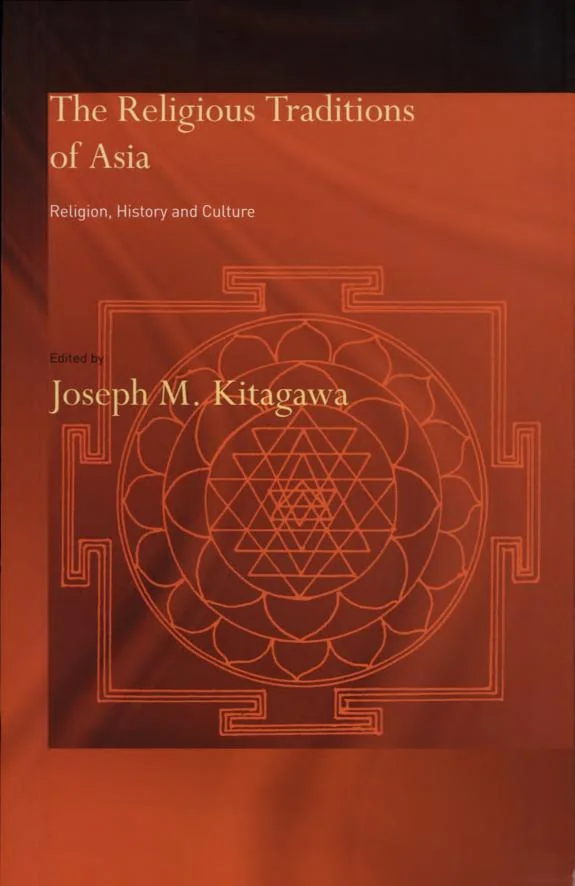
The Religious Traditions of Asia
 76
76

The Religious Traditions of Asia
Kitagawa’s edited volume provides a commendable breadth of coverage, touching upon the major religious traditions of Asia with contributions from recognized scholars. The strength lies in its systematic organization and the depth of expertise brought to each section, particularly the detailed discussions of Hinduism and the various schools of Buddhism. However, the collection's academic tone, while appropriate for its intended audience, can sometimes feel dry, lacking a more vibrant exploration of the lived, devotional aspects of these faiths. The section on Shinto, for instance, while informative on its doctrinal underpinnings, could benefit from more exploration of its integration into Japanese daily life and festivals. The work offers a solid academic foundation, but readers seeking an emotional or experiential connection to these traditions might need to supplement it. It stands as a valuable reference, but not an evocative guide.
📝 Description
76
Joseph Mitsuo Kitagawa's 2002 survey covers seventeen major Asian religious traditions.
Published in 2002, "The Religious Traditions of Asia" presents a systematic academic overview of the spiritual practices across the Asian continent. The volume comprises seventeen sections, each contributed by a specialist in the relevant field. It was designed to give students and scholars a solid understanding of the major religious systems that have shaped Asian societies. The book addresses traditions from Southwest Asia, Southeast Asia, Central Asia, Tibet, and East Asia. Its multi-authored format allows for in-depth coverage of diverse traditions such as Hinduism, Buddhism, Taoism, and Islam.
This work is intended for undergraduate and graduate students of comparative religion, Asian studies, and history. Researchers seeking a reliable reference for the historical development and core tenets of Asian religions will also find it useful. Kitagawa, a noted scholar, curated this collection to meet a need for accessible yet authoritative scholarship on non-Western religious systems. The book's release supported the growing academic effort to connect Western and Eastern religious studies.
While not strictly an esoteric text itself, "The Religious Traditions of Asia" documents traditions that often contain esoteric dimensions. Many of the covered religions, such as Buddhism and Taoism, have distinct contemplative and mystical lineages that focus on inner transformation and direct experience. The book's academic approach provides the historical and doctrinal background against which these more specialized practices operate. It situates these traditions within their broader cultural and historical contexts, allowing readers to understand the societal frameworks that gave rise to and sustained both the exoteric and esoteric aspects of Asian spirituality.
💡 Why Read This Book?
• Gain a structured understanding of Hinduism's diverse philosophical schools and devotional practices, as presented by leading scholars, enabling a comparative analysis with other Indian subcontinent religions. • Explore the specific historical development and doctrinal variations of Taoism and Confucianism, learning how these traditions shaped Chinese governance and social ethics. • Comprehend the unique theological and ritualistic aspects of Bon, the indigenous tradition of Tibet, and its historical relationship with Tibetan Buddhism.
⭐ Reader Reviews
Honest opinions from readers who have explored this book.
❓ Frequently Asked Questions
What specific Asian religious traditions are covered in Kitagawa's book?
The book covers major traditions from Southwest Asia (Hinduism, Jainism, Buddhism, Sikhism, Islam), East Asia (Taoism, Confucianism, Shinto), Central Asia, Tibet (Bon), and Southeast Asia, offering a wide geographical and doctrinal scope.
Who are the primary authors or editors of 'The Religious Traditions of Asia'?
The book is edited by Joseph Mitsuo Kitagawa, and its seventeen sections are authored by various leading scholars in their respective fields of religious studies.
When was 'The Religious Traditions of Asia' first published?
The book was first published in 2002, making it a relatively contemporary academic survey of Asian religions.
Is this book suitable for beginners in religious studies?
Yes, it is designed as a student textbook, offering a foundational yet comprehensive academic introduction to the major religious traditions of Asia.
What is the academic approach of this book?
It adopts a scholarly, multi-authored approach, with each section written by an expert, focusing on the history, doctrines, and cultural expressions of the religions covered.
Does the book discuss shamanistic religions?
Yes, the work includes a discussion on the shamanistic religions of Inner Asia, broadening its scope beyond the major world religions.
🔮 Key Themes & Symbolism
Comparative Doctrinal Frameworks
The work systematically contrasts and compares the core tenets of diverse Asian religions. It highlights how concepts like karma, dharma, and salvation are understood differently within Hinduism, Buddhism, and Jainism, and examines the ethical systems of Confucianism and Taoism. This comparative approach allows readers to appreciate the unique philosophical underpinnings and historical divergences of these traditions, offering a structured method for understanding religious pluralism in Asia.
Historical Development of Religions
Each chapter traces the historical evolution of its featured religious tradition, from origins to its state by the early 21st century. This includes examining the influence of key figures, the formation of distinct schools (e.g., within Buddhism), and the spread of religions across geographical regions. The book emphasizes how historical events and cultural interactions have shaped religious practices and beliefs, providing a chronological understanding of their development.
The Interplay of Religion and Culture
"The Religious Traditions of Asia" explores how religious beliefs and practices are interwoven with the social, political, and cultural fabric of Asian societies. It examines how traditions like Confucianism have influenced governance and social order in East Asia, and how Hindu practices are integrated into daily life in India. The book illustrates the reciprocal relationship between religious systems and the societies they inhabit.
Tibetan Religious Systems
A specific focus is placed on the religious range of Tibet, detailing both the indigenous Bon tradition and Tibetan Buddhism. The work elucidates the unique cosmology, monastic structures, and esoteric practices associated with these traditions. It also addresses the historical interactions and syncretic elements that have emerged between Bon and Buddhism in the Himalayan region.
💬 Memorable Quotes
Direct passages from the work, attributed to the author.
“The major traditions that are described and discussed are (from the Southwest) Hinduism, Jainism, Buddhism, Sikhism and Islam, and (from the East) Taoism, Confucianism and Shinto.”
— This statement clearly delineates the geographical and thematic scope of the book, establishing its focus on foundational religious systems from key Asian regions and setting expectations for the reader regarding the core content.
“Seventeen sections, all written by leading scholars in their different fields.”
— This highlights the book's structure and the caliber of its contributors, emphasizing its authority and the specialized knowledge brought to bear on each religious tradition discussed.
“The tradition of Bon in Tibet, the shamanistic religions of Inner Asia, a”
— This phrase indicates the inclusion of less commonly discussed or indigenous spiritual practices, alongside major world religions, suggesting a commitment to a comprehensive view of Asian religiosity beyond the most prominent faiths.
“The book covers all the religious traditions of Southwest Asia, Southeast Asia, Central Asia, Tibet, and East Asia.”
— This assertion underscores the book's ambitious geographical coverage, promising a broad overview of the diverse religious phenomena present across a vast and varied continental expanse.
“This essential student textbook consists of seventeen sections.”
— This framing positions the work as a core academic resource for students, indicating its pedagogical intent and structured approach to presenting complex religious studies material.
🌙 Esoteric Significance
Tradition
While not strictly an esoteric text in the Western sense, Kitagawa's work engages with traditions that contain significant esoteric dimensions, such as certain schools of Buddhism (Vajrayana, Zen) and the mystical Sufi branches of Islam. It situates these within their broader religious and cultural contexts, offering scholarly insights rather than direct initiatory guidance. It departs from purely academic, secular analyses by acknowledging the spiritual and metaphysical claims inherent in these traditions.
Symbolism
The book likely touches upon symbols central to Asian religions, such as the Wheel of Dharma (Dharmachakra) in Buddhism, representing the Buddha's teachings and the cycle of rebirth, or the Om symbol in Hinduism, signifying the ultimate reality and consciousness. The concept of Yin and Yang in Taoism, representing complementary opposites, would also be a key motif explored for its philosophical and cosmological implications.
Modern Relevance
Contemporary scholars and students of comparative religion continue to reference Kitagawa's volume for its foundational overview. Thinkers and practitioners interested in the intersection of religion, culture, and history in Asia find its systematic approach invaluable. Its discussion of traditions like Bon and shamanism also informs modern anthropological and religious studies exploring indigenous spiritualities and their resilience.
👥 Who Should Read This Book
• Students of comparative religion and Asian studies seeking a comprehensive, multi-authored textbook to build a foundational knowledge of diverse Asian spiritual systems. • Academic researchers requiring a reliable reference work for the historical development, key doctrines, and cultural expressions of traditions like Hinduism, Buddhism, Taoism, and Islam. • Individuals interested in understanding the unique religious range of Tibet, including Bon and Tibetan Buddhism, through an academically rigorous lens.
📜 Historical Context
Joseph Mitsuo Kitagawa's "The Religious Traditions of Asia," published in 2002, arrived in an academic landscape increasingly focused on globalizing religious studies. As a respected scholar in the field, Kitagawa curated this volume to consolidate expert knowledge on non-Western traditions, addressing a need for accessible, yet rigorous, scholarship. The book's multi-authored format was a standard approach for comprehensive surveys, allowing for depth in specialized areas. It contributed to a growing academic interest in comparative religion, moving beyond Eurocentric perspectives. While specific reception details are not widely publicized, its publication year places it alongside contemporary works that sought to contextualize Asian religions within global dialogues, contrasting with earlier, more fragmented studies. It engaged with the ongoing scholarly discourse on Buddhism, Hinduism, and Islam, providing updated perspectives for students and researchers.
📔 Journal Prompts
The concept of karma as explored across Buddhist and Hindu traditions.
The ethical principles of Confucianism and their societal impact.
The historical relationship between Bon and Tibetan Buddhism.
The role of shamanism in Inner Asian cultures.
The doctrinal distinctions between Jainism and Buddhism.
🗂️ Glossary
Dharma
A fundamental concept with varied meanings, often referring to cosmic law and order in Hinduism, the teachings of the Buddha in Buddhism, or the path of righteousness.
Karma
The principle of cause and effect, where actions (physical, verbal, or mental) have consequences that influence an individual's present and future existence, central to Hinduism, Buddhism, Jainism, and Sikhism.
Samsara
The cycle of birth, death, and rebirth, a core concept in Indian religions, from which liberation is sought.
Tao (Dao)
The fundamental principle of the universe in Taoism, often translated as 'the Way,' representing the natural order and the source of all things.
Shinto
The indigenous religion of Japan, characterized by the worship of kami (spirits or deities) and a focus on ritual purity and harmony with nature.
Bon
The indigenous spiritual tradition of Tibet, predating and coexisting with Tibetan Buddhism, featuring shamanistic elements and its own complex cosmology.
Kami
Spirits, deities, or essences in the Shinto religion, often associated with natural phenomena, ancestors, or significant places.
This book appears in 1 collection
🔮 Readers Also Liked
Browse all →






From the “Hinduism” Collection
View all →








More Free Sacred Texts & Gnosticism Books
View all →