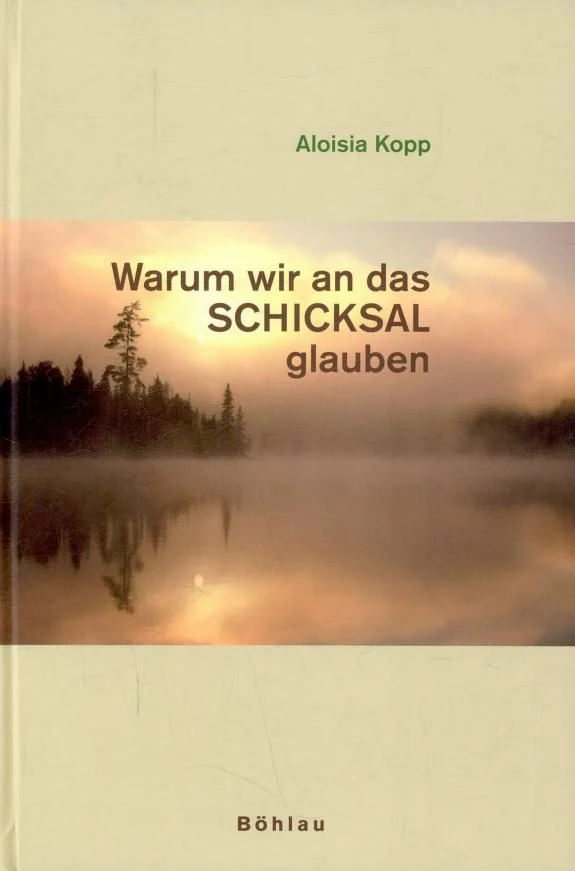
Warum wir an das Schicksal glauben
 75
75

Warum wir an das Schicksal glauben
Aloisia Kopp’s "Warum wir an das Schicksal glauben" is a sober examination of our innate need to perceive order in the chaos of existence. Kopp avoids the sensationalism often found in popular esoterica, instead focusing on a critical analysis of how we construct narratives of fate. The book's strength lies in its grounding of these profound questions within the socio-cultural landscape of contemporary Europe, particularly its critique of consumer culture’s impact on meaning-making. A notable passage explores how "meaningful coincidences" become psychological anchors in an uncertain world. Its primary limitation is a tendency towards academic abstraction, which may leave readers seeking practical guidance wanting. Despite this, the work offers a valuable perspective on a fundamental human preoccupation.
📝 Description
75
Aloisia Kopp's 2008 book questions why humans seek meaning in random events.
Aloisia Kopp's "Warum wir an das Schicksal glauben" examines the human drive to find purpose in what appears to be chance. Published in 2008, the book does not present fate as a predetermined path. Instead, it views fate as a lens through which individuals interpret "meaningful coincidences." Kopp scrutinizes how unexpected events, especially human connections, influence our life's direction. She probes the possibility that an inherent purpose guides all occurrences.
The work is intended for those wrestling with fundamental questions about existence. It speaks to individuals who feel disoriented by contemporary European societies, marked by changing values and a focus on consumerism. Readers interested in the philosophical and psychological roots of belief systems will find resonance here, particularly those striving to connect their lived experiences with larger ideas of destiny or divine guidance.
Kopp's work emerged in the early 21st century, a time when interest in spirituality outside established religions was growing. This period saw a renewed engagement with concepts like synchronicity, a term associated with Carl Jung. Her book reflects a broader philosophical critique of secular materialism and a search for personal significance, aligning with traditions that explore the interplay between subjective experience and objective reality.
💡 Why Read This Book?
• Understand the psychological drivers behind belief in fate, as Kopp meticulously dissects the concept of "meaningful coincidences" that shape our perception of life events. • Analyze the influence of societal shifts on personal meaning-making, a key focus for readers interested in the 2008 European context of value changes. • Reframe your understanding of seemingly random occurrences by exploring Kopp's thesis on how perceived fate offers a psychological anchor in a world of perceived uncertainty.
⭐ Reader Reviews
Honest opinions from readers who have explored this book.
❓ Frequently Asked Questions
What is Aloisia Kopp's main argument about fate?
Aloisia Kopp argues that our belief in fate stems from a fundamental human need to find meaning in "meaningful coincidences" and life events, rather than from a deterministic external force.
When was "Warum wir an das Schicksal glauben" first published?
The book "Warum wir an das Schicksal glauben" by Aloisia Kopp was first published in 2008.
What societal context does the book address?
The book addresses the context of European service societies experiencing value shifts and a pervasive consumer culture, exploring how these factors influence the search for meaning.
Does the book offer practical advice for dealing with fate?
While not a self-help guide, the book offers a philosophical framework for understanding why we believe in fate, encouraging readers to critically examine their own perceptions of life events and coincidences.
Who is Aloisia Kopp?
Aloisia Kopp is an author who explores philosophical and psychological themes related to human experience, particularly the concepts of fate, meaning, and coincidence.
What is a "meaningful coincidence" according to the book?
A "meaningful coincidence" refers to an event, often an encounter with another person, that feels significant and appears to guide or influence one's life path, suggesting a hidden purpose.
🔮 Key Themes & Symbolism
The Nature of Fate
This theme scrutinizes the human tendency to perceive fate as an active force shaping our lives. Kopp examines how 'meaningful coincidences' and seemingly random events are interpreted as evidence of a guiding hand, providing comfort and structure in an often unpredictable existence. The work contrasts deterministic views of fate with a more psychological interpretation, focusing on our internal need for narrative and purpose.
Meaningful Coincidences
Central to Kopp's analysis are "sinnvolle Zufälle" (meaningful coincidences), such as significant encounters or unexpected occurrences. The book explores how these events are not merely random but are imbued with personal meaning, often reinforcing our beliefs about our life's path or destiny. This concept challenges the purely mechanistic view of the universe.
The Search for Meaning
In the context of a modern European society marked by value shifts and consumerism, the book addresses the profound human quest for meaning. Kopp posits that the belief in fate is a significant coping mechanism and a way to structure personal experience when traditional sources of meaning may be less accessible or convincing.
Suffering and Purpose
The work touches upon the existential question of human suffering and its perceived role within a fated life. It considers how the belief in an overarching purpose, even one found in hardship, can help individuals endure difficult circumstances and find a sense of coherence in their life narrative.
💬 Memorable Quotes
Direct passages from the work, attributed to the author.
“Are 'meaningful coincidences', like encounters with people, steering our lives?”
— This question expresses the book's core inquiry into how we perceive external events, particularly human interactions, as steering our personal destinies and guiding our life's path.
“Is there a hidden meaning in all events?”
— This probes the fundamental human desire to find order and purpose, questioning whether apparent randomness in life actually conceals a deeper, intentional structure.
“Humans are searching for meaning in an era of value change and consumer culture.”
— This highlights the socio-cultural backdrop of the book, identifying the contemporary European landscape as a key environment where the need for existential meaning becomes particularly acute.
“Fate as meaning?”
— A concise framing of the central thesis, suggesting that our concept of fate might be intrinsically linked to our fundamental need to find significance and purpose in our existence.
“The course of human destiny.”
— This phrase points to the book's exploration of how individuals perceive and narrate the unfolding of their lives, often through the lens of fate or a predetermined path.
🌙 Esoteric Significance
Tradition
While not strictly adhering to a single esoteric lineage, Kopp's work engages with themes resonant in Hermeticism and depth psychology, particularly concerning synchronicity and the search for hidden order. It touches upon the Hermetic principle of correspondence ('As above, so below') by suggesting a connection between internal meaning-making and external events, albeit framed analytically rather than mystically.
Symbolism
The primary 'symbol' explored is the "meaningful coincidence" itself – an event that bridges the subjective inner world of the seeker with the objective outer world. Encounters with specific people are often highlighted as potent symbols of destiny, representing crossroads or catalysts for personal evolution within the narrative of one's life.
Modern Relevance
Kopp's examination of fate and meaning-making remains highly relevant today. Contemporary thinkers in existential psychology, narrative therapy, and even secular mindfulness practices continue to explore how individuals construct meaning from life events and perceived coincidences, echoing her core arguments about our innate need for purpose.
👥 Who Should Read This Book
• Individuals questioning the role of chance versus destiny in their lives, seeking a structured analysis of "meaningful coincidences." • Students of European intellectual history and philosophy of the early 21st century, interested in contemporary debates on meaning-making. • Readers of existential psychology and Jungian analysis, looking for perspectives on synchronicity and the human search for purpose.
📜 Historical Context
Aloisia Kopp's "Warum wir an das Schicksal glauben" emerged in 2008, a period where philosophical and psychological discourse continued to grapple with meaning in a secularized, increasingly individualistic West. This era saw sustained interest in concepts like Carl Jung's synchronicity, which explored meaningful coincidences, a theme directly addressed by Kopp. While not directly engaging with figures like Viktor Frankl, whose work on meaning in suffering predated Kopp's, her book contributed to a broader conversation about existential psychology and the human need for narrative. Unlike the more overtly spiritual movements of the late 20th century, Kopp's approach was more analytical, situated within a European intellectual tradition that often critiques facile spiritualism. There is no widely documented reception event like a major prize or controversy, suggesting its impact was more within academic and thoughtful lay circles.
📔 Journal Prompts
The concept of 'meaningful coincidences' and their perceived role in your life trajectory.
Reflecting on encounters with individuals as potential steering forces.
Analyzing the influence of value shifts on your personal search for meaning.
The purpose attributed to human suffering within a narrative of fate.
Identifying patterns that suggest a guiding hand versus arbitrary chance in your experiences.
🗂️ Glossary
Schicksal
German term for 'fate' or 'destiny,' referring to the predetermined course of events believed to be beyond human control.
Sinnvolle Zufälle
Literally 'meaningful coincidences.' These are events that appear to be more than mere chance, carrying personal significance and suggesting an underlying order or purpose in life.
Wertewandel
German for 'value change.' It refers to shifts in societal norms, beliefs, and priorities, particularly relevant in the context of European service economies.
Erlebnisgesellschaft
German for 'experience society.' A term describing modern societies where the pursuit of experiences and consumption plays a central role in individual identity and lifestyle.
Konsumkultur
German for 'consumer culture.' Pertains to a society in which the buying and selling of goods and services is the primary economic and social activity.
Sinn
German for 'meaning' or 'purpose.' The book explores the human quest for meaning, especially in relation to perceived fate and life events.
Schicksalsverlauf
German for 'course of destiny.' Refers to the perceived progression or unfolding of an individual's life path as guided by fate.
This book appears in 1 collection
🔮 Readers Also Liked
Browse all →![The Byrhtferth's Manuscript (MS 17) † Saint John’s College † Oxford † [1111]](/img/thumb/the-byrhtferth-s-manuscript-ms-17-saint-john-s-college-oxford-1111-the-monk-byrhtferth.webp)







From the “Karma” Collection
View all →








More Free Sacred Texts & Gnosticism Books
View all →