Was Hinduism Invented?
 82
82

Was Hinduism Invented?
Pennington’s interrogation of the colonial gaze upon Hinduism in 19th-century Bengal is a sharp, academic intervention. He meticulously dissects how Christian perceptions and the desire to categorize 'Eastern' religions shaped the very identity of what was being 'discovered.' The analysis of how indigenous responses accommodated or resisted these externally imposed frameworks offers a particularly strong counterpoint to simplistic colonial narratives. A limitation, however, is the dense academic prose, which may challenge readers unfamiliar with postcolonial theory or religious studies jargon. The exploration of how concepts like 'Brahminism' were constructed for Western consumption is a standout section, demonstrating the book's critical edge. "Was Hinduism Invented?" offers a vital corrective to narratives of religious encounter.
📝 Description
82
In early 19th-century Bengal, colonial encounters actively constructed religious identities, not merely discovered them.
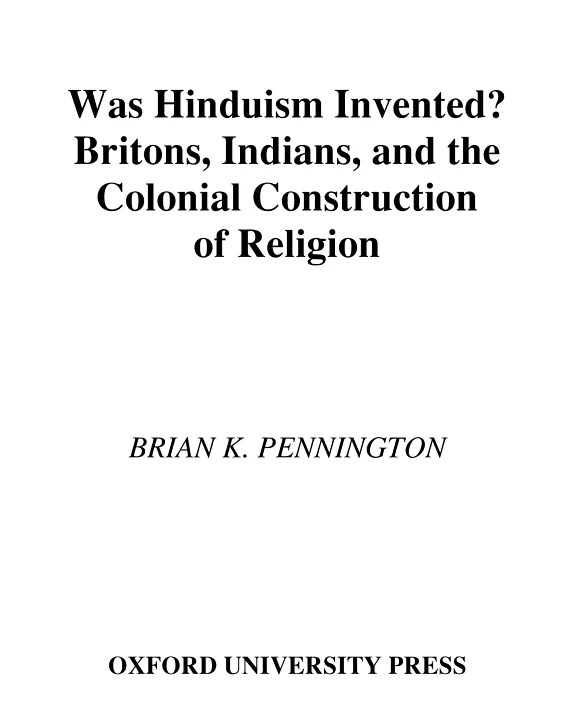
Brian K. Pennington's "Was Hinduism Invented?" scrutinizes the cultural and religious exchanges between Christian missionaries and Hindu scholars in early 19th-century Bengal. He demonstrates that colonial encounters were not simple discoveries but active processes of shaping religious identities. Pennington challenges the idea of Hinduism as a static, monolithic entity that outsiders found. Instead, he argues that both Christian and Hindu viewpoints were mutually created, influencing how each tradition understood itself and the other.
The book is set in the 1800s, a time of significant colonial presence and intellectual activity in Bengal. British figures were documenting, translating, and often reframing Indian traditions. This period saw the rise of Orientalism, where scholars like William Jones sought to categorize Indian religions, which in turn affected how these traditions were perceived and developed. Pennington's work centers on the concept that religious categories are fluid, produced through interaction and power dynamics.
This work engages with the historical construction of religious categories, questioning essentialist views of traditions like Hinduism. It situates itself within scholarly discussions about how religions are defined and understood, particularly in colonial contexts. The book examines the intellectual history surrounding the classification and interpretation of religious beliefs and practices, a topic relevant to those interested in how esoteric and exoteric forms of knowledge are established and maintained.
💡 Why Read This Book?
• Learn how colonial encounters in early 19th-century Bengal actively constructed religious identities, rather than simply discovering them, challenging simplistic notions of religious origins. • Understand the role of intellectual frameworks, such as Orientalism, in shaping the perception and categorization of Eastern religions, as discussed in the context of Bengal. • Gain insight into how mutual perceptions between Christian missionaries and Hindu scholars in the 1800s led to the very formation of the religions that colonialism 'discovered'.
⭐ Reader Reviews
Honest opinions from readers who have explored this book.
❓ Frequently Asked Questions
What is the central argument of Brian K. Pennington's "Was Hinduism Invented?"
The central argument is that Hinduism, as understood by colonial powers, was not a static entity discovered in the 19th century, but rather a category actively constructed through the interactions and perceptions of Christian missionaries and Hindu scholars in Bengal.
When was "Was Hinduism Invented?" first published?
"Was Hinduism Invented?" was first published on April 28, 2005.
What historical period does the book focus on?
The book primarily focuses on the early 19th century, specifically the period of intense colonial presence and intellectual exchange in Bengal.
What does Pennington mean by 'invented' in the context of Hinduism?
Pennington uses 'invented' to suggest that the way Hinduism was understood and categorized by colonial powers was a product of their own worldview and the dynamic interactions of the time, rather than a neutral observation of an ancient, pre-defined religion.
Which regions are central to the book's analysis?
The region central to the book's analysis is Bengal, where the encounters between Christian missionaries and Hindu intellectuals took place and shaped religious identities.
Who are the key groups discussed in relation to religious identity formation?
The key groups discussed are Christian missionaries and Hindu scholars, whose mutual perceptions and representations played a crucial role in the formation of religious identities during the colonial era.
🔮 Key Themes & Symbolism
Colonial Construction of Religion
The book critically examines how colonial encounters, particularly in 19th-century Bengal, were not passive observations but active processes of constructing religious identities. Pennington argues that categories like 'Hinduism' were shaped by the preconceptions of Christian missionaries and administrators, influenced by their own worldviews. This challenges the idea of religion as a fixed entity discovered by outsiders, highlighting instead the dynamic interplay of power and perception in defining religious traditions for both the colonizer and the colonized.
Mutual Influence in Encounters
Pennington emphasizes the bidirectional nature of religious encounters. It wasn't solely the West imposing its views; indigenous responses and reinterpretations also played a significant role in shaping religious expression. The work illustrates how Hindu scholars and thinkers engaged with, adapted to, or resisted the categories and interpretations presented by Christian observers, leading to a complex mutual formation of religious self-understanding.
Orientalism and Religious Categorization
The study explores how Orientalist scholarship, prevalent in the early 19th century, contributed to the categorization and understanding of Indian religions. Pennington shows how figures and intellectual currents of the time sought to define Hinduism within Western frameworks, often simplifying or distorting its diverse traditions. This process, driven by specific historical and intellectual contexts, influenced how Hinduism was perceived and subsequently developed.
Identity Formation Under Colonialism
A core theme is the formation of religious identity under the pressures of colonialism. The book demonstrates that the very notion of 'Hinduism' as a singular, coherent religion was significantly influenced by its representation to and by the colonial administration and missionary efforts. This process reveals the contingent nature of religious identity, particularly when subjected to external scrutiny and power dynamics.
💬 Memorable Quotes
Direct passages from the work, attributed to the author.
“Christian missionaries and Hindu scholars produced each other in the encounter.”
— This statement captures Pennington's core thesis: religious identities are not isolated but are mutually constituted through interaction. The presence and perceptions of missionaries influenced how Hindus understood themselves, and vice versa, during the colonial period.
“The encounter was shaped by the power of respective worldviews.”
— This points to the significant influence of the internal beliefs, assumptions, and intellectual traditions of both Christian and Hindu participants in shaping the nature and outcome of their interactions in 19th-century Bengal.
“The reception of each other was a key element in identity formation.”
— Pennington emphasizes that how Christian missionaries viewed Hindus, and how Hindus responded to that gaze, was fundamental to how both groups came to define their own religious and cultural identities during this historical period.
“Colonial 'discovery' was an act of religious construction.”
— This interpretation underscores the book's critique of the colonial narrative. It suggests that the act of 'discovering' or documenting non-Western religions was, in fact, a process of imposing existing Western categories and interpretations, thereby constructing a new understanding of those religions.
💡 Key Ideas
Editorial paraphrase of the work's core concepts — not direct quotes.
The religions colonialism 'discovered' were partly produced by the colonial encounter.
This paraphrased concept highlights the book's argument that the categories and understandings of religions like Hinduism were not simply unearthed but actively shaped by the colonial project itself, including its intellectual frameworks and power dynamics.
🌙 Esoteric Significance
Tradition
While not directly a text within a specific esoteric lineage like Hermeticism or Theosophy, "Was Hinduism Invented?" speaks to a meta-level of esoteric inquiry. It aligns with critical traditions that question the received narratives of spiritual and religious origins, a common concern in esoteric thought. Its focus on the constructed nature of identity can inform esoteric practitioners who seek to deconstruct imposed belief systems and understand the subjective nature of spiritual experience.
Symbolism
The book's primary 'symbolism' lies not in traditional motifs but in the conceptual representations of 'Hinduism' and 'Christianity' themselves. These become symbolic of broader categories of 'East' and 'West,' 'colonizer' and 'colonized.' The colonial encounter itself can be seen as a symbolic space where the perceived boundaries between religions are tested, blurred, and re-established according to the power dynamics at play.
Modern Relevance
Contemporary scholars of religion and postcolonial theory frequently cite Pennington's work for its foundational critique of how religious categories are formed. Thinkers examining religious syncretism, the impact of globalization on belief systems, and the ongoing negotiation of cultural identity in formerly colonized nations draw upon its insights. It remains relevant for understanding how perceptions of 'other' religions continue to be shaped by historical power imbalances and dominant cultural narratives.
👥 Who Should Read This Book
• Scholars of Religious Studies: Those researching the sociology of religion, comparative religion, and the impact of colonialism on belief systems will find Pennington's critical analysis indispensable. • Postcolonial Theory Enthusiasts: Readers interested in how colonial power structures shaped cultural and intellectual landscapes will gain a deeper understanding of religious identity formation. • Historians of South Asia: Individuals studying 19th-century Bengal and the intellectual history of the region will benefit from this detailed examination of intercultural religious exchange.
📜 Historical Context
Brian K. Pennington's "Was Hinduism Invented?" emerged from the intellectual milieu of the early 2000s, a period when postcolonial studies were critically examining historical narratives of empire and religion. The book specifically revisits the early 19th century in Bengal, a time of burgeoning British colonial power and intense missionary activity. Figures like William Carey, a prominent Baptist missionary and Orientalist, were actively engaged in translating religious texts and documenting Indian culture, often through a lens shaped by Christian theology and Enlightenment rationalism. This era saw the rise of comparative religion as a field, but one frequently predicated on Western hierarchical assumptions. Pennington's work directly engages with and challenges these foundational Orientalist interpretations, offering a nuanced view of how religious categories were negotiated and, in effect, constructed through these colonial interactions, rather than being pre-existing truths discovered by scholars like Jones or Carey.
📔 Journal Prompts
The colonial construction of 'Hinduism': analyze the implications of this framing.
Mutual identity production: How did Christian perceptions influence Hindu self-understanding?
Analyze the role of Orientalist scholarship in shaping religious categories.
Reflect on the power dynamics inherent in the encounter between worldviews.
How does the concept of 'invention' apply to other religious traditions?
🗂️ Glossary
Orientalism
A term coined by Edward Said, referring to the way Western cultures perceive and represent Eastern cultures. It often involves a complex mixture of fascination, condescension, and the imposition of Western frameworks onto Eastern subjects.
Postcolonial Theory
An academic field that analyzes the cultural legacy of colonialism and imperialism, focusing on issues of power, identity, race, and representation in formerly colonized societies.
Worldview
The fundamental cognitive orientation of an individual or society encompassing the whole of the individual's or society's knowledge and point of view.
Bengal
A region in South Asia, historically a major center of colonial activity and intellectual exchange between British India and indigenous populations during the 18th and 19th centuries.
Missionaries
Individuals sent out by religious organizations to spread their faith, often involving cultural and social engagement with local populations, particularly prominent in colonial contexts.
Categorization
The process of classifying or dividing things into groups or classes based on shared qualities or characteristics, often reflecting the categorizer's own assumptions.
Mutual Constitution
The idea that two or more entities or concepts are formed and defined in relation to each other, influencing and shaping one another's existence and identity.
This book appears in 1 collection
🔮 Readers Also Liked
Browse all →








From the “Hinduism” Collection
View all →






More Free Sacred Texts & Gnosticism Books
View all →