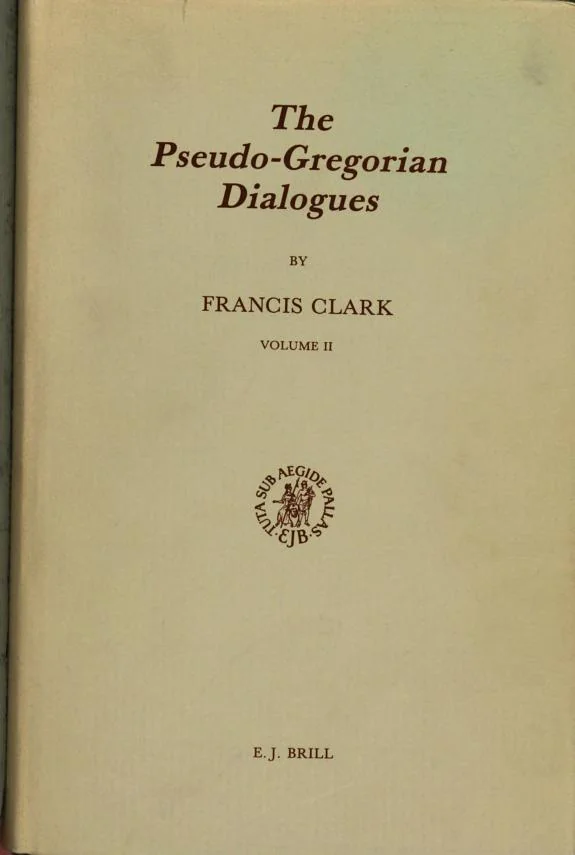
The Pseudo-Gregorian dialogues. 1 (1987)
 74
74

The Pseudo-Gregorian dialogues. 1 (1987)
Francis Clark’s analysis of the Pseudo-Gregorian Dialogues is a rigorous exercise in textual scholarship, particularly in its meticulous dissection of manuscript evidence. The strength of the work lies in its detailed philological approach, which is essential for understanding the complexities of early Christian textual transmission. Clark’s careful consideration of the linguistic and stylistic features, for instance, in distinguishing genuine Gregorian works from those appended later, is commendable. However, the book’s dense academic prose and specialized focus can present a barrier to those not deeply immersed in patristic studies. A section discussing the *Dialogues'* influence on later medieval visions of the afterlife, beyond mere attribution, would have broadened its appeal and contextual significance. Nevertheless, for its intended audience, Clark provides an indispensable scholarly tool for authenticating and interpreting these critical early Christian texts.
📝 Description
74
Francis Clark's 1987 study examines Christian texts wrongly attributed to Pope Gregory the Great.
Published in 1987, Francis Clark's "The Pseudo-Gregorian Dialogues I" undertakes a critical analysis of a body of early Christian literature falsely assigned to Pope Gregory the Great. Clark's research focuses on the textual history and theological content of these dialogues. He aims to clarify their authorship and their place within the patristic tradition, working to disentangle the complex layers of influence and attribution surrounding these writings.
This scholarly work is suited for advanced students and researchers specializing in patristics, early Christian history, and classical theology. It requires a solid grounding in Latin and a serious interest in textual criticism and the shaping of Christian doctrine in late antiquity. Those looking for introductory Christian history or simple devotional texts will find this academic study quite dense and less accessible.
The late antique period, spanning roughly the 3rd to 7th centuries CE, was a formative era for Christian thought, marked by creed formation, the rise of monasticism, and significant theological disputes. Attributions to major figures like Gregory the Great (c. 540-604 CE) were highly consequential. Clark's 1987 analysis engages with a long-standing academic discussion about the authenticity of texts linked to prominent Church Fathers, a field also addressed by scholars such as Peter Brown.
While not overtly Gnostic, this work engages with the historical and textual complexities surrounding texts that shaped early Christian thought. The "Pseudo-Gregorian" dialogues, often misattributed, represent a stratum of Christian literature where authorship and authority were fluid concepts. Examining these works requires understanding the period's intellectual environment, where spiritual authority could be projected onto texts, influencing theological development. The study touches on themes of the soul and the afterlife, common in both mainstream and heterodox Christian traditions of late antiquity.
💡 Why Read This Book?
• Gain a nuanced understanding of textual criticism as applied to early Christian literature, specifically by analyzing Clark's methodology for attributing the *Dialogues* to their correct author(s), a process vital for historical accuracy. • Explore the theological landscape of the late antique period by examining the specific concepts of eschatology and the soul as presented in the Pseudo-Gregorian texts, offering a window into the spiritual concerns of the era. • Appreciate the historical context of papal authority and influence, understanding how texts attributed to figures like Gregory the Great (c. 540-604 CE) shaped perceptions of doctrine and saintly authority in the centuries following their composition.
⭐ Reader Reviews
Honest opinions from readers who have explored this book.
❓ Frequently Asked Questions
What is the primary focus of Francis Clark's Pseudo-Gregorian Dialogues I?
The primary focus is the critical examination and authentication of early Christian dialogues attributed to Pope Gregory the Great, analyzing their textual history and theological content.
Who is the intended audience for this scholarly work?
The work is intended for advanced students and researchers in patristics, early Christian history, and classical theology who possess a background in Latin and textual criticism.
What historical period does the book primarily address?
The book addresses the late antique period, specifically focusing on texts from around the time of Pope Gregory the Great (c. 540-604 CE) and their subsequent reception.
What are some key concepts explored within the dialogues examined?
Key concepts include textual attribution, hagiography, early Christian eschatology, the nature of the soul, the afterlife, and divine judgment.
Why is textual criticism important for understanding these dialogues?
Textual criticism is crucial for distinguishing authentic works from later misattributions, which impacts our understanding of theological development and the historical influence of figures like Gregory the Great.
When was Francis Clark's work on the Pseudo-Gregorian Dialogues first published?
Francis Clark's Pseudo-Gregorian Dialogues I was first published in 1987.
🔮 Key Themes & Symbolism
Textual Authentication
The core of Clark's work lies in establishing the genuine authorship of the Pseudo-Gregorian Dialogues. This involves intricate textual analysis, comparing manuscript traditions, and scrutinizing linguistic and stylistic markers. The book demonstrates how the veneration of figures like Pope Gregory the Great (c. 540-604 CE) could lead to the accretion of texts to their oeuvre, necessitating careful scholarly intervention to discern historical reality from later devotional or scholarly accretion.
Early Christian Eschatology
The dialogues themselves, regardless of precise attribution, offer significant insights into early Christian beliefs about the end times, the afterlife, and divine judgment. Clark's analysis situates these discussions within the broader theological currents of late antiquity, exploring how contemporary anxieties and developing doctrines shaped the narratives and theological assertions within the texts.
Patristic Authority
This work engages with the concept of patristic authority, exploring how texts associated with prominent Church Fathers, even if misattributed, wielded considerable influence. The book implicitly questions the uncritical acceptance of ancient texts and highlights the scholarly responsibility to investigate the provenance and historical context of writings that shaped Christian thought.
Manuscript Traditions
Understanding the transmission of these dialogues relies heavily on analyzing their manuscript traditions. Clark's research explores the variations and lineages of these manuscripts, revealing the complex path texts took from their likely origins to their eventual preservation and study, a process critical for any historical reconstruction.
💬 Memorable Quotes
Direct passages from the work, attributed to the author.
“The attribution of these dialogues to Gregory the Great is a matter of considerable scholarly debate.”
— This statement highlights the central challenge of the book: the contested authorship of the texts. It signals that the work will engage in critical analysis to resolve or illuminate this historical uncertainty rather than accepting traditional attributions at face value.
“The eschatological themes reflect the theological concerns of the late antique period.”
— This interpretation emphasizes the book's engagement with the content of the dialogues, situating their discussions of the end times and the afterlife within the specific intellectual and spiritual climate of their historical era.
“The influence of these dialogues extended beyond their immediate authorship.”
— This interpretation suggests that the book considers the broader impact of the Pseudo-Gregorian Dialogues, acknowledging that their theological or narrative content played a role in shaping later Christian thought and literature, irrespective of their precise origin.
💡 Key Ideas
Editorial paraphrase of the work's core concepts — not direct quotes.
Linguistic and stylistic analysis reveals significant divergence from Gregory's known authentic works.
This paraphrased concept points to the methodological approach used by Clark. It suggests that internal textual evidence, such as vocabulary and sentence structure, provides key clues for questioning or confirming the traditional authorship of the dialogues.
Manuscript variations necessitate careful comparison to reconstruct the original text.
This paraphrased concept underscores the importance of textual criticism and the study of manuscript traditions. It implies that the process of understanding the dialogues involves not just interpreting their meaning but also meticulously tracing their textual lineage.
🌙 Esoteric Significance
Tradition
While primarily a work of historical and textual criticism within Christian patristics, the Pseudo-Gregorian Dialogues touch upon themes often explored in esoteric traditions, particularly concerning the nature of the soul, the afterlife, and spiritual ascent. These themes align with mystical and Gnostic currents that sought direct knowledge of the divine and understanding of hidden realities, though Clark's analysis remains grounded in historical authenticity rather than esoteric interpretation.
Symbolism
The dialogues often employ symbolic language to describe the spiritual journey and the structure of the cosmos. Concepts such as divine light, the purification of the soul through trials, and the symbolic representation of virtues and vices can be seen as motifs that resonate with later esoteric traditions. For instance, the journey of the soul through different spiritual states can be interpreted through a symbolic lens, reflecting common esoteric archetypes.
Modern Relevance
Modern esoteric thinkers and practitioners interested in the historical roots of Christian mysticism and angelology may find value in Clark's work. While not an esoteric text itself, it provides a critical foundation for understanding the source material that influenced later mystical movements. Scholars and practitioners exploring the historical development of concepts like spiritual intermediaries or the structure of spiritual realms might consult Clark's findings.
👥 Who Should Read This Book
• Advanced students of theology and Church history: To rigorously assess the authenticity of texts attributed to major Church Fathers and understand the methods of patristic scholarship. • Researchers in late antique studies: To gain specific insights into the eschatological beliefs and spiritual concerns prevalent in the period surrounding Pope Gregory the Great (c. 540-604 CE). • Scholars of textual criticism: To examine a case study in the authentication of ancient religious literature and the analysis of manuscript traditions.
📜 Historical Context
Francis Clark's *The Pseudo-Gregorian Dialogues I*, published in 1987, emerged from a rich tradition of patristic scholarship focused on the authenticity and influence of early Church Fathers. The late antique and early medieval periods, from which these dialogues originate, were foundational for Christian doctrine and practice. Scholars like Peter Brown, in his extensive work on Gregory the Great (c. 540-604 CE), have illuminated the immense authority associated with such figures. Clark’s work participates in a scholarly conversation that, for centuries, has sought to disentangle genuine writings from apocryphal or later accretions. This critical approach was particularly relevant in the 20th century, as scholars refined methodologies for textual criticism. While not directly a product of the immediate reception of Gregory's own time, Clark’s analysis engages with a scholarly debate that has continued through figures like Ernst Kantorowicz and his contemporaries, who also grappled with the historical layering of texts and their attributed authors.
📔 Journal Prompts
The criteria for textual authentication in Pseudo-Gregorian Dialogues I.
Reflections on the eschatological themes as presented in the dialogues.
Comparing the concept of patristic authority in the late antique period with modern scholarship.
The significance of manuscript traditions for understanding early Christian texts.
Analyzing the symbolic language used to describe the soul's journey within the dialogues.
🗂️ Glossary
Patristics
The academic study of the Church Fathers, early Christian theologians and writers who established the intellectual and doctrinal foundations of Christianity.
Textual Criticism
The scholarly discipline focused on identifying the original wording of a text, especially ancient documents, by comparing different manuscript copies and analyzing variations.
Eschatology
The theological study of final things, including concepts of the end of the world, the afterlife, judgment, and the ultimate destiny of humanity and the cosmos.
Hagiography
The writing of the lives of saints, often involving historical accounts mixed with devotional or legendary material.
Late Antiquity
A period in the history of the Near East, Middle East, and Mediterranean world, roughly spanning from the 3rd to the 7th centuries CE, characterized by significant cultural and religious transitions.
Apocryphal
Texts, particularly religious ones, that are not considered authentic or canonical, often attributed to well-known figures but lacking verifiable origin.
Oevre
The complete body of works of a particular artist, composer, or writer.
This book appears in 1 collection
🔮 Readers Also Liked
Browse all →








From the “Immortality” Collection
View all →






More Free Esoteric History & Biography Books
View all →