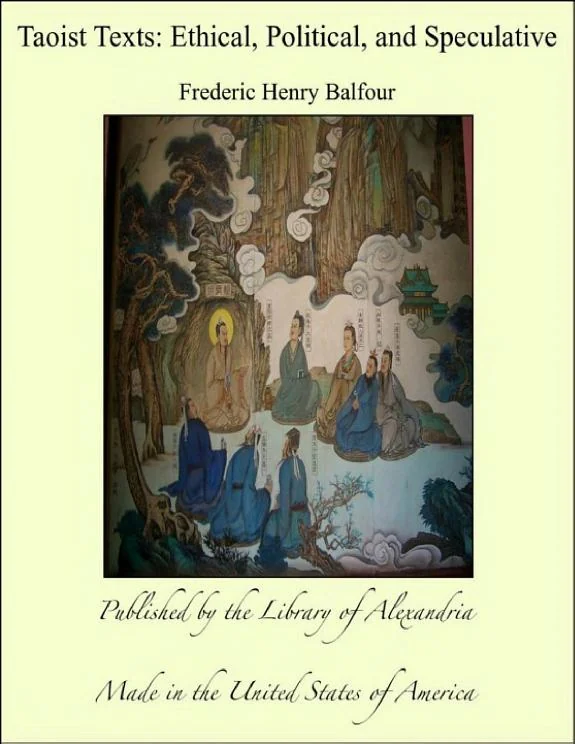
Taoist Texts: Ethical, Political, and Speculative
 79
79

Taoist Texts: Ethical, Political, and Speculative
Balfour's "Taoist Texts" offers a valuable, if dated, compilation for those interested in the ethical and political dimensions of early Taoism. The strength lies in its curated selection, bringing together disparate strands of thought that illustrate the practical application of Taoist philosophy. Balfour's annotations, while sometimes reflecting the biases of his era, provide essential context for understanding concepts like Wu Wei. However, the prose can feel dense, and the translation style, typical of the late 19th century, may require patient engagement. A particularly illuminating section discusses the application of Taoist principles to statecraft, offering a perspective often overshadowed by discussions of individual spiritual practice. It serves as a solid, if not always accessible, scholarly resource.
📝 Description
79
Frederic Henry Balfour translated classical Chinese Taoist writings in 1884.
Frederic Henry Balfour's "Taoist Texts: Ethical, Political, and Speculative" presents classical Chinese philosophical writings, translated and annotated for English readers. The collection illuminates the core ideas of Taoism, covering its practical ethics, its approach to governance, and its metaphysical speculations. Balfour's work seeks to clarify the philosophical world of ancient China for those unfamiliar with its intellectual traditions. The focus is on texts that show the Taoist way of life and societal organization.
This volume is for students of comparative philosophy, scholars of religion, and anyone interested in the roots of Eastern thought. It appeals to those who want to grasp the ethical systems that shaped ancient Chinese society and rule, as well as those curious about Taoist cosmology. Readers who value detailed scholarly introductions and annotated translations will find this book useful. It is especially helpful for investigating the historical development of Taoist ideas beyond their more common interpretations.
Published in 1884, Balfour's collection arrived during a period of growing Western interest in Eastern philosophies. It contributed to the academic and popular understanding of Taoist thought, offering insights into how these texts were interpreted by a Victorian audience. This work reflects the scholarly approaches and translation methods of its era, situating the study of Taoism within the broader context of comparative philosophy and religious studies.
💡 Why Read This Book?
• Gain specific insights into the Taoist concept of *Wu Wei* as applied to governance, as discussed in Balfour's annotations, offering a practical framework for leadership distinct from modern political theory. • Understand the historical reception of Taoist thought in the late 19th century by examining Balfour's scholarly approach and the intellectual currents he navigated, providing context not found in purely philosophical analyses. • Explore speculative Taoist cosmology through the translated texts, learning about foundational ideas that shaped Chinese philosophy and continue to inform esoteric traditions today.
⭐ Reader Reviews
Honest opinions from readers who have explored this book.
❓ Frequently Asked Questions
What is the significance of Wu Wei as presented in Balfour's collection?
Wu Wei, or non-action, is presented as effortless action, aligning with the natural flow of the Tao. Balfour's selection illustrates its application in governance and personal conduct, advocating for a non-interfering approach that allows natural order to prevail, as seen in texts discussing leadership.
When was Frederic Henry Balfour's 'Taoist Texts' first published?
Frederic Henry Balfour's 'Taoist Texts: Ethical, Political, and Speculative' was first published in 1884, a period of growing Western academic interest in Asian philosophies.
Does the book include translations of famous Taoist works like the Tao Te Ching?
While Balfour's collection focuses on ethical, political, and speculative aspects, it includes selections that interpret or elaborate on core Taoist principles, though it may not be a direct translation of the complete Tao Te Ching itself. Its aim is broader coverage of related texts.
What historical context is provided for these Taoist texts?
The book situates Taoist thought within ancient Chinese philosophical discourse, exploring its influence on governance and ethics. Balfour's annotations offer insight into the late 19th-century Western understanding and academic study of these texts.
Are the speculative sections accessible to beginners?
The speculative sections delve into metaphysical concepts of Taoism. While Balfour strives for clarity, the subject matter and the translation style of 1884 may require focused reading for those new to Eastern philosophical traditions.
What is the 'Tao' according to the texts Balfour selected?
According to the texts Balfour selected, the Tao is the fundamental, ineffable principle underlying all existence. It represents the natural order, the source of all things, and the way things ought to be when in harmony.
🔮 Key Themes & Symbolism
The Way of Wu Wei
This theme centers on the principle of Wu Wei, often translated as non-action or effortless action. Balfour's selection highlights how this concept applies not merely to personal detachment but also to effective governance and societal harmony. It's presented as a method of acting in accordance with the natural flow of the Tao, minimizing unnecessary intervention and allowing events to unfold organically. This contrasts with forceful or contrived approaches, emphasizing spontaneity and alignment with universal principles for achieving balance and order.
Ethical Governance
The collection explores Taoism's unique perspective on statecraft and leadership. Rather than focusing on rigid laws or authoritarian control, the ethical dimension emphasizes ruling through example, simplicity, and a deep understanding of human nature. Balfour's work illustrates how Taoist thinkers proposed that a ruler who embodies humility and practices Wu Wei can foster a stable and prosperous society. This involves cultivating virtue, understanding the needs of the people, and avoiding actions that disrupt the natural order.
Speculative Cosmology
Beyond practical applications, the texts study the speculative and metaphysical aspects of Taoism. This includes concepts of the Tao as the ultimate, ineffable reality from which all things arise, and the interplay of Yin and Yang as fundamental forces. Balfour's translations offer glimpses into the Taoist understanding of the cosmos, the nature of existence, and the pursuit of wisdom through contemplation and attunement with universal principles. These elements address the underlying philosophical framework of Taoist thought.
Harmony with Nature
A central tenet presented is the imperative to live in harmony with the natural world and its inherent rhythms. The Taoist worldview, as conveyed in these texts, sees humanity as an integral part of the larger cosmic order, not separate from or superior to it. Achieving balance and well-being, both individually and collectively, requires understanding and respecting these natural patterns. This theme underscores the importance of simplicity, contentment, and avoiding artificiality in all aspects of life.
💬 Memorable Quotes
Direct passages from the work, attributed to the author.
“The Way is eternal, nameless.”
— This captures the ineffable nature of the Tao. It suggests that the fundamental principle of the universe is beyond human conceptualization or designation, existing prior to and independent of language or form.
“He who knows others is wise; he who knows himself is enlightened.”
— This highlights the Taoist emphasis on inner cultivation and self-awareness as the highest form of wisdom. While understanding the external world is valuable, true enlightenment comes from profound introspection and self-knowledge.
“When the people of the world all know beauty as beauty, there arises the idea of ugliness.”
— This illustrates the Taoist idea that dualistic concepts are interdependent and arise from each other. The very act of defining something positive creates its opposite, suggesting that true understanding lies beyond such distinctions.
“The Tao is like a well, it is never exhausted.”
— This metaphor emphasizes the inexhaustible and ever-present nature of the Tao. It serves as a constant source of sustenance, wisdom, and renewal, available to those who seek to connect with it.
💡 Key Ideas
Editorial paraphrase of the work's core concepts — not direct quotes.
To govern without interfering is the principle of the sage.
This paraphrases the core of Wu Wei in governance. It suggests that the most effective leadership involves minimal intervention, allowing the natural order and the people's own capabilities to guide societal development.
🌙 Esoteric Significance
Tradition
This work fits within the broader context of Western esoteric interest in Eastern traditions, particularly Taoism, which gained traction in the late 19th and early 20th centuries. While not strictly Hermetic or Gnostic, Taoism offered a complementary worldview focused on natural law, cosmic harmony, and subtle energies that resonated with esoteric practitioners seeking alternatives to dogmatic religious structures. Balfour's scholarly approach provided a foundation for understanding Taoist principles that informed later esoteric interpretations and practices.
Symbolism
Key symbols explored include the Tao itself, representing the ultimate, ineffable source and governing principle of the universe. The concept of Yin and Yang, though not always explicitly detailed in Balfour's selection, is foundational to the Taoist understanding of cosmic balance and the interplay of complementary forces. The motif of the sage, embodying wisdom and adherence to the Tao, also serves as a symbolic guide for ethical conduct and effective leadership within the translated texts.
Modern Relevance
Contemporary practitioners of mindfulness, Qigong, and certain branches of Western psychology draw upon Taoist principles of naturalness and effortless action found in texts like those Balfour translated. Modern interpreters of Taoism often reference these historical translations as foundational, even as they develop more nuanced understandings of concepts like Wu Wei and the Tao for applications in personal development, leadership, and ecological awareness.
👥 Who Should Read This Book
• Scholars of comparative philosophy and religious studies seeking primary source material on early Taoist thought, particularly its ethical and political dimensions. • Students of ancient Chinese history and governance interested in understanding the philosophical underpinnings of statecraft and societal organization in pre-imperial China. • Individuals exploring alternative philosophical frameworks and contemplative traditions who wish to engage with foundational Taoist concepts beyond popular interpretations.
📜 Historical Context
Frederic Henry Balfour's "Taoist Texts: Ethical, Political, and Speculative" emerged in 1884, a period marked by significant Western scholarly engagement with Eastern philosophies. This era saw figures like James Legge making strides in translating Confucian classics, and Balfour's work contributed to the growing body of translated Taoist literature. It was published against a backdrop where comparative religion and philosophy were becoming established academic disciplines. While not directly engaging with Western philosophical movements like Existentialism, which would develop later, Balfour's translations provided source material for intellectuals grappling with diverse worldviews. The book's reception reflected the Victorian era's blend of academic curiosity and a sometimes romanticized view of Eastern wisdom, offering a scholarly bridge to ancient Chinese thought.
📔 Journal Prompts
The Tao's eternal and nameless nature: how does this concept challenge conventional understanding of reality?
Reflect on the principle of Wu Wei: in what specific, non-interfering ways could it be applied to a current challenge?
Ancient Chinese governance: what parallels, if any, exist between Taoist ideals and contemporary leadership challenges?
Self-knowledge versus knowing others: how does the emphasis on inner enlightenment shape one's perception of wisdom?
Harmony with nature: identify one aspect of the natural world that exemplifies Taoist balance and its lesson.
🗂️ Glossary
Tao (or Dao)
The fundamental, ineffable principle underlying all existence in Taoist philosophy. It is the natural order of the universe, the source of all things, and the way things are when in their natural state.
Wu Wei
A central Taoist concept often translated as 'non-action' or 'effortless action'. It signifies acting in accordance with the natural flow of the Tao, without artificiality or excessive intervention.
Sage
In Taoism, a person who embodies wisdom, virtue, and understanding of the Tao. Sages often govern through example and by practicing Wu Wei.
Yin and Yang
The complementary, interdependent forces that govern the natural universe. Yin represents passive, dark, and feminine qualities, while Yang represents active, light, and masculine qualities.
Te (or De)
Often translated as 'virtue' or 'power'. It refers to the inherent quality or character of a thing, and how it manifests the Tao in its natural state.
Ch'i (or Qi)
Vital life force or energy that flows through all things. While not always central to Balfour's focus, it's a key concept in Taoist cosmology and practice.
Naturalness
The state of being in accordance with the Tao, uncorrupted by artificiality or human artifice. It is a core ideal in Taoist ethics and governance.
This book appears in 1 collection
🔮 Readers Also Liked
Browse all →








From the “Taoism” Collection
View all →




More Free Occult Philosophy Books
View all →