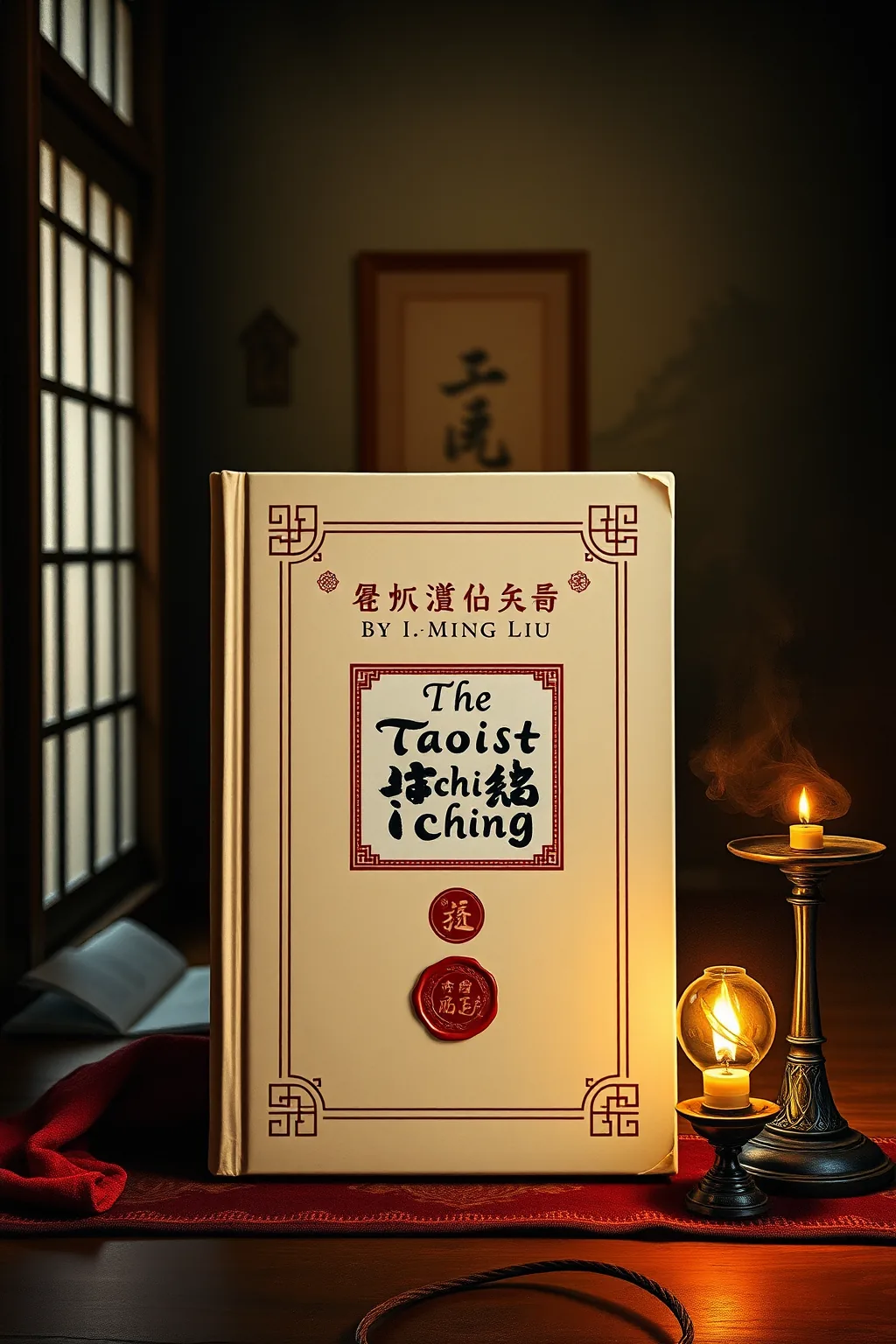
The Taoist I ching
 62
62

The Taoist I ching



Cassian Rothmann (Senior Critic, Ancient Wisdom) — I-ming Liu's "The Taoist I Ching" is a luminous revelation, breathing new life into an ancient oracle. Liu masterfully bridges the gap between esoteric practice and profound philosophical inquiry, presenting the hexagrams not as static pronouncements, but as dynamic keys to understanding the Tao. The work excels in its clear exposition of complex symbolism and its emphasis on the I Ching as a tool for spiritual cultivation. This is an indispensable resource for serious practitioners and scholars seeking authentic, deeply rooted insights into the I Ching's mystical dimensions. It offers a rare clarity that elevates the reader's understanding and practice.
📝 Description
62
I-ming Liu's "The Taoist I Ching" interprets the classic divination text through a Taoist lens.
This edition of the I Ching, authored by I-ming Liu, approaches the ancient text not as a method of fortune-telling but as a philosophical guide. Liu connects the symbolism of the 64 hexagrams to core Taoist concepts, such as balance, change, and the cyclical patterns of the universe. The author's writing aims to clarify the relationships between these symbols and Taoist thought, suggesting a deeper understanding of existence.
The book focuses on interpreting the hexagrams as expressions of Taoist principles. It seeks to reveal the inherent connections between the I Ching's structure and the Taoist worldview. Liu's work encourages readers to see the text as a resource for understanding personal harmony and the broader cosmic order. It is intended for those interested in applying these ideas to their lives.
This work situates the I Ching within the Taoist tradition, viewing it as a reflection of the Tao. Unlike purely divinatory interpretations, Liu's approach emphasizes the I Ching's philosophical dimensions. It aligns with schools of thought that see the text as a map of cosmic processes and human engagement with them. The book draws parallels between the I Ching's dynamic interplay of forces and the Taoist concept of wu wei, or effortless action.
💡 Why Read This Book?
Embark on a profound journey of self-discovery and cosmic attunement with "The Taoist I Ching." This book offers more than just answers; it provides a framework for understanding the ebb and flow of life through the lens of ancient Taoist philosophy. Ideal for seekers of wisdom, scholars of Eastern thought, and practitioners of divination who desire a deeper, more philosophical engagement with the I Ching.
⭐ Reader Reviews
Honest opinions from readers who have explored this book.
❓ Frequently Asked Questions
What makes this edition of the I Ching unique?
This edition uniquely integrates the I Ching with Taoist philosophical principles, offering a holistic understanding of its divinatory and spiritual dimensions. It moves beyond simple interpretation to explore the underlying cosmic laws.
Is prior knowledge of Taoism or the I Ching required?
While helpful, prior knowledge is not strictly necessary. The author's clear exposition makes the complex concepts accessible to both newcomers and experienced practitioners.
How can the I Ching be used for spiritual growth?
The I Ching serves as a mirror to one's inner state and external circumstances, offering guidance on aligning actions with the natural flow of the Tao, fostering wisdom, and promoting balance.
What is the role of symbolism in this book?
Symbolism is paramount. The book deciphers the rich imagery of the hexagrams, revealing their profound connections to natural phenomena, human psychology, and spiritual archetypes.
Can this book be used for practical decision-making?
Absolutely. The I Ching, as presented here, offers profound insights into potential outcomes and the most harmonious paths forward, aiding in informed and wise decision-making.
🔮 Key Themes & Symbolism
The Interplay of Yin and Yang
This theme looks at the fundamental Taoist concept of Yin and Yang, exploring how their dynamic interplay manifests within the I Ching's hexagrams. It illuminates the perpetual dance of opposing forces, the creation and dissolution, and the essential balance required for cosmic and personal harmony. Understanding this duality is key to deciphering the messages of the oracle and navigating life's inherent dualities with grace and wisdom.
The Philosophy of Change and Flow
Central to "The Taoist I Ching" is the profound understanding that change is the only constant. This theme examines how the I Ching serves as a map of perpetual transformation, reflecting the natural cycles of growth, decay, and renewal. It guides the reader to embrace fluidity, adapt to shifting circumstances, and find power in surrender to the natural currents of the Tao, rather than resisting the inevitable tides of existence.
Symbolism as Cosmic Language
This theme explores the collection of symbolism embedded within the I Ching's imagery. It reveals how the trigrams and hexagrams act as a universal language, communicating profound truths about the cosmos, human nature, and the interconnectedness of all things. Liu's interpretation unlocks the esoteric meanings behind these archetypal images, offering a deeper, intuitive understanding of the oracle's wisdom.
💬 Memorable Quotes
Direct passages from the work, attributed to the author.
“The hexagrams are not static pronouncements, but living maps of the Tao.”
— This highlights the dynamic and fluid nature of the I Ching, emphasizing its role as a guide through the ever-changing range of existence rather than a fixed prediction.
“Balance is not an end, but a perpetual dance.”
— This emphasizes the ongoing effort required to maintain equilibrium, mirroring the constant flux and adjustment inherent in both the Tao and life itself.
“The wisdom of the ancients flows through the lines.”
— This speaks to the timeless nature of the I Ching's teachings and its ability to transmit useful insights across generations.
“To know the pattern is to walk in harmony.”
— This suggests that understanding the underlying cosmic principles revealed by the I Ching allows one to align their actions with the natural order, leading to a more peaceful existence.
💡 Key Ideas
Editorial paraphrase of the work's core concepts — not direct quotes.
In stillness, one finds the elements of the universe.
This quote points to the importance of introspection and quiet contemplation in discerning the subtle messages of the I Ching and connecting with deeper truths.
🌙 Esoteric Significance
Tradition
This work is deeply rooted in the esoteric traditions of Taoism and ancient Chinese mysticism. It views the I Ching not merely as a divinatory tool, but as a profound system for understanding the cosmic order, the principles of the Tao, and the interconnectedness of all phenomena. It offers insights into the subtle energies that govern existence and provides a framework for aligning one's life with these universal currents.
Symbolism
The esoteric significance of the I Ching lies in its rich, multi-layered symbolism. The eight trigrams, formed from combinations of three yin and yang lines, represent fundamental archetypes of nature and human experience. The 64 hexagrams, formed by combining two trigrams, depict the dynamic unfolding of situations and the cyclical nature of change. These symbols are seen as a cosmic language, revealing the underlying patterns and forces at play in the universe.
Modern Relevance
In the modern era, "The Taoist I Ching" offers a powerful antidote to the fragmentation and disquiet of contemporary life. Its emphasis on balance, adaptability, and understanding the natural flow of events provides timeless wisdom for navigating personal challenges, fostering inner peace, and cultivating a deeper connection to the world. It empowers individuals to find clarity, make wise decisions, and live in greater harmony with themselves and the universe.
👥 Who Should Read This Book
This key work is essential for anyone drawn to the mysteries of ancient wisdom. **Seekers of Truth** will find a profound philosophical guide to the nature of reality and personal destiny. **Scholars of Eastern Philosophy** will appreciate its meticulous scholarship and unique integration of Taoist thought with the I Ching. **Practitioners of Divination** will discover a deeper, more nuanced approach to interpreting the oracle, moving beyond surface-level readings. **Those striving for personal growth and spiritual development** will find practical wisdom and a pathway to greater self-awareness and inner harmony.
📜 Historical Context
Originating in ancient China, the I Ching (Book of Changes) is one of the oldest and most revered texts in the world. Its roots are deeply intertwined with shamanistic practices and early cosmological theories, evolving over millennia into a sophisticated system of divination and philosophical inquiry. During the Zhou Dynasty, its influence grew significantly, becoming a central to Chinese thought, influencing Confucianism, Taoism, and later, various schools of metaphysics and esoteric practices. Its transmission through dynasties and its adaptation by different philosophical schools underscore its enduring relevance and adaptability as a source of wisdom. The integration of Taoist principles, as explored in this edition, reflects a specific hermeneutical approach that highlights the I Ching's inherent connection to the Taoist understanding of the universe.
📔 Journal Prompts
Reflect on a recent situation where the principles of Yin and Yang were clearly at play. How did you navigate these opposing forces?
Consider a time you resisted change. How might embracing the Taoist philosophy of flow have altered the outcome?
What archetypal symbol from the I Ching resonates most strongly with your current life circumstances, and why?
How can the concept of 'balance as a dance' be applied to a challenging relationship in your life?
If the I Ching is a living map, what part of your journey are you currently exploring, and what guidance might it offer?
🗂️ Glossary
Tao (Dao)
The fundamental principle of the universe in Taoism; the natural order, the Way, the source and substance of everything that exists. It is ineffable and beyond human comprehension.
Yin
The passive, dark, feminine, and receptive principle in Taoist cosmology, often associated with the moon, earth, and water. It is complementary to Yang.
Yang
The active, light, masculine, and assertive principle in Taoist cosmology, often associated with the sun, heaven, and fire. It is complementary to Yin.
Hexagram
A figure composed of six horizontal lines, each of which may be broken (Yin) or unbroken (Yang). There are 64 unique hexagrams in the I Ching, representing different states and transformations of reality.
Trigram
A figure composed of three horizontal lines, each of which may be broken (Yin) or unbroken (Yang). There are eight fundamental trigrams, each representing a primary element or concept.
This book appears in 3 collections
🔮 Readers Also Liked
Browse all →









More by I-ming Liu
All books →
From the “I Ching” Collection
View all →









More Free Divination & Tarot Books
View all →