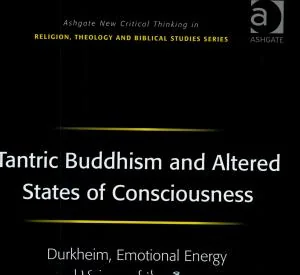
Tantric Buddhism and Altered States of Consciousness
 76
76

Tantric Buddhism and Altered States of Consciousness
Child's approach to Tantric Buddhism through the lens of Durkheim and Jung offers a novel perspective on how ritualistic altered states can function as conduits for communal and interpersonal emotional exchange. The strength of the book lies in its rigorous application of sociological and psychological theory to often experiential subject matter, particularly in her analysis of how dreams and visionary experiences relate to the 'subtle body.' However, the dense theoretical apparatus, while commendable for its intellectual depth, occasionally overshadows the practical or experiential dimensions of tantric practice itself. A particularly compelling section details how societal anxieties might manifest and be processed through collective ritualistic engagement, drawing parallels between Durkheim's concept of collective effervescence and tantric communal practices. This is a significant scholarly contribution, though its accessibility might be limited for readers unfamiliar with the foundational theorists.
📝 Description
76
Louise Child's 2007 book analyzes how Tantric Buddhist rituals shape consciousness.
Louise Child's "Tantric Buddhism and Altered States of Consciousness" examines the connection between ritual practices and psychological states within Tantric Buddhism. The book discusses how altered states, often achieved through Tantric methods, can facilitate the transfer of social and emotional energies. Child builds her argument using ideas from early 20th-century social theorists, including Durkheim, and depth psychology, particularly the work of Jung.
This work is for academics in religious studies, comparative psychology, and anthropology, as well as experienced Buddhist practitioners who want to understand the theoretical basis of their practices. It will appeal to readers interested in serious academic study of esoteric topics, especially when viewed through the lenses of thinkers like Durkheim and Jung. The book addresses scholarly discussions on how rituals work and how people experience them.
Published in 2007, the book appeared when academic interest in the subjective experience of religion and the global study of consciousness was growing. It engages with existing research on Durkheimian sociology and Jungian psychology, applying these concepts to a specific, often misunderstood, area of Buddhism. Child situates her work within ongoing academic debates concerning ritual effectiveness and personal experience.
This book enters the discourse on Tantric Buddhism, a tradition often characterized by complex rituals and contemplative practices aimed at transforming consciousness. It bridges this specific Buddhist lineage with broader discussions in the psychology of religion and the anthropology of ritual. By referencing thinkers like Jung and Durkheim, Child connects Tantric concepts to Western psychological and sociological frameworks for understanding subjective experience and collective phenomena.
💡 Why Read This Book?
• Gain an understanding of how Durkheimian social theory, specifically concepts like collective effervescence, can illuminate the communal functions of Tantric Buddhist rituals, offering a unique sociological interpretation. • Explore Louise Child's original application of Jungian psychology to interpret tantric dreams and visionary experiences, providing a framework for understanding the 'subtle body' beyond purely religious doctrine. • Appreciate the 2007 publication's contribution to the academic study of altered states, bridging anthropology, psychology, and religious studies with concrete examples from tantric Buddhist biography and ritual.
⭐ Reader Reviews
Honest opinions from readers who have explored this book.
❓ Frequently Asked Questions
What specific Durkheimian theorists does Louise Child reference in her analysis?
Louise Child draws significantly on the work of Émile Durkheim himself, as well as his close collaborators and interpreters, including Marcel Mauss, Henri Hubert, and Robert Hertz, to frame her understanding of social and emotional energy transmission.
How does the book connect Jungian psychology to Tantric Buddhism?
The book applies Jungian concepts, such as archetypes and the collective unconscious, to interpret the symbolism and visionary experiences encountered in tantric Buddhist practices, particularly those related to the 'subtle body'.
What is the primary focus regarding altered states of consciousness?
The book focuses on altered states as a means of communicating social and emotional energies, examining their role on both societal and individual levels within the context of Tantric Buddhist ritual and personal experience.
When was 'Tantric Buddhism and Altered States of Consciousness' first published?
The work by Louise Child was first published in 2007, positioning it within contemporary academic scholarship on religion, psychology, and sociology.
Does the book discuss specific tantric Buddhist lineages or schools?
While the book analyzes tantric Buddhist ritual and biographical material generally, it focuses on the theoretical application of social and psychological theories rather than a detailed lineage-specific study.
What is the 'subtle body' as discussed in the book?
In the context of the book, the 'subtle body' refers to the energetic and visionary dimensions of consciousness explored in tantric traditions, often linked to dreams and altered states, which Child analyzes through a Jungian lens.
🔮 Key Themes & Symbolism
Ritual and Social Energy
The work critically examines how Tantric Buddhist rituals, particularly those inducing altered states, function as mechanisms for the transmission and transformation of social and emotional energies. By referencing Durkheimian sociology, Child suggests these practices foster a sense of collective effervescence and shared consciousness, impacting societal cohesion and individual emotional landscapes. The analysis moves beyond simple descriptions of ritual to explore its deep psychological and sociological utility.
Dreams and Visionary Experience
A central theme is the exploration of dreams and visionary states as vital channels for communication and understanding. Child posits that these altered states, often associated with the tantric concept of the 'subtle body,' are not merely subjective experiences but are integral to the way individuals and societies process emotional and energetic information. This perspective bridges esoteric interpretations with psychological frameworks.
Jungian Archetypes in Tantra
Louise Child applies analytical psychology, specifically Carl Jung's theories on archetypes and the unconscious, to the study of Tantric Buddhism. This approach allows for a reinterpretation of tantric symbolism and narrative through the lens of universal psychological structures, suggesting that the experiences within tantric practice may map onto fundamental aspects of the human psyche.
Interpersonal Energy Dynamics
The book studies how altered states within Tantric Buddhism facilitate communication and exchange of emotional energies on an interpersonal level. It explores the nuanced ways individuals connect and influence each other through these heightened states of consciousness, offering insights into empathy, shared experience, and psychological resonance within a spiritual context.
💬 Memorable Quotes
Direct passages from the work, attributed to the author.
“The role of altered states in the communication of social and emotional energies.”
— This core statement captures the book's central thesis: that shifts in consciousness are not just personal experiences but are fundamental to how emotional and social information is conveyed and processed within groups and between individuals.
“Drawing from an original reading of Durkheimian social theorists and Jungian psychology.”
— This highlights the interdisciplinary foundation of Child's work, signaling an academic and analytical approach that seeks to synthesize sociological insights on collective life with psychological theories of the individual psyche.
“Dreams and visionary experiences (including those related to the 'subtle body').”
— This phrase points to the specific phenomena Child examines, emphasizing the importance of non-ordinary states of consciousness and their connection to esoteric concepts like the 'subtle body' as pathways to understanding energy and communication.
“Applies this analysis to tantric Buddhist ritual and biographical material.”
— This indicates the specific domain of religious practice and individual accounts that serve as the empirical basis for Child's theoretical explorations, grounding abstract concepts in concrete examples.
“Communication of social and emotional energies, both on a societal level and between individual persons.”
— This elaborates on the scope of 'communication,' showing that the book addresses macro-level societal dynamics as well as micro-level interpersonal interactions, all mediated through altered states of consciousness.
🌙 Esoteric Significance
Tradition
This work engages with esoteric traditions primarily through its focus on Tantric Buddhism, a lineage often perceived as esoteric due to its emphasis on direct experience, visualization, and the manipulation of subtle energies. While not strictly Hermetic or Gnostic, Tantric Buddhism shares with these traditions an interest in transformative practices and non-ordinary states of consciousness as pathways to deeper understanding and liberation.
Symbolism
Key symbols explored implicitly relate to the tantric understanding of the body, particularly the 'subtle body' which includes concepts like chakras and energy channels (nadis). Dreams and visionary experiences function as symbolic language, interpreted through a Jungian lens to reveal archetypal patterns. The ritualistic actions themselves become symbolic, representing cosmic processes or psychological transformations.
Modern Relevance
Contemporary thinkers in transpersonal psychology, consciousness studies, and even some somatic practices may find resonance in Child's work. Her bridging of sociological frameworks with the subjective experience of altered states offers valuable insights for understanding the communal and psychological functions of spiritual practices in the modern era, particularly as interest in meditation and mindfulness continues to grow.
👥 Who Should Read This Book
• Scholars of comparative religion and psychology seeking to understand the intersection of social theory, depth psychology, and specific religious practices. • Advanced practitioners of Buddhist traditions interested in the theoretical frameworks that explain the psychological and social dimensions of ritual and altered states. • Researchers in consciousness studies and anthropology who analyze how subjective experiences, such as dreams and visions, contribute to social cohesion and individual meaning-making.
📜 Historical Context
Published in 2007, Louise Child's "Tantric Buddhism and Altered States of Consciousness" emerged within a vibrant academic landscape increasingly focused on the phenomenology of religious experience and the cross-cultural study of consciousness. The work engaged directly with foundational 20th-century thinkers, notably Émile Durkheim and Carl Jung, whose ideas on collective consciousness and the unconscious respectively, provided frameworks for analyzing ritual and subjective states. This was a period where scholars were actively seeking to bridge the gap between social sciences and the study of esoteric traditions, moving beyond purely historical or theological accounts. Child's synthesis offered a counterpoint to more purely anthropological or philosophical approaches to Buddhism prevalent at the time. While not explicitly tied to a specific reception event like a ban or prize, the book contributed to a growing body of literature that applied Western psychological and sociological theories to Eastern religious practices, a trend exemplified by contemporary scholars like Geoffrey Samuel who also explored the embodied and social aspects of religious life.
📔 Journal Prompts
Tantric Buddhist ritual as a vehicle for social and emotional energy.
The significance of dreams and visionary experiences in understanding the 'subtle body'.
Jungian archetypes and their manifestation in tantric symbolism.
Durkheimian concepts of collective effervescence applied to ritual practice.
Personal reflections on energy exchange during altered states of consciousness.
🗂️ Glossary
Altered States of Consciousness
Non-ordinary states of awareness that deviate from the typical waking state, often induced through meditation, ritual, or other practices, characterized by changes in perception, cognition, and emotion.
Social Energies
The collective emotional and psychological forces generated within a group or society, influencing social cohesion, behavior, and shared understanding, as theorized by Durkheimian thinkers.
Emotional Energies
The affective states and their energetic qualities experienced by individuals, which can be communicated, shared, or transformed through interpersonal interactions and ritualistic engagement.
Durkheimian Social Theorists
Scholars, including Émile Durkheim, Marcel Mauss, and Henri Hubert, who developed theories concerning the social basis of religion, collective consciousness, and social solidarity.
Jungian Psychology
The school of analytical psychology founded by Carl Jung, emphasizing archetypes, the collective unconscious, individuation, and the symbolic interpretation of dreams and myths.
Subtle Body
In tantric and yogic traditions, a non-physical energetic body composed of channels (nadis), vital winds (prana), and energy centers (chakras), believed to be the seat of consciousness and experience.
Visionary Experiences
Subjective experiences involving vivid internal imagery, perceptions, or encounters with non-ordinary realities, often occurring during altered states of consciousness.
This book appears in 1 collection
🔮 Readers Also Liked
Browse all →





From the “Altered States of Consciousness” Collection
View all →



More Free Sacred Texts & Gnosticism Books
View all →