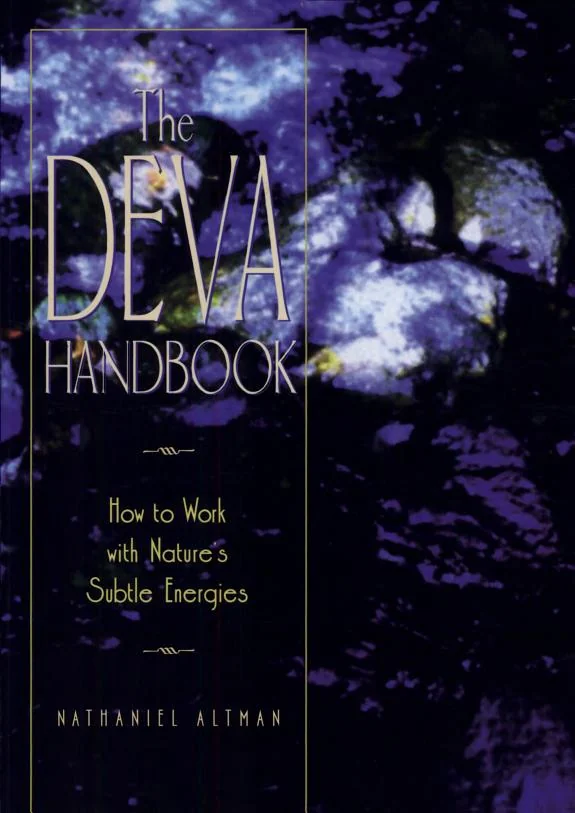
The Deva Handbook
 80
80

The Deva Handbook
Nathaniel Altman’s *The Deva Handbook* attempts to bridge the vast chasm between disparate spiritual traditions, focusing on the ubiquitous presence of angelic or nature spirits. The strength of the book lies in its ambitious synthesis, drawing connections between figures as varied as Vedic devas, West African orishas, and the more familiar Judeo-Christian angels. Altman’s discussion of devas as elemental forces tied to specific natural phenomena, such as air or water, offers a tangible link for practitioners. However, the book occasionally suffers from an overzealousness to find universal parallels, sometimes glossing over crucial distinctions between traditions. For instance, the conceptual leap from the sophisticated pantheon of Yoruba orishas to the more generalized 'shining ones' might feel less precise than some scholars would prefer. Despite this, Altman’s effort to demystify these potent spiritual entities for a Western audience is commendable. It serves as a valuable primer for exploring the myriad forms divine messengers take across human cultures.
📝 Description
80
Nathaniel Altman's 1995 book examines spiritual entities known as devas, angels, and orishas.
Published in 1995, *The Deva Handbook* by Nathaniel Altman is a study of spiritual entities recognized across various global traditions. The book details their roles, characteristics, and importance within both ancient belief systems and modern esoteric thought. Altman draws on a wide array of cultural viewpoints, moving beyond single religious doctrines to offer a unified perspective on these celestial and nature spirits.
The work is suited for those interested in comparative religion, esoteric studies, and mythology. It addresses individuals seeking to find commonalities in spiritual hierarchies across different cultures, from Vedic devas to West African orishas. Those involved with nature-based spiritualities or interested in the phenomenology of spiritual experiences will also find its accounts valuable. The book systematically analyzes the concept of devas by looking at their forms in different cultures, discussing the structure of spiritual hierarchies, their links to natural forces, and their function as intermediaries.
Altman's work appeared in the late 20th century, a period marked by increased interest in comparative spirituality and the blending of Eastern and Western esoteric paths. Following Helena Blavatsky and the Theosophical Society's efforts to popularize concepts like devas and a universal spiritual structure, *The Deva Handbook* continues this line of inquiry. It fits within the broader Hermetic and New Age movements that aimed to synthesize diverse religious and occult philosophies, providing a structured framework for understanding spiritual intermediaries.
💡 Why Read This Book?
• Gain a comparative understanding of spiritual intermediaries across global traditions, moving beyond singular religious frameworks by examining specific examples like the Vedic devas and West African orishas. • Learn how these entities are perceived as intrinsically linked to natural forces and elemental planes, providing practical insights for nature-based spiritual practices detailed within the book. • Discover a structured approach to classifying and understanding the varied roles of spiritual beings, informed by the book's extensive research into indigenous and modern esoteric teachings published since 1995.
⭐ Reader Reviews
Honest opinions from readers who have explored this book.
❓ Frequently Asked Questions
What are Devas according to Nathaniel Altman in 'The Deva Handbook'?
Altman defines devas as spiritual entities recognized across diverse global traditions, encompassing figures often known as angels, orishas, and 'shining ones,' serving as intermediaries between the divine and material realms.
Which specific traditions does 'The Deva Handbook' draw upon?
The book draws on a wide array of traditions, including native beliefs from around the world, with specific mentions or implications of Vedic, West African (e.g., orishas), and Judeo-Christian angelic hierarchies.
What is the significance of Devas in relation to nature?
Altman explores the devas' deep connection to natural forces and elemental planes, suggesting they govern aspects of the environment and act as expressions of cosmic energies within the physical world.
When was 'The Deva Handbook' first published?
'The Deva Handbook' by Nathaniel Altman was first published in June 1995.
Does the book include visual aids?
Yes, the original publication of 'The Deva Handbook' includes black and white photographs to illustrate its concepts and the entities discussed.
Is 'The Deva Handbook' suitable for beginners in esoteric studies?
Yes, its comparative approach and clear explanations make it accessible for beginners seeking to understand the broad spectrum of spiritual beings across cultures.
🔮 Key Themes & Symbolism
Comparative Angelology
The work meticulously compares and contrasts the concept of spiritual intermediaries across a vast array of global cultures. It moves beyond singular religious doctrines to highlight common archetypes and functions attributed to beings like the Vedic devas, West African orishas, and Judeo-Christian angels. Altman's approach emphasizes their role as messengers and agents of divine will, illustrating how different societies have conceptualized these 'shining ones' and their place within cosmic order. This theme is central to understanding the book's aim of presenting a unified, cross-cultural perspective on spiritual hierarchies.
Devas and Elemental Forces
A significant focus of *The Deva Handbook* is the intrinsic link between devas and the fundamental forces of nature. Altman explores how these spiritual entities are often associated with specific elements – air, water, fire, earth – and natural phenomena. This perspective connects esoteric cosmology with animistic traditions, suggesting that devas are not merely abstract divine agents but are immanent within the natural world, governing its processes and energies. This understanding offers a practical framework for those seeking to engage with nature spirits.
Indigenous and Modern Esotericism
Altman draws heavily on indigenous traditions from around the world while also incorporating modern esoteric teachings. This fusion highlights how ancient spiritual beliefs can inform contemporary metaphysical understanding. The book bridges the gap between traditional shamanic cosmologies and later Hermetic or Theosophical developments, demonstrating the continuity and evolution of ideas about spiritual hierarchies. It presents these ancient concepts as relevant and applicable to modern spiritual seekers looking for guidance and connection.
The Role of Orishas
The inclusion of orishas, particularly from West African traditions like Yoruba, is a notable aspect of the book's comparative approach. Altman examines their distinct characteristics, domains, and roles, integrating them into the broader category of devas or 'shining ones.' This specific focus enriches the reader's understanding of the diversity within spiritual pantheons and the sophisticated mythologies that underpin them. It underscores the book's commitment to representing a global spectrum of spiritual beliefs and practices.
💬 Memorable Quotes
Direct passages from the work, attributed to the author.
“Devas are often known as angels, orishas, and the shining ones.”
— This foundational statement captures the book's core thesis: that seemingly disparate spiritual entities across various cultures share fundamental characteristics and roles, serving as a unifying concept for comparative spiritual study.
“The work draws on native traditions around the world as well as modern teachings.”
— This highlights the book's methodological approach, emphasizing a synthesis of ancient, indigenous wisdom with contemporary esoteric thought, aiming for a holistic understanding of spiritual hierarchies.
“Devas are often connected to elemental forces and natural phenomena.”
— This interpretation points to the book's exploration of the immanence of spiritual beings within the natural world, suggesting a direct link between celestial entities and the earth's elemental energies.
“The book presents black and white photographs.”
— This factual statement about the book's physical content indicates that visual elements are included to support the textual exploration of spiritual entities and concepts.
💡 Key Ideas
Editorial paraphrase of the work's core concepts — not direct quotes.
The significance of the devas is explored through global perspectives.
This paraphrased concept underscores the book's comparative nature, indicating that it does not rely on a single cultural lens but rather examines the many-sided roles and meanings attributed to devas worldwide.
🌙 Esoteric Significance
Tradition
The work fits within the broad lineage of comparative esotericism, heavily influenced by Theosophical concepts of cosmic evolution and spiritual hierarchies. It departs from purely Western Hermeticism by integrating a wider range of global traditions, particularly indigenous and Eastern spiritualities, to illuminate the universal nature of spiritual intermediaries. Altman's approach seeks to find common archetypes and functions across diverse belief systems, aligning with a post-Blavatskian synthesis that aimed for a global occult philosophy.
Symbolism
Key symbols explored include the 'shining ones,' representing radiant spiritual beings, and the devas as personifications of natural forces and elements. The orishas function as symbols of divine energies manifesting in specific aspects of life and nature, akin to Greek daemons or elemental spirits. These symbols collectively represent the interconnectedness of the spiritual, natural, and human realms, illustrating how divine consciousness permeates all existence.
Modern Relevance
Contemporary practitioners of nature-based spirituality, animism, and comparative mythology continue to find value in Altman's work. Thinkers and groups exploring polytheistic reconstructionism or seeking to understand elemental spirits often reference or are influenced by such syntheses. The book's comparative framework remains relevant for modern spiritual seekers interested in understanding the universal archetype of the spiritual intermediary beyond Western angelic traditions.
👥 Who Should Read This Book
• Students of comparative religion and mythology seeking to understand the global phenomenon of spiritual intermediaries. • Practitioners of nature-based spiritualities interested in the connection between devas, elements, and the natural world. • Esoteric researchers and students of Theosophy or New Age thought looking for a synthesized overview of global spiritual hierarchies.
📜 Historical Context
Published in June 1995, *The Deva Handbook* emerged during a period of significant cross-pollination in Western esoteric thought. The late 20th century saw a surge in interest in comparative religion and spirituality, fueled by movements like Theosophy and New Age philosophy, which actively sought to synthesize Eastern and Western mystical traditions. Helena Blavatsky's foundational work in the late 19th century had already popularized concepts of global spiritual hierarchies and elemental beings, paving the way for works like Altman's. This era also witnessed a growing academic and popular fascination with indigenous cosmologies, challenging the dominance of purely Abrahamic frameworks. While not directly engaging with specific academic debates or facing censorship, Altman's book contributed to a broader cultural trend that viewed spiritual realities through a more inclusive, global lens, contrasting with earlier, more exclusivist religious perspectives. It offered a structured way to understand beings previously siloed within specific mythologies.
📔 Journal Prompts
The many-sided roles of devas across Vedic, Orisha, and angelic traditions.
Personal reflections on the connection between nature and spiritual entities.
Identifying the 'shining ones' in one's own belief system or spiritual practice.
The significance of elemental forces as perceived through the lens of devas.
Comparing and contrasting the characteristics of different spiritual hierarchies discussed.
🗂️ Glossary
Deva
A Sanskrit term referring to divine or semi-divine beings in Hindu, Buddhist, and Jain traditions. Often translated as 'god' or 'celestial being,' they are considered part of a cosmic hierarchy and can be associated with natural forces.
Orisha
Deities or spirits in the Yoruba religion and its diaspora, such as Santería and Candomblé. They represent natural forces and human archetypes, acting as intermediaries between humans and the supreme creator god, Olodumare.
Shining Ones
A general term used to refer to celestial or spiritual beings characterized by radiance or luminosity. It often encompasses angels, devas, and other higher spiritual intelligences across various traditions.
Elemental Forces
The fundamental components or energies that constitute the physical universe, traditionally categorized as earth, air, fire, and water. In esoteric traditions, these are often seen as being governed or embodied by specific spirits.
Spiritual Hierarchies
A concept found in many religions and esoteric systems that posits a ranked order of spiritual beings, from the most supreme deity down to lesser spirits or human souls, often serving as a structure for understanding divine administration.
Indigenous Traditions
The beliefs, customs, spiritual practices, and cosmologies of indigenous peoples, often deeply connected to the land, ancestors, and natural world, passed down through oral history and ritual.
Esoteric Teachings
Knowledge or teachings that are meant only for a select group of people who are initiated or have a certain level of understanding. These often involve mystical, spiritual, or occult subjects beyond the scope of ordinary understanding.
This book appears in 1 collection
🔮 Readers Also Liked
Browse all →





From the “Pranic Healing” Collection
View all →







More Free Esoteric History & Biography Books
View all →