Spook

 79
79

Spook
Mary Roach’s "Spook" tackles the afterlife not with reverence, but with a scalpel and a healthy dose of gallows humor. She approaches the ghost hunt as a scientific endeavor, dissecting the history of spiritualism and parapsychology with her signature blend of curiosity and skepticism. A particular strength is her ability to make complex scientific theories and often murky historical accounts accessible, even entertaining. Roach navigates the quagmires of ectoplasm and mediumistic trickery with a journalist’s eye for detail. However, while the book excels at presenting the *attempts* at scientific validation, it sometimes struggles to offer definitive conclusions, mirroring the inherent challenges of its subject matter. The section on near-death experiences, while informative, feels less conclusive than others. Ultimately, "Spook" serves as an excellent, often amusing, guide to humanity's persistent, scientifically-fraught quest to understand what happens when we die.
📝 Description
79
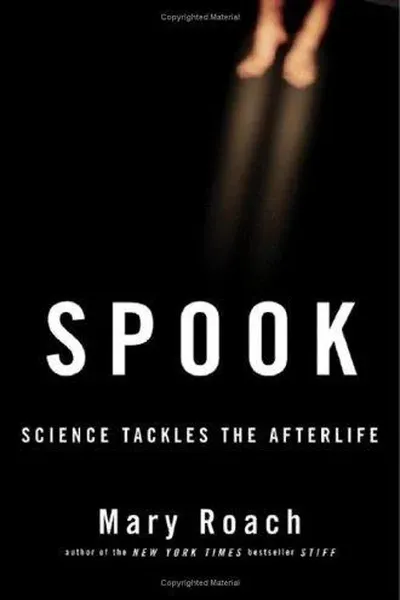
Mary Roach’s 2015 book, Spook, examines scientific attempts to understand the afterlife.
In Spook, Mary Roach investigates the scientific efforts to study phenomena typically associated with the supernatural. Known for her clear and often funny writing on difficult subjects, Roach turns to the enduring human curiosity about ghosts, spirits, and what happens after death. The book covers many historical and current attempts to prove or disprove claims about an afterlife.
Roach looks at investigations into mediums, out-of-body experiences, near-death experiences, and the nature of consciousness. She approaches these topics with a skeptical but open mind, appealing to readers interested in the meeting point of science and the unexplained. The book offers well-researched accounts that do not avoid strange subjects, seeking explanations based on empirical study, even for topics that are inherently difficult to grasp. It is a good fit for those who enjoy Roach’s previous works, which also analyze unusual subjects with humor and scientific detail.
The study of spiritualism and the afterlife has a long and often debated history. The mid-19th century saw a surge in spiritualism in America and Europe, featuring séances and reported supernatural visitations, which occurred alongside a growing interest in scientific methods. Prominent figures like Sir Arthur Conan Doyle supported spiritualism, while skeptics such as Harry Houdini worked to expose fraudulent mediums. Roach revisits this historical conflict, showing how scientific tools, from early photography to modern neuroscience, have been used to examine persistent questions about life after death.
💡 Why Read This Book?
• Learn about the historical attempts to scientifically prove life after death, such as the work of early parapsychologists investigating mediums in the late 19th and early 20th centuries. • Understand the neurological and psychological explanations for phenomena like out-of-body or near-death experiences, as explored through Roach's interviews with medical professionals. • Gain insight into how modern scientific tools, from EEG machines to quantum physics concepts, have been speculatively applied to the question of consciousness survival.
⭐ Reader Reviews
Honest opinions from readers who have explored this book.
❓ Frequently Asked Questions
What is Mary Roach's approach to the paranormal in 'Spook'?
Mary Roach approaches the paranormal in 'Spook' with a journalistic and scientific lens. She investigates claims of the afterlife and spiritual phenomena through empirical research, interviews with scientists, and historical accounts, rather than accepting them at face value.
Does 'Spook' offer proof of ghosts or an afterlife?
No, 'Spook' does not offer definitive proof of ghosts or an afterlife. Instead, it explores the scientific attempts, both historical and contemporary, to investigate these phenomena and understand the human fascination with them.
What historical periods does 'Spook' cover regarding spiritualism?
'Spook' covers significant periods of spiritualism, including the height of the movement in the mid-19th century and its subsequent investigations and debunking efforts through the 20th century.
Which scientific fields does Mary Roach consult in 'Spook'?
Mary Roach consults a range of scientific fields in 'Spook,' including neuroscience, physics, psychology, and parapsychology, to examine the scientific basis or lack thereof for afterlife claims.
Is 'Spook' a scary book?
'Spook' is not a horror or scary book. While it discusses potentially unsettling topics like death and the afterlife, Mary Roach's tone is primarily curious, humorous, and investigative, focusing on the science rather than inducing fear.
What is the significance of the year 1900 in the context of 'Spook'?
The year 1900 is significant as it marks a period where scientific inquiry into spiritualism was gaining momentum, with many researchers attempting to apply new methodologies to phenomena like ectoplasm and mediumship.
🔮 Key Themes & Symbolism
The Scientific Method vs. The Supernatural
Roach scrutinizes how the rigorous principles of the scientific method have been applied, or misapplied, to phenomena like ghosts, mediums, and apparitions. She documents instances where fraud was exposed, but also where genuine curiosity drove investigations into the unexplained. The book highlights the inherent conflict between empirical evidence and subjective experiences, particularly concerning the afterlife. This theme underscores the human drive to find rational explanations for the irrational, even when the evidence remains elusive or contradictory.
Consciousness and its Persistence
A central theme is the scientific exploration of consciousness itself – what it is, where it resides, and whether it can exist independently of the physical body. Roach examines research into out-of-body experiences, near-death experiences (NDEs), and altered states of consciousness. She introduces concepts from physics and neuroscience that speculative thinkers have used to theorize about a non-corporeal existence, such as quantum entanglement or the idea of consciousness as an energy field. The book questions whether current scientific paradigms are sufficient to explain these phenomena.
Historical Spiritualism and Parapsychology
The book provides a detailed look at the history of spiritualism, particularly its surge in popularity in the late 19th and early 20th centuries. Roach introduces key figures, both believers and skeptics, who shaped the discourse around ghosts and the afterlife. She examines the methods employed by early parapsychologists, including the use of photography to capture spirits and the investigation of mediums claiming to channel the deceased. This historical lens reveals the evolution of attempts to legitimize the study of the supernatural within scientific circles.
The Human Drive for Proof
Underlying 'Spook' is an examination of why humans are so profoundly drawn to the idea of an afterlife and the persistent search for evidence. Roach explores the psychological comfort derived from believing consciousness survives death, the fear of annihilation, and the cultural narratives that perpetuate these beliefs. The book illustrates how this deep-seated human need often fuels both genuine scientific inquiry and widespread gullibility, making the quest for proof a complex interplay of desire and discovery.
💬 Memorable Quotes
Direct passages from the work, attributed to the author.
“Science is a tool, not a belief system.”
— This highlights Roach's perspective that scientific methodology should be applied with critical inquiry, rather than being used to confirm pre-existing beliefs about the supernatural or the afterlife.
“When we die, the battery runs out.”
— This metaphorical quote, reflecting a common materialistic viewpoint discussed in the book, suggests that consciousness is a product of biological processes and ceases to exist upon physical death.
“The spirits seemed to be more interested in rapping than in revealing the secrets of the universe.”
— This observation, drawn from accounts of spiritualist séances, humorously points out the often mundane or trivial nature of alleged paranormal communications encountered during historical investigations.
“Proof is a heavy burden.”
— This sentiment captures the difficulty inherent in scientifically proving the existence of an afterlife or paranormal phenomena, suggesting that definitive evidence remains elusive.
💡 Key Ideas
Editorial paraphrase of the work's core concepts — not direct quotes.
The afterlife is not a place. It's a concept.
This statement, paraphrased from the book's underlying themes, suggests that the human understanding of what happens after death is more a construct of our minds and cultures than a scientifically verifiable destination.
🌙 Esoteric Significance
Tradition
While not strictly adhering to a single esoteric lineage, "Spook" engages with themes present in Hermeticism and Gnosticism concerning the nature of consciousness and the potential for existence beyond the material realm. It approaches these concepts through a modern scientific lens, rather than mystical revelation. The work departs from traditional esoteric texts by seeking empirical validation for experiences often described in allegorical or symbolic terms within those traditions.
Symbolism
The book frequently encounters symbolic representations of the afterlife, such as 'ectoplasm' (often depicted as spectral or misty material) and the concept of 'spirit energy.' In many esoteric traditions, these could be interpreted as manifestations of subtle bodies or astral plane phenomena. Roach, however, scrutinizes them for physical explanations, such as chemical reactions or psychological projection, thus explaining their symbolic weight.
Modern Relevance
Contemporary thinkers in fields like consciousness studies and transpersonal psychology, as well as individuals interested in the neuroscience of religious experiences, draw on the groundwork laid by the investigations discussed in "Spook." The book's accessible examination of parapsychology and NDE research provides a foundational understanding for those exploring modern spiritual or philosophical inquiries into life after death.
👥 Who Should Read This Book
• Skeptical inquirers interested in the scientific investigation of paranormal claims, who appreciate a humorous and accessible narrative. • Readers fascinated by the history of science and pseudoscience, particularly concerning spiritualism and the study of consciousness. • Fans of Mary Roach's distinctive writing style, who enjoy her approach to dissecting unconventional topics with research and wit.
📜 Historical Context
Published in 2015, "Spook" emerged during a period where popular science writing was flourishing, with authors like Roach bridging the gap between academic research and general readership. The book revisits the era of spiritualism, which peaked in the mid-19th century, a time characterized by figures like the Fox sisters and widespread belief in communication with the dead. This period saw both fervent belief and rigorous skepticism, exemplified by magicians like Harry Houdini who actively sought to debunk fraudulent mediums. Roach's work stands in contrast to the more dogmatic approaches of earlier spiritualists or outright debunkers, instead focusing on the scientific *process* of investigation. Her contemporary, Carl Sagan, had famously advocated for "extraordinary claims requiring extraordinary evidence" in his own work, a principle implicitly guiding Roach's exploration of the afterlife, though she often does so with more humor and less direct pronouncement than Sagan.
📔 Journal Prompts
The scientific attempts to measure 'ectoplasm' discussed in chapter 3.
The neurological explanations for out-of-body experiences.
The historical role of figures like Harry Houdini in debunking mediums.
The concept of consciousness as an energy field.
Your personal definition of what constitutes 'proof' regarding the afterlife.
🗂️ Glossary
Ectoplasm
A supposed supernatural substance or spiritual energy made manifest, often described as a viscous, luminous fluid emanating from the bodies of mediums during séances.
Medium
A person believed to be able to communicate with the spirits of the dead or to act as an intermediary, channeling their messages or presence.
Parapsychology
The branch of psychology that studies alleged psychic phenomena, including telepathy, clairvoyance, precognition, and psychokinesis.
Near-Death Experience (NDE)
A profound personal experience associated with death or dying, often involving a sense of being dead, out-of-body experiences, and a tunnel of light.
Spiritualism
A religious movement, popular in the 19th and early 20th centuries, based on the belief that the spirits of the dead can be communicated with through a medium.
Consciousness
The state of being aware of and responsive to one's surroundings; the mind, especially as a center of thought and awareness.
Séance
A meeting at which people attempt to make contact with the spirit world, especially through the mediumship of a person believed to have psychic powers.
🔮 Readers Also Liked
Browse all →









More by Mary Roach
All books →

More Free Occult Philosophy Books
View all →