Light on Life
 72
72

Light on Life
B.K.S. Iyengar's "Light on Life" offers a potent counterpoint to the often-sanitized, fitness-focused approach to yoga in contemporary Western discourse. The book's strength lies in Iyengar's unwavering insistence on yoga's spiritual core, articulated with the authority of a master who began his own practice in the 1930s. He skillfully guides the reader to see the practice not as a mere physical pursuit but as a path toward self-awareness and equanimity. A notable limitation is that, at times, the prose can feel dense, requiring careful attention to fully absorb the philosophical nuances. The passage discussing the concept of *Sthira* (steadfastness) and *Sukha* (joyful ease) in posture, for instance, demands contemplation, illustrating how physical stability can be a gateway to mental and emotional balance. Ultimately, "Light on Life" serves as an essential corrective for anyone seeking the complete essence of yogic philosophy.
📝 Description
72
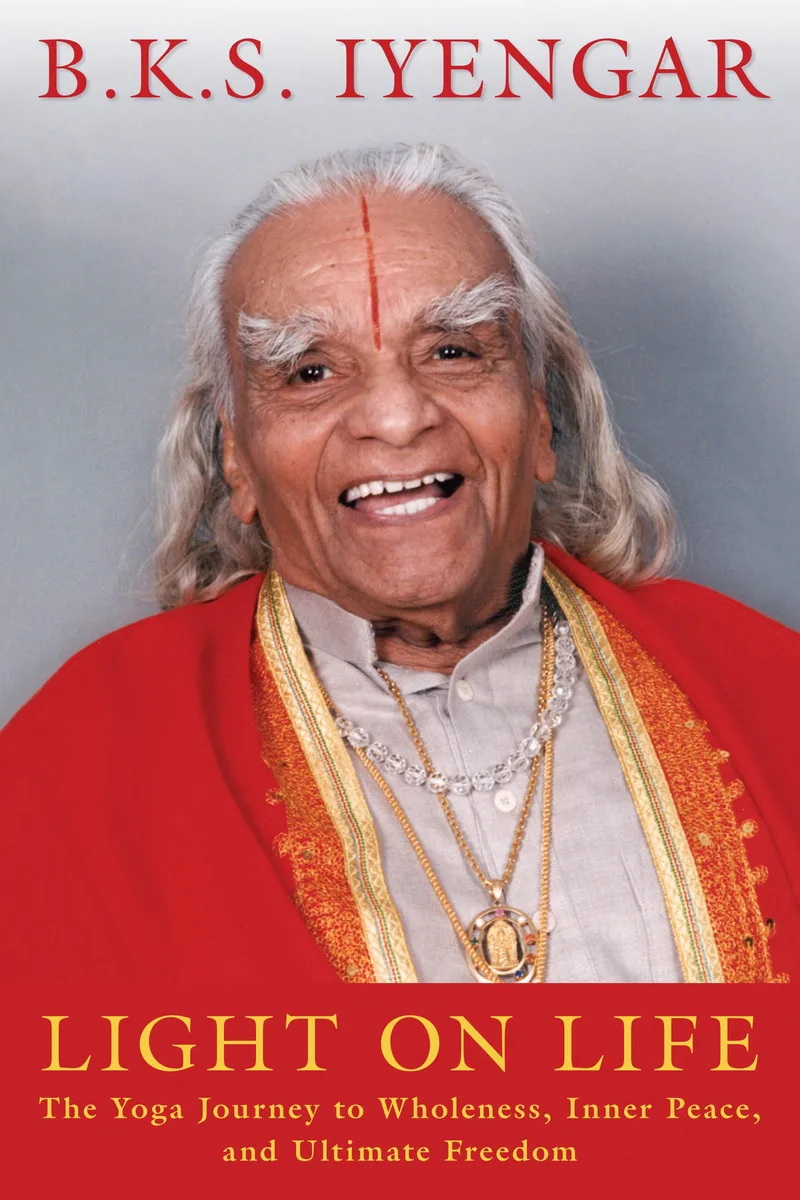
Published in 2006, Light on Life reveals B.K.S. Iyengar's spiritual interpretation of yoga.
"Light on Life" is not a simple guide to yoga poses. First released in 2006, this book details the philosophical and spiritual framework behind yoga, as conveyed by B.K.S. Iyengar. Iyengar, recognized for his significant part in popularizing yoga in the West, aimed to counter a common Western focus on physical postures alone. The book is intended for practitioners who want to grasp yoga as a complete practice, one that includes mental focus, emotional balance, and spiritual advancement. It addresses the growing worldwide fascination with yoga in the early 21st century. The text discusses how to weave yoga into everyday existence for personal discovery and inner calm. It moves past the simple execution of poses to foster awareness, focus, and a deep sense of self.
This book emerges from the lineage of classical yoga, specifically the teachings of B.K.S. Iyengar. Iyengar's approach, while grounded in ancient yogic texts like the Yoga Sutras of Patanjali, often emphasizes precise alignment and the therapeutic potential of postures. "Light on Life" translates these principles into a spiritual context, suggesting yoga's capacity to lead to self-realization and a deeper understanding of consciousness, moving beyond mere physical conditioning. It speaks to an esoteric tradition that views the body as a vehicle for spiritual development.
💡 Why Read This Book?
• Understand yoga's philosophical depth beyond physical postures, as detailed in sections discussing the Eight Limbs of Yoga, offering a framework for self-mastery first articulated by Patanjali. • Gain practical methods for cultivating mental discipline and emotional stability through the practices described, referencing Iyengar's own lifelong dedication to the art since the 1930s. • Connect with the spiritual evolution yoga offers, moving beyond mere exercise to a path of introspection and self-realization, as presented in the book's exploration of yoga's holistic benefits.
⭐ Reader Reviews
Honest opinions from readers who have explored this book.
❓ Frequently Asked Questions
When was B.K.S. Iyengar's "Light on Life" first published?
"Light on Life" was first published on September 19, 2006, marking a significant contribution to the understanding of yoga's philosophical dimensions in the early 21st century.
What is the primary focus of "Light on Life"?
The book's primary focus is on the spiritual, intellectual, and emotional aspects of yoga, presenting it as a comprehensive path to self-discovery rather than solely a physical fitness regimen.
Who is B.K.S. Iyengar, and why is he significant in the context of this book?
B.K.S. Iyengar is a globally renowned yoga master, often called the 'Michelangelo of yoga,' who dedicated his life to teaching and refining the practice, making yoga accessible to millions worldwide since the mid-20th century.
Does "Light on Life" discuss the physical aspects of yoga?
While acknowledging the physical practice, the book emphasizes the philosophical and spiritual dimensions. It uses the physical postures (asanas) as a means to achieve mental and spiritual development, a concept central to yogic traditions originating in India.
What kind of emotional and spiritual development does yoga offer according to this book?
According to "Light on Life," yoga offers development through increased self-awareness, mental concentration, emotional balance, and a deeper understanding of one's inner self, moving toward a state of peace and equanimity.
What makes "Light on Life" different from other yoga books?
This book distinguishes itself by prioritizing yoga's philosophical and spiritual core, as taught by a master with decades of experience, offering insights into its transformative potential beyond physical benefits.
🔮 Key Themes & Symbolism
Yoga as a Path to Self-Awareness
The book posits that yoga is fundamentally a journey inward. Iyengar details how the discipline, cultivated through consistent practice of asanas and pranayama, sharpens one's perception of the self. This heightened awareness extends to physical sensations, mental patterns, and emotional responses, allowing practitioners to observe their internal landscape without judgment. This self-knowledge is presented as the bedrock upon which all further spiritual development is built, moving beyond the superficial understanding of yoga as mere physical exertion.
The Integration of Body and Mind
A central theme is the inseparable nature of the physical and mental aspects of yoga. Iyengar explains how the precision and focus required in performing yoga postures (asanas) directly influence the mind, fostering concentration and stillness. Conversely, mental states impact physical well-being. The book elaborates on concepts like *Sthira* (steadfastness) and *Sukha* (joyful ease) to illustrate how physical stability in a pose can lead to mental calm and emotional resilience, a principle explored through Iyengar's own lifelong practice.
Yoga's Role in Daily Life
"Light on Life" moves yoga from the mat into the fabric of everyday existence. Iyengar argues that the principles and awareness cultivated in practice should permeate all activities, transforming mundane tasks into opportunities for mindfulness and spiritual growth. The book guides readers to apply yogic wisdom to their relationships, work, and personal challenges, suggesting that true yogic mastery is demonstrated not just in advanced postures but in the equanimity and compassion brought to all aspects of life.
Beyond Physical Fitness
This work directly challenges the Western tendency to view yoga primarily as a form of physical exercise. Iyengar meticulously outlines the intellectual and spiritual benefits, including enhanced clarity, emotional regulation, and a deeper connection to one's inner being. He presents yoga as an ancient system for holistic human development, emphasizing its capacity to foster peace, understanding, and a more profound sense of purpose, a perspective he championed throughout his extensive teaching career.
💬 Memorable Quotes
Direct passages from the work, attributed to the author.
“The asana is not just a posture, but a way of being.”
— This statement expresses the book's core message: yoga's physical forms are intended to cultivate a deeper, more integrated state of consciousness and presence in the practitioner's life.
“When the body is healthy, the mind is healthy.”
— This simple assertion underscores the interconnectedness of physical well-being and mental clarity, a fundamental principle that Iyengar applies throughout his teachings on yoga.
“The practice of yoga is the practice of awareness.”
— This emphasizes that the essence of yoga lies not in the physical execution of poses but in the mindful attention and consciousness brought to the practice.
“True yoga is not about touching your toes, but about what you learn on the way down.”
— This interpretation, attributed to Iyengar, redirects focus from achieving a physical goal to the internal process of self-discovery and learning during the practice.
💡 Key Ideas
Editorial paraphrase of the work's core concepts — not direct quotes.
Yoga is the journey of the self, through the self, to the self.
This quote highlights yoga's introspective nature. It is presented not as an external pursuit but as an internal exploration and realization of one's true essence.
🌙 Esoteric Significance
Tradition
This work is deeply rooted in the classical Hatha Yoga tradition, which itself draws from the broader philosophical framework of Vedanta and Patanjali's Yoga Sutras. While not strictly adhering to Western esoteric lineages like Hermeticism or Kabbalah, it shares common ground in its pursuit of self-knowledge, liberation, and the understanding of consciousness. Iyengar's meticulous approach to asana and pranayama can be seen as a practical, embodied method for achieving states of awareness often sought through more purely contemplative or ritualistic esoteric practices.
Symbolism
The book implicitly uses the human body as a primary symbol. The physical form, through the precise practice of asanas, becomes a vehicle for exploring the subtle body and the mind. Concepts like 'Sthira' (steadfastness) and 'Sukha' (joyful ease) act as symbolic guides, representing the balance between effort and surrender, stability and peace. The journey of yoga itself is symbolized as a path toward integration, where the individual self (Atman) realizes its unity with the universal consciousness (Brahman).
Modern Relevance
Contemporary thinkers and practitioners in fields ranging from somatic psychology to contemplative neuroscience draw inspiration from Iyengar's emphasis on embodied awareness and the mind-body connection. His precise methodology continues to influence modern yoga teachers and therapists. Furthermore, in an era saturated with quick fixes and superficial engagement, "Light on Life" remains relevant for its call to disciplined, in-depth practice as a means of achieving genuine inner transformation and self-understanding.
👥 Who Should Read This Book
['• Dedicated yoga practitioners seeking to deepen their understanding beyond the physical, who are interested in the philosophical underpinnings of the practice as taught by a master since the 1930s.', '• Students of comparative religion and philosophy, particularly those interested in Indic traditions, who wish to grasp the spiritual and ethical dimensions of yoga beyond popular interpretations.', '• Individuals experiencing mental or emotional stress, looking for a structured, disciplined approach to cultivate inner peace, self-awareness, and resilience through a holistic system.']
📜 Historical Context
Published in 2006, "Light on Life" emerged during a period of immense global popularization of yoga, a phenomenon largely spearheaded by figures like B.K.S. Iyengar himself since the mid-20th century. Iyengar, recognized globally for his precise methodology, sought to counteract the growing trend of yoga being reduced to mere physical fitness, a perspective often championed by Western fitness instructors. This book arrived at a time when academic and popular interest in Eastern philosophies was high, yet often lacked depth. While competing schools of thought, such as Transcendental Meditation and various Buddhist mindfulness practices, also gained traction, Iyengar's work offered a distinct, rigorous approach grounded in classical Hatha Yoga. The reception was largely positive, reinforcing his status as a foremost authority, though some critics noted the demanding intellectual level required to fully engage with its philosophical content, which contrasted with more simplified yoga guides.
📔 Journal Prompts
The integration of *Sthira* and *Sukha* in daily actions.
How the precision of a physical practice can cultivate mental stillness.
The concept of yoga as a journey of the self.
Observing mental patterns during moments of physical challenge.
Applying yogic awareness to interpersonal interactions.
🗂️ Glossary
Asana
Refers to the physical postures practiced in yoga. In "Light on Life," asanas are presented not just as exercises but as tools for self-awareness and spiritual development.
Pranayama
The practice of breath control and regulation in yoga. It is considered a vital component for managing energy, calming the mind, and deepening meditative states.
Sthira
A Sanskrit term meaning steadfastness, firmness, or stability. In yoga, it refers to the effort and strength required to maintain a posture with correct alignment and concentration.
Sukha
A Sanskrit term meaning joy, ease, or happiness. In yoga, it signifies the state of comfort, peace, and lightness that arises from a stable and mindful practice.
Patanjali
The ancient Indian sage credited with compiling the Yoga Sutras, a foundational text for yoga philosophy. His work provides a systematic framework for yogic practice and understanding.
Self-awareness
The conscious knowledge of one's own character, feelings, motives, and desires. The book posits yoga as a primary means to cultivate this critical aspect of personal growth.
Holistic discipline
An approach that considers the whole system—mind, body, and spirit—rather than isolated parts. Yoga, as presented in the book, is a holistic discipline for comprehensive human development.