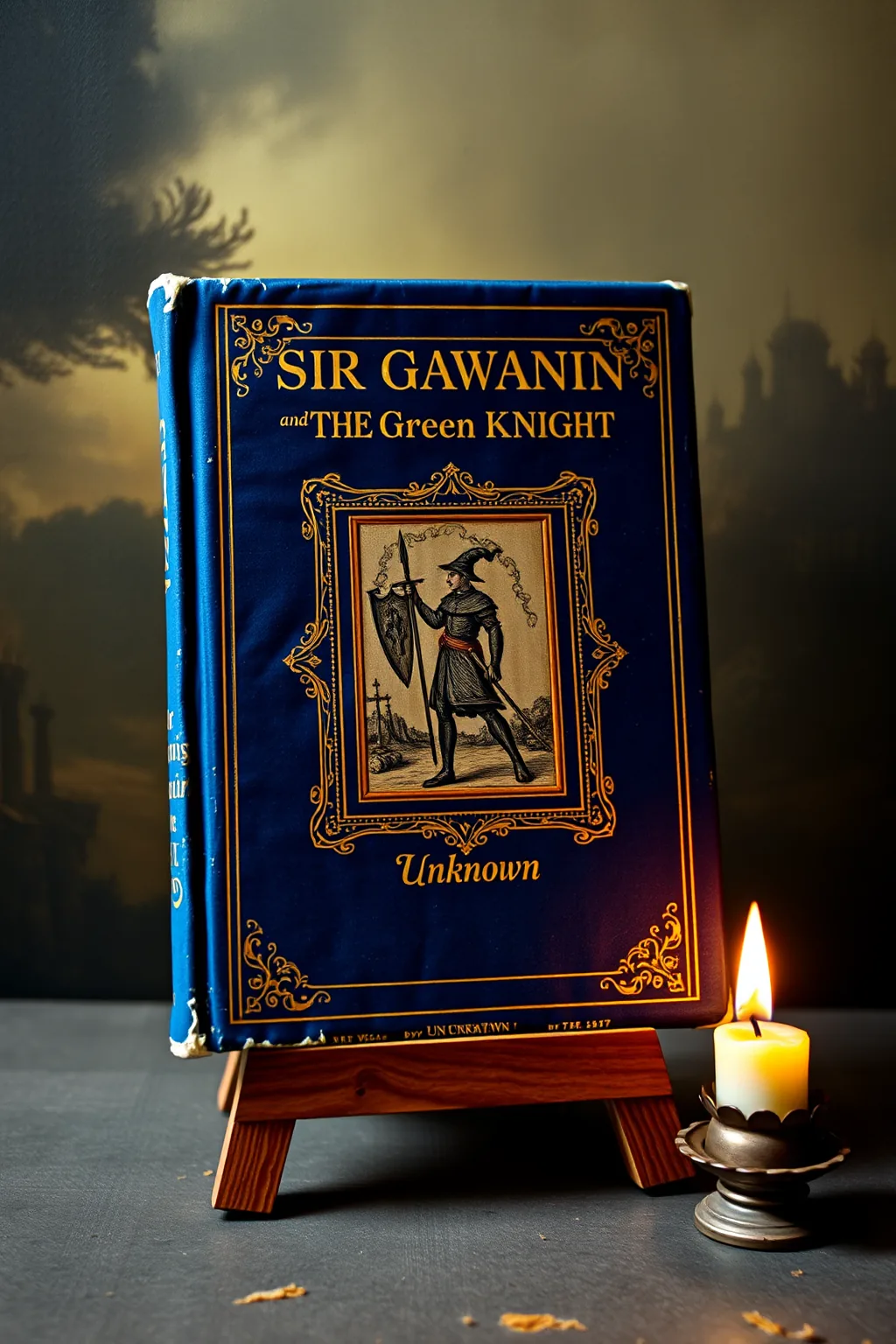
Sir Gawain and the Green Knight
 71
71

Sir Gawain and the Green Knight


Balthazar Finch (Senior Critic, Occult Philosophy) — 'Sir Gawain and the Green Knight' transcends its Arthurian trappings to reveal a potent allegorical framework for spiritual awakening. The enigmatic Green Knight embodies the untamed, primordial forces that demand acknowledgment, while Gawain’s ordeal is a masterful depiction of the soul’s confrontation with its shadow self. This poem is a rich repository of chivalric ideals interwoven with elemental magic and the stark reality of divine judgment. Its enduring power lies in its intricate symbolism, offering profound insights into the nature of courage, temptation, and the ultimate pursuit of spiritual perfection. Essential reading for those who delve into the mystical underpinnings of Western esotericism.
📝 Description
71
Written around 1390, Sir Gawain and the Green Knight details a knight's encounter with a supernatural challenger.
This late 14th-century poem presents Sir Gawain's trial after accepting a challenge from the mysterious Green Knight. The knight, seemingly an elemental force, tests Gawain's adherence to chivalric vows and his personal integrity. Gawain's subsequent journey involves encounters that question his perception of virtue, truth, and cosmic order.
The narrative explores themes of life and death cycles, the contrast between outward appearance and inner reality, and the difficult path of self-awareness. It offers a meditation on maintaining one's principles when confronted by powerful, unknown forces. The work appeals to those interested in the deeper meanings within myth and the pursuit of moral steadfastness.
The poem can be read as an allegory for spiritual initiation. Gawain's journey mirrors a descent into hidden knowledge, where conventional understanding is challenged. The Green Knight represents a primal, perhaps chthonic, power that forces Gawain to confront the limits of his earthly virtues. The cyclical elements suggest a process of death and rebirth, common in mystery traditions, pushing Gawain toward a deeper, perhaps alchemical, transformation of self.
✍️ Author
💡 Why Read This Book?
Unravel the arcane symbolism of a legendary quest, explore the mystical confrontation between man and the primal forces of nature, and discover profound lessons on integrity, fate, and spiritual resilience. Ideal for seekers of ancient wisdom, students of comparative mythology, and practitioners interested in the esoteric dimensions of chivalric lore. Experience a timeless journey of self-discovery and cosmic reckoning.
⭐ Reader Reviews
Honest opinions from readers who have explored this book.
❓ Frequently Asked Questions
What is the primary esoteric theme in Sir Gawain and the Green Knight?
The primary esoteric theme is the initiation into a spiritual test, where Sir Gawain confronts the wild, untamed forces of nature and his own inner limitations, mirroring the alchemical process of purification and transformation.
Who is the Green Knight and what does he represent?
The Green Knight is an embodiment of primal, elemental power, a force of nature and perhaps a divine arbiter, challenging the established order and testing the virtue and spiritual fortitude of King Arthur's court.
What kind of symbolism is present in the poem?
The poem is rich with symbolism, including the pentangle representing Gawain's virtues, the oak and holly representing duality, the hunt symbolizing inner struggle, and the journey itself representing spiritual progression.
Is this book suitable for beginners in esoteric studies?
Yes, while complex, the narrative structure and clear allegorical progression make it accessible. It serves as an excellent entry point into the symbolic language of medieval esotericism.
What is the significance of the exchange of gifts and hunts?
The exchange of gifts and the parallel hunts symbolize the testing of Gawain's honesty and his ability to navigate the treacherous interplay between external appearances and hidden truths, mirroring the alchemical concept of separating and recombining essences.
🔮 Key Themes & Symbolism
The Threshold of the Unknown
The arrival of the Green Knight signifies a rupture in the mundane reality of Camelot, ushering in an era of supernatural challenge. This encounter represents a crossing of the threshold into the liminal, where the natural order is suspended and the spiritual realm intrudes. Gawain's acceptance of the challenge is an act of courage, but more importantly, a willingness to confront the unknown aspects of existence and himself, echoing the alchemical journey of confronting the prima materia.
The Purity of the Pentangle
The pentangle embroidered on Gawain's shield is not merely decorative; it is a potent symbol of his fivefold virtues: generosity, courtesy, chastity, fellowship, and piety. In esoteric traditions, such symbols often serve as protective talismans and markers of spiritual attainment. Gawain's adherence to these virtues, particularly under duress, is tested, revealing the delicate balance between outward appearance of virtue and the inner strength required to uphold it when faced with temptation and fear.
The Cycle of Death and Rebirth
The Green Knight's seemingly fatal challenge and subsequent return to life mirrors the ancient rites of death and rebirth found in various mystical traditions. Gawain's own journey can be interpreted as a symbolic death to his old self and a rebirth into a more profound understanding of truth and consequence. The cyclical nature of the narrative, from the initial challenge to the final confrontation and return, underscores the eternal process of transformation and renewal inherent in the spiritual path.
💬 Memorable Quotes
Direct passages from the work, attributed to the author.
“Now the New Year has come round again...”
— This cyclical reference highlights the eternal return of challenges and opportunities for spiritual growth, emphasizing the timeless nature of the quest.
“And that is the most worthy thing that a man can do.”
— This underscores the chivalric and spiritual ideal of acting with integrity and honor, even in the face of personal peril.
“He is not worth the trouble.”
— This seemingly dismissive phrase can be interpreted esoterically as a recognition that external judgments or superficial appearances hold little true spiritual weight.
💡 Key Ideas
Editorial paraphrase of the work's core concepts — not direct quotes.
I am the one who should be punished.
A profound admission of responsibility, this quote signifies Gawain's understanding of his own fallibility and his willingness to accept the consequences of his actions.
I am in your hands, and you can have me.
A surrender to fate and a test of trust, this line reveals Gawain's acceptance of his vulnerability and his willingness to submit to a higher power or destiny.
🌙 Esoteric Significance
Tradition
The poem aligns closely with the Western esoteric tradition, particularly its themes of chivalry as a spiritual discipline and the allegorical journey of self-mastery. It echoes elements found in Hermeticism, Gnosticism, and early Christian mysticism, where the knight's quest is a metaphor for the soul's arduous path toward divine illumination and wholeness. The emphasis on inner purity and the confrontation with primal forces suggests a connection to initiatory rites.
Symbolism
The symbolism is dense and multi-layered. The Green Knight represents the untamed, elemental power of nature and the divine, often associated with pagan deities or the wild forces that lie beyond human control. The pentangle on Gawain's shield is a powerful sigil of wholeness and protection, symbolizing his five virtues. The hunt metaphors throughout the narrative represent the internal pursuit and capture of desires and fears, mirroring the alchemical process of refining the self.
Modern Relevance
In an age often characterized by superficiality and moral compromise, 'Sir Gawain and the Green Knight' offers enduring relevance. It speaks to the universal human struggle for integrity, the importance of facing one's shadow self, and the necessity of spiritual resilience. The poem's exploration of truth, deception, and consequence continues to resonate, providing a timeless framework for understanding personal responsibility and the pursuit of authentic selfhood in a complex world.
👥 Who Should Read This Book
This timeless epic is a treasure for the dedicated seeker of arcane wisdom, offering a profound glimpse into the spiritual undercurrents of medieval society. Scholars of comparative mythology and Arthurian legend will find its intricate symbolism and narrative depth invaluable. Practicing mystics and those on a path of self-discovery will appreciate its allegorical portrayal of inner trials and the quest for virtue. Even beginners to esoteric studies will find an accessible yet potent narrative that illuminates the enduring human journey toward spiritual enlightenment and integrity.
📜 Historical Context
Composed in the late 14th century, 'Sir Gawain and the Green Knight' emerged from a period of rich literary and cultural ferment in England. The poem reflects the sophisticated courtly culture of the time, where chivalric ideals, Arthurian romances, and a burgeoning interest in allegory and symbolism were prevalent. It was written in a unique dialect of Middle English, showcasing the linguistic artistry of the era. The poem's blend of fantastical elements with moral and spiritual inquiry speaks to a society grappling with faith, honor, and the unseen forces that governed their lives. It stands as a proof of the era's fascination with tales of heroism, temptation, and the quest for perfect virtue, often infused with a subtle awareness of the divine and the mystical.
📔 Journal Prompts
Reflect on a time you faced an unexpected 'Green Knight' challenge in your life. How did you respond, and what did you learn about your own virtues?
Consider the symbolism of the pentangle. How do you embody or strive to embody each of its five virtues in your daily life?
The exchange of gifts and hunts in the story symbolizes a testing of truth. Where in your life are you challenged to reveal your true self versus presenting a curated image?
The Green Knight's power is tied to nature. How do you connect with or feel challenged by the natural world, and what spiritual insights does this connection bring?
Gawain endures a symbolic death and rebirth. What 'deaths' (transformations, endings) have you experienced, and how have they led to a spiritual rebirth?
🗂️ Glossary
Chivalry
A medieval knightly code of conduct emphasizing honor, courage, loyalty, courtesy, and the protection of the weak, often interwoven with spiritual ideals and courtly love.
Arthurian Legend
A body of literature and folklore centered around the legendary King Arthur and his Knights of the Round Table, exploring themes of heroism, magic, and the quest for an ideal kingdom.
Esoteric
Relating to or accessible only by a relatively small number of people with a specialized knowledge or interest; inner, hidden, or secret teachings.
Allegory
A story, poem, or picture that can be interpreted to reveal a hidden meaning, typically a moral or political one. In 'Sir Gawain,' the narrative serves as a spiritual journey.
Pentangle
A five-pointed star, often used in medieval times as a symbol of protection, wholeness, and the five virtues of a knight: generosity, courtesy, chastity, fellowship, and piety.
This book appears in 1 collection
🔮 Readers Also Liked
Browse all →







More by Unknown
All books →



From the “Transcendental Meditation” Collection
View all →







More Free Esoteric History & Biography Books
View all →