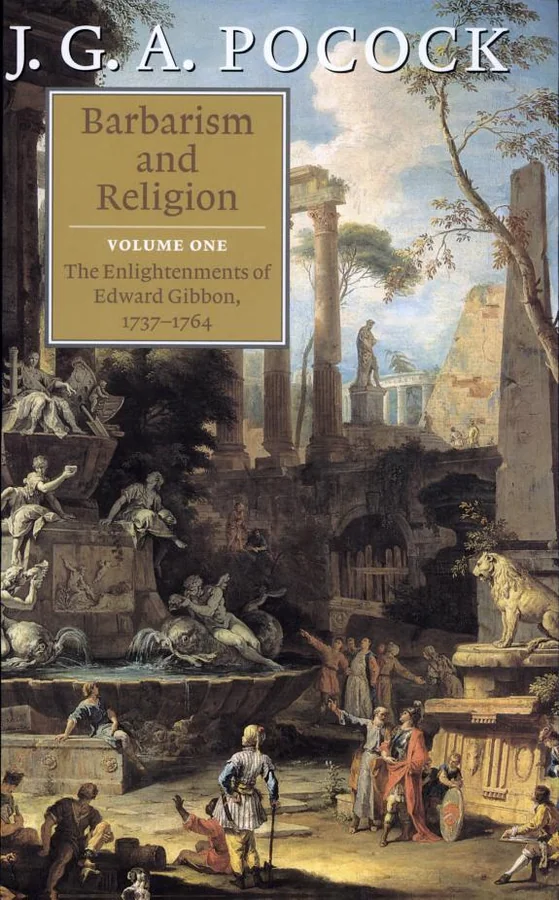
Barbarism and Religion
 74
74

Barbarism and Religion
J. G. A. Pocock’s *Barbarism and Religion* is a formidable intellectual undertaking, not for the faint of heart. Its strength lies in Pocock’s meticulous dissection of how historical concepts are forged and weaponized. He compellingly argues that "barbarism" and "religion" are not static descriptors but fluid, historically contingent constructs used to delineate the boundaries of the civilized and the self. The limitation, however, is the sheer density of the prose, which often demands a reader deeply versed in 18th-century intellectual currents. A particularly striking passage for me was the examination of how early modern European scholars used these terms to understand non-Western societies, revealing more about the scholars' own biases than the cultures they described. This is a work that rewards patience with a profoundly altered perspective on how we categorize the world.
📝 Description
74
Published in 2001, J. G. A. Pocock's Barbarism and Religion analyzes the historical creation of key analytical terms.
In this initial volume of a major sequence, J. G. A. Pocock scrutinizes the historical construction of "barbarism" and "religion" as analytical categories. The book traces their evolution through European intellectual history, challenging conventional understandings of these terms. Pocock demonstrates how "barbarism" and "religion" have been used over centuries to define, exclude, and categorize different societies and belief systems.
This work is aimed at scholars and advanced students in intellectual history, the history of religion, and political thought. Readers interested in the long arc of Western thought, critiques of Orientalism, and the philosophical basis of cultural categorization will find significant material here. It will appeal to those who value rigorous historical analysis that reframes seemingly fixed concepts. Pocock's analysis arose during a period of intense scholarly discussion on post-colonial theory and the critique of Eurocentrism. He engages with the historiography of religion and the Enlightenment, particularly the work of figures like David Hume and Edward Gibbon, who shaped ideas about civilizational progress and religious "superstition." The book revisits the late 18th century, a significant time for articulating these concepts alongside global exploration and colonial expansion.
While not strictly an esoteric text in the occult sense, Pocock's work engages with the deep intellectual currents that shape how societies understand themselves and others. His examination of how categories like "barbarism" and "religion" are historically constructed, rather than inherent truths, resonates with traditions that question established dogma and reveal the contingent nature of knowledge. It speaks to a tradition of critical thought that seeks to deconstruct the foundations of Western self-understanding, revealing the power dynamics embedded within seemingly neutral analytical tools.
💡 Why Read This Book?
• Gain a new framework for analyzing historical narratives by understanding how "barbarism" and "religion" were constructed as analytical tools, a concept Pocock details when examining Enlightenment scholarship. • Appreciate the critical methods of intellectual history, learning how to deconstruct seemingly objective terms and recognize their embedded political and social judgments, as seen in the book's analysis of 18th-century European thought. • Understand the historical roots of modern cultural categorizations, recognizing how concepts debated in the late 18th century continue to shape contemporary discourse on civilization and belief.
⭐ Reader Reviews
Honest opinions from readers who have explored this book.
❓ Frequently Asked Questions
What is the central argument of J. G. A. Pocock's Barbarism and Religion?
The book argues that "barbarism" and "religion" are not objective categories but historical constructs developed in Europe, particularly during the Enlightenment, to categorize and often denigrate other societies and belief systems, revealing more about the observers than the observed.
When was Barbarism and Religion first published?
The first volume of Barbarism and Religion was first published on April 2, 2001.
Who is J. G. A. Pocock and why is he significant?
J. G. A. Pocock (1924-2021) was a highly influential British historian of political thought and ideas, renowned for his work on the history of concepts and the intellectual history of the Anglophone world, particularly his engagement with the Cambridge School of intellectual history.
What historical period does Barbarism and Religion primarily focus on?
While tracing long historical arcs, the book significantly focuses on the late 18th century and the Enlightenment period, examining how thinkers of that era articulated and employed concepts of barbarism and religion.
How does this book relate to post-colonial studies?
Barbarism and Religion offers a crucial historical lens for post-colonial studies by exposing the Eurocentric biases embedded in early European analyses of non-Western cultures, demonstrating how terms like 'barbarism' served to justify colonial endeavors.
Is Barbarism and Religion an easy read?
No, the book is known for its dense, academic prose and requires a strong background in intellectual history. It is intended for scholars and advanced students rather than a general audience.
🔮 Key Themes & Symbolism
The Invention of "Barbarism"
This theme explores how the concept of "barbarism" was not an inherent quality of certain peoples but an invention of European intellectual traditions, particularly from the Enlightenment onward. Pocock examines how "barbarians" were defined in opposition to a perceived "civilized" European norm. This involved attributing a lack of reason, religion, or social order, often to justify colonial expansion and the imposition of European values. The work demonstrates that the label "barbarian" served as a tool for exclusion and othering, shaping political and cultural discourse for centuries.
The Historiography of Religion
Pocock investigates the historical development of how "religion" itself became an object of study and categorization. He scrutinizes how Enlightenment thinkers began to distinguish between "true" or "rational" religion (often exemplified by Christianity) and "false" or "superstitious" faiths. This involved creating typologies of religious belief and practice, often ranking them according to perceived levels of sophistication or proximity to reason. The work highlights the subjective nature of these religious classifications and their embedded biases.
The Enlightenment Apparatus
A core theme is the intellectual machinery of the Enlightenment that produced and disseminated these concepts. Pocock traces how thinkers of the late 18th century, influenced by figures like Hume and Gibbon, developed frameworks for understanding human societies across time and space. This "apparatus" involved theories of progress, stages of civilization, and comparative religion. The book argues that this apparatus was not neutral but deeply implicated in the political and colonial projects of the era, shaping how Europe viewed itself and the rest of the world.
Boundary Making in Thought
This theme focuses on the act of drawing lines – between "us" and "them," "civilized" and "barbarian," "rational" and "superstitious." Pocock shows how intellectual history is often a history of boundary-making. The terms "barbarism" and "religion" were crucial in establishing these intellectual and cultural boundaries. Understanding this process is key to recognizing how categories of thought are formed and how they influence perceptions of identity, difference, and belonging across cultures and historical periods.
💬 Memorable Quotes
Direct passages from the work, attributed to the author.
“The history of the West is the history of its own definition against the non-West.”
— This interpretation highlights Pocock's central thesis that Western identity and self-understanding were often constructed in opposition to perceived 'others,' particularly those labeled 'barbarian' or practicing 'foreign' religions.
“The late eighteenth century was a crucible for the formation of concepts that defined civilization.”
— This idea points to the crucial role of the late 18th century and the Enlightenment in forging the very ideas and language used to categorize societies, understand progress, and establish hierarchies of civilization.
“The idea of "barbarism" served as a mirror reflecting the anxieties and self-perceptions of "civilized" societies.”
— This interpretation suggests that the concept of "barbarism" was less about the reality of those labeled as such and more about how "civilized" societies used this label to define themselves and their own perceived superiority and anxieties.
“Intellectual history is often about the history of terms that allow us to think about the world.”
— This reflects Pocock's meta-historical stance, emphasizing that the study of ideas involves understanding the very vocabulary and conceptual frameworks that shape our perception and analysis of reality.
💡 Key Ideas
Editorial paraphrase of the work's core concepts — not direct quotes.
"Religion" was a concept that Enlightenment thinkers used to classify and often denigrate forms of belief they considered irrational.
This paraphrased concept underscores how the term "religion" in the Enlightenment era was frequently employed not as a neutral descriptor but as a critical tool to demarcate supposedly "primitive" or "superstitious" faiths from "rational" ones.
🌙 Esoteric Significance
Tradition
While not directly a text of esoteric practice, *Barbarism and Religion* provides crucial historical context for understanding the Western esoteric tradition's self-perception and its historical relationship with dominant religious and philosophical frameworks. It illuminates how esoteric ideas, often marginalized or labeled as "superstitious" or "heretical" by mainstream discourse, were historically positioned within the broader intellectual landscape shaped by concepts of "civilization" and "rational" religion.
Symbolism
The primary "symbols" in this work are conceptual rather than visual. "Barbarism" functions as a symbolic signifier of the 'other,' representing a perceived lack of order, reason, or advanced civilization. "Religion," in Pocock's analysis, becomes symbolic of the formalized, often institutionalized, expressions of belief that Enlightenment thinkers sought to categorize and rationalize, distinguishing them from 'superstition' or 'enthusiasm.' The very act of categorization itself becomes symbolic of the human impulse to impose order and meaning.
Modern Relevance
Contemporary thinkers engaged with critical theory, religious studies, and post-colonial thought continue to draw on Pocock's meticulous unmasking of conceptual genealogies. Scholars examining the history of comparative religion, the philosophical underpinnings of secularism, and the persistent influence of civilizational rhetoric in global politics find his work indispensable. It provides a vital framework for deconstructing the historical biases embedded in contemporary discussions about cultural identity, religious pluralism, and geopolitical categorizations.
👥 Who Should Read This Book
• Scholars of intellectual history and the history of ideas, who will gain a sophisticated understanding of how foundational Western concepts were constructed and deployed. • Students of political theory and philosophy, particularly those interested in the Enlightenment and its legacy, who will learn to critically analyze the language of civilization and progress. • Researchers in comparative religion and cultural studies, who can use Pocock's framework to deconstruct historical biases in the study of diverse belief systems and cultures.
📜 Historical Context
Published in 2001, *Barbarism and Religion* emerged from a rich intellectual milieu deeply engaged with the historiography of ideas and the critiques of Eurocentrism. J. G. A. Pocock, a towering figure in the history of political thought, was writing in the shadow of the "Cambridge School" of intellectual history, which he helped shape, emphasizing the importance of context and linguistic practice. The work grapples with the intellectual currents of the late 18th century, particularly the Enlightenment’s attempts to categorize global societies and religions. This era saw contemporaries like Edward Gibbon publish seminal works on the decline of Rome and the rise of Christianity, and David Hume developing theories of human nature and progress. Pocock’s analysis directly engages with these foundational texts and the intellectual apparatus they represent, questioning the neutrality of categories like "barbarism" and "religion" that were integral to Enlightenment thought and, by extension, to the justification of colonial expansion. The book implicitly responded to post-colonial critiques that were gaining momentum, offering a historical genealogy of the very concepts used to construct the 'other.'
📔 Journal Prompts
The Enlightenment apparatus for defining civilization and its others.
The historical construction of "religion" as a category of study.
Barbarism as a concept used for boundary-making in Western thought.
The intellectual lineage of "civilization" and its implications.
Identifying how "barbarism" functions as a mirror in contemporary discourse.
🗂️ Glossary
Enlightenment
An 18th-century intellectual and cultural movement emphasizing reason, individualism, and skepticism toward traditional authority, which significantly shaped Western thought on civilization, progress, and religion.
Historiography
The study of the writing of history, including the analysis of historical methods, the evolution of historical thought, and the interpretation of historical sources and narratives.
Eurocentrism
A worldview centered on Western civilization, often leading to the belief that Western culture is superior to others and that Western standards should be applied universally.
Longue Durée
A concept popularized by Fernand Braudel, referring to long-term historical processes and structures that shape societies over extended periods, often transcending short-term events.
Orientalism
A term coined by Edward Said, describing the Western practice of representing the East (the Orient) in a stereotyped and often condescending manner, reflecting Western colonial attitudes and power dynamics.
Skepticism
An attitude of doubt or inquiry towards claims of knowledge or belief, particularly prevalent during the Enlightenment regarding religious dogma and traditional authority.
Civilization
In the context of the Enlightenment, a term used to denote a perceived advanced stage of social, cultural, and technological development, often contrasted with 'barbarism'.
This book appears in 1 collection
🔮 Readers Also Liked
Browse all →







From the “Enlightenment” Collection
View all →




More Free Esoteric History & Biography Books
View all →