Return of the rishi
 80
80

Return of the rishi
Chopra’s 1995 exploration of the rishi archetype offers a compelling, if at times overly generalized, bridge between Vedic wisdom and contemporary self-help. The book’s strength lies in its accessible distillation of complex philosophical ideas, particularly its emphasis on consciousness as the ground of being. Chopra effectively frames the rishi as an attainable state of awakened awareness, urging readers to recognize this potential within themselves. However, the work occasionally falters under the weight of its own optimism, sometimes presenting spiritual principles as guaranteed outcomes rather than nuanced paths. A passage discussing the 'Seven Spiritual Laws of Success' illustrates this, offering practical guidance that, while beneficial, might oversimplify the intricate nature of spiritual progress. The book’s primary limitation is its tendency to homogenize diverse Vedic traditions into a singular, easily digestible narrative. Nevertheless, *Return of the Rishi* remains a significant text for its ability to demystify profound spiritual concepts for a broad audience.
📝 Description
80
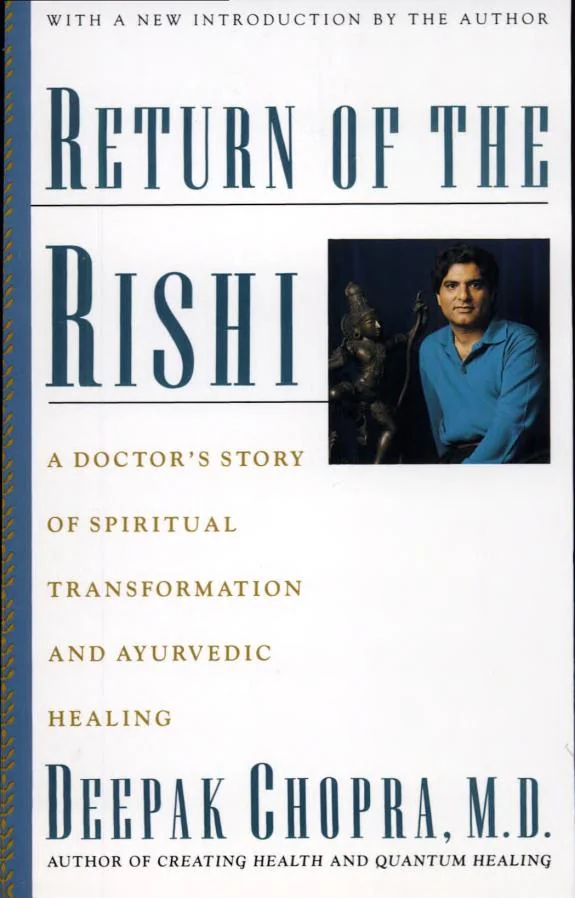
Deepak Chopra's 1995 book, *Return of the Rishi*, reintroduces the Vedic concept of the seer.
First published in 1995, Deepak Chopra's *Return of the Rishi* examines the figure of the rishi, a seer from the Vedic tradition. Chopra presents these ancient figures not just as historical individuals, but as archetypes of consciousness that modern individuals can access. The book connects the rishi's wisdom and their perception of cosmic principles to contemporary spiritual aspirations. It looks at the links between consciousness, health, and spiritual growth, drawing parallels between older yogic ideas and current views on the mind-body connection. The work is for people interested in the philosophical side of yoga and meditation, going beyond physical postures. Readers wanting to grasp the deeper spiritual and intellectual currents within Indic traditions will find it valuable. It suits those who study consciousness, the nature of enlightenment, and how spiritual insight can appear in daily life. The book offers arguments for those questioning a purely materialist view of the world and seeking different ideas about reality and human capacity.
Published in 1995, *Return of the Rishi* appeared as Western interest in Eastern spirituality grew. Chopra, already a known figure, was popularizing ideas about the mind-body link, partly inspired by Herbert Benson's work on relaxation. The book arrived when New Age thought had a broad reach, providing a more philosophically grounded perspective than some other contemporary works. It entered the ongoing discussion between scientific materialism and spiritual inquiry, a conversation that included thinkers like Fritjof Capra and his work on physics and mysticism.
💡 Why Read This Book?
• Gain insight into the Vedic concept of the rishi, understanding it not just as an ancient figure but as an archetype of awakened consciousness, as explored in the book's examination of Vedic philosophy. • Learn about consciousness-based healing principles, which posit that mental and spiritual states directly influence physical well-being, a core tenet discussed throughout the text. • Discover the potential for accessing innate wisdom and higher states of awareness, moving beyond materialist perspectives to embrace a more holistic view of existence, as exemplified by the rishi archetype.
⭐ Reader Reviews
Honest opinions from readers who have explored this book.
❓ Frequently Asked Questions
What is the historical origin of the term 'rishi' that Deepak Chopra discusses?
The term 'rishi' originates from the Vedic Sanskrit tradition in ancient India. It refers to sages, seers, or enlightened individuals who are believed to have perceived or 'seen' the mantras and hymns of the Vedas, acting as conduits for divine knowledge.
When was Deepak Chopra's 'Return of the Rishi' first published?
Deepak Chopra's book 'Return of the Rishi' was first published in 1995, a period when his work on spirituality and mind-body medicine gained significant traction in Western popular culture.
What are the 'Seven Spiritual Laws of Success' mentioned in the book?
The 'Seven Spiritual Laws of Success' are principles Chopra outlines, derived from Vedic philosophy, intended to guide individuals toward achieving their goals by aligning with natural universal laws of consciousness and success.
How does 'Return of the Rishi' relate to yoga and meditation practices?
The book connects the practices of yoga and meditation to the attainment of the rishi consciousness, suggesting these disciplines are pathways to unlocking inner wisdom, self-awareness, and spiritual understanding beyond mere physical exercise.
Is 'Return of the Rishi' considered a primary source for Vedic philosophy?
While 'Return of the Rishi' synthesizes and interprets Vedic philosophical concepts for a modern audience, it is not a primary source text like the Vedas themselves. It serves as an accessible commentary and application of those ancient ideas.
What is the central message about human potential in Chopra's book?
The central message is that every individual possesses the potential for awakened consciousness, akin to that of a rishi. Chopra suggests that by understanding and applying certain spiritual principles, one can realize this innate potential for well-being and fulfillment.
🔮 Key Themes & Symbolism
The Rishi Archetype
The book centers on the rishi, a Vedic sage embodying profound wisdom and direct perception of truth. Chopra presents the rishi not as a historical relic but as an attainable state of consciousness accessible to all. This archetype serves as a model for spiritual seekers, illustrating the potential for heightened awareness and connection to universal principles. The work explores how embodying the qualities of a rishi—clarity, insight, and detachment—can lead to a more meaningful and spiritually aligned existence, moving beyond ordinary perception to a deeper understanding of reality's fabric.
Consciousness as Primary Reality
Chopra argues that consciousness is the fundamental ground of all existence, preceding and shaping material reality. This perspective, rooted in Vedanta philosophy, challenges conventional materialism. The book suggests that by understanding and mastering our own consciousness, we can influence our experiences, health, and overall well-being. Concepts like thought-forms and the power of intention are explored as mechanisms through which consciousness manifests, offering a framework for personal transformation and spiritual growth.
The Seven Spiritual Laws of Success
Derived from ancient wisdom traditions, these laws are presented as practical principles for living in harmony with the universe to achieve fulfillment. They include laws like 'The Law of Pure Potentiality' and 'The Law of Karma,' emphasizing the interconnectedness of actions, intentions, and outcomes. Chopra frames these laws not as rigid rules but as dynamic forces that govern life. Applying them, the book suggests, allows individuals to tap into their inherent creativity and manifest their desires aligned with cosmic order.
Mind-Body Integration
A recurring theme is the inseparable connection between the mind and body, a concept central to Chopra's broader work. 'Return of the Rishi' posits that psychological and spiritual states are primary drivers of physical health. It explores how practices like meditation and cultivating positive mental states can foster healing and vitality. This perspective moves beyond a purely biomedical model, advocating for a holistic approach to well-being that integrates mental, emotional, and spiritual dimensions.
💬 Memorable Quotes
Direct passages from the work, attributed to the author.
“The seer is not a person but a state of consciousness.”
— This highlights Chopra's core argument that the wisdom and insight associated with ancient Vedic sages (rishis) are not exclusive to historical figures but represent an accessible level of awareness available to anyone through spiritual practice.
“Your body is a manifestation of consciousness.”
— This statement underscores the book's premise that physical reality, including our bodies, arises from and is sustained by consciousness, suggesting that mental and spiritual states have a direct impact on physical health and form.
“The present moment is the only reality.”
— This concept emphasizes the importance of mindfulness and living fully in the now, suggesting that dwelling on the past or future detracts from our ability to experience and shape our present reality effectively.
“Success is the unfolding of a predetermined potential.”
— This interpretation of success aligns with the idea of inherent potential within each individual, suggesting that true success comes from recognizing and actualizing this innate capacity rather than from external striving alone.
“We are not human beings having a spiritual experience; we are spiritual beings having a human experience.”
— This fundamental reorientation shifts the perspective from the human, material existence being primary, to the spiritual essence being the core identity, with the human life being a temporary expression or journey for that spirit.
🌙 Esoteric Significance
Tradition
The work draws heavily from the Vedanta school of Hindu philosophy, particularly Advaita Vedanta, which posits the non-dualistic nature of reality and the ultimate identity of the individual soul (Atman) with the Absolute (Brahman). It also incorporates elements of yogic philosophy concerning consciousness, meditation, and the attainment of higher states of awareness, placing it within the broad stream of Indic esoteric traditions.
Symbolism
The central symbol is the 'rishi' itself, representing the awakened seer who perceives ultimate truth. Another key motif is the concept of 'Om' (Aum), the primordial sound vibration often seen as the sonic manifestation of the Absolute, symbolizing the unity of all creation. The book also implicitly uses the symbolism of the lotus flower, often associated with spiritual enlightenment and purity emerging from muddy waters.
Modern Relevance
Chopra's synthesis of Vedic concepts with modern psychology and quantum physics continues to influence contemporary wellness movements, mindfulness practices, and consciousness studies. Thinkers and practitioners in fields ranging from positive psychology to transpersonal psychology often reference his accessible explanations of mind-body connection and spiritual principles. His work remains a touchstone for many seeking to integrate spiritual growth with practical life, influencing modern meditation apps and holistic health approaches.
👥 Who Should Read This Book
• Aspiring practitioners of meditation and yoga seeking a philosophical framework to deepen their practice beyond the physical. • Individuals interested in comparative religion and philosophy, particularly those exploring Indic traditions and the concept of consciousness. • Readers exploring self-help and personal development who are looking for spiritual perspectives on success, well-being, and the nature of reality.
📜 Historical Context
When *Return of the Rishi* was released in 1995, Deepak Chopra was already a leading figure in the popularization of Eastern spirituality and mind-body medicine in the West. The book emerged amidst a flourishing New Age movement, which saw increased interest in concepts like meditation, yoga, and alternative healing. Chopra’s work offered a sophisticated, albeit simplified, interpretation of Vedic philosophy, drawing parallels with emerging scientific ideas about consciousness. This period saw thinkers like Fritjof Capra exploring the connections between modern physics and mysticism, and Herbert Benson’s research on the relaxation response provided a scientific veneer for practices like meditation. While embraced by many, Chopra's approach also faced critique from some academics and spiritual traditionalists for its synthesis and popularization, sometimes seen as diluting or misrepresenting the complex philosophical systems of Indic traditions.
📔 Journal Prompts
The rishi's perception of truth: How does the concept of the seer as a state of consciousness challenge your current understanding of wisdom?
Reflect on the statement, 'Your body is a manifestation of consciousness.' What are the implications for your daily health practices?
Consider the Seven Spiritual Laws of Success. Which law feels most relevant to your current life circumstances and why?
Explore the idea of 'consciousness-based healing.' How might shifting your mental state influence your physical well-being?
Meditate on the 'present moment as the only reality.' What sensations or thoughts arise when you fully inhabit the now?
🗂️ Glossary
Rishi
In Vedic tradition, a sage, seer, or enlightened individual believed to have perceived divine truths and hymns. Chopra expands this to represent an attainable state of awakened consciousness.
Vedas
The oldest scriptures of Hinduism, considered by adherents to be divinely revealed. They form the foundation of Vedic philosophy and esoteric traditions.
Atman
The individual soul or self in Hindu philosophy, often considered to be identical with Brahman (the Absolute) in Advaita Vedanta.
Brahman
The ultimate reality or absolute cosmic spirit in Hinduism. It is the supreme, unchanging, all-pervading essence of the universe.
Om (Aum)
A sacred syllable and mantra in Hinduism, Buddhism, and Jainism, considered the primordial sound vibration of the universe and a symbol of the Absolute.
Karma
The principle of cause and effect in Hindu and Buddhist traditions, where actions (karma) influence future experiences and rebirths.
Maya
An important concept in Indian philosophies, often translated as 'illusion' or 'deception,' referring to the illusory nature of the phenomenal world that conceals the true reality of Brahman.
🔮 Readers Also Liked
Browse all →








More by Deepak Chopra
All books →


More Free Spiritual Development Books
View all →