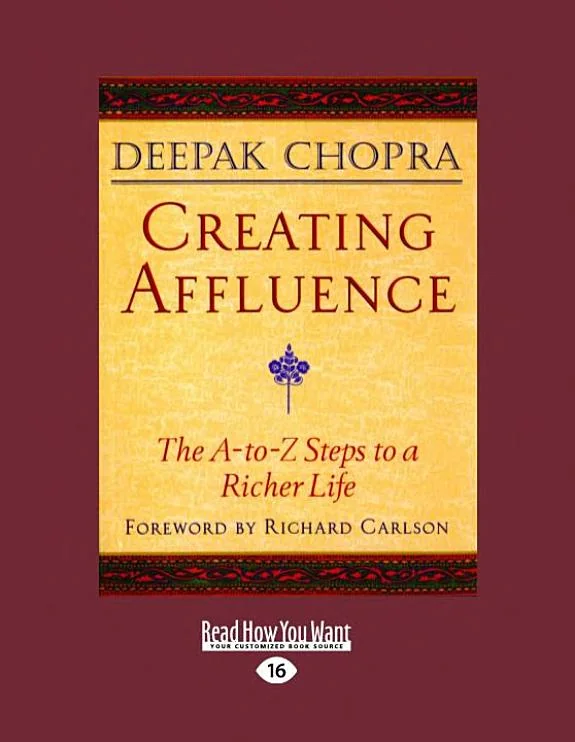
Creating Affluence
 81
81

Creating Affluence
Chopra's "Creating Affluence" offers a familiar, yet persistently relevant, distillation of his core philosophies on abundance. The strength lies in its accessible articulation of complex spiritual ideas, framing wealth not as an external pursuit but an internal cultivation. He adeptly connects concepts like the quantum field to personal manifestation, making the abstract tangible for a broad audience. However, the book occasionally leans into repetition, and its reliance on broad spiritual pronouncements may leave skeptics wanting more concrete, empirically verifiable mechanisms beyond the philosophical. A particularly effective passage explores the concept of "non-attachment" to desired outcomes, suggesting that releasing the desperate need for wealth paradoxically makes its arrival more probable. It’s a well-structured guide for those open to spiritual principles for material well-being.
📝 Description
81
Deepak Chopra's 2009 book, Creating Affluence, proposes a spiritual path to wealth beyond financial metrics.
Creating Affluence, published in 2009, presents a framework for cultivating wealth that extends beyond financial accumulation to a broader sense of abundance and well-being. Deepak Chopra argues that wealth consciousness is a mental state accessible to everyone through specific mental disciplines and changes in perception. The book is for individuals seeking to redefine their relationship with prosperity, especially those feeling limited by conventional success definitions and desiring a more holistic life approach. Readers dealing with financial anxieties or aiming to align material circumstances with spiritual growth will find actionable guidance.
Chopra's work centers on the idea that internal states directly influence external reality. He introduces concepts like the "seven spiritual laws of success" and the principle of "pure potentiality" as core elements for generating affluence. The book emphasizes the role of intention, detachment from outcomes, and understanding the universe's inherent abundance as a blueprint for aligning one's life with prosperity.
Creating Affluence emerged in 2009, a time when New Age and self-help literature continued to examine the connection between consciousness and material reality. Chopra builds on earlier concepts of positive thinking and manifestation, drawing on interpretations of Vedic philosophy and quantum physics through a spiritual lens. The book situates itself within ongoing discussions about mind-body-spirit connections for achieving personal fulfillment, reflecting a continued interest in esoteric traditions for practical life application.
💡 Why Read This Book?
• Learn to shift your internal state from scarcity to abundance, directly impacting your perception and attraction of resources, a core principle explored in Chopra's "wealth consciousness" framework. • Understand the practical application of concepts like "pure potentiality" to overcome limiting beliefs and unlock new avenues for financial and personal fulfillment, as detailed in the book's step-by-step plan. • Discover how to detach from outcomes while maintaining focused intention, a key strategy for creating affluence without anxiety, directly referencing Chopra's interpretation of spiritual laws.
⭐ Reader Reviews
Honest opinions from readers who have explored this book.
❓ Frequently Asked Questions
What is the core message of Deepak Chopra's "Creating Affluence"?
The book's core message is that affluence is a state of consciousness achievable by understanding and applying spiritual principles, extending beyond financial wealth to encompass overall well-being and fulfillment.
When was "Creating Affluence" by Deepak Chopra first published?
"Creating Affluence" was first published on April 14, 2009, positioning it within Chopra's extensive body of work on mind-body-spirit connections.
Does the book offer practical steps for financial improvement?
Yes, the book presents a step-by-step plan and actionable guidance rooted in spiritual and philosophical concepts to help readers cultivate wealth consciousness and improve their material circumstances.
What distinguishes Chopra's approach to wealth from conventional methods?
Chopra distinguishes his approach by emphasizing internal transformation and spiritual laws (like pure potentiality) over purely external actions or financial strategies, viewing wealth as an inner state that manifests outwardly.
Who is the intended audience for "Creating Affluence"?
The book is intended for individuals seeking a more holistic understanding of wealth, those interested in the intersection of spirituality and material success, and anyone wishing to cultivate abundance in all areas of life.
Are there specific spiritual laws discussed in the book?
Yes, the book explores principles often referred to as the "seven spiritual laws of success," which form a foundation for creating affluence by aligning personal energy with universal abundance.
🔮 Key Themes & Symbolism
Wealth Consciousness
The central theme posits that affluence is not merely about accumulating money but about cultivating a specific state of mind. Chopra argues that this "wealth consciousness" is characterized by an awareness of infinite possibilities and inherent abundance. It involves shifting from a perspective of scarcity and lack to one of gratitude and trust in the universe's provision. This internal shift, according to the book, is the prerequisite for attracting and sustaining material prosperity and overall life fulfillment.
Pure Potentiality
This concept, drawn from Vedic philosophy, describes the fundamental ground of all existence as pure consciousness, a area of infinite possibilities. Chopra suggests that by connecting with this state of pure potentiality, individuals can transcend limitations and tap into a boundless source of creativity and resources. Accessing this realm involves practices that quiet the mind, such as meditation, allowing one to align with the universe's natural flow of abundance.
Spiritual Laws of Success
The book outlines a set of principles, often referred to as the "seven spiritual laws of success," which serve as a practical guide for manifestation. These laws, including the Law of Pure Potentiality, the Law of Giving and Receiving, and the Law of Detachment, provide a framework for aligning one's actions and intentions with the natural order of the universe to create desired outcomes, including affluence.
Mind-Body-Spirit Integration
A recurring theme is the interconnectedness of our thoughts, emotions, physical well-being, and external circumstances. Chopra emphasizes that true affluence requires harmonizing these aspects of life. By addressing the spiritual and mental dimensions of wealth creation, the book advocates for a holistic approach that fosters not only financial security but also inner peace, health, and meaningful relationships.
💬 Memorable Quotes
Direct passages from the work, attributed to the author.
“The source of all abundance is still within you.”
— This statement emphasizes that external wealth is a reflection of an internal state. It suggests that individuals possess an inherent capacity for abundance, which can be accessed by looking inward rather than solely focusing on external acquisition.
“Wealth consciousness is the ability to know that you are abundant.”
— This highlights the subjective nature of wealth. It proposes that true affluence begins with a deep-seated belief and knowing of one's own abundance, irrespective of current material possessions or financial status.
“Intention is the starting point of all achievement.”
— This underscores the power of focused desire and mental clarity in bringing about desired outcomes. It suggests that clearly defining one's intentions is the crucial first step in the process of creation and manifestation.
“Detachment is a principle that allows you to be free.”
— This refers to releasing the anxious grip on specific outcomes. By practicing detachment, one can pursue goals with focus but without desperate attachment, fostering peace and allowing the natural unfolding of events.
“Your body is a field of pure potentiality.”
— This conceptualizes the physical body not just as a biological entity but as a conduit for infinite possibilities, capable of manifesting desired realities when aligned with consciousness and intention.
🌙 Esoteric Significance
Tradition
Chopra's work draws heavily from Advaita Vedanta, a school of Hindu philosophy emphasizing the oneness of the individual soul (Atman) with the ultimate reality (Brahman). It aligns with Hermetic principles concerning the correspondence between the microcosm (individual) and macrocosm (universe), suggesting that understanding internal states unlocks external control. The emphasis on pure consciousness and infinite potential echoes Gnostic ideas of divine spark within humanity and Kabbalistic notions of creation through divine thought, though Chopra synthesizes these rather than adhering strictly to any single lineage.
Symbolism
The concept of "pure potentiality" functions symbolically as the primordial, unmanifest source from which all creation emerges, akin to the Kabbalistic Keter or the Hermetic Prima Materia. The "seven spiritual laws" act as symbolic pathways or stages, guiding the practitioner toward aligning their individual will with cosmic order. The idea of "wealth consciousness" itself symbolizes a state of divine awareness and abundance, representing the realized potential of the individual consciousness.
Modern Relevance
Chopra's "Creating Affluence" continues to influence contemporary discussions on manifestation, positive psychology, and conscious capitalism. Modern wellness influencers and life coaches frequently echo his themes of abundance mindset and the power of intention. Practices such as mindfulness meditation, often presented secularly, share roots with the contemplative techniques Chopra advocates for accessing pure potentiality. His work is also referenced in discussions bridging quantum physics with consciousness studies, a field that continues to attract thinkers and practitioners seeking to understand the universe's fundamental nature.
👥 Who Should Read This Book
• Aspiring manifestation practitioners seeking structured guidance on aligning their mindset with material goals, benefiting from Chopra's specific "wealth consciousness" framework. • Individuals interested in Eastern philosophies, particularly Vedic concepts like "pure potentiality," who wish to apply them to modern challenges of financial and personal fulfillment. • Those feeling spiritually disconnected from their material pursuits, looking for a holistic approach that integrates inner well-being with external success, as outlined in the "seven spiritual laws."
📜 Historical Context
Deepak Chopra's "Creating Affluence," published in 2009, arrived during a sustained period of interest in the intersection of consciousness, spirituality, and personal success, a trend significantly amplified by the self-help movement of the late 20th century. Chopra himself became a prominent figure in this space, building on the foundations laid by thinkers like Napoleon Hill and Norman Vincent Peale, while integrating concepts from Vedic traditions and quantum physics. His approach, often categorized under New Age thought, proposed that mental states directly influence material reality. The book's release occurred roughly two decades after the emergence of popular spiritual authors like Shirley MacLaine and coincided with a growing academic and popular fascination with the placebo effect and mind-body medicine. While not facing overt censorship, Chopra's work, like that of other popularizers of spiritual concepts, has been subject to critique from some scientific and skeptical communities for its interpretations of quantum mechanics and its broad claims about manifestation, representing a continuing intellectual tension between esoteric philosophies and empirical science.
📔 Journal Prompts
Reflect on your current "wealth consciousness" and identify its dominant scarcity-based thoughts.
Explore the concept of "pure potentiality" in relation to a current life challenge.
How does the "Law of Giving and Receiving" manifest in your daily interactions?
Consider the "seven spiritual laws of success" and their applicability to your aspirations.
Meditate on the idea that abundance is an internal state, not an external condition.
🗂️ Glossary
Wealth Consciousness
A state of mind characterized by the deep-seated belief in one's own inherent abundance and the certainty of prosperity, extending beyond financial matters to encompass overall life fulfillment.
Pure Potentiality
The foundational ground of existence, representing a area of infinite possibilities and unmanifest potential from which all creation arises, often accessed through stillness and consciousness.
Seven Spiritual Laws of Success
A set of principles derived from Chopra's interpretation of Vedic philosophy, designed to guide individuals in aligning their intentions and actions with natural laws to achieve success and abundance.
Intention
The focused direction of consciousness toward a specific outcome or goal; considered the starting point for all creation and achievement in Chopra's framework.
Detachment
The practice of releasing anxious attachment to specific outcomes, allowing goals to be pursued with focus but without desperate clinging, fostering inner peace and receptivity.
Abundance
A state of plentifulness and sufficiency, viewed not just in material terms but also encompassing spiritual, emotional, and relational richness.
Manifestation
The process by which thoughts, intentions, and consciousness translate into tangible reality or external circumstances.
This book appears in 1 collection
🔮 Readers Also Liked
Browse all →









From the “Transcendental Meditation” Collection
View all →









More Free Spiritual Development Books
View all →