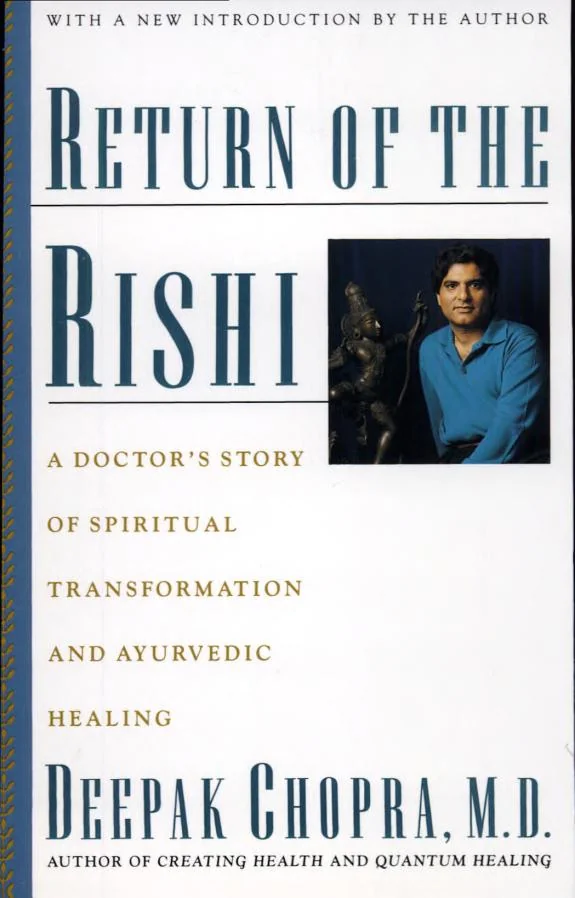
Return of the Rishi
 79
79

Return of the Rishi
Chopra's "Return of the Rishi" offers a compelling narrative of personal discovery, charting his pivot from conventional endocrinology to the expansive world of Ayurveda. The strength of the book lies in its accessible presentation of complex Indian philosophical concepts, particularly how they relate to health. Chopra’s early career in the US provides a relatable anchor for readers unfamiliar with Vedic traditions. However, the narrative sometimes leans towards a generalized optimism that can feel less grounded than the specific medical details he initially provides. A notable passage details his initial encounter with Maharishi Mahesh Yogi, marking a significant turning point, though the subsequent elaboration on consciousness sometimes feels more like assertion than argument. The book ultimately succeeds as an introduction to Ayurvedic thought for a Western audience, though it may leave critical readers wanting more rigorous exploration of the empirical basis for some claims.
📝 Description
79
Deepak Chopra's 1991 book chronicles his shift from endocrinology to Indian traditions.
Deepak Chopra's "Return of the Rishi," published in 1991, details his personal evolution from practicing medicine in the United States to a deep study of ancient Indian philosophies. Dissatisfied with the limits of Western medicine for addressing holistic well-being, Chopra turned to systems like Ayurveda. This book acts as an introduction to Ayurvedic principles and its associated philosophy, aiming to connect readers with these ancient Indian practices.
The work is suited for individuals interested in the convergence of contemporary science and traditional Eastern thought, especially those looking for different paths to health and healing. It will attract those curious about Eastern philosophies, the practice of Ayurveda, and how consciousness relates to physical and mental health. Readers who feel conventional medical approaches do not fully address their health concerns may find particular relevance here.
Published in 1991, "Return of the Rishi" appeared as Western interest in alternative medicine and Eastern spirituality grew. The late 20th century saw many yogic and Ayurvedic practices enter Western discourse, often brought by individuals with Western backgrounds. Chopra's own history as an endocrinologist gave him a distinct perspective. This period also coincided with the rise of New Age thought, which frequently blended Eastern mysticism with a focus on personal transformation and holistic health, situating Chopra's work within this cultural milieu.
💡 Why Read This Book?
• Learn about the Ayurvedic concept of doshas (Vata, Pitta, Kapha) as described in the book, understanding how these elemental forces are posited to influence individual health and constitution, offering a framework for personal well-being assessment. • Discover the author's personal transition from Western medicine in the 1980s to embracing Ayurvedic principles, providing a unique perspective on integrating scientific and ancient healing modalities. • Explore the meaning of the 'rishi' archetype as presented in the text, reflecting on how this ancient ideal of awakened consciousness can be interpreted in the context of modern self-healing and personal growth.
⭐ Reader Reviews
Honest opinions from readers who have explored this book.
❓ Frequently Asked Questions
When was Deepak Chopra's "Return of the Rishi" first published?
"Return of the Rishi" by Deepak Chopra was first published in 1991, marking a significant point in his career when he began widely sharing his insights on Ayurveda and consciousness.
What is Ayurveda as explained in "Return of the Rishi"?
In "Return of the Rishi," Ayurveda is presented as an ancient Indian system of medicine emphasizing balance through diet, lifestyle, and herbal remedies, linked to the elemental forces of Vata, Pitta, and Kapha.
What does the term 'Rishi' refer to in the book?
The 'Rishi' in Chopra's book refers to an ancient Indian sage or seer, representing a state of profound consciousness and wisdom believed to be the source of Vedic knowledge, including Ayurveda.
Did Deepak Chopra practice medicine before writing "Return of the Rishi"?
Yes, prior to the widespread reception of "Return of the Rishi," Deepak Chopra had an established career as a practicing endocrinologist in the United States.
What is the main subject matter of "Return of the Rishi"?
The book primarily discusses Deepak Chopra's medical background, his introduction to Ayurvedic medicine, and his views on achieving holistic health and healing through mind-body integration.
What are the three doshas mentioned in Ayurvedic medicine according to the book?
According to "Return of the Rishi," the three primary Ayurvedic doshas are Vata (ether and air), Pitta (fire and water), and Kapha (water and earth), each associated with specific physiological and psychological characteristics.
🔮 Key Themes & Symbolism
Mind-Body Integration
The work posits that consciousness is not separate from the physical body but intrinsically linked, forming a unified system. Chopra details how mental states, beliefs, and awareness directly impact physiological processes and overall health. This perspective challenges purely biomedical models by suggesting that true healing requires addressing the mind and spirit alongside the body, drawing from ancient Vedic understandings of interconnectedness.
Ayurvedic Principles
Central to the book is the introduction of Ayurveda, India's traditional medical system. Chopra explains its foundational concepts, such as the three doshas (Vata, Pitta, Kapha), which represent different elemental energies governing bodily functions. The text emphasizes that maintaining equilibrium among these doshas through diet, lifestyle, and herbal remedies is crucial for preventing disease and promoting longevity, offering a holistic approach to wellness.
The Concept of the Rishi
The title itself points to the 'rishi,' an ancient seer embodying profound wisdom and a connection to universal consciousness. Chopra interprets the rishi archetype as a model for human potential – a state of heightened awareness capable of understanding the deepest truths of existence, including those related to health and healing. This concept serves as an aspirational guide for readers seeking self-realization and holistic well-being.
Critique of Western Medicine
Chopra articulates his evolving perspective, sharing his early frustrations with the limitations of Western medicine in addressing the root causes of chronic illness and the subjective experience of suffering. He contrasts the often reductionist approach of conventional science with the more holistic, consciousness-centered framework of Ayurveda, advocating for a broader understanding of health that encompasses spiritual and mental dimensions.
💬 Memorable Quotes
Direct passages from the work, attributed to the author.
“The body is a field of consciousness.”
— This statement captures Chopra's core thesis: that our physical form is not merely a collection of biological mechanisms but is profoundly influenced and shaped by our awareness and mental state.
“Ayurveda is the science of life.”
— This simple definition highlights Ayurveda's comprehensive scope, suggesting it offers not just a system of medicine but a complete framework for living a healthy, balanced, and purposeful life.
“The mind influences the body.”
— A central idea presented is that our thoughts, emotions, and beliefs have a direct, tangible impact on our physical health, opening pathways for healing through mental and spiritual practices.
“Balance is the key to well-being.”
— The work emphasizes that achieving harmony within the body's elemental forces (doshas) and between the mind and body is essential for preventing illness and maintaining vitality.
“We are more than our physical bodies.”
— This interpretation suggests that the book encourages readers to consider their existence beyond the material realm, pointing towards a deeper, consciousness-based identity and its role in health.
🌙 Esoteric Significance
Tradition
The work draws heavily from the Vedic tradition, specifically the ancient Indian system of Ayurveda and Vedanta philosophy. It aligns with broader esoteric currents that seek to understand the universe and human existence through consciousness rather than solely materialist principles. While not strictly Hermetic or Gnostic, it shares their interest in hidden knowledge and the potential for human transformation through inner understanding.
Symbolism
The 'rishi' is a central symbolic figure, representing the awakened sage who perceives deeper realities. The three doshas (Vata, Pitta, Kapha) function symbolically as archetypal energies that govern both the microcosm of the individual body and the macrocosm of the universe, reflecting the Hermetic principle of 'As Above, So Below.' The concept of consciousness itself acts as a pervasive symbolic medium.
Modern Relevance
Chopra's work continues to influence contemporary discussions on integrative medicine, mindfulness, and the science of consciousness. Modern practitioners of yoga and meditation often encounter his interpretations of Ayurvedic principles. Thinkers in the fields of positive psychology and neuroplasticity also engage with the ideas of mind-body connection that he helped popularize, demonstrating the enduring impact of his early writings.
👥 Who Should Read This Book
• Individuals interested in holistic health and alternative medicine: Readers seeking to understand the foundational principles of Ayurveda and its approach to well-being beyond conventional Western medical paradigms. • Students of comparative religion and philosophy: Those exploring the intersection of Eastern spiritual traditions with modern scientific and medical thought, particularly the Vedic perspective on consciousness. • Anyone questioning the limitations of purely materialist views of health: Readers looking for frameworks that integrate the mind, body, and spirit, offering a more comprehensive understanding of human existence and healing.
📜 Historical Context
Published in 1991, "Return of the Rishi" arrived as Western interest in Eastern spirituality and alternative medicine was accelerating. The late 20th century saw figures like the Dalai Lama gaining wider recognition, and practices like Transcendental Meditation, associated with Maharishi Mahesh Yogi, were becoming more mainstream. Chopra, a former endocrinologist trained in Western medicine, offered a unique bridge between these worlds. His work appeared alongside that of authors such as Fritjof Capra, who explored the 'Tao of Physics,' and Marianne Williamson, who popularized concepts of spiritual healing. This period was marked by a cultural shift questioning the sufficiency of purely materialistic explanations for health and consciousness, making Chopra's integration of Vedic knowledge particularly resonant.
📔 Journal Prompts
The concept of the 'rishi' as an awakened consciousness: How does this ancient ideal inform your understanding of personal potential for health and insight?
Reflecting on the three doshas (Vata, Pitta, Kapha): What personal tendencies or imbalances do you observe that might align with these Ayurvedic principles?
Chopra's transition from endocrinology to Ayurveda: What does this personal journey suggest about the limitations and potential expansions of current medical paradigms?
The idea of the body as a 'field of consciousness': How might this perspective shift your daily experience and approach to physical well-being?
Integrating ancient wisdom with modern life: What specific practices from Ayurvedic or Vedic thought could you explore to enhance your current health regimen?
🗂️ Glossary
Rishi
In the Vedic tradition, a sage or seer who has attained profound spiritual knowledge and insight. Chopra uses the term to represent an ideal state of consciousness.
Ayurveda
An ancient Indian system of holistic medicine that emphasizes balance in life through diet, herbal treatment, yoga, and meditation to promote physical and mental well-being.
Dosha
The three elemental bio-energies (Vata, Pitta, Kapha) in Ayurvedic medicine that govern physiological and psychological functions. Maintaining their balance is key to health.
Vata
The Ayurvedic dosha composed of ether and air, associated with movement, creativity, and the nervous system. Imbalances can lead to anxiety or dryness.
Pitta
The Ayurvedic dosha composed of fire and water, associated with metabolism, digestion, and transformation. Imbalances can manifest as inflammation or irritability.
Kapha
The Ayurvedic dosha composed of earth and water, associated with structure, stability, and lubrication. Imbalances can lead to lethargy or congestion.
Consciousness
In the context of the book, consciousness is presented not just as awareness but as a fundamental aspect of reality, influencing physical matter and health.
This book appears in 1 collection
🔮 Readers Also Liked
Browse all →









From the “Transcendental Meditation” Collection
View all →








More Free Spiritual Development Books
View all →