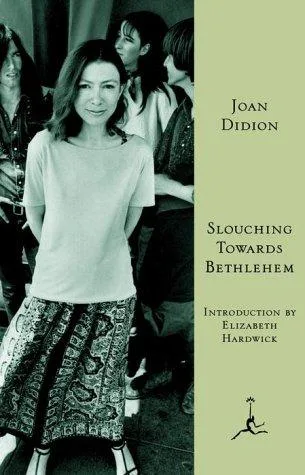
Slouching Toward Bethlehem
 71
71

Slouching Toward Bethlehem
Didion's 1968 collection arrives not with a bang, but with a precisely aimed, often chillingly quiet, observation. The essay 'Slouching Toward Bethlehem' itself, detailing the drug-addled scene in San Francisco's Haight-Ashbury, remains a masterclass in journalistic detachment, stripping away any romanticism to reveal a stark landscape of lost youth and manufactured rebellion. Didion’s particular strength lies in her ability to articulate a pervasive sense of unease, a feeling that the social fabric is fraying. However, the collection occasionally suffers from a certain emotional distance; while her prose is undeniably elegant, it can sometimes feel so controlled as to keep the reader at arm's length from the very human chaos she describes. The piece on the Black Panthers, for example, offers a sharp analysis but lacks the visceral impact one might expect from such a volatile subject. Nevertheless, *Slouching Toward Bethlehem* is a vital document of its time, offering a discomfitingly clear-eyed view of American society at a critical juncture.
📝 Description
71
Joan Didion's 1968 collection of essays chronicles the cultural fractures of late 1960s America.
Published in 1968, Joan Didion's *Slouching Toward Bethlehem* collects essays that dissect the social fabric of America during a period of rapid change. Didion turns her sharp eye toward the counterculture of San Francisco, the political landscape of Washington D.C., and the broader anxieties of a nation facing the Vietnam War and civil rights struggles. She avoids romanticizing rebellion, instead focusing on the alienation and disillusionment felt by individuals caught in societal shifts.
Her reporting on the Haight-Ashbury district, for example, stands apart from more celebratory accounts. Didion's prose cuts through sentimentality, revealing the fragmentation and desperation beneath the surface of the hippie movement. The essays collectively examine the tension between perception and reality, how people create meaning in a changing world, and the psychological effects of these transformations. The book's title, taken from W.B. Yeats, reflects a sense of a world losing its coherence, a theme Didion applies to the American experience.
While not strictly an esoteric text in the vein of occultism or mysticism, *Slouching Toward Bethlehem* engages with a form of cultural esotericism. Didion's essays examine the hidden currents and underlying psychological realities of a society seemingly in disarray. She probes the narratives people construct to understand their world, revealing their fragility when confronted with a disintegrating social order. Her work can be seen as an attempt to articulate the unspoken anxieties and the sense of a lost center that characterized the late 1960s, a period many felt was undergoing a fundamental, almost mystical, shift.
💡 Why Read This Book?
• Understand the cultural fragmentation of the 1960s through Didion's unvarnished lens, particularly her depiction of the Haight-Ashbury district, revealing the darker undercurrents beneath the counterculture. • Gain insight into Didion's signature analytical style, which dissects societal trends with a precision that contrasts with the era's more idealistic narratives, as seen in her observations on California. • Appreciate a literary approach to historical commentary that prioritizes observation over overt judgment, exemplified by her nuanced portrayal of political figures and movements of the late 1960s.
⭐ Reader Reviews
Honest opinions from readers who have explored this book.
❓ Frequently Asked Questions
What is the central theme of Joan Didion's 'Slouching Toward Bethlehem'?
The central theme is the fragmentation and disillusionment of American society in the late 1960s, particularly observed through the lens of the counterculture and political shifts.
Which specific location is famously described in the book?
The book famously describes the Haight-Ashbury district of San Francisco, the epicenter of the 1967 Summer of Love, through Didion's critical perspective.
When was 'Slouching Toward Bethlehem' originally published?
'Slouching Toward Bethlehem' was first published in 1968, capturing the turbulent atmosphere of the late 1960s.
What is the origin of the book's title?
The title is taken from the first line of the second stanza of W.B. Yeats' 1920 poem 'The Second Coming,' referencing a world in chaos.
How does Didion's writing style differ from typical accounts of the 1960s?
Didion's style is characterized by its detached, analytical, and unsentimental tone, contrasting with more celebratory or romanticized portrayals of the era's movements.
What makes this book relevant to esoteric studies?
Its exploration of societal breakdown, the search for meaning amidst chaos, and the psychological landscapes of its subjects offers a secular yet profound examination of existential currents.
🔮 Key Themes & Symbolism
Societal Fragmentation
Didion meticulously documents the fraying of social bonds and the erosion of shared meaning in late 1960s America. Her essays, particularly those focusing on the Haight-Ashbury scene, portray a range of individuals adrift, seeking connection or escape in a culture that offers few stable anchors. This fragmentation is not just social but psychological, reflecting a broader loss of narrative coherence in the face of rapid change. The collection implicitly questions the viability of communal ideals when individual realities diverge so sharply.
Perception vs. Reality
A recurring motif is the stark contrast between idealized perceptions of movements and their often grim realities. Didion dissects the romanticized image of the counterculture, revealing the underlying desperation, aimlessness, and even nihilism present in places like San Francisco. She interrogates how narratives are constructed, both by participants and observers, and how these narratives often obscure the more complex, less palatable truths of human behavior and societal conditions. The collection challenges readers to look beyond surface appearances.
The Search for Meaning
In an era marked by profound upheaval and the questioning of traditional structures, Didion's subjects are often depicted in a state of searching. Whether it’s for spiritual enlightenment, political revolution, or personal liberation, the essays highlight a collective, albeit often misguided, quest for meaning. Didion frames this search not as a heroic endeavor but as a often desperate scramble, underscoring the existential void many felt in the post-war era. The title itself points to a world whose traditional order has collapsed, leaving a vacuum.
Alienation and Dislocation
Didion's prose frequently evokes a sense of profound alienation. Her characters, and by extension the society she observes, often appear disconnected from themselves, from each other, and from any stable sense of place or purpose. This is particularly evident in her depictions of individuals caught between established societal norms and the allure of radical change. The essays capture a specific kind of modern malaise, where individual identity becomes unstable in the face of overwhelming cultural forces, contributing to a pervasive feeling of dislocation.
💬 Memorable Quotes
Direct passages from the work, attributed to the author.
“The center was not holding.”
— This iconic phrase, echoing Yeats, expresses the book's exploration of societal breakdown and the loss of traditional structures and unifying principles during a period of intense cultural flux.
“This is not a story I am telling. It is a story that is telling itself.”
— This interpretation of Didion's narrative stance highlights her journalistic approach, emphasizing observation and the unfolding of events rather than authorial imposition, allowing the raw reality of her subjects to speak for themselves.
“The people who were going to the Haight-Ashbury were the people who were looking for something.”
— This observation points to the underlying motivation driving many involved in the counterculture, framing their participation as a search for meaning, belonging, or escape from perceived societal failings.
💡 Key Ideas
Editorial paraphrase of the work's core concepts — not direct quotes.
We are all of us living in the same room, and the walls are closing in.
This paraphrased sentiment captures Didion's recurring theme of confinement and shared, inescapable societal pressures, suggesting a collective entrapment within the cultural and psychological range of the late 1960s.
We are all of us living in the same room, and the walls are closing in.
This paraphrased sentiment captures Didion's recurring theme of confinement and shared, inescapable societal pressures, suggesting a collective entrapment within the cultural and psychological range of the late 1960s.
🌙 Esoteric Significance
Tradition
While not explicitly aligned with a specific esoteric tradition, Didion's work engages with existential and psychological currents that resonate with Gnostic and Hermetic concerns about societal illusion and the search for authentic meaning. Her focus on the breakdown of social order and the individual's struggle to navigate a seemingly chaotic world touches upon themes of fallenness and the quest for gnosis, or inner knowledge, in a disoriented reality. She dissects the 'veils' of societal narratives, much like a mystic might examine illusory appearances.
Symbolism
The 'room' with 'closing walls' serves as a potent symbol of societal and psychological entrapment, a modern interpretation of a 'prison house' often found in esoteric thought. The Haight-Ashbury itself, while a literal place, becomes a symbol of a failed utopian experiment, representing the allure and subsequent collapse of collective spiritual or social quests. The titular phrase from Yeats' 'The Second Coming' acts as a primal symbol for a world spinning out of control, a common motif in apocalyptic and esoteric literature predicting cycles of dissolution and renewal.
Modern Relevance
Didion's examination of societal fragmentation, the construction of false narratives, and the pervasive sense of alienation continues to inform contemporary discussions on disinformation, cultural polarization, and psychological well-being. Thinkers and practitioners interested in critical theory, existential psychology, and the deconstruction of societal myths find her work foundational. Her sharp analysis of how meaning erodes in a rapidly changing world remains relevant for understanding contemporary spiritual and social disquiet.
👥 Who Should Read This Book
• Students of American cultural history and the 1960s counterculture seeking a non-idealized, critical perspective that goes beyond surface-level accounts. • Readers interested in literary journalism and essay writing who appreciate precise, analytical prose and a detached observational style. • Individuals exploring themes of societal fragmentation, existential searching, and the psychological impact of cultural upheaval in the late 20th century.
📜 Historical Context
First published in 1968, *Slouching Toward Bethlehem* emerged during a period of seismic cultural and political shifts in the United States. The Vietnam War raged, the Civil Rights Movement reached critical junctures, and the counterculture movement, particularly its manifestation in San Francisco's Haight-Ashbury, captured national attention. Didion's essays offered a stark counter-narrative to the often-romanticized portrayals of these phenomena. Her unflinching prose, marked by a detached, critical eye, contrasted with the more overtly ideological or celebratory accounts prevalent at the time. For instance, her depiction of the Haight-Ashbury scene eschewed the perceived utopianism, focusing instead on fragmentation and disillusionment, a perspective that generated significant discussion and debate. This work positioned Didion as a keen observer of American malaise, engaging with the era's anxieties in a way that distinguished her from many contemporaries, such as Tom Wolfe, who also chronicled the period but with a different stylistic approach.
📔 Journal Prompts
The closing walls of the room as a symbol of societal pressure.
The contrast between perceived rebellion and its underlying reality.
Didion's observational stance on the search for meaning.
The feeling of alienation in specific cultural settings.
The construction of narratives versus lived experience.
🗂️ Glossary
Haight-Ashbury
A neighborhood in San Francisco, California, famous as the center of the counterculture movement in the late 1960s, particularly associated with the Summer of Love in 1967.
Counterculture
A subculture whose values and norms of behavior differ substantially from those of mainstream society, often in opposition to it.
Fragmentation
The process or state of breaking into pieces; in a social context, it refers to the breakdown of shared values, norms, and social cohesion.
Disillusionment
A feeling of disappointment resulting from the discovery that something is not as good as one believed it to be.
Existential Malaise
A pervasive feeling of unease, anxiety, or lack of purpose stemming from fundamental questions about existence, freedom, and meaning.
Gnosticism
A complex set of religious and philosophical ideas and systems, originating in the first centuries CE, emphasizing spiritual knowledge (gnosis) for salvation.
Hermeticism
A religious, philosophical, and esoteric tradition based primarily upon writings attributed to Hermes Trismegistus, emphasizing the unity of all things and the pursuit of divine knowledge.
🔮 Readers Also Liked
Browse all →









More by Joan Didion
All books →
More Free Spiritual Development Books
View all →