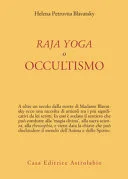
Raja yoga, o occultismo
 82
82

Raja yoga, o occultismo
Helena Petrovna Blavatsky’s Raja Yoga, o occultismo presents an ambitious synthesis of yogic philosophy and occult science, challenging conventional Western interpretations of Eastern practices. The work’s strength lies in its uncompromising intellectual rigor, pushing readers to confront the deeper metaphysical implications of yogic discipline. However, its dense prose and reliance on Theosophical terminology can present a significant barrier to entry for newcomers. A particularly illuminating section discusses the concept of the "lower manas" (lower mind) and its entanglement with the physical senses, illustrating the intricate psychological architecture Blavatsky posits. While occasionally opaque, the book remains a significant artifact for understanding the Theosophical perspective on spiritual development.
📝 Description
82
Helena Petrovna Blavatsky's 1981 "Raja Yoga, o occultismo" connects yogic philosophy to Theosophy.
This book examines Raja Yoga not just as physical or meditative practice, but as a complete system for spiritual development aligned with occult principles. Blavatsky details the connections between the human mind, consciousness, and the subtle dimensions of existence. It provides a structure for personal growth and understanding these higher planes. The work is aimed at dedicated students of esoteric subjects, especially those interested in the fusion of Eastern thought and Western occultism. It offers a more philosophical and detailed perspective on yoga than commonly found in popular wellness circles. Readers engaged with Theosophy, comparative religion, or the history of metaphysical ideas will discover substantial material for their studies.
The book presents complex yogic teachings in a way that is understandable for those already familiar with Blavatsky's Theosophical system. It discusses the nature of the astral body, various states of consciousness, and the final aim of spiritual unification. This edition revisits Blavatsky's original interpretations, situating them within the broader field of occult studies. It contrasts with more contemporary movements by maintaining a rigorous, philosophical, and traditionally oriented approach to occult sciences and Eastern mysticism. The text also addresses contemporary critiques from established religious and scientific viewpoints of Blavatsky's era.
Published in 1981, this work revisits Helena Petrovna Blavatsky's late 19th-century Theosophical interpretations of Raja Yoga. Emerging during a time of Western interest in Eastern spirituality, it grounds itself in Blavatsky's foundational movement. The book offers a more philosophically dense and traditionally informed perspective on occult sciences and Eastern mystical practices, distinct from the burgeoning New Age movement. It engages with the occult and metaphysical thought that characterized Blavatsky's era and her approach to comparative religion.
💡 Why Read This Book?
• Gain a Theosophical perspective on the true nature of Raja Yoga, moving beyond superficial physical postures to understand its spiritual and occult dimensions, as detailed in Blavatsky's foundational writings. • Understand the intricate interplay between consciousness, the subtle bodies (like the astral body), and the higher spiritual planes, concepts central to Blavatsky's metaphysical system. • Explore the philosophical underpinnings of yogic attainment, including the goal of uniting the individual consciousness with the Universal Soul, a core tenet presented in this work.
⭐ Reader Reviews
Honest opinions from readers who have explored this book.
❓ Frequently Asked Questions
What is the primary focus of Raja Yoga, o occultismo?
The book's primary focus is presenting Raja Yoga not just as physical or meditative practices, but as a profound spiritual and occult discipline for understanding higher consciousness and the subtle planes of existence, within the Theosophical framework.
Who was Helena Petrovna Blavatsky?
Helena Petrovna Blavatsky was a prominent figure in the late 19th century, co-founder of the Theosophical Society in 1875, and a prolific author on esoteric philosophy, occultism, and comparative religion.
Does this book offer practical yoga techniques?
While it discusses the principles behind yogic discipline, Raja Yoga, o occultismo is primarily a philosophical and esoteric treatise, rather than a practical guide for performing asanas or meditation exercises.
What is the relationship between Raja Yoga and occultism in this book?
The book posits that Raja Yoga, when understood esoterically, is a path to developing occult powers and achieving spiritual liberation by mastering the mind and understanding the hidden laws of nature.
Is this book suitable for beginners to yoga?
It is generally not recommended for absolute beginners to yoga. Its dense Theosophical language and complex metaphysical concepts are best suited for those already familiar with esoteric literature or Blavatsky's other works.
When was Raja Yoga, o occultismo first published?
While the original concepts stem from Blavatsky's teachings, this specific compilation or edition was first published in 1981, making it a later interpretation of her extensive writings.
🔮 Key Themes & Symbolism
The Occult Nature of Yoga
This work reinterprets Raja Yoga as a profound occult science, distinct from its popular physical or meditative manifestations. Blavatsky argues that true yogic attainment involves mastering the subtle bodies and psychic faculties, enabling the practitioner to perceive and interact with higher planes of existence. It explores how the disciplined mind, a core element of Raja Yoga, can unlock latent psychic powers and facilitate spiritual evolution, aligning the individual will with cosmic principles. This perspective places yoga firmly within the esoteric tradition, emphasizing its role in spiritual transformation and the acquisition of hidden knowledge.
Consciousness and the Subtle Body
A central theme is the exploration of consciousness and its relationship to the subtle human constitution, particularly the astral body. Blavatsky details how the physical body is merely a dense manifestation of subtler energetic forms. Through the practice of Raja Yoga, one learns to purify and control these subtle vehicles, leading to altered states of consciousness and expanded awareness. The book elucidates how these subtler aspects of being are crucial for understanding reincarnation, karma, and the ultimate journey of the soul beyond physical limitations, offering a detailed map of inner realities.
Spiritual Liberation as Union
The ultimate goal of Raja Yoga, as presented here, is spiritual liberation, conceptualized as the union of the individual consciousness (Atman) with the Universal Soul (Brahman). This is not an easy attainment but the culmination of rigorous self-discipline, ethical conduct, and profound philosophical understanding. The book outlines the stages of this journey, emphasizing the transcendence of personal ego and the illusory nature of the material world. It presents yoga as the path to realizing one's divine nature and achieving a state of cosmic consciousness, free from the cycle of rebirth.
Theosophical Interpretation of Eastern Doctrines
Raja Yoga, o occultismo is deeply embedded within the Theosophical framework established by Blavatsky. It synthesizes concepts from various Eastern traditions, particularly Hinduism and Buddhism, through a unique Western esoteric lens. The work often reframes traditional doctrines to align with Theosophical cosmology, including ideas about root races, cycles of time, and the hierarchy of spiritual beings. This perspective offers a distinctive interpretation of yogic philosophy, making it a key text for understanding the evolution of esoteric thought in the late 19th and early 20th centuries.
💬 Memorable Quotes
Direct passages from the work, attributed to the author.
“The true Raja Yoga is not a doctrine for the lazy or the ignorant.”
— This highlights Blavatsky's emphasis on Raja Yoga as a demanding spiritual discipline requiring significant intellectual effort and dedication, rather than passive contemplation or simple physical exercises.
“The mind is the great slayer of the real.”
— This conveys the idea that the ordinary, discursive mind, bound by sensory perception and ego, acts as a barrier to perceiving ultimate reality or truth. Yoga aims to transcend this limitation.
“The astral body is the vehicle of consciousness.”
— This asserts the importance of the astral body in the Theosophical view, presenting it as the essential medium through which consciousness operates and experiences the world beyond the physical.
“One must purify the lower manas to ascend.”
— This refers to the necessity of refining the lower, egoic mind (manas) and its attachments to the material world before one can achieve spiritual progress and connect with higher consciousness.
💡 Key Ideas
Editorial paraphrase of the work's core concepts — not direct quotes.
Liberation is the ultimate aim, the merging of the individual spark with the universal fire.
This paraphrases the core goal of yogic and esoteric paths: to achieve spiritual freedom by dissolving the illusion of separateness and realizing one's fundamental unity with the divine or cosmic consciousness.
🌙 Esoteric Significance
Tradition
This work is firmly rooted in the Theosophical tradition, established by H.P. Blavatsky herself. It synthesizes and reinterprets concepts from Hindu Vedanta, Yoga Sutras, and Buddhism through a Western esoteric lens, emphasizing a universal spiritual science. It departs from purely devotional or ascetic interpretations of yoga by framing it as a path to developing occult faculties and understanding cosmic laws, integral to Blavatsky’s broader metaphysical system.
Symbolism
Key symbols include the 'Lotus,' often representing the unfolding of spiritual consciousness and the interconnectedness of all planes of existence, and the 'Serpent,' symbolizing Kundalini energy and primordial wisdom. The concept of 'Dhyana' (meditation) is also central, not merely as a practice but as a state of being that allows access to higher spiritual knowledge and the dissolution of egoic boundaries.
Modern Relevance
Contemporary esoteric practitioners, particularly those within Theosophical study groups and related movements like Anthroposophy, continue to engage with Blavatsky's interpretations. Modern Western yoga practitioners seeking deeper philosophical and metaphysical context beyond the physical often turn to her works. Thinkers exploring comparative mysticism and the history of occultism also reference her synthesis of Eastern and Western esoteric thought.
👥 Who Should Read This Book
• Students of Theosophy seeking to understand H.P. Blavatsky's specific interpretation of yogic philosophy and its occult applications. • Comparative religion scholars interested in how Eastern spiritual traditions were synthesized and presented within Western esoteric movements of the late 19th and 20th centuries. • Advanced practitioners of meditation or yoga looking for a rigorous, philosophical framework that explores the deeper metaphysical implications of inner development.
📜 Historical Context
Published in 1981, Raja Yoga, o occultismo emerges from the enduring legacy of Helena Petrovna Blavatsky, the formidable co-founder of the Theosophical Society in 1875. The late 19th and early 20th centuries, Blavatsky's active period, were marked by intense intellectual ferment, with figures like Annie Besant and later C.W. Leadbeater significantly expanding upon her work. This era saw a Western fascination with Eastern religions, often filtered through esoteric interpretations. Blavatsky’s writings were a central to this movement, aiming to present a universal wisdom tradition while often drawing critique from both traditional religious scholars and emerging scientific rationalists. Her work competed for attention with other burgeoning occult and spiritual movements, but its philosophical depth and systematic approach offered a distinct alternative to more populist spiritual trends.
📔 Journal Prompts
The concept of the astral body and its role in consciousness.
Blavatsky's definition of true Raja Yoga versus common interpretations.
The relationship between the mind ('lower manas') and spiritual perception.
The ultimate goal of spiritual liberation as presented in the text.
The synthesis of Eastern doctrines within the Theosophical framework.
🗂️ Glossary
Raja Yoga
In this context, refers to the 'royal' or 'kingly' path of yoga, interpreted esoterically as a comprehensive system for spiritual development, mental discipline, and the attainment of occult knowledge, beyond mere physical postures.
Astral Body
A subtle, non-physical body composed of finer matter, believed to be the vehicle of consciousness, emotions, and desires, which can act independently of the physical body.
Manas
A Sanskrit term referring to the mind or intellect. Blavatsky often distinguishes between 'higher manas' (spiritual mind) and 'lower manas' (egoic, rational mind tied to sensory experience).
Theosophy
A spiritual philosophy founded by Helena Petrovna Blavatsky, aiming to reveal a universal wisdom underlying all religions and sciences, emphasizing the spiritual evolution of humanity and the cosmos.
Occultism
The study and practice of hidden or secret knowledge concerning the supernatural, mystical, or magical, often involving the belief in subtle energies, spiritual planes, and hidden laws of nature.
Dhyana
A Sanskrit term for meditation or contemplation, considered a key stage in Raja Yoga, leading to deeper states of consciousness and spiritual insight.
Universal Soul
In a Theosophical context, this refers to the absolute, infinite divine principle or consciousness from which all individual souls emanate and to which they ultimately seek to return.