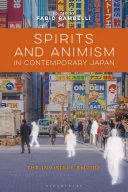
Spirits and Animism in Contemporary Japan
 80
80

Spirits and Animism in Contemporary Japan
Fabio Rambelli’s "Spirits and Animism in Contemporary Japan" offers a compelling survey of how spiritual entities permeate modern Japanese cultural products. Rambelli effectively demonstrates that discussions of ‘tama’ or ‘tamashii’ extend far beyond ancestral rites, finding vibrant expression in anime, manga, and literature. A particular strength lies in his analysis of how these popular forms engage with an 'invisible dimension of reality,' giving shape to otherwise abstract spiritual concepts. However, the work occasionally feels more descriptive than deeply analytical, particularly when cataloging examples without always pushing the theoretical implications further. The discussion around the diversification of animism, while present, could benefit from a more sustained engagement with specific theoretical frameworks. Despite this, the book provides an invaluable resource for understanding the persistent, evolving spiritual landscape of Japan.
📝 Description
80
Fabio Rambelli's 2012 book examines spirits and animism in contemporary Japan.
This volume looks at how spirits and animistic ideas are still present in Japan today. It goes further than just ancestor worship to show how modern culture, like manga, anime, and books, uses and changes the idea of the spiritual. The book studies the concept of 'tama' or 'tamashii,' which means spirit or soul, not only in religious settings but also as a lively part of art.
Academics interested in Japanese religion, cultural studies, and comparative animism will find this work useful. It is for people who want to understand how old beliefs connect with new media. Readers looking for the spiritual currents in Japan outside of organized religion will appreciate its detail. The book connects its analysis to Japan's long history of spirit veneration, including ancestor cults. It points out how this animistic view has grown a lot recently, appearing in many cultural forms beyond just religious rituals.
The book places its study within Japan's long history of spirit veneration, acknowledging the role of ancestor cults. It shows how this animistic framework has expanded, particularly in recent decades. This growth is seen in how more phenomena engage with invisible or spiritual aspects, moving from ritualistic uses to broader cultural representation. The work investigates the 'invisible dimension of reality' as depicted in art and literature, demonstrating a continuing, changing spiritual awareness in modern Japan.
💡 Why Read This Book?
• Gain insight into the concept of 'tama'/'tamashii' as presented in contemporary Japanese media, understanding its evolution beyond traditional ancestor cults, as detailed in the book's examination of manga and anime. • Learn about the diversification of Japanese animism, recognizing how phenomena like spirits and ghosts are explored in art and literature, moving beyond formal religious structures. • Understand the 'invisible dimension of reality' as a cultural construct in modern Japan, appreciating its representation in popular culture and its connection to historical spiritual beliefs.
⭐ Reader Reviews
Honest opinions from readers who have explored this book.
❓ Frequently Asked Questions
What is the difference between 'tama' and 'tamashii' as discussed in the book?
The book explores 'tama' and 'tamashii' as often interchangeable terms for spirit or soul in contemporary Japanese discourse. While 'tamashii' might carry a more profound or spiritual connotation, both terms are used to discuss the presence of spiritual entities and the invisible dimension of reality in various cultural contexts.
How does this book connect traditional ancestor cults to modern media?
Rambelli illustrates that while ancestor cults form a historical bedrock, contemporary media like manga and anime have expanded the realm of Japanese animism. These platforms actively represent and discuss spirits, ghosts, and other phenomena, diversifying the cultural understanding of spiritual presence.
What kind of 'spirits' are discussed in 'Spirits and Animism in Contemporary Japan'?
The book discusses a broad spectrum of spirits, including ancestral spirits, ghosts, and other entities that inhabit the 'invisible dimension of reality.' These are explored through their representation in various forms of Japanese popular culture, such as television shows, literature, and art.
Does the book focus on specific anime or manga titles?
Yes, the book draws upon numerous examples from contemporary Japanese popular culture, including manga, anime, and television shows, to illustrate its points about the prevalence and diversification of discussions surrounding spirits and animism.
What is the historical period covered by the book's analysis?
While acknowledging centuries of ancestor cults, the book primarily focuses on 'contemporary' Japanese culture, with particular attention to phenomena and representations that have expanded and diversified in recent decades, especially within popular media.
What does 'animism' mean in the context of this book?
In this context, animism refers to the belief that spirits inhabit natural phenomena and objects, and that these spiritual dimensions are actively present and discussed in contemporary Japanese society. The book examines how this belief system is expressed and evolved through culture.
🔮 Key Themes & Symbolism
The Ubiquitous Spirit
This theme centers on the pervasive presence of 'tama' or 'tamashii' within the Japanese cultural consciousness. It highlights how these concepts, often translated as spirit or soul, are not confined to religious dogma but actively permeate everyday life and artistic expression. The work demonstrates that the understanding and representation of spirits have broadened significantly beyond traditional ancestor veneration, finding new life in popular media, suggesting a persistent engagement with the spiritual dimension of existence.
Animism in Popular Culture
Here, the focus shifts to how contemporary Japanese media—manga, anime, television, literature, and art—serves as a vibrant arena for exploring animistic beliefs. The book argues that these cultural products are not mere entertainment but active participants in shaping and diversifying the discourse around spirits and the invisible. It examines how fictional narratives and visual representations give form to spectral entities and explore the interplay between the seen and unseen worlds.
Evolution of Spiritual Concepts
This theme addresses the dynamic nature of spiritual beliefs in Japan. It tracks how long-standing traditions, such as ancestor cults, have been reinterpreted and expanded upon in recent decades. The work illustrates a cultural adaptation where the concept of animism evolves, integrating new phenomena and representations that reflect a modern, yet deeply spiritual, society. It showcases a living tradition, not a static relic.
The Invisible Dimension
Central to the book is the exploration of the 'invisible dimension of reality' as a significant aspect of Japanese culture. This theme investigates how this unseen realm is conceptualized, represented, and discussed across various cultural forms. It suggests that an awareness of, and engagement with, this invisible world remains a potent force, influencing artistic creation and public discourse on spirituality and existence.
💬 Memorable Quotes
Direct passages from the work, attributed to the author.
“The prevalence of discussions and representations of 'spirits' (tama or tamashii) in contemporary Japanese culture.”
— This statement captures the core observation of the book: that spiritual concepts are not marginal but are a widespread and actively discussed aspect of modern Japanese life, especially evident in its artistic output.
“Ancestor cults have played a central role in Japanese culture and religion for many centuries.”
— This highlights the historical foundation upon which contemporary animistic expressions are built. It acknowledges the deep roots of spirit veneration in Japan, providing essential context for understanding its modern manifestations.
“In recent decades, however, other phenomena have expanded and diversified the field of Japanese animism.”
— This points to the book's focus on recent cultural shifts. It indicates that the study will move beyond historical religious practices to explore how new forms, particularly in media, have broadened the scope and understanding of animistic beliefs.
“Many manga, anime, TV shows, literature, and art works deal with spirits, ghosts, or with an invisible dimension of reality.”
— This serves as a concrete illustration of the book's central thesis, identifying specific cultural mediums where the exploration of spirits and the unseen is prevalent and actively engaging audiences.
“The work examines the 'invisible dimension of reality' as portrayed in art and literature.”
— This signifies the book's analytical approach, focusing on how abstract spiritual concepts are given concrete form and meaning within creative works, revealing cultural attitudes towards the supernatural and the unknown.
🌙 Esoteric Significance
Tradition
While rooted in the academic study of religion and anthropology, the work touches upon themes resonant with Shinto and East Asian esoteric traditions. It examines a worldview where spirits permeate reality, aligning with animistic perspectives found across various esoteric lineages. The book departs from Western Hermeticism or Kabbalah by focusing on a distinct cultural manifestation, yet it offers a lens through which to view universal animistic principles present in many esoteric systems.
Symbolism
The primary symbols explored are 'tama' and 'tamashii,' representing the spirit or soul. In an animistic context, these symbols signify the animating force within all things—people, ancestors, and potentially even objects or natural phenomena. The 'invisible dimension of reality' itself acts as a symbolic space, representing the unseen forces and entities that interact with the manifest world, a concept found in many esoteric cosmologies.
Modern Relevance
Contemporary thinkers and practitioners interested in the resurgence of animism, the spiritual in secular culture, and the impact of media on belief systems find this work highly relevant. It informs discussions within fields like comparative religion, media studies, and anthropology, offering a case study for how ancient spiritual concepts are reinterpreted and sustained through modern cultural narratives, potentially influencing contemporary pagan and occult discussions.
👥 Who Should Read This Book
['• Students of comparative religion and anthropology: Gain a nuanced understanding of animism as a living tradition, particularly within the Japanese context, by examining its expression in modern media.', '• Enthusiasts of Japanese popular culture (anime, manga): Discover how spiritual and animistic themes are deeply embedded within these genres, offering a critical perspective beyond entertainment value.', '• Scholars of cultural studies and media theory: Analyze the role of popular media in shaping and disseminating spiritual and metaphysical concepts in contemporary society.']
📜 Historical Context
Published in 2019, Fabio Rambelli's work emerged during a period of renewed academic interest in global animism and the intersection of religion and popular culture. It engaged with scholarship that challenged Western dichotomies between the sacred and secular, particularly within East Asian contexts. While not a direct debate with specific contemporaries in its immediate publication, the book implicitly responds to scholars like Graham Harvey, who championed broader definitions of animism, and Japanese studies scholars examining media's role in religious expression. The work arrived without major censorship controversies, but its focus on popular media as a site for spiritual discourse represented a departure from more traditional religious studies approaches, highlighting the evolving nature of belief and representation in post-war Japan.
📔 Journal Prompts
The concept of 'tama'/'tamashii' as depicted in contemporary media.
Representations of the 'invisible dimension of reality' in manga and anime.
The diversification of Japanese animism beyond ancestor cults.
The role of spirits in modern Japanese literature and art.
The relationship between traditional beliefs and popular culture in Japan.
🗂️ Glossary
Tama
A Japanese term often translated as spirit or soul. In the context of the book, it refers to the animating principle or entities that inhabit the 'invisible dimension of reality' within contemporary Japanese culture and media.
Tamashii
Another Japanese term for spirit or soul, frequently used interchangeably with 'tama.' It denotes the essence of a being or entity, central to discussions of animism and spiritual presence in Japan.
Animism
A belief system that posits spirits inhabit natural objects and phenomena, and that these spiritual forces are active in the world. The book explores its contemporary manifestations in Japan, extending beyond traditional religious practice.
Ancestor Cults
Religious practices centered on venerating deceased family members. These cults have historically played a significant role in Japanese culture and religion, forming a foundational element of spirit veneration discussed in the book.
Invisible Dimension of Reality
A concept referring to the unseen world of spirits, ghosts, and other supernatural phenomena. The book examines how this dimension is represented and explored in contemporary Japanese art, literature, and media.
Manga
Japanese comics or graphic novels. The book utilizes manga as a key medium through which contemporary discussions and representations of spirits and animism are explored and disseminated.
Anime
Japanese animation. Similar to manga, anime is examined as a significant cultural output that actively engages with themes of spirits, ghosts, and the spiritual realm in modern Japan.