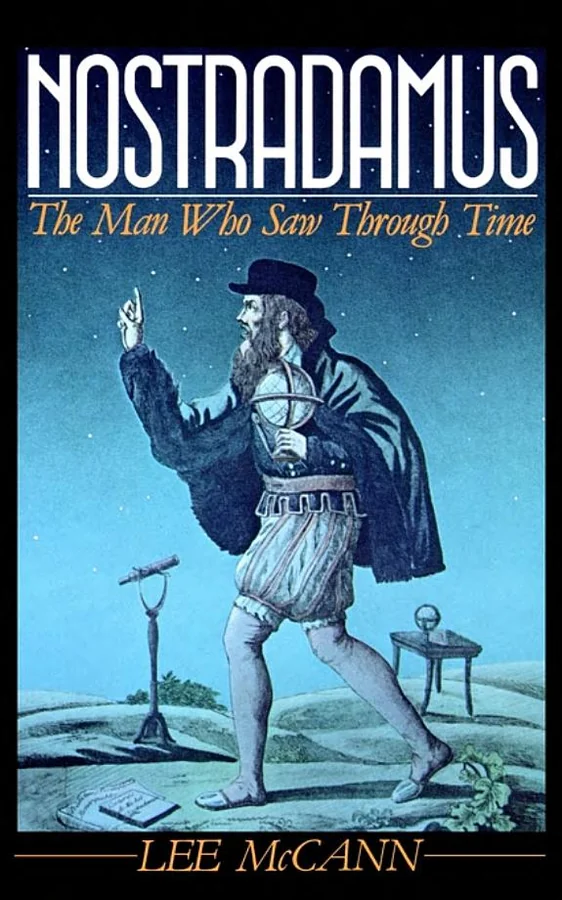
Nostradamus
 72
72

Nostradamus
Lee McCann's "Nostradamus" presents a compelling portrait of Michel de Nostradame, focusing on the integration of his scientific background as a physician with his later fame as a seer. The book's strength lies in its grounded approach, attempting to contextualize Nostradamus's abilities within the intellectual currents of the 16th century rather than simply cataloging predictions. McCann highlights the prophet's active, fulfilled life, suggesting a mind capable of both rigorous scientific inquiry and extraordinary foresight. A notable passage discusses the apothecary's medical practices during plague outbreaks, underscoring his practical engagement with life before his prophetic fame. However, the work occasionally leans into speculation regarding the future scientific validation of mental forces, a conjecture that, while intriguing, remains unsupported by the text's historical evidence. Despite this, McCann offers a well-researched biography that invites contemplation on the nature of genius and foresight. The book serves as a solid biographical study for those intrigued by historical figures who bridge science and the seemingly supernatural.
📝 Description
72
Lee McCann's 1982 biography examines Nostradamus not just as a seer but as a figure with unique mental faculties.
Lee McCann's biography of Michel de Nostradame, published in 1982, investigates the 16th-century French apothecary and alleged seer. The book details Nostradamus's life, his famous quatrains, and the persistent public interest in his predictions. McCann presents Nostradamus as an individual whose mental abilities might offer insights into future scientific discoveries concerning consciousness.
The work is suited for readers interested in the history of prophecy and esoteric thought. It appeals to those curious about the connections between science, history, and extraordinary human mental capabilities. The book provides an understanding of Nostradamus's life beyond popular myth, exploring the intellectual atmosphere of the 16th century.
McCann's biography was published in 1982, a time when interest in esoteric subjects was growing. This period saw increased engagement with mysticism and historical figures like Nostradamus. The book appeared during a trend of literature that sought to reconcile historical accounts with speculative interpretations of prophecy. This era followed the influence of figures like Frances Yates, who studied Renaissance esotericism, shaping the scholarly background for McCann's work.
💡 Why Read This Book?
• Gain insight into the life of Michel de Nostradame, understanding his dual role as a 16th-century physician and prophet, a perspective not often detailed in popular accounts of his quatrains. • Explore the concept of "mental forces" as presented by McCann, examining the author's early 1980s perspective on potential scientific discoveries related to foresight. • Understand the historical reception of Nostradamus's prophecies, learning how his predictions were viewed and interpreted during and after his lifetime.
⭐ Reader Reviews
Honest opinions from readers who have explored this book.
❓ Frequently Asked Questions
When was Lee McCann's book on Nostradamus first published?
Lee McCann's "Nostradamus" was first published in August 1982, offering a biographical exploration of the French prophet.
What was Nostradamus's profession before becoming known as a seer?
Before his fame as a seer, Michel de Nostradame was primarily known as an apothecary and a physician, practicing medicine in the 16th century.
Does the book present Nostradamus's predictions literally?
The book explores Nostradamus's life and the context of his quatrains, presenting them as a product of his unique genius and perspective, rather than a literal, universally accepted prophetic record.
What is the main argument of Lee McCann's book regarding Nostradamus's abilities?
McCann argues that Nostradamus possessed extraordinary mental faculties, suggesting that future scientific understanding of mental forces might one day explain abilities akin to his foresight.
What historical period does the book focus on?
The book primarily focuses on the life and times of Michel de Nostradame, who lived in the 16th century, and the historical context surrounding his predictions.
Is this book a collection of Nostradamus's quatrains?
While it discusses his quatrains, McCann's "Nostradamus" is a biographical work examining the life and purported abilities of the seer, not an exhaustive compilation of his prophecies.
🔮 Key Themes & Symbolism
The Physician-Seer
McCann's work examines the dual nature of Michel de Nostradame as both a practicing physician and a widely recognized seer. It posits that his scientific understanding of the human body and natural world informed, rather than contradicted, his prophetic endeavors. The book looks at his medical career, including his work during plague outbreaks, suggesting that his empirical approach to medicine provided a foundation for his later explorations into foresight and the potential of the human mind.
Mental Forces and Foresight
A central concept explored is the idea of 'mental forces' – a term McCann uses to describe the extraordinary perceptive and predictive capabilities attributed to Nostradamus. The author frames these abilities not as supernatural intervention but as latent potentials within the human psyche, which he suggests future scientific advancements might one day unlock and understand. This perspective positions Nostradamus as a precursor to potential future developments in consciousness studies.
The Quatrains' Context
The book addresses Nostradamus's famous 'quatrains' not in isolation but within the biographical and historical framework of his life. McCann's analysis aims to provide context for the creation of these cryptic verses, exploring the intellectual and cultural milieu of 16th-century France. The focus is on understanding the man behind the prophecies and how his life experiences and worldview shaped his unique predictive method.
Historical Reception and Legacy
McCann's biography touches upon the enduring fascination with Nostradamus and the continuous interpretation of his prophecies throughout history. It examines how his work has been perceived from his own time through to the modern era, highlighting the ongoing debate surrounding the accuracy and meaning of his predictions. The book contributes to the understanding of Nostradamus's lasting impact on popular culture and esoteric thought.
💬 Memorable Quotes
Direct passages from the work, attributed to the author.
“The rich, actively fulfilled life of the French prophet, Michel de Nostradame, is the story of genius not only in its rarest but its most modern form.”
— This opening statement frames Nostradamus as a figure of exceptional intellect whose life and abilities possess a relevance that transcends his historical era, hinting at a 'modern' quality in his genius.
“The work explores the apothecary's medical practices during plague outbreaks.”
— This highlights McCann's effort to ground Nostradamus's life in tangible historical reality, focusing on his professional duties as a physician in challenging circumstances before exploring his prophetic reputation.
“The book discusses the creation of 'quatrains' as a predictive system.”
— This points to the specific method Nostradamus employed for his prophecies, emphasizing the structured, albeit cryptic, nature of his prognostications as analyzed within McCann's biographical account.
“McCann presents Nostradamus as an individual whose unique mental faculties hold keys to understanding future scientific discoveries.”
— This interpretation focuses on the author's view of Nostradamus's mind as a subject of scientific inquiry, suggesting that his historical example could inform future understanding of human consciousness and its potential.
💡 Key Ideas
Editorial paraphrase of the work's core concepts — not direct quotes.
His ability foreshadowed a hope, now gaining a first hearing in this our day, that science may, in some not too remote tomorrow, discover principles of mental forces which will permit every man to realize within himself a reflection of the powers of Nostradamus.
This passage articulates McCann's core thesis: that Nostradamus's foresight might be explicable through future scientific discovery concerning latent human mental capacities, suggesting a potential for widespread development of such abilities.
🌙 Esoteric Significance
Tradition
McCann's work engages with the Hermetic and Renaissance esoteric traditions, which sought to synthesize natural philosophy, astrology, and divine knowledge. Nostradamus, with his background in medicine and astrology, fits squarely within this lineage. The book implicitly aligns with the Theosophical and New Age interpretations that emerged later, viewing Nostradamus as an exemplar of latent human potential and a precursor to a more scientifically understood form of foresight.
Symbolism
While not explicitly detailing complex symbolism, the book's focus on Nostradamus's "quatrains" points to the symbolic language he employed. These four-line verses, often allegorical and multi-layered, served as the primary medium for his prophecies. The act of prophecy itself, presented as a form of heightened perception or "mental force," can be seen as symbolic of humanity's potential to grasp deeper truths beyond the mundane, a theme resonant in many esoteric paths.
Modern Relevance
In contemporary esoteric circles, Nostradamus remains a figure of fascination, often invoked in discussions of predictive arts, historical cycles, and consciousness studies. McCann's early exploration of "mental forces" finds echoes in modern research into precognition and altered states of consciousness within fields like parapsychology and transpersonal psychology. His work provides a historical anchor for those seeking to understand the perceived scientific basis for intuitive and predictive abilities.
👥 Who Should Read This Book
• Students of Renaissance history and esotericism seeking biographical context for Michel de Nostradame beyond his prophetic fame. • Readers interested in the historical development of ideas about human potential and foresight, particularly the early 1980s perspective on "mental forces." • Individuals curious about the intersection of medicine, astrology, and prophecy in the 16th century, as explored through the life of a prominent historical figure.
📜 Historical Context
Published in 1982, Lee McCann's "Nostradamus" emerged during a period of significant popular and academic interest in esoteric history and prophecy. The late 20th century saw a resurgence in studies of Renaissance humanism and its mystical underpinnings, influenced by scholars like Frances Yates, who explored figures like Giordano Bruno and John Dee. McCann's work can be seen as contributing to this broader intellectual current, attempting to analyze Nostradamus not just as a predictor but as a product of his time. The era was also marked by a burgeoning interest in parapsychology and the potential for scientifically explaining phenomena previously relegated to the supernatural. While not a direct engagement, McCann's exploration of "mental forces" implicitly responded to contemporary debates about consciousness and extrasensory perception, contrasting with more purely historical or skeptical analyses of Nostradamus prevalent in academic circles. The book's approach of seeking a scientific basis for prophetic ability reflects a specific, optimistic scientific zeitgeist of the early 1980s.
📔 Journal Prompts
Nostradamus's life as a physician and apothecary during the 16th century.
The concept of "mental forces" as presented by McCann.
Your interpretation of a specific quatrain's potential meaning.
Reflecting on the balance between scientific inquiry and visionary insight.
The historical reception of prophetic figures like Nostradamus.
🗂️ Glossary
Michel de Nostradame
The 16th-century French apothecary, physician, and reputed seer, famous for his book of prophecies, Les Prophéties.
Quatrains
Four-line verses, the poetic form in which Nostradamus wrote his prophecies, known for their cryptic and often ambiguous language.
Apothecary
A historical term for a person who prepared and sold medicines and drugs; a pharmacist.
Mental Forces
A concept discussed by McCann, referring to extraordinary latent human perceptive or predictive abilities that the author suggests might be scientifically understood in the future.
16th Century France
The historical period and geographical location during which Michel de Nostradame lived and produced his works, a time of significant intellectual and social change in Europe.
Prophecy
The foretelling of future events, often attributed to divine inspiration or exceptional foresight, as associated with Nostradamus.
Renaissance Esotericism
Mystical, magical, and philosophical traditions prevalent in Europe during the Renaissance, often blending Hermeticism, Neoplatonism, and Kabbalah with natural philosophy.
This book appears in 2 collections
🔮 Readers Also Liked
Browse all →









From the “Prophecy” Collection
View all →


More Free Occult Philosophy Books
View all →