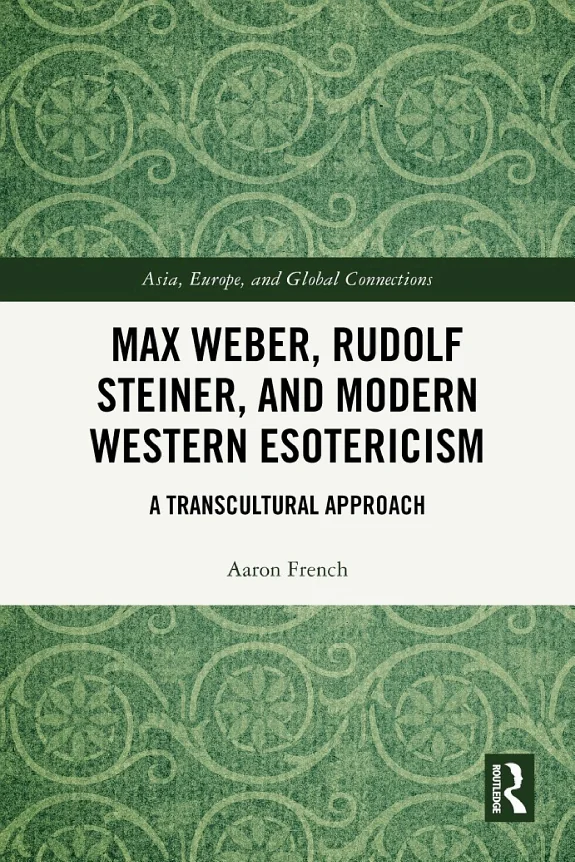
Max Weber, Rudolf Steiner, and Modern Western Esotericism
 79
79

Max Weber, Rudolf Steiner, and Modern Western Esotericism
Aaron French's comparative study of Max Weber and Rudolf Steiner offers a compelling re-evaluation of their intellectual proximity. The author astutely points out how both men, operating from vastly different premises—one a secular sociologist, the other an esoteric visionary—were nonetheless engaged in a dialogue, however indirect, with the profound societal shifts occurring in Europe around the turn of the 20th century. French's insistence on tracing the entwined histories, rather than merely juxtaposing their ideas, is the book's signal strength. A limitation, however, is the extensive reliance on secondary interpretations of Steiner, which occasionally obscures a direct engagement with his primary texts. The exploration of Steiner's concept of 'spiritual science' as a response to the perceived crisis of meaning in a rationalized world, as discussed in relation to Weber's sociology, provides a particularly illuminating passage. This work is a valuable, if dense, contribution to understanding the multifaceted nature of modernity.
📝 Description
79
Aaron French's 2023 book connects sociologist Max Weber and Anthroposopher Rudolf Steiner.
This book examines the intellectual connections between Max Weber and Rudolf Steiner, figures often seen as occupying separate intellectual worlds. French argues that their personal and intellectual lives were more intertwined than commonly understood, challenging the clear divisions between sociology and esotericism. The study places both men within the late 19th and early 20th century European context, a time of significant social change, industrialization, and a search for meaning.
Weber's analysis of rationalization and the 'iron cage' is contrasted with Steiner's vision of 'spiritual science' and human development. The book details how both responded to the perceived decline of traditional religion and the rise of secular modernity. Their differing approaches to social reform and the individual's role in a changing society are analyzed through specific concepts like Weber's 'disenchantment' and Steiner's 'spiritual science'.
This work situates Anthroposophy, founded by Rudolf Steiner, within the broader history of modern Western esotericism. It acknowledges Steiner's roots in Theosophy and his subsequent development of a distinct spiritual philosophy. The book engages with how esoteric movements like Anthroposophy responded to and interacted with mainstream intellectual and social currents, particularly during the early 20th century. It highlights the tension and overlap between esoteric spiritual impulses and the forces of secularization and rationalization.
💡 Why Read This Book?
• Gain a novel perspective on the sociology of modernity by understanding how thinkers like Max Weber and Rudolf Steiner, despite their divergent paths, responded to shared cultural anxieties of the late 19th century. • Explore the concept of 'spiritual science' as presented by Steiner, and its potential as an alternative framework for understanding consciousness and society beyond purely materialist explanations. • Understand the historical entanglement of esoteric movements with mainstream intellectual discourse, particularly how figures like Steiner engaged with the challenges of rationalization identified by Weber.
⭐ Reader Reviews
Honest opinions from readers who have explored this book.
❓ Frequently Asked Questions
How does Aaron French's book challenge traditional views of modernity?
The book challenges the definition of modernity by showing the unexpected intellectual and personal connections between Max Weber, a key sociologist, and Rudolf Steiner, the founder of Anthroposophy, suggesting their influences were more intertwined than previously understood.
What is the relationship between Max Weber and Rudolf Steiner discussed in the book?
The book argues that while distinct, Weber and Steiner's individual histories and intellectual projects are more entangled than commonly recognized. It explores how both grappled with the transformations of modern Western society from different perspectives.
What esoteric concepts are central to the discussion?
Key esoteric concepts include Rudolf Steiner's 'spiritual science' and his movement, Anthroposophy. The book examines these in contrast and comparison to Max Weber's sociological theories, particularly his ideas on rationalization and disenchantment.
Who is the intended audience for 'Max Weber, Rudolf Steiner, and Modern Western Esotericism'?
The book is for scholars and students of sociology, philosophy, religious studies, and Western esotericism who are interested in the intellectual history of modernity and the interplay between esoteric thought and mainstream academia.
When was this book first published?
The book 'Max Weber, Rudolf Steiner, and Modern Western Esotericism' by Aaron French was first published on March 10, 2025.
What specific sociological concept of Weber's is contrasted with Steiner's ideas?
The book specifically contrasts Weber's concept of the 'disenchantment of the world,' which describes the loss of magic and spiritual meaning in modern societies, with Steiner's development of 'spiritual science' as a means to re-enchant the world.
🔮 Key Themes & Symbolism
Disenchantment and Re-enchantment
The work examines how Max Weber's theory of the 'disenchantment of the world'—the loss of magical and spiritual explanations in modernity—is paralleled and countered by Rudolf Steiner's project of 'spiritual science.' Steiner sought to provide a framework for spiritual understanding that could re-enchant a world increasingly dominated by rationalization and scientific materialism. The book probes the shared concerns of both thinkers regarding the spiritual vacuum emerging in Western societies.
Intellectual Genealogy of Modernity
French reconfigures the intellectual history of modernity by demonstrating the unexpected entanglement of Weber and Steiner. This challenges the common perception of them as disparate figures. The study illustrates how their personal biographies and intellectual pursuits, though distinct, were responsive to similar societal pressures and transformations occurring in the late 19th and early 20th centuries.
Esotericism in Sociological Discourse
This book bridges the gap between esoteric traditions and academic sociology. It analyzes how a prominent esoteric movement, Anthroposophy, and its founder, Rudolf Steiner, can be understood in relation to core sociological concepts developed by Max Weber. It highlights the relevance of esoteric thought for understanding broader cultural and intellectual shifts.
Social Reform and Spiritual Vision
Both Weber and Steiner were deeply concerned with the future of society, though their proposed solutions differed vastly. Weber's work laid groundwork for understanding bureaucratic structures, while Steiner offered radical social reform ideas rooted in his spiritual cosmology, including the threefolding of the social organism. The book explores these divergent visions for social renewal.
💬 Memorable Quotes
Direct passages from the work, attributed to the author.
“The individual histories of these two thinkers are more entangled than previously recognized.”
— This statement expresses the book's central thesis, suggesting that the conventional separation of Max Weber and Rudolf Steiner in intellectual history is artificial and that a deeper analysis reveals shared concerns and influences.
“Weber's 'disenchantment of the world' and Steiner's 'spiritual science' as responses to modernity.”
— This highlights the core thematic contrast: Weber's observation of secularization and loss of meaning versus Steiner's proposed alternative of a scientifically verifiable spiritual path, both addressing the crisis of the modern era.
“The fin-de-siècle intellectual milieu and its impact on Weber and Steiner.”
— This points to the historical backdrop of the late 19th century, characterized by rapid change and spiritual questioning, as a crucial context for understanding the motivations and intellectual projects of both figures.
“Challenging previous definitions of modernity through comparative analysis.”
— This emphasizes the book's methodological approach and its aim to offer a revised understanding of the modern period by examining figures often considered on the periphery of mainstream thought alongside established intellectual giants.
“The sociologists' analysis of rationalization versus the esotericist's vision for social renewal.”
— This captures the fundamental divergence in their proposed solutions for society's ills, with Weber focusing on the mechanisms of rationalization and Steiner on a spiritually-informed social restructuring.
🌙 Esoteric Significance
Tradition
This work engages with the broader tradition of Western Esotericism, particularly its manifestation in Anthroposophy founded by Rudolf Steiner. It examines how Steiner's 'spiritual science' sought to create a modern, scientifically-grounded path to spiritual knowledge, departing from earlier Theosophical or occult frameworks while still addressing the need for a non-materialist worldview.
Symbolism
While the book focuses on intellectual comparison, it touches upon symbolic concepts inherent in Steiner's work. For example, the 'threefolding of the social organism' represents a symbolic ideal for societal organization, balancing spiritual, legal, and economic spheres. The 'Ahrimanic' and 'Luciferic' forces, central to Steiner's cosmology, can be seen as symbolic representations of intellectual materialism and spiritual pride, respectively, which both thinkers implicitly addressed.
Modern Relevance
Contemporary thinkers and practitioners in fields like integral theory, transpersonal psychology, and alternative education (e.g., Waldorf schools) continue to draw from Steiner's work. French's analysis provides a critical framework for understanding how these esoteric currents relate to broader philosophical and sociological discussions about the nature and future of Western society, offering insights for those seeking alternatives to purely materialistic paradigms.
👥 Who Should Read This Book
• Students of sociology and comparative intellectual history seeking to expand their understanding of modernity beyond secular frameworks. • Practitioners and scholars of Western Esotericism interested in the historical development and intellectual engagement of movements like Anthroposophy. • Researchers of early 20th-century European thought who are investigating the diverse responses to industrialization, secularization, and the perceived spiritual crisis of the era.
📜 Historical Context
Published in 2025, Aaron French's work engages with the intellectual ferment of the late 19th and early 20th centuries, a period marked by the rise of scientific materialism and a concurrent spiritual revival. Max Weber (1864–1920), a foundational figure in sociology, grappled with the consequences of rationalization and the 'disenchantment of the world.' Simultaneously, Rudolf Steiner (1861–1925), developing his system of Anthroposophy, offered a spiritual science as an antidote to this perceived spiritual void. The book implicitly addresses the intellectual currents of thinkers like Émile Durkheim and Henri Bergson, who also explored the nature of modern consciousness and society. While Weber's analyses became central to secular academic discourse, Steiner's esoteric path remained largely outside it, yet French posits a significant, under-explored connection between their responses to modernity's challenges.
📔 Journal Prompts
Max Weber's concept of the 'iron cage' and its relation to Rudolf Steiner's vision for social renewal.
The implications of Rudolf Steiner's 'spiritual science' for understanding contemporary societal challenges.
Reflecting on the 'disenchantment of the world' as described by Max Weber.
How might the entanglement of Weber and Steiner's ideas redefine our understanding of modernity?
The role of esoteric thought in shaping responses to intellectual and social transformations.
🗂️ Glossary
Anthroposophy
A spiritual philosophy founded by Rudolf Steiner, proposing a path of spiritual knowledge accessible through a scientifically rigorous, yet imaginative, approach to consciousness and the cosmos.
Disenchantment of the world
Max Weber's term for the process by which magic, superstition, and spiritual explanations are replaced by scientific, rational, and bureaucratic modes of thought and organization in modern society.
Spiritual Science
Rudolf Steiner's term for his method of investigating the spiritual world with a clarity and rigor analogous to natural science, aiming to provide verifiable knowledge of spiritual realities.
Waldorfpädagogik
An educational philosophy and pedagogical approach based on Rudolf Steiner's spiritual philosophy, emphasizing the holistic development of the child across intellectual, emotional, and physical domains.
Rationalization
In Weberian sociology, the increasing dominance of calculation, efficiency, and bureaucratic control in all spheres of social life, often leading to a loss of traditional values and individual freedom.
Fin-de-siècle
A French term referring to the end of the 19th century, a period characterized by significant social, cultural, and intellectual upheaval, artistic innovation, and anxieties about the future.
Social Reform
The movement to improve society through changes in social, economic, or political structures. Both Weber and Steiner engaged with ideas of social reform, albeit through vastly different conceptual frameworks.
This book appears in 1 collection
🔮 Readers Also Liked
Browse all →









From the “Western Esotericism” Collection
View all →






More Free Occult Philosophy Books
View all →