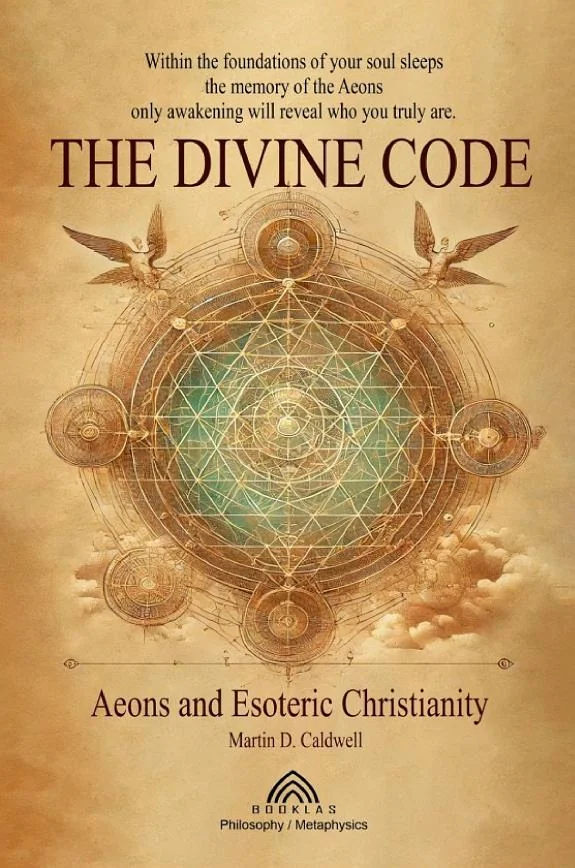
The Divine Code
 71
71

The Divine Code
Martin D. Caldwell and Luiz Santos's *The Divine Code* offers a compelling, albeit dense, exploration of a pre-Nicene Christian cosmology often obscured by centuries of dogma. The authors meticulously reconstruct a vision of the Aeons as active, intelligent forces, a concept central to certain Gnostic traditions but largely absent from mainstream Christianity. Their argument for a systematic suppression of this knowledge is persuasive, drawing connections between early Christian sects and their later marginalization. The work's strength lies in its detailed exposition of the Pleroma and its emanations, providing a framework for understanding spiritual realities beyond the material. However, the sheer density of the theological and cosmological concepts can be challenging, demanding significant reader engagement. A passage detailing the procession of Archons from the Demiurge, for instance, requires careful attention to grasp its implications for the soul's journey. While it offers a unique perspective, its accessibility might be limited for those not already immersed in esoteric studies. Caldwell and Santos present a significant scholarly contribution to the study of early Christian mysticism.
📝 Description
71
Martin D. Caldwell and Luiz Santos reinterpreted early Christian cosmology by focusing on the Aeons.
The Divine Code offers a new perspective on early Christian thought, centering on the concept of Aeons. The authors propose a hidden spiritual hierarchy, a system of cosmic intelligences that exists between the Pleroma, or spiritual fullness, and the material world. This framework, they argue, was deliberately obscured, leading to a disconnect from divine energies.
The book targets students of esoteric Christianity, Gnosticism, and comparative religion who question standard interpretations. It will appeal to those curious about consciousness, cosmic structures, and the evolution of religious ideas. Readers seeking to understand less common currents within spiritual history will find substantial material here.
Published in the early 21st century, this work engages with the renewed interest in Gnostic texts like the Nag Hammadi library. Caldwell and Santos examine scholarly discussions on Marcionism and Valentinian Gnosticism. They challenge established timelines and theological ideas that developed after the Council of Nicaea in 325 CE.
This book is situated within the Gnostic tradition, specifically re-examining early Christian esotericism. It engages with the rediscovery of texts from the Gnostic revival of the 20th century. The authors place their work in dialogue with historical debates concerning early Christian sects and their cosmology, particularly Valentinianism and Marcionism, seeking to understand pre-Nicene theological structures outside of later orthodox frameworks.
💡 Why Read This Book?
• Understand the concept of Aeons as distinct cosmic intelligences, a core tenet of certain early Christian esoteric traditions, offering a view of spiritual hierarchy absent in conventional theology. • Gain insight into the historical suppression of Gnostic ideas, examining how doctrines like those of Valentinus were sidelined after the Council of Nicaea in 325 CE. • Explore the Pleroma not merely as a divine realm but as an active, dynamic source of spiritual emanations, providing a richer understanding of the Godhead's relationship to creation.
⭐ Reader Reviews
Honest opinions from readers who have explored this book.
❓ Frequently Asked Questions
What is the central argument of The Divine Code regarding early Christianity?
The book argues that early Christianity possessed a sophisticated cosmology centered on the Aeons, a hierarchy of divine intelligences, which was later suppressed and replaced by simpler, more orthodox doctrines after the 4th century CE.
Who were the primary influences or schools of thought discussed in The Divine Code?
The work engages deeply with Gnostic traditions, particularly Valentinianism and Sethian Gnosticism, as well as other mystery schools that influenced early Christian thought before the establishment of Roman orthodoxy.
What is the Pleroma according to the book?
The Pleroma is described as the spiritual fullness or totality, the ultimate divine realm from which the Aeons emanate. It is presented as a living, active source of creation and consciousness.
How does The Divine Code explain the existence of evil or suffering?
The book posits that suffering arises from the disconnection from the divine hierarchy of Aeons and the limitations imposed by the material world, often governed by a less enlightened Demiurge.
Is The Divine Code a historical text or a modern interpretation?
While first published in 2025, the book is a modern scholarly and esoteric interpretation based on the study of ancient texts and traditions, aiming to reconstruct and elucidate lost cosmological frameworks.
What makes the concept of Aeons significant in this work?
The Aeons are presented as the active intermediaries between the unknowable Godhead and humanity, representing specific divine energies and intelligences crucial for spiritual understanding and salvation.
🔮 Key Themes & Symbolism
The Hierarchy of Aeons
The book posits a complex spiritual hierarchy of Aeons, divine emanations from the ultimate Godhead, which formed the core of early esoteric Christian understanding. These Aeons are not static concepts but active intelligences that structure reality and mediate between the spiritual and material realms. Caldwell and Santos detail their procession from the Pleroma, emphasizing their distinct roles and energies, contrasting sharply with later, simplified theological models that focused solely on a singular, transcendent God.
Suppression of Gnosis
A central theme is the systematic suppression of Gnostic teachings and the original cosmological frameworks of early Christianity. The authors argue that doctrines emphasizing the Aeons and a complex spiritual universe were deemed heretical and actively removed from the historical record by emerging orthodox authorities, particularly after the Council of Nicaea in 325 CE. This act of censorship, they contend, led to a profound loss of spiritual knowledge for subsequent generations.
The Pleroma and Material Creation
The Pleroma, the divine totality or spiritual fullness, is explored as the active source from which the Aeons emanate. The work contrasts this vibrant spiritual reality with the limitations and illusions of the material world, often seen as a lesser creation. The relationship between the Pleroma, the Aeons, and the Demiurge is examined to understand the origins of the cosmos and the human predicament within it.
Esoteric Christianity vs. Orthodoxy
The Divine Code differentiates between the esoteric currents of early Christianity, rich with Gnostic cosmology, and the later orthodox doctrines that solidified into mainstream religious structures. It highlights how concepts like the Aeons were foundational to many early believers but were ultimately sidelined in favor of a more centralized, hierarchical, and less pneumatically-attuned theology.
💬 Memorable Quotes
Direct passages from the work, attributed to the author.
“The Aeons are not mere abstract principles, but luminous intelligences governing the cosmic order.”
— This statement emphasizes the dynamic and active nature of the Aeons. They are presented as conscious forces, not just conceptual ideas, which actively shape and manage the universe, suggesting a living, intelligent design beyond simple material causation.
“Dogma arose to veil the intricate dance of divine emanations.”
— This interpretation suggests that established religious doctrines were created as a means to obscure or simplify the complex, multi-layered spiritual reality described in the book, thereby controlling access to deeper Gnosis.
“The silencing of the Aeonic teachings impoverished the soul's connection to the divine.”
— This highlights the negative consequences of the suppression of esoteric knowledge. By losing the understanding of the Aeons, humanity's direct access to and comprehension of the divine spiritual forces was diminished.
💡 Key Ideas
Editorial paraphrase of the work's core concepts — not direct quotes.
Matter is but a shadow cast by the true light of the Pleroma.
This paraphrase captures the Gnostic dualism present in the book. It suggests that the physical world is a lesser, perhaps illusory, reflection of a higher, spiritual reality, implying that true existence and consciousness reside in the spiritual area of the Pleroma.
The Demiurge's creation is a flawed echo of the Pleromatic perfection.
This paraphrased concept illustrates the book's view of the material world's origin. It suggests that the creator of our physical reality (the Demiurge) operated with incomplete knowledge or power, resulting in a universe that is an imperfect imitation of the divine ideal.
🌙 Esoteric Significance
Tradition
This work is deeply rooted in the Gnostic and Hermetic traditions, seeking to reconstruct and elucidate an esoteric understanding of early Christianity. It aligns with Gnostic cosmology by positing a Pleroma, Aeons, and a Demiurge, offering a view of spiritual reality that contrasts sharply with mainstream Abrahamic faiths. It departs from some Gnostic schools by focusing specifically on the potential for an 'esoteric Christian' interpretation, suggesting these ideas were not entirely alien to certain early followers of Christ, but rather a more profound layer of their belief system.
Symbolism
Key symbols include the 'Pleroma,' representing the infinite, unmanifest divine totality from which all existence emanates. The 'Aeons' are depicted as luminous, intelligent forces or divine beings within this Pleroma, forming a spiritual hierarchy. The 'Demiurge' represents the creator of the material world, often portrayed as ignorant or limited, responsible for the flawed nature of physical reality and the imprisonment of spirit within matter.
Modern Relevance
Contemporary esotericists, particularly those involved in Gnostic revival movements and Western mystery traditions, find *The Divine Code* a valuable resource. Thinkers exploring consciousness studies, alternative cosmologies, and comparative religion often reference its detailed exposition of Aeonic hierarchies. The work speaks to modern spiritual seekers who question orthodox religious narratives and are drawn to the idea of a hidden, more complex spiritual order governing existence.
👥 Who Should Read This Book
• Students of Gnosticism and early Christian heterodoxies seeking to understand the concept of Aeons beyond simplistic definitions. • Esoteric researchers interested in comparative cosmology and the historical suppression of spiritual knowledge, particularly concerning the Valentinian system. • Individuals exploring non-dualistic or emanationist philosophies who wish to connect these ideas to early mystical interpretations of Christianity.
📜 Historical Context
The early 21st century has witnessed a significant resurgence of interest in Gnostic texts, spurred by archaeological discoveries like the Nag Hammadi library in the mid-20th century. *The Divine Code* emerges within this milieu, engaging with scholarly debates that re-evaluate the diversity of early Christian thought. Authors Martin D. Caldwell and Luiz Santos position their work as a corrective to the historical narrative solidified by the Roman Empire's embrace of Christianity, particularly after the Council of Nicaea in 325 CE. They challenge the monolithic view of early Christianity by foregrounding the complex cosmological systems of groups like the Valentinians, whose intricate theories of Aeons and emanation were later deemed heretical. This book stands in dialogue with scholars who seek to understand the pre-Nicene era not as a prelude to orthodoxy, but as a vibrant range of competing spiritual philosophies, including various forms of Gnosticism and Hermeticism, which offered alternative pathways to salvation and understanding the divine.
📔 Journal Prompts
The procession of Aeons from the Pleroma: How does this hierarchy inform your understanding of divine intermediaries?
The concept of the Demiurge: Reflect on its role in creating a flawed material world.
The Pleroma as spiritual fullness: What does this totality represent in your spiritual framework?
Historical suppression of Gnosis: Consider the implications of lost spiritual knowledge.
The veil of matter: How does this concept influence your perception of reality?
🗂️ Glossary
Aeons
Divine emanations or spiritual beings originating from the Pleroma. They constitute a hierarchy of cosmic intelligences that govern the spiritual realms and mediate between the ultimate Godhead and creation.
Pleroma
The spiritual totality or divine fullness. It represents the ultimate, unmanifest source of all existence, from which the Aeons and the cosmos originate in Gnostic cosmology.
Demiurge
The creator of the material universe. In this context, the Demiurge is often depicted as an imperfect, ignorant, or lesser divine being responsible for the flawed nature of the physical world.
Gnosis
Spiritual knowledge or insight, particularly the direct, intuitive understanding of divine mysteries. It is often seen as the key to salvation and liberation from the material world.
Dogma
A principle or set of principles laid down by an authority as incontrovertibly true. In the context of the book, dogma often refers to orthodox beliefs that obscured or replaced more complex esoteric teachings.
Valentinianism
A prominent school of Gnosticism founded by Valentinus in the 2nd century CE, known for its elaborate cosmology involving Aeons, the Pleroma, and intricate mythologies of creation and salvation.
Council of Nicaea
A council of Christian bishops convened in Nicaea in 325 CE by the Roman Emperor Constantine I. It established key doctrines of Christianity, including the divinity of Christ, and marked a turning point in the suppression of Gnostic and other competing schools of thought.
This book appears in 1 collection
🔮 Readers Also Liked
Browse all →









From the “Esoteric Christianity” Collection
View all →


More Free Occult Philosophy Books
View all →