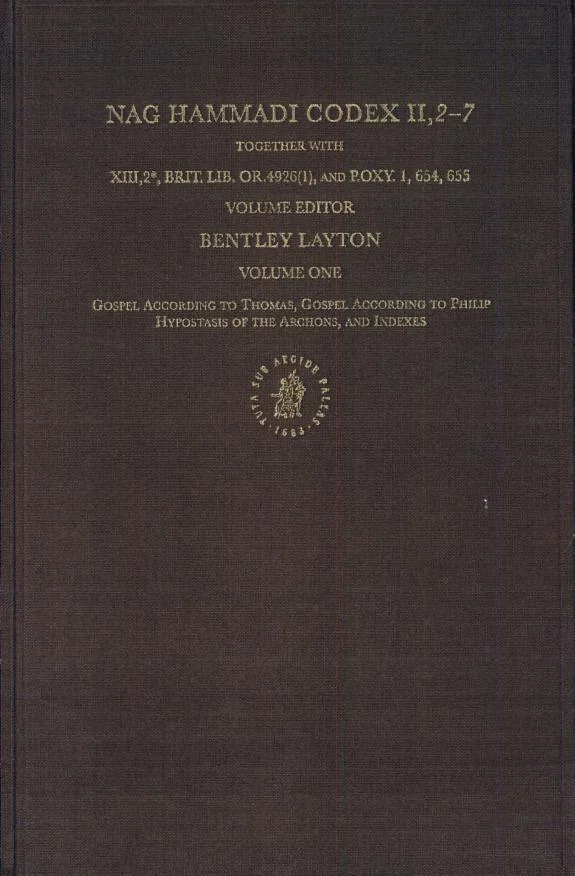
Nag Hammadi codex II, 2 - 7. 1. Gospel according to Thomas, gospel according to Philip, hypostasis of the archons, and indexes
 75
75

Nag Hammadi codex II, 2 - 7. 1. Gospel according to Thomas, gospel according to Philip, hypostasis of the archons, and indexes
Bentley Layton’s scholarly edition of Nag Hammadi Codex II is a rigorous academic undertaking, prioritizing textual fidelity and critical analysis. The inclusion of the Gospel of Thomas and the Gospel of Philip provides direct access to foundational Gnostic texts, bypassing centuries of interpretation and often hostile commentary. Layton’s meticulous translation and annotation are its greatest strengths, illuminating the intricate theological arguments and unique worldview presented. However, the dense scholarly apparatus, while invaluable for specialists, can present a steep barrier to entry for casual readers. The work's focus on textual accuracy means it offers less in the way of interpretive synthesis, leaving much of the deeper meaning for the reader to uncover through careful study. The 'Hypostasis of the Archons' section, with its portrayal of flawed celestial rulers, is particularly striking for its alien cosmology. This volume stands as an indispensable, albeit demanding, tool for serious Gnostic scholarship.
📝 Description
75
Bentley Layton's 1989 edition presents key Gnostic texts from Nag Hammadi Codex II.
This volume provides a scholarly edition of Nag Hammadi Codex II, sections 2 through 7. It includes the Gospel according to Thomas, the Gospel according to Philip, and the Hypostasis of the Archons. Bentley Layton prepared the edition, which features the original Coptic texts alongside extensive scholarly notes, introductions, and translations. The book is a significant resource for anyone studying early Christian deviations and the philosophical ideas that supported them.
Its discovery near Nag Hammadi, Egypt, in 1945, yielded a vital collection of Gnostic writings. These texts, dating to the 3rd and 4th centuries CE, offer a contrast to the orthodox Christian literature that later dominated. They reflect a time of intense theological discussion and varied interpretations of Christian teachings. This edition situates these works within the wider context of early Christian thought.
The texts within Nag Hammadi Codex II are central to understanding Gnosticism, a diverse set of religious movements in the early centuries CE. Gnosticism often emphasized a hidden knowledge (gnosis) as the means of salvation. These writings explore concepts like a flawed creation, the struggle against oppressive cosmic powers (the Archons), and the revelation of true divinity. They present a vision of spiritual liberation achieved through understanding one's divine origin and escaping the material world.
💡 Why Read This Book?
• Gain direct access to the Gospel of Thomas's unique sayings of Jesus, offering a perspective on early Christology that diverges significantly from the canonical Gospels, as presented in this 1989 edition. • Understand the Gnostic creation narrative in the 'Hypostasis of the Archons,' which features the Archons as flawed cosmic powers, providing insight into early dualistic cosmologies. • Explore the Gospel of Philip's complex Christology and soteriology, including its intricate symbolism and esoteric interpretations of sacraments and spiritual ascent.
⭐ Reader Reviews
Honest opinions from readers who have explored this book.
❓ Frequently Asked Questions
When were the Nag Hammadi codices, including Codex II, discovered?
The Nag Hammadi codices, a collection of early Christian and Gnostic texts, were discovered in 1945 near the town of Nag Hammadi in Upper Egypt, providing invaluable primary source material.
What is the primary language of the texts in Nag Hammadi Codex II?
The texts within Nag Hammadi Codex II, such as the Gospel of Thomas and the Gospel of Philip, are written in Coptic, an ancient Egyptian language that was the last stage of that language's development.
Who is Bentley Layton and why is his edition significant?
Bentley Layton is a prominent scholar of Gnosticism and early Christianity. His 1989 edition is significant for its scholarly rigor, providing critical apparatus and translations of these key Gnostic texts.
What distinguishes the Gospel of Thomas from the New Testament Gospels?
The Gospel of Thomas is a collection of sayings attributed to Jesus, emphasizing inner knowledge and spiritual gnosis, rather than the narrative and theological focus found in the canonical Gospels like Matthew or John.
What is the 'Hypostasis of the Archons' about?
The 'Hypostasis of the Archons' (The Reality of the Rulers) is a Gnostic text that describes a creation myth where flawed cosmic rulers, the Archons, attempt to control humanity, contrasting with a divine spark within.
Are these texts considered orthodox Christian writings?
No, the texts in Nag Hammadi Codex II, particularly the Gnostic gospels, are considered heterodox or Gnostic, representing a diverse range of early Christian beliefs that differed from the developing mainstream orthodoxy.
🔮 Key Themes & Symbolism
The Sophia Mythos
The codex explores intricate cosmogonies, notably within texts like the 'Hypostasis of the Archons.' These narratives often detail the fall of a divine emanation, Sophia (Wisdom), whose imperfect creation leads to the material world and the dominion of lower cosmic powers, the Archons. This theme highlights a Gnostic preoccupation with tracing the origins of suffering and ignorance back to a primordial divine disruption, setting up the necessity for gnosis as a means of escape.
The Nature of Jesus' Teachings
The Gospel of Thomas presents Jesus not primarily as a divine redeemer in the traditional sense, but as a revealer of hidden knowledge. His sayings focus on the Kingdom of God as an internal state, the importance of self-knowledge, and the realization of one's divine potential. This interpretation challenges orthodox Christology by emphasizing esoteric understanding over faith in his atoning sacrifice, positioning Jesus as a guide to gnosis.
Dualism and the Material World
A pervasive theme is the sharp distinction between the spiritual realm and the material world, which is often viewed as a prison or illusion created by ignorant or malevolent forces. The 'Hypostasis of the Archons' explicitly details the malevolent influence of the Archons, who seek to keep humanity enslaved to the material. The path to liberation, therefore, involves recognizing this illusory nature and awakening to one's true, divine origin.
Gnosis as Salvation
Salvation in these texts is achieved not through faith or good works alone, but through 'gnosis'—direct, intuitive knowledge of the divine and one's own true nature. The Gospel of Thomas, in particular, suggests that understanding these esoteric sayings leads to liberation from the cycles of reincarnation and the ignorance imposed by the material cosmos and its rulers. This knowledge is often depicted as a rediscovery of what was lost or forgotten.
💬 Memorable Quotes
Direct passages from the work, attributed to the author.
“Jesus said, 'Know what is before your face, and what is hidden from you will be revealed to you.'”
— This saying from the Gospel of Thomas underscores the Gnostic emphasis on direct perception and inner awareness. It suggests that true revelation comes not from external dogma but from understanding the immediate reality of one's own consciousness and spiritual potential.
“The Archons created man, and the Archons' son is the one who will die.”
— Found in the 'Hypostasis of the Archons,' this statement reflects a radical Gnostic cosmology. It posits that humanity's origin is tied to flawed cosmic rulers, and that the earthly, material existence defined by these rulers is inherently mortal and illusory, distinct from the immortal spiritual self.
“The kingdom of the Father is not here or there, but it is spread out upon the earth and people do not see it.”
— This concept from the Gospel of Thomas challenges the notion of the divine as an external, geographically located entity. It proposes that the spiritual realm, the Kingdom, is immanent and accessible through inner perception, yet veiled from those who do not possess the requisite gnosis.
“The Gospel of Philip speaks of the 'bridal chamber' as a mystical union.”
— This refers to a central sacrament or spiritual state in the Gospel of Philip, representing the divine union of the spiritual self with Christ or the Pleroma, leading to spiritual rebirth and integration.
“They do not know from where they came or where they are going.”
— This description, often applied to humanity by the Gnostics, highlights the core problem addressed by gnosis: a state of ignorance regarding one's divine origin and ultimate spiritual destiny, trapped within the material cosmos.
🌙 Esoteric Significance
Tradition
This work is a core part of Gnostic studies within the broader esoteric traditions. Gnosticism, characterized by its emphasis on spiritual knowledge (gnosis) for salvation, posits a complex cosmology involving a transcendent God, a fallen divine emanation (Sophia), and malevolent intermediary beings (Archons) who rule the material world. Nag Hammadi Codex II directly transmits foundational texts that articulate these ideas, positioning Gnosticism as a distinct spiritual path seeking liberation from material entrapment.
Symbolism
Key symbols include the 'Archons,' representing the forces of ignorance and material bondage, often depicted as serpents or flawed creators. The 'bridal chamber' in the Gospel of Philip symbolizes the sacred union of the spiritual self with the divine, a mystical integration leading to rebirth. Light and darkness are fundamental motifs, distinguishing the spiritual area of the Pleroma from the shadowy material existence overseen by the Archons.
Modern Relevance
Contemporary esoteric thinkers and practitioners, particularly those within modern Gnostic revivals and certain strands of New Age spirituality, draw heavily on the cosmologies and soteriologies presented in these texts. The emphasis on immanent divinity, personal gnosis, and liberation from societal or material constraints continues to find resonance. Figures exploring consciousness studies and alternative spiritualities often reference these ancient texts for their radical perspectives on reality and the human condition.
👥 Who Should Read This Book
• Scholars of early Christianity and Gnosticism: To access primary source material with critical scholarly apparatus, essential for academic research and understanding theological development. • Students of comparative religion: To explore the diverse beliefs and practices present in the early centuries CE, offering a counter-narrative to dominant orthodoxies. • Esoteric practitioners and seekers: To engage directly with foundational Gnostic texts that emphasize inner knowledge, spiritual liberation, and alternative cosmologies.
📜 Historical Context
The discovery of the Nag Hammadi library in 1945, including Codex II, was a watershed moment for understanding early Christianity, particularly its Gnostic streams. These texts, mostly dating from the 3rd and 4th centuries CE, offered direct access to writings previously known only through the condemnations of Church Fathers like Irenaeus. They emerged from a milieu of intense intellectual ferment, where diverse interpretations of Jesus' teachings flourished, contrasting sharply with the emerging orthodox doctrines. Scholars like Elaine Pagels, in her influential works from the late 1970s onwards, brought these texts to wider academic and public attention, highlighting their significance in understanding early Christian diversity and the philosophical dialogues of the era. The Coptic translations, likely made from Greek originals, reveal a vibrant intellectual landscape where Gnostic ideas interacted with Neoplatonism and other Hellenistic philosophies.
📔 Journal Prompts
Reflect on the concept of 'gnosis' as presented in the Gospel of Thomas.
Consider the role of the Archons as described in the 'Hypostasis of the Archons.'
Analyze the symbolism of the 'bridal chamber' in the Gospel of Philip.
What does the emphasis on internal knowledge suggest about the nature of spiritual authority?
Compare the portrayal of Jesus in the Gospel of Thomas with canonical depictions.
🗂️ Glossary
Gnosis
A Greek term meaning 'knowledge,' central to Gnosticism. It refers to intuitive, salvific knowledge of the divine and one's true spiritual nature, distinct from empirical or intellectual knowledge.
Archons
In Gnostic cosmology, these are malevolent or ignorant cosmic rulers who govern the material world and seek to trap human souls in ignorance and illusion.
Pleroma
The divine totality or fullness of God in Gnostic thought, comprising all the aeons or divine emanations emanating from the supreme, unknowable God.
Aeon
A divine being or power emanating from the supreme God in Gnostic cosmology. Pairs of aeons, male and female, constitute the Pleroma.
Coptic
The final stage of the ancient Egyptian language, written using a modified Greek alphabet. Many Gnostic texts were translated into Coptic.
Sayings Gospel
A genre of text, exemplified by the Gospel of Thomas, that primarily consists of sayings attributed to Jesus, often without narrative context.
Heterodox
Beliefs or practices that deviate from or contradict established or orthodox doctrines, particularly within a religious context.
This book appears in 1 collection
🔮 Readers Also Liked
Browse all →







From the “Gnosticism” Collection
View all →





More Free Sacred Texts & Gnosticism Books
View all →