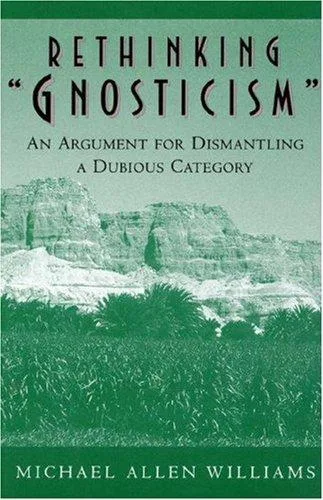
Rethinking "Gnosticism"
 83
83

Rethinking "Gnosticism"
Michael Allen Williams’s "Rethinking 'Gnosticism'" is a necessary corrective, though its implications can feel somewhat stark for those invested in the traditional picture. Williams methodically dismantles the notion of a singular "Gnosticism," arguing persuasively that the term functions more as a convenient academic construct than a historically accurate descriptor of a unified movement. His examination of how scholars, beginning in the late 19th and early 20th centuries, synthesized disparate materials into this cohesive category is particularly sharp. He rightly points out the danger of imposing a monolithic identity onto a genuinely diverse set of beliefs and practices flourishing in late antiquity. A limitation, however, is that in deconstructing the category, the book offers less in terms of alternative frameworks for understanding these complex early traditions, leaving the reader with a critical diagnosis but a less detailed prescription. The work strongly questions the reception of figures and ideas that have often been retroactively labeled "Gnostic." Ultimately, Williams provides a vital, if challenging, scholarly intervention that forces a critical look at received wisdom in the study of ancient religions.
📝 Description
83
In 1999, Michael Allen Williams questioned the established category of "Gnosticism."
Michael Allen Williams's "Rethinking 'Gnosticism'" scrutinizes the common scholarly approach to ancient religious movements. Published in 1999, the book contends that the label "Gnosticism" has been applied too broadly. This oversimplification, Williams argues, masks the true diversity and internal contradictions present in late antique religious groups. He posits that the unified image of "Gnosticism"—often depicted as a singular sect opposing dominant religions—is a modern invention, not a faithful historical portrayal.
Williams's work challenges readers to consider how academic categories shape our understanding of historical data. It is particularly relevant for students and scholars of religious history, comparative mythology, and the evolution of esoteric traditions. The book encourages a more precise method for examining ancient religious phenomena, moving beyond potentially anachronistic generalizations.
Williams's critique emerged as scholarship on "Gnosticism" was heavily influenced by discoveries like the Nag Hammadi library and interpretations by scholars such as Hans Jonas. These views often emphasized a cohesive "Gnostic" worldview. Williams's book acts as a counterpoint, questioning the validity of broad labels. It aligns with later academic trends that highlight fragmentation and local variations within ancient religious landscapes, urging a more careful distinction between historical reality and scholarly categorization.
💡 Why Read This Book?
• Gain a critical perspective on the term "Gnosticism," understanding how the category itself was constructed by scholars, as detailed in the book's analysis of late antiquity's religious landscape. • Learn to identify the historical forces and intellectual currents, particularly from the late 19th century, that led to the widespread adoption of the "Gnosticism" label, as explored by Williams. • Develop a more nuanced approach to studying ancient religious diversity, recognizing the limitations of monolithic labels when examining groups from the second and third centuries CE.
⭐ Reader Reviews
Honest opinions from readers who have explored this book.
❓ Frequently Asked Questions
What is the main argument of Michael Allen Williams's 'Rethinking "Gnosticism"'?
The book's central thesis is that "Gnosticism" is a problematic and oversimplified academic category. Williams argues it wrongly suggests a monolithic religious movement in late antiquity, obscuring the actual diversity of beliefs and practices.
When was 'Rethinking "Gnosticism"' first published?
Michael Allen Williams's influential work 'Rethinking "Gnosticism"' was first published on April 12, 1999.
Who is Michael Allen Williams?
Michael Allen Williams is a scholar known for his critical work on the study of "Gnosticism" and ancient religions, challenging established categories and methodologies.
What historical period does 'Rethinking "Gnosticism"' primarily address?
The book primarily addresses the religious landscape of late antiquity, focusing on the second and third centuries CE, a period often broadly labeled as "Gnostic."
What does Williams suggest about the term 'Gnosticism'?
Williams suggests the term "Gnosticism" is a modern scholarly construct that imposes a false unity on diverse ancient religious expressions, potentially misrepresenting their historical reality.
What academic fields benefit from reading 'Rethinking "Gnosticism"'?
Fields such as religious studies, comparative mythology, early Christian history, ancient Judaism, and Jungian theory benefit from this work's critical examination of categorization.
🔮 Key Themes & Symbolism
The "Gnosticism" Construct
This theme dissects the scholarly invention of "Gnosticism" as a unified movement. Williams argues that the term, popular since the late 19th century and amplified by discoveries like the Nag Hammadi library, simplifies a complex reality. He illustrates how the desire for a distinct "heretical" counterpoint to early Christianity led scholars to group disparate texts and ideas under this single, misleading banner, obscuring the actual diversity of beliefs in late antiquity.
Diversity in Late Antiquity
Williams emphasizes the heterogeneity of religious thought and practice in the Roman Empire during the second and third centuries CE. Rather than a single "Gnostic" rebellion, he highlights a spectrum of beliefs that defy easy categorization. This includes various interpretations of creation, divine figures, and salvation that did not necessarily cohere into a single, recognizable system, challenging the notion of a unified "Gnostic" opposition.
Scholarly Methodology Critique
A core focus is the critique of academic methods used to study ancient religions. Williams questions the tendency to impose modern conceptual frameworks onto historical data, leading to anachronistic interpretations. He calls for greater methodological rigor, urging scholars to engage with primary sources more critically and to be aware of how their own historical and cultural biases shape their understanding of the past.
Creation Mythology
The book implicitly engages with creation myths prevalent in antiquity, particularly those that deviate from orthodox accounts. By challenging the "Gnostic" label, Williams prompts a re-examination of these diverse cosmogonies. He suggests that rather than seeing them as part of a singular "Gnostic" cosmology, they should be understood within their specific contexts, reflecting a variety of attempts to explain the origin of the material world and humanity's place within it.
💬 Memorable Quotes
Direct passages from the work, attributed to the author.
“The term 'Gnosticism' often connotes a single rebellious movement against the prevailing religions of late antiquity.”
— This highlights the popular, yet flawed, perception that "Gnosticism" was a unified opposition. Williams uses this common understanding as his starting point to deconstruct the category itself.
“The monolithic impression of 'Gnosticism' gives a false impression of a singular religious phenomenon.”
— This emphasizes Williams's core critique – that the academic and popular understanding of "Gnosticism" as a unified movement is misleading and obscures historical complexity.
“Scholarly work on creation mythology, Jungian theory, and 'secret teachings' has often relied on the term 'Gnosticism'.”
— This points to the broad influence and application of the "Gnosticism" label across various academic disciplines and esoteric interests, underscoring why rethinking it is important.
“Williams challenges the ways the category of ancient 'Gnosticism' has been constructed.”
— This concise statement expresses the book's critical stance, focusing on the artificiality and problematic nature of the scholarly and popular construct of "Gnosticism."
💡 Key Ideas
Editorial paraphrase of the work's core concepts — not direct quotes.
The category of ancient 'Gnosticism' faces challenges regarding its validity and application.
This paraphrased concept captures the essence of Williams's central argument: that the academic label "Gnosticism" is not a reliable or accurate descriptor of historical reality.
🌙 Esoteric Significance
Tradition
While not strictly a work *within* an esoteric tradition, Williams's book critically examines the category often used to define a significant stream of Western esotericism: Gnosticism. It forces a re-evaluation of the source materials and scholarly interpretations that have shaped the esoteric understanding of "gnosis" and its associated mythologies, traditions, and practices.
Symbolism
The book's focus is primarily on the category itself, rather than specific symbols. However, by questioning the unified "Gnostic" label, it indirectly affects how symbols associated with Gnosticism—such as the Archons, the Demiurge, or the concept of Sophia—are understood. It encourages viewing these not as universal Gnostic tenets but as elements within diverse, context-specific mythologies.
Modern Relevance
Contemporary esoteric scholars and practitioners often engage with Williams's critique. His work provides a vital academic counterpoint to romanticized or overly systematized views of Gnosticism. Thinkers interested in the historical accuracy of esoteric traditions, comparative mythology, and the evolution of religious thought continue to draw upon his arguments for a more nuanced historical perspective.
👥 Who Should Read This Book
• Scholars of Religious Studies and Ancient History: Those researching early Christianity, Hellenistic religions, or the history of ideas will gain a critical tool for analyzing established categories and primary sources. • Students of Esotericism: Individuals exploring the historical roots of Western esoteric traditions will benefit from understanding the scholarly debate surrounding "Gnosticism." • Comparative Mythology Enthusiasts: Readers interested in creation myths and diverse cosmologies will find a valuable perspective that challenges monolithic interpretations of ancient religious narratives.
📜 Historical Context
Michael Allen Williams's "Rethinking 'Gnosticism'" emerged in 1999, a period when the study of ancient religions was grappling with the implications of the Nag Hammadi library, discovered in 1945. Scholars like Hans Jonas had already established influential frameworks, often presenting "Gnosticism" as a distinct dualistic worldview opposing the material cosmos and orthodox Christianity. Williams’s work directly challenged this established consensus, questioning the very coherence of the "Gnostic" category. He argued that the monolithic view, prevalent in the scholarship of figures like Jonas and Elaine Pagels, obscured the genuine diversity of religious expressions in the second and third centuries CE. The reception of his work contributed to a broader scholarly trend toward emphasizing fragmentation and local variation over unified movements, pushing back against the tendency to create overarching categories for complex historical phenomena.
📔 Journal Prompts
The scholarly category of "Gnosticism" as a monolithic entity.
The diversity of beliefs in late antiquity beyond the "Gnosticism" label.
The influence of the Nag Hammadi library discoveries on religious studies.
The construction of academic categories in the study of ancient religions.
The relationship between creation mythology and early religious movements.
🗂️ Glossary
Gnosticism
A broad and often debated term used to describe a range of religious and philosophical movements in late antiquity, typically characterized by an emphasis on spiritual knowledge (gnosis) for salvation.
Late Antiquity
The historical period generally spanning from the 3rd to the 8th century CE, marking the transition from the classical era to the Middle Ages, characterized by significant religious and cultural shifts.
Monolithic
Formed of a single large block or stone; used metaphorically to describe something that is uniform, powerful, and undifferentiated.
Nag Hammadi Library
A collection of thirteen Coptic and ancient Egyptian documents discovered near the town of Nag Hammadi in 1945, containing a number of early Christian texts, some of which are considered "Gnostic."
Dualism
The belief that reality is composed of two fundamental, often opposing, principles (e.g., good and evil, spirit and matter).
Esotericism
Belief systems and practices that consider certain knowledge or initiation to be accessible only to a narrow circle of the 'enlightened,' 'initiated,' or 'wise.'
Cosmogony
The branch of science or mythology that deals with the origin of the universe; a theory or account of the origin of the universe.