Two Ways of Light
 74
74

Two Ways of Light
Judd's "Two Ways of Light" is a commendable effort to bridge the gulf between Kabbalistic and Vedantic thought, a task often approached with more enthusiasm than precision. The author meticulously dissects core tenets, drawing compelling parallels between the Kabbalistic Tree of Life and the unfolding of Brahman in Vedanta. His analysis of the Sephiroth as analogous to the stages of divine manifestation or consciousness offers a fresh perspective for those familiar with these systems. However, the work occasionally risks oversimplification; the profound nuances of each tradition, particularly the lived, devotional aspects of Hinduism, are sometimes flattened to fit the comparative framework. A notable strength lies in Judd's patient exposition of the concept of 'Ein Sof' and its parallel in the formless Absolute of Vedanta, demonstrating how both traditions grapple with the ineffable source of all existence. Despite this, the book might leave practitioners seeking practical application wanting more direct guidance. It serves best as a scholarly bridge, illuminating common ground for the contemplative mind.
📝 Description
74
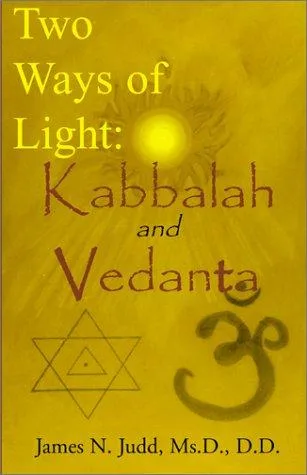
James N. Judd's 2000 book, "Two Ways of Light," compares Kabbalah and Vedanta.
First published in 2000, James N. Judd's "Two Ways of Light" undertakes a comparative analysis of Kabbalah and Vedanta. The book's central argument is that these two distinct spiritual traditions share a core metaphysical understanding of reality, consciousness, and the divine, despite differences in their terminology and cultural expression. Judd focuses on detailed textual comparisons to uncover these intersections.
This work is intended for students of comparative mysticism and esoteric philosophy who possess some familiarity with either Kabbalah or Vedanta. It is suited for those interested in academic rigor applied to spiritual traditions, rather than solely devotional texts. The book emerged during a time of growing Western interest in Eastern philosophies.
Published in 2000, "Two Ways of Light" situates itself within the Western esoteric tradition's engagement with Eastern thought. It builds upon earlier comparative efforts but distinguishes itself through Judd's focus on direct textual parallels between Jewish mysticism and Hindu philosophy. This approach contributes to the scholarly discussion on mystical convergences, moving beyond broad generalizations to specific conceptual alignments.
💡 Why Read This Book?
• Gain a concrete understanding of the shared metaphysical underpinnings between Kabbalah and Vedanta, specifically how the concept of 'Ein Sof' in Kabbalah mirrors the Absolute Brahman of Vedanta, as explored in Judd's comparative analysis. • Discover specific parallels in cosmological structures, such as the role of the Sephiroth on the Tree of Life and their potential correspondence to the stages of divine emanation described in Vedantic texts. • Appreciate the historical context of esoteric thought comparison, understanding how Judd's work, published in 2000, contributes to ongoing dialogues about mystical convergences, referencing earlier influences in comparative mysticism.
⭐ Reader Reviews
Honest opinions from readers who have explored this book.
❓ Frequently Asked Questions
What is the central argument of James N. Judd's "Two Ways of Light"?
The book argues that Jewish Kabbalah and Hindu Vedanta, despite outward differences, share fundamental metaphysical concepts regarding the nature of reality and spiritual attainment, proposing a common esoteric language.
When was "Two Ways of Light" first published?
The book was first published on October 1, 2000, positioning it within late 20th-century esoteric scholarship.
Which specific Kabbalistic concepts are compared to Vedanta in the book?
Judd compares core Kabbalistic ideas such as the 'Ein Sof' (the Infinite) and the 'Sephiroth' (divine emanations) with corresponding Vedantic concepts like Brahman and its manifestations.
Is this book suitable for beginners in Kabbalah or Vedanta?
While accessible, the book assumes some prior familiarity with the basics of either tradition. It is best suited for those looking to deepen their comparative understanding.
What is the author's background or perspective?
James N. Judd approaches the subject from a perspective of comparative mysticism, focusing on textual analysis to reveal underlying spiritual philosophies rather than a specific devotional practice.
Does "Two Ways of Light" offer practical exercises?
The primary focus is on comparative philosophical and theoretical exploration. While insights may inspire practice, the book does not detail specific meditative or ritualistic exercises.
🔮 Key Themes & Symbolism
The Infinite Source
Judd meticulously examines the concept of the absolute, unmanifest Godhead as presented in both traditions. He draws explicit parallels between the Kabbalistic 'Ein Sof'—the Without End—and the Vedantic 'Brahman'—the Ultimate Reality. The work explores how both systems posit an ineffable, primordial state from which all existence emanates, highlighting the shared challenge of conceptualizing the boundless.
Emanations and Manifestations
A significant portion of the book is dedicated to comparing the ten Sephiroth of the Kabbalistic Tree of Life with the various stages of manifestation or divine presence described within Vedanta. Judd analyzes how these emanations function as intermediaries, channels of divine energy, and blueprints for creation, revealing structural similarities in their cosmological ordering and purpose.
The Path to Realization
The book investigates the ultimate goal of spiritual practice within both Kabbalah and Vedanta. Judd discusses concepts such as 'Devekut' (cleaving to God) in Jewish mysticism and 'Moksha' (liberation) in Hindu philosophy, identifying common themes of union, self-realization, and the transcendence of illusion as the pinnacle of human spiritual endeavor.
Symbolic Language
Judd underscores how both Kabbalah and Vedanta employ rich symbolic languages to convey profound metaphysical truths. The work explores how specific symbols, archetypes, and narrative structures within each tradition, despite their cultural differences, often point to similar underlying spiritual realities and psychological processes.
💬 Memorable Quotes
Direct passages from the work, attributed to the author.
“The similarities become obvious. And such a study is not just an academic exercise...”
— This reflects Judd's core premise: the deep connections between Kabbalah and Vedanta are not mere coincidences but point to universal truths accessible through dedicated study and analysis.
“Outwardly they appear to be vastly different...”
— This highlights the initial challenge and the subsequent reward of Judd's comparative approach, emphasizing that superficial distinctions mask profound underlying harmonies between the two systems.
💡 Key Ideas
Editorial paraphrase of the work's core concepts — not direct quotes.
These ancient teachings not only augment each other in providing answers to the questions of life...
This paraphrased concept suggests that the value of comparing Kabbalah and Vedanta lies in their combined ability to offer comprehensive answers to fundamental existential inquiries.
Analysis of the Sephiroth and their relation to the Absolute.
This paraphrased concept points to a specific focus within the book: the detailed examination of the Kabbalistic emanations and how they relate to the unmanifest divine, a key area of comparative study with Vedanta.
The Vedantic concept of Brahman as the ultimate, undifferentiated reality.
This paraphrased concept identifies a central tenet of Vedanta that Judd uses as a point of comparison, likely in relation to the Kabbalistic 'Ein Sof' or Keter.
🌙 Esoteric Significance
Tradition
This work is firmly rooted in the Western Esoteric Tradition, specifically within the comparative mystical studies that gained traction following the rise of Theosophy. It engages directly with Kabbalah, a central to Jewish mysticism, and juxtaposes it with Vedanta, a foundational school of Hindu philosophy. Judd's contribution lies in demonstrating how these distinct traditions, often studied in isolation, can illuminate each other within a broader esoteric framework.
Symbolism
Key symbols explored include the Kabbalistic 'Ein Sof' (The Infinite/Without End) and the ten 'Sephiroth' (divine emanations) on the Tree of Life. Judd likely correlates these with Vedantic concepts such as 'Brahman' (the ultimate reality) and its various manifestations or aspects. The comparative analysis highlights how different symbolic languages can describe the ineffable divine source and its ordered expression into the cosmos.
Modern Relevance
In contemporary spiritual and philosophical discourse, "Two Ways of Light" remains relevant for practitioners and scholars interested in cross-cultural mysticism and the unification of disparate spiritual paths. Thinkers and groups exploring comparative religion, non-dual philosophies, and the underlying structures of consciousness continue to find value in Judd's methodical approach to bridging Kabbalistic and Vedantic thought.
👥 Who Should Read This Book
• Students of comparative religion and mysticism seeking to understand the potential convergences between Western and Eastern esoteric traditions. • Practitioners of Kabbalah interested in exploring its philosophical parallels with Hindu Vedanta, gaining new perspectives on familiar concepts. • Scholars of philosophy and theology looking for rigorous textual analysis that bridges distinct metaphysical systems.
📜 Historical Context
Published in 2000, "Two Ways of Light" emerged at a time when Western esoteric interests were increasingly engaging with Eastern philosophies, a trend significantly amplified by the Theosophical Society movement in the late 19th century. James N. Judd's work positions itself within this lineage of comparative mysticism, yet distinguishes itself through a rigorous, text-focused analysis. Unlike more syncretic or generalized interpretations of the period, Judd's study emphasizes specific conceptual parallels between Kabbalah and Vedanta. His approach can be seen as a response to the ongoing academic and spiritual quest to find universal threads within diverse religious and mystical traditions. While figures like Aldous Huxley had previously explored 'The Perennial Philosophy' across various systems, Judd applies this lens with particular attention to the structural and symbolic language of these two specific, influential traditions, contributing to a deeper understanding of their potential shared origins or convergent evolution.
📔 Journal Prompts
The concept of 'Ein Sof' and its Vedantic counterpart, Brahman.
The symbolic representation of divine emanations in Kabbalah and Vedanta.
The ultimate goal of spiritual realization as described in both traditions.
Identifying points of convergence in the cosmological structures presented.
The role of symbolic language in conveying metaphysical truths.
🗂️ Glossary
Kabbalah
A system of Jewish mysticism that explores the nature of God and the universe through esoteric interpretations of scripture, often involving symbolic diagrams like the Tree of Life.
Vedanta
A school of Hindu philosophy and spiritual thought, characterized by its investigation into the nature of ultimate reality (Brahman) and the self (Atman).
Ein Sof
A Kabbalistic term referring to God in God's absolute essence, conceived as infinite, boundless, and unknowable prior to any manifestation.
Brahman
In Vedanta, the supreme, unchanging, ultimate reality that is the source and sustainer of all existence; often described as consciousness itself.
Sephiroth
The ten divine emanations or attributes of God as described in Kabbalistic cosmology, typically represented on the Tree of Life.
Moksha
A Sanskrit term in Hinduism meaning liberation, release, or salvation, often referring to liberation from the cycle of death and rebirth (samsara).
Devekut
A Hebrew term in Jewish mysticism signifying 'cleaving' or 'adherence' to God, representing a state of intense spiritual communion and intimacy.